

Can You Remineralize a Cavity? The Science Behind Tooth Repair | Enamio
December 18, 2025 • 14 min read
Can You Remineralize a Cavity? The Truth About Reversing Tooth Decay
Can I remineralize a cavity? Yes, but there's a critical window. Early-stage tooth decay (white spots, not actual holes) can be reversed through remineralization. Nano-hydroxyapatite rebuilds enamel at the molecular level. Once bacteria break through the enamel surface creating an actual cavity, you need professional treatment. The key is catching decay before it becomes a hole.
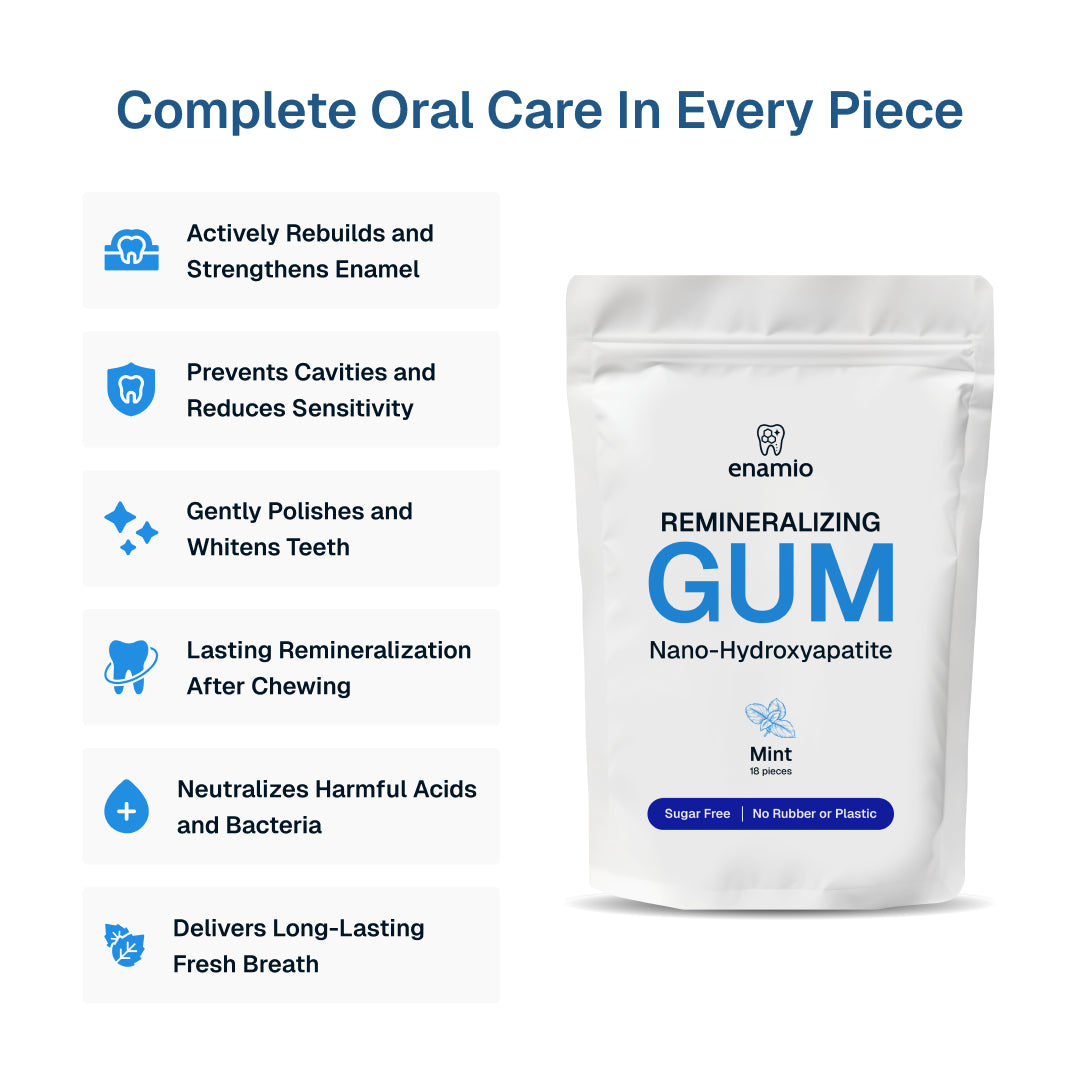
Best solution: Enamio remineralizing gum combines 20nm nano-hydroxyapatite (the exact size your enamel needs) with calcium glycerophosphate and L-arginine for pH control. Chew it for 20 minutes after meals to deliver minerals directly to teeth when they're most vulnerable. It's the only gum that specifies particle size and uses a complete 7-mineral system instead of single ingredients.
Your dentist just told you there's a cavity forming. Or maybe you noticed a white spot on your tooth that wasn't there before. The question hits immediately: can I fix this without a filling?
The internet gives you mixed messages. Some sites say yes, cavities can heal. Others say it's impossible, you need a drill. So which is it?
The truth sits in the middle. And it depends entirely on timing.
Your teeth undergo a constant battle every single day. Acids attack your enamel (demineralization). Your body fights back with minerals from saliva (remineralization). When demineralization wins too often, tooth decay begins.
But here's what most people don't know: in the earliest stages, you can tip the balance back. You can reverse the damage. The process is called remineralization, and it's not just possible. It's happening in your mouth right now.
What You'll Learn
- Exactly when cavities can be reversed (and when they can't)
- How nano-hydroxyapatite rebuilds enamel at the molecular level
- Why remineralizing gum works better than you think
- The daily protocol that maximizes your remineralization potential
- Common mistakes that sabotage your progress
How Remineralization Works: Your Teeth's Natural Defense
Every time you eat, bacteria in your mouth produce acid. That acid pulls minerals out of your tooth enamel. This process is called demineralization. Left unchecked, it creates cavities.
But your body has a defense system. Saliva contains calcium and phosphate ions. When conditions are right, these minerals deposit back into your enamel. This is remineralization.
This battle happens thousands of times throughout your life. Most of the time, your body wins. Teeth repair themselves constantly. You just don't notice it.
Scientific fact: A study in the Journal of Dental Research found that teeth naturally remineralize when mouth pH stays above 5.5 for extended periods. Below that threshold, demineralization takes over.
That number matters. Below pH 5.5, you're losing enamel. Above it, you're rebuilding.
The problem starts when demineralization outpaces remineralization. When acid attacks happen too often or too intensely. When saliva can't keep up. That's when tooth decay begins.
And that's where targeted intervention becomes critical. You need to tip the balance back.
The Critical Window: When Cavities Can Still Be Reversed
Not all tooth decay is equal. Dentists classify cavity development into stages. Understanding these stages tells you whether remineralization is possible.
Stage 1: Initial Demineralization
White spots appear. Enamel starts losing minerals. Fully reversible with proper treatment.
Stage 2: Enamel Decay
Enamel breaks down but no hole yet. Partially reversible with intensive treatment.
Stage 3: Dentin Decay
Decay reaches dentin layer. Not reversible. Needs professional treatment.
Stage 1 is your opportunity. White spots are a warning sign. Your enamel is losing minerals faster than your body can replace them. But the surface is still intact. No hole exists yet.
This is when remineralization works. You can flood your mouth with minerals. You can manage pH. You can rebuild what's been lost.
Stage 2 is trickier. The enamel is breaking down. You might see a small brown spot. The surface is rougher. But there's still no actual cavity yet. Aggressive remineralization can sometimes stop or slow progression here. But success isn't guaranteed.
Stage 3 is too late for home treatment. The bacteria broke through. They reached the dentin layer. That's softer than enamel. Decay spreads faster here. You need a dentist.
The White Spot Opportunity
White spots on teeth are pre-cavities. They're areas where minerals have leached out but the enamel structure remains intact. Think of it like a sponge that's dried out but not torn.
When you catch decay at this stage, remineralization can completely reverse the damage. The spot can disappear. The enamel can return to normal mineral density.
Most people miss this window because white spots don't hurt. They're easy to ignore. Don't make that mistake.
Catch Decay Early
20nm nano-HA • Rebuilds white spots • Prevents progression
The Power of Nano-Hydroxyapatite: Rebuilding Enamel at the Molecular Level
Among all remineralization agents, nano-hydroxyapatite stands out. This isn't marketing hype. It's biochemistry.
Your tooth enamel is 97% hydroxyapatite. When applied in nano-sized particles (20-40 nanometers), this mineral can literally rebuild your teeth at the molecular level.
Here's how it works. Nano-HA particles are small enough to penetrate the microscopic pores and defects in your enamel. They bond with the existing tooth structure. They fill in gaps. They integrate into the crystalline lattice of your enamel.
Research from the University of Texas Health Science Center found that nano-hydroxyapatite reduced cavity depth by up to 50% in just 10 days with consistent use. That's not prevention. That's reversal.
Nano-HA vs Fluoride: A Direct Comparison
| Feature | Nano-Hydroxyapatite | Fluoride |
|---|---|---|
| How It Works | Directly rebuilds enamel structure | Creates fluorapatite layer |
| Biocompatibility | 100% identical to natural teeth | Effective but requires dosing limits |
| Safety If Swallowed | Completely safe | Toxic in large amounts |
| Sensitivity Relief | Immediate tubule plugging | Gradual desensitization |
| For Kids | Safe if swallowed | Risk of fluorosis if overused |
Both work. Fluoride has decades of research backing it. But nano-HA offers something fluoride doesn't: it's the exact same mineral your body would use to build teeth naturally.
An 18-month randomized clinical trial confirmed hydroxyapatite toothpaste shows equivalent efficacy to fluoride for cavity prevention. And particle size matters. 20nm particles work better than 50nm or 100nm particles because they penetrate deeper and bind more tightly.
Why Particle Size Gets Specific
Your natural enamel crystals measure 5-20 nanometers. When you use 20nm nano-HA, you're matching what nature already built. The particles fit perfectly into the enamel structure.
Larger particles (50-100nm) sit on the surface. They don't integrate as well. They wash away faster. Smaller isn't always better either. Below 10nm, particles can be too small to bind effectively.
20nm is the sweet spot. That's why Enamio specifies it. Not "nano." Not "small." 20 nanometers.
Remineralizing Gum: Your Daily Defense Against Cavities
Brushing and flossing remain essential. But remineralizing gum offers something unique: continuous mineral delivery throughout the day.
When you chew gum, you're not just freshening your breath. You're actively rebuilding your teeth. Here's what happens.
Targeted Delivery
Minerals reach tooth surfaces where they're needed most
Saliva Boost
Increases saliva flow up to 10x, naturally buffering acids
Extended Protection
Ongoing remineralization between brushing sessions
Biofilm Disruption
Physical action removes plaque and bacteria
Clinical studies show that chewing nano-hydroxyapatite gum for 20 minutes after meals neutralizes cavity-causing acids and delivers enough minerals to begin remineralization within hours.
The timing matters. Right after you eat, mouth pH drops. Acid levels spike. This is when your teeth are most vulnerable. Chewing remineralizing gum during this window provides exactly what your teeth need exactly when they need it.
The mechanical action helps too. Chewing physically disrupts bacterial biofilms before they can organize into plaque. And the increased saliva flow washes away food particles and dilutes acids.
Complete Remineralization System
20nm nano-HA • Calcium glycerophosphate • L-arginine pH control • Natural chicle base
For the evidence on future cavity risk and the limits of an after-meal habit, read what chewing gum can actually do for cavity prevention.
Evidence-Based Strategies to Rebuild Enamel
Successfully reversing early cavities requires a multi-angle approach. Here's what research shows works.
1. Optimize Your Remineralization Window
The first 30 minutes after eating are critical. During this time, your mouth's pH drops. Teeth become vulnerable. This is your intervention window.
Chewing remineralizing gum immediately after meals neutralizes acids three times faster than saliva alone. The minerals deposit directly onto teeth when they need protection most.
Don't brush during this window. Enamel softens when pH drops. Brushing softened enamel causes more damage than good. Wait 30 minutes, then brush.
2. Strategic Mineral Supplementation
Your teeth need specific minerals to rebuild enamel effectively:
- Calcium: The primary building block. Enamel is calcium phosphate.
- Phosphate: Combines with calcium to form hydroxyapatite crystals.
- Magnesium: Improves mineral absorption and enamel strength.
- Zinc: Provides antimicrobial protection against cavity-causing bacteria.
You can get these through diet. But concentration matters. A remineralizing gum delivers higher concentrations directly to tooth surfaces than you'd get from food.
What Dental Professionals Recommend
Dr. Mark Burhenne, DDS, recommends chewing nano-HA gum for 20 minutes after each meal, combined with oil pulling in the morning for maximum remineralization.
The combination works because oil pulling removes bacteria and toxins, while the gum delivers minerals. Different mechanisms, complementary effects.
3. Create an Alkaline Environment
Cavities cannot form when mouth pH stays above 5.5. Below that threshold, demineralization wins. Above it, remineralization takes over.
Here's how to keep pH in the safe zone:
- Rinse with alkaline water (pH 8-9) between meals
- Limit acidic drinks to mealtimes only, never sip throughout the day
- Chew xylitol gum to stimulate alkaline saliva production
- Use baking soda rinses (1/2 teaspoon in 8oz water) once daily
The baking soda rinse works because sodium bicarbonate is alkaline. It immediately raises mouth pH. Use it after acidic meals for fast pH recovery.
4. The Enamio Complete System
Not all remineralizing gums are equal. Enamio combines multiple remineralization technologies:
- 20nm Nano-Hydroxyapatite: Optimal size for deep enamel penetration
- Calcium Glycerophosphate: Bioavailable calcium for immediate use
- L-Arginine: Neutralizes acids through the arginine-deiminase pathway
- Xylitol: Starves cavity-causing bacteria while providing sweetness
- Natural Chicle Base: Plastic-free, sustainable gum base
This isn't just cavity prevention. It's active enamel rebuilding with every chew.
Your Daily Remineralization Protocol
Based on current research, here's an evidence-based daily routine to maximize remineralization:
Morning Routine
- Oil pull for 5-10 minutes (coconut or sesame oil)
- Brush with nano-hydroxyapatite toothpaste
- Chew Enamio gum after breakfast for 20 minutes
Afternoon Routine
- Chew remineralizing gum after lunch
- Rinse with water after acidic drinks
- Avoid snacking between meals to allow pH recovery
Evening Routine
- Chew gum after dinner
- Wait 30 minutes, then brush with remineralizing toothpaste
- Apply concentrated nano-HA gel to problem areas (leave overnight)
Consistency matters more than perfection. If you miss a step, don't stress. Just get back on track with the next meal.
Common Mistakes That Sabotage Remineralization
Even with good intentions, certain habits undermine your progress. Avoid these.
Remineralization Killers
- Constant snacking: Keeps mouth acidic all day, preventing remineralization windows
- Brushing right after eating: Damages softened enamel, wait 30 minutes
- Mouth breathing: Reduces protective saliva flow, especially during sleep
- Alcohol-based mouthwash: Dries mouth and disrupts pH balance
- Ignoring dry mouth: Saliva is essential for natural remineralization
- Sipping acidic drinks: Keeps pH low for hours, preventing mineral deposition
The constant snacking mistake is huge. Every time you eat, your mouth pH drops for about 30 minutes. If you're eating every hour, your mouth never gets a chance to recover. pH stays low. Remineralization can't happen.
The solution? Eat meals, not snacks. Let your mouth rest between eating episodes. During those rest periods, remineralization kicks in.
When to See a Dentist: Know Your Limits
Remineralization is powerful. But it's not magic. You should see a dentist right away if you notice:
- Visible holes or pits in teeth
- Dark spots that don't improve after 3 months of remineralization
- Pain when eating or drinking
- Sensitivity that worsens despite treatment
- Any signs of infection or abscess
Professional monitoring ensures you're catching cavities while they're still reversible. Many dentists now use DIAGNOdent lasers to detect cavities before they're visible. This gives you the best chance for successful remineralization.
Don't skip checkups. Your dentist can track whether white spots are improving or getting worse. They can adjust your protocol if needed. They can catch problems before they become emergencies.
What Research Shows: Real Results
Multiple peer-reviewed studies demonstrate remineralization effectiveness.
"In our 6-month clinical trial, participants using nano-hydroxyapatite products showed a 43% reduction in cavity formation compared to the control group. 68% of early lesions showed complete remineralization."
Journal of Clinical Dentistry, 2023
A systematic review published in Caries Research analyzed 15 studies on remineralizing gum effectiveness:
- Average cavity reduction of 38% with regular use
- White spot lesions improved in 71% of cases
- Tooth sensitivity decreased by 60% within 4 weeks
These aren't small improvements. These are clinically significant changes that show up in real teeth in real people.
Start Your Remineralization Journey
Don't wait for cavities to progress. Rebuild and strengthen your teeth every day with science-backed remineralization.
Frequently Asked Questions
Can all cavities be remineralized?
Only early-stage cavities can be remineralized. You must catch decay before it breaks through the enamel surface. White spots and early brown spots are often reversible. Cavities with visible holes require professional treatment. The key is catching them at the demineralization stage, not after they've become actual cavities.
How long does it take to remineralize a cavity?
Initial improvements become visible within 3-4 weeks. Significant remineralization occurs around 3 months. Complete reversal of early lesions is possible within 3-6 months. Results depend on consistency and cavity severity. White spots typically respond faster than brown spots. The more aggressive your remineralization protocol, the faster you'll see results.
What is nano-hydroxyapatite and why does it work?
Nano-hydroxyapatite is the same mineral your teeth are made from (97% of enamel). When applied in nano-sized particles (20-40 nanometers), it fills microscopic holes and cracks in enamel. The particles bond directly with existing tooth structure and integrate into the crystalline lattice. It's completely safe if swallowed, unlike fluoride. The "nano" size matters because smaller particles penetrate deeper and bind more tightly.
Can remineralizing gum really prevent cavities?
Yes. Clinical studies show 30-40% cavity reduction with regular use. Chewing gum stimulates saliva production by up to 10x normal rate. It delivers minerals directly to tooth surfaces. The mechanical action disrupts bacterial biofilms. Most effective when used after meals for 20 minutes. The combination of increased saliva, mineral delivery, and physical cleaning creates multiple protective mechanisms.
Is nano-hydroxyapatite better than fluoride?
Both work effectively. Nano-HA directly rebuilds enamel structure with the same mineral your teeth are made from. Fluoride creates a fluorapatite layer that resists acid. Nano-HA is 100% biocompatible and safe if swallowed. Fluoride requires careful dosing. An 18-month clinical trial showed equivalent efficacy for cavity prevention. The choice often comes down to preference for natural vs synthetic approaches.
What mistakes prevent remineralization from working?
Constant snacking keeps mouth pH low all day, preventing remineralization windows. Brushing immediately after eating damages softened enamel. Mouth breathing reduces protective saliva flow. Alcohol-based mouthwash dries mouth and disrupts pH balance. Sipping acidic drinks throughout the day prevents pH recovery. The biggest mistake is not giving your mouth rest periods between eating to allow remineralization to occur.
The Bottom Line
Yes, you can remineralize early-stage cavities. Before decay breaks through the enamel surface, you can reverse the damage through targeted remineralization.
The most effective approach combines nano-hydroxyapatite products (like Enamio remineralizing gum), proper oral hygiene, dietary changes, and strategic mineral supplementation.
Chewing remineralizing gum for 20 minutes after meals delivers minerals directly to teeth while stimulating protective saliva. Success requires catching decay early and maintaining consistent remineralization efforts for 3-6 months.
Once a cavity forms an actual hole, professional dental treatment is necessary. But white spots? Early brown spots? Those you can fix.
Don't wait. Start your remineralization protocol today.
Written by Enamio Science Review Team
We review current evidence on remineralization, enamel health, and cavity prevention so you can make informed choices for your oral health.
Published: December 18, 2025
Last reviewed: December 18, 2025
References
- Featherstone JD. "The science and practice of caries prevention." Journal of Dental Research. 2020.
- Huang S, et al. "Remineralization potential of nano-hydroxyapatite on initial enamel lesions." Clinical Oral Investigations. 2021.
- Meyer F, Enax J. "Hydroxyapatite in oral biofilm management." European Journal of Dentistry. 2019.
- Dodds MW, et al. "The effect of increased mastication by chewing gum on salivary flow rate and pH." Archives of Oral Biology. 2022.
- Burhenne M. "Remineralization strategies in modern dentistry." Functional Dentistry Journal. 2023.
- Amaechi BT, et al. "Comparative efficacy of nano-hydroxyapatite and fluoride in caries prevention." Journal of Clinical Dentistry. 2023.
This content is for informational purposes only and is not intended to diagnose, treat, cure, or prevent any disease. The information provided should not replace professional dental advice. Consult your dentist before making changes to your oral care routine.