

Hydroxyapatite Gum: Brands Compared
Share
Hydroxyapatite gum brands differ in their mineral, sweeteners and gum base. Enamio declares nano-hydroxyapatite, Underbrush lists nano and micro, and Crait states 70 mg of non-nano hydroxyapatite per piece. Start with those differences, then check your dietary needs. [1] [9]
- Compare formulas, not slogans.
- Check the selected flavor.
- Keep brushing.
Updated November 5, 2026 · Published by Enamio · Manufacturer pages checked, not lab-tested
Compare ten gums by their mineral, sweeteners, gum base and dietary fit. The table gives you the main differences, with details on each brand below.
Disclosure: Enamio makes one gum in this comparison. The same questions apply to every brand, including ours. No clinical winner is assigned.
Hydroxyapatite gum brands at a glance
Hydroxyapatite is a calcium-phosphate mineral found in teeth. In gum, it’s an added ingredient. The table summarizes manufacturer pages checked November 5, 2026. “Not stated” refers to the checked pages, not proof that a product lacks the ingredient.
| Brand | Formula and differences |
|---|---|
| Enamio [1] |
Nano · amount not stated 20 nm manufacturer claim. Chicle base and xylitol. |
| Underbrush [2] |
Nano + micro · amount not stated Chicle, mastic and spruce with xylitol and erythritol. |
| Dentagum [3] |
Nano · amount not stated Lab-synthesized mineral stated. Eggshell and propolis also listed. |
| Larineco [4] |
Nano · amount not stated Several tree resins. Eggshell appears in the ingredient list. |
| Minvelle [5] |
Nano · 5.7 mg per piece Publishes supplier particle dimensions. Formula contains egg. |
| Halo [6] |
Nano · amount not stated Chicle, xylitol and a botanical oil blend. |
| Kreain [7] |
Nano · amount not stated Berry is described as egg-free. Other flavors differ. |
| VanMan [8] |
HAp · size class and amount not stated Grass-fed cattle-bone hydroxyapatite. Six listed ingredients. |
| Crait [9] |
Non-nano · 70 mg per piece OMYADENT ingredient. Sorbitol, maltitol, xylitol and isomalt. |
| NanoChew [10] |
Nano · amount not stated Chicle and mastic. Eggshell and bee-derived propolis. |
HAp means hydroxyapatite. This is a selected comparison, not every gum on the market. CaviChew is excluded because a current brand-owned formula wasn’t verified.
For pack sizes and broader purchase considerations, see the remineralizing gum buying guide. Below, the focus is on what each formula gives you to compare.
What’s different about each brand?
Ingredients can help narrow your options without pretending there’s one best gum for everyone. Look for the differences that matter to you: mineral type, dietary restrictions, sweeteners and the chew’s base.
Enamio: nano-hydroxyapatite in a chicle base
Enamio lists rod-shaped nano-hydroxyapatite, xylitol and natural chicle, plus calcium glycerophosphate and zinc gluconate. Its product page states a 20 nm particle size. That’s a manufacturer statement, not an independently verified measurement in this guide. The page doesn’t state milligrams of nHA per piece or supply a public particle-size report. [1]
Choose it on its disclosed formula and your preferences, without treating the particle number as proof of superior results. You can check Enamio’s current ingredients and options or read the ingredient breakdown. A longer ingredient list isn’t a clinical score.
Underbrush: a declared nano-and-micro blend
Underbrush lists both nano and micro hydroxyapatite. Its formula also names chicle, mastic, spruce, xylitol and erythritol. The checked page doesn’t give a per-piece mineral amount or the ratio of nano to micro material. [2]
If you’re comparing resin-based gums, check Underbrush’s mastic, spruce and sweeteners against the other labels. Use Underbrush vs Enamio for a closer look at the two formulas.
Dentagum: synthetic mineral, with egg and propolis elsewhere
Dentagum’s ingredient page describes its nano-hydroxyapatite as lab-synthesized. Its gum formula separately includes eggshell powder and propolis, along with xylitol, erythritol, mastic and chicle. Synthetic mineral doesn’t make this whole formula animal-free. [3]
The product page links heavy-metal and phthalate testing material. Those tests answer different questions from whether the gum improves a dental outcome. No nHA amount per piece was found on the checked product and ingredient pages. The Dentagum comparison separates those ingredient and evidence questions.
Larineco: check the ingredient list against the headline
Larineco lists nano-hydroxyapatite, xylitol, erythritol and several tree resins. Eggshell powder appears in the product’s ingredient list, while the checked homepage also uses vegan language. That conflict needs clarification before an egg-avoiding shopper relies on the headline. [4]
Check the specific package with the seller. Don’t infer that its hydroxyapatite comes from eggshell merely because both appear on the page. They’re separate declarations. Our Larineco and Enamio comparison provides more context without turning a missing dose into a verdict on quality.
Minvelle: a stated dose and supplier dimensions
Minvelle states 5.7 mg of nano-hydroxyapatite per piece. It also publishes supplier dimensions of about 200 nm long and 20 to 50 nm wide. The mineral is described as synthetic, but the full formula includes eggshell powder. [5]
Its transparency page links batch and raw-material documents. This guide hasn’t independently validated those reports. The page also states that its finished gum has no clinical trial. These disclosures help you inspect the product, but they don’t establish a clinical winner.
See Minvelle vs Enamio for the focused comparison.
Halo: chicle with a botanical oil blend
Halo’s current ingredient list starts with xylitol and chicle gum base, followed by nano-hydroxyapatite. It names flaxseed oil, rosehip oil, stevia and mint ingredients. The brand calls its botanical blend BioFuse Oil Matrix. [6]
This is a different formula from the resin-and-eggshell combinations elsewhere in the table. The checked page doesn’t state an nHA amount per piece. If that oil blend interests you, compare the named ingredients rather than assuming the proprietary name proves a benefit. Read Halo vs Enamio for more detail.
Kreain: flavor changes the dietary answer
Kreain lists nano-hydroxyapatite with xylitol, erythritol, chicle and other resins. Its current page says Mint and Cinnamon contain eggshell powder, while Berry excludes it and is described as vegan. The flavor choice matters. [7]
Don’t apply one flavor’s ingredient list to the entire range. The checked page doesn’t state nHA milligrams per piece, and the listed eggshell doesn’t establish the mineral’s source. The Kreain comparison explains the product-specific differences.
VanMan: an explicitly animal-derived mineral
VanMan names grass-fed cattle-bone hydroxyapatite. Its six-ingredient list also includes chicle, mastic, organic xylitol, peppermint extract and peppermint oil. This makes the mineral’s animal source clear. [8]
That declaration rules it out for someone seeking an animal-free formula. The checked product page doesn’t specify a nano category or a per-piece mineral amount, so neither is assumed here. A short ingredient list may suit a shopper’s preferences, but it doesn’t demonstrate better effectiveness or individual tolerance.
Crait: a published non-nano amount
Crait states 70 mg of non-nano hydroxyapatite per gum piece and names OMYADENT as the ingredient. Its sweeteners include sorbitol, maltitol, xylitol and isomalt. That blend differs from a gum sweetened only with xylitol. [9]
The amount is useful information, not a reason to declare Crait stronger than a nano formula. Different materials and finished products need their own evidence. If you’re comparing particle categories, the nano vs non-nano guide explains what those terms do and don’t tell you.
NanoChew: a multi-ingredient formula with egg and bee inputs
NanoChew lists nano-hydroxyapatite, xylitol, erythritol, chicle and mastic, alongside other ingredients. Its ingredient page expressly identifies eggshell powder and bee-derived propolis. Those details matter if you avoid animal-derived ingredients. [10]
The checked pages don’t give an nHA amount per piece. Eggshell and propolis are the clearer dietary distinctions. Our NanoChew comparison is the next step if these two products are on your shortlist.
What about Spry, PUR and Zellie’s?
These belong in a separate category. The checked Spry flavors, PUR Peppermint and Zellie’s Cherry Berry ingredient lists don’t declare hydroxyapatite. They’re xylitol-gum alternatives, not three more verified HAp formulas. [11] [12] [13]
If you mainly want a sugar-free chew, you may not need a mineral-specific formula. Compare the actual flavor’s ingredients, price and your experience of the chew. The xylitol gum guide covers that separate choice.
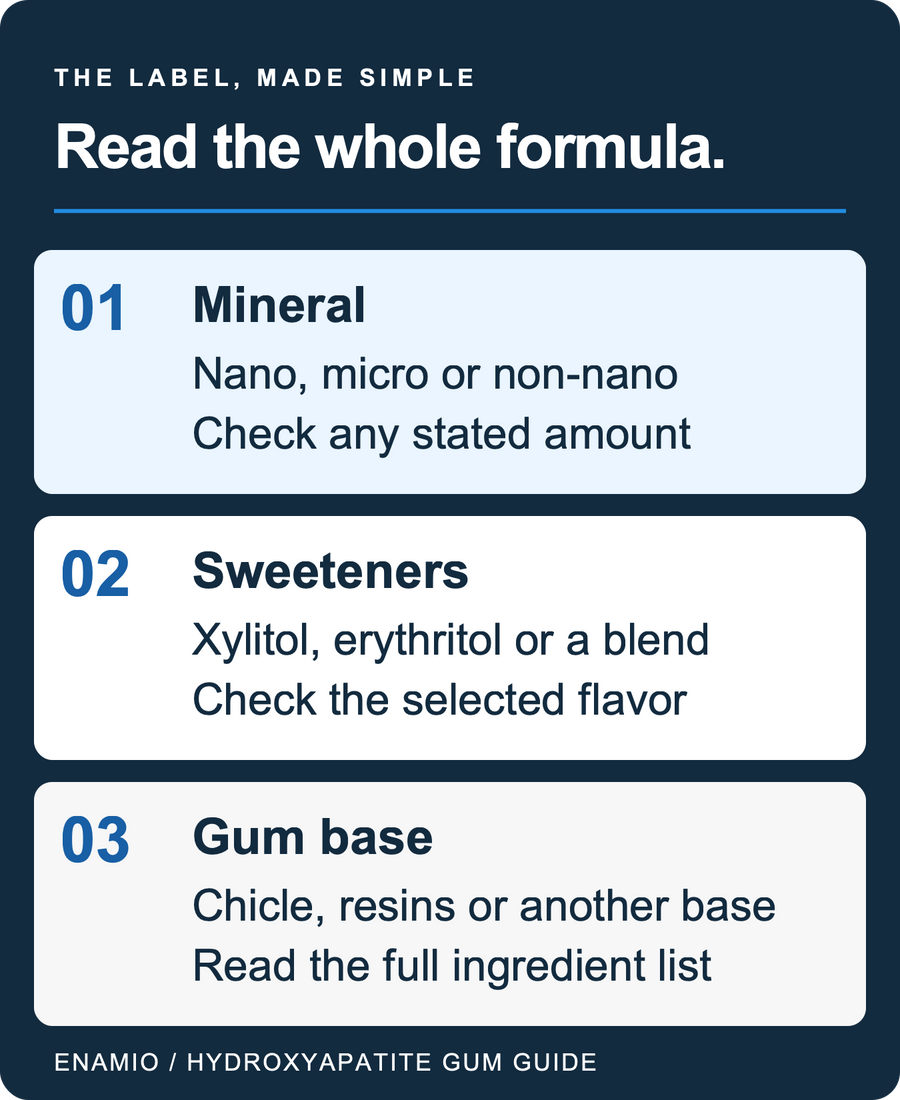
Narrow the list in three steps
- Start with ingredients you need to avoid. Check the selected flavor, not just a brand’s homepage. Kreain’s flavor difference and Larineco’s conflicting wording show why this matters.
- Choose the formula you actually want. A nano label, mixed mineral declaration and non-nano amount answer different questions. Chicle, other resins, generic gum base and sweetener blends are separate preferences.
- Check the practical purchase. Confirm the seller, pack count, current price, shipping and subscription terms. A small initial order may make more sense than committing before you know whether you like the chew.
For Enamio, the chicle-base page explains its gum base. The where-to-buy guide covers purchase routes. Treat these as product information, not independent tests.
What does the research actually establish?
Chewing sugar-free gum stimulates saliva. American Dental Association guidance treats it as an addition to twice-daily fluoride brushing and daily cleaning between teeth. [14]
Research on hydroxyapatite-containing gum does exist. A 2014 trial enrolled 107 people and compared a gum containing calcium hydroxyapatite and dicalcium phosphate dihydrate with a placebo. One hundred participants completed it. The test gum performed better on the study’s hypersensitivity measures after two weeks. [15]
That’s a result for the tested combination and regimen. It doesn’t establish the effectiveness of every gum in this comparison, or prove that one modern nano formula is best. Neither the dose on a label nor a toothpaste study closes that gap.
- A manufacturer ingredient list describes what the brand declares.
- A laboratory report can assess the sample and measurements it names.
- A finished-gum study tests a particular product and outcome.
The European SCCS’s 2025 opinion assesses specified nano-hydroxyapatite materials in toothpaste and mouthwash. Its conclusion has material and use restrictions. It is not approval of these chewing gums. [16] See the safety guide for the fuller discussion.
For claims about cavities, sensitivity or whitening, read what remineralizing gum evidence can support. Buying a mineral gum shouldn’t mean accepting every outcome promised on a product page.
Where to buy hydroxyapatite gum
Hydroxyapatite gum is mostly sold online, directly by the brands. It's rarely stocked in pharmacies or supermarkets, so a "near me" search usually returns regular xylitol gum instead. Buy from the brand's own store or its official marketplace listing, and check three things on the listing before you pay:
- The mineral is named in the ingredient list, not only in the marketing copy (look for "hydroxyapatite" or "nano-hydroxyapatite").
- The seller is the brand or an authorized reseller, so the pack, flavor and date match the brand's published label.
- Price per piece, after shipping, rather than price per pack: pack sizes vary from 9 to 144 pieces.
Enamio (our gum) ships from enamiogum.com in 18-piece pouches, sold as 36, 72 or 144 pieces.
Nano vs non-nano hydroxyapatite gum
"Nano" describes particle size: nano-hydroxyapatite particles are under 100 nanometers. Brands use the word differently, and some list "nano and micro" together. A size printed on a page is a manufacturer statement; ask how and on what it was measured. The size alone doesn't tell you the amount per piece or the result of chewing the finished gum.
Common questions
Which brand publishes the most hydroxyapatite per piece?
Of the ten checked brands, Crait states 70 mg of non-nano hydroxyapatite and Minvelle states 5.7 mg of nano-hydroxyapatite per piece. The other checked pages don’t supply a comparable amount. That makes Crait’s the larger published amount in this set, not proof of a stronger clinical effect. [9] [5]
Is nano better than non-nano?
You can’t choose a clinical winner from the category alone. Particle dimensions, material properties, dose and the finished formula differ. Underbrush even declares a mixture of nano and micro material. Use the label to understand the product, then look for evidence that matches the specific benefit being claimed.
Does eggshell in a gum mean its hydroxyapatite comes from eggs?
Not necessarily: Minvelle describes synthetic hydroxyapatite and separately lists eggshell powder. Dentagum also declares lab-synthesized mineral alongside eggshell. Read the mineral-source statement and the complete ingredient list as separate facts. Someone avoiding egg still needs to check the entire formula. [5] [3]
How often should I chew it?
Follow the selected product’s current package directions. Don’t copy a study schedule or another brand’s instructions to increase mineral intake. Ask the maker about conflicting directions. Gum remains an addition to daily oral care, and chewing that causes discomfort is a reason to stop and seek individual advice.
Does “third-party tested” mean the gum works?
The badge alone doesn’t answer that: read what was tested, which sample it covered and what the report measured. A heavy-metal result, particle specification and clinical outcome are different findings. Testing for one doesn’t automatically establish the others. Ask for the underlying report when a test claim affects your purchase.
What should I check before switching brands?
Compare the exact flavor’s ingredients, directions, pack count and purchase terms. Keep the old and new labels if you’re checking a formulation difference. If you have an allergy, dental work or persistent symptoms, discuss the actual product with an appropriate clinician. Don’t use a brand comparison as a diagnosis.
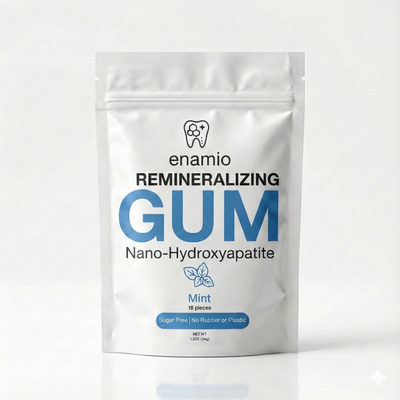
CONSIDERING ENAMIO?
See the formula. Choose your flavor.
Review the current ingredients, pack options and terms before ordering.
Explore Enamio gumFind the detail you need next
- Compare purchase options in the broader buying guide.
- Read the reviews guide to separate customer experience from clinical proof.
- Explore Enamio’s product information on enamel care, breath care and sensitivity. These are brand pages, not independent clinical evidence.
- The Enamio routine quiz offers a product browsing route, not a diagnosis.
Sources and review notes
Manufacturer pages were checked November 5, 2026. Product facts remain manufacturer declarations unless stated otherwise. No taste test or laboratory comparison was performed. Competitor sources are named without store links.
- Enamio. Current Remineralizing Gum product page, ingredient section and particle-size statement.
- Underbrush / Nathan & Sons. Current homepage, product and ingredient sections.
- Dentagum. Remineralizing Chewing Gum product page and Ingredients page.
- Larineco. Current U.S. Remineralizing Gum product page and homepage.
- Minvelle. Transparency page, formula and supplier specifications. Linked reports were not independently validated for this guide.
- Something Nice Company. Halo Advanced Gum product page and ingredient list.
- Kreain Co. Natural Remineralizing Gum product page, including flavor-specific egg statements.
- VanMan. VanMan’s Remineralizing Chewing Gum product page and six-ingredient list.
- Crait. Hydroxyapatite Gum with Xylitol product page, amount and ingredient list.
- NanoChew. Remineralizing Gum product page and Ingredients page.
- Xlear. Spry 100-count Xylitol Gum product page and flavor ingredient lists.
- PUR. Peppermint gum product page and ingredient list.
- Zellie’s. Cherry Berry Xylitol Dental Gum product page and ingredient list.
- American Dental Association. Chewing Gum. Category guidance, accessed November 5, 2026.
- Porciani, Chazine and Grandini, A clinical study of calcium-hydroxyapatite chewing gum and dentin hypersensitivity. Journal of Clinical Dentistry, 2014, PMID 25122980. Abstract accessed November 5, 2026.
- European Commission SCCS. Hydroxyapatite (nano), Submission IV, SCCS/1677/25, adopted June 26, 2025. Accessed November 5, 2026.
- United States Food and Drug Administration, Paws Off! Xylitol is Toxic to Dogs. Accessed November 5, 2026.
