

Is Aspartame Bad for You? Oral Health Facts | Enamio
December 18, 2025 • 12 min read
Is Aspartame Bad for You? What Science Says About This Sweetener
Here's the short answer: The WHO calls aspartame "possibly carcinogenic" as of 2023. The FDA still says it's safe at normal levels. But here's what matters for your teeth: aspartame does nothing to help enamel. Zero. When you're chewing gum for oral health, why pick a sweetener that only tastes sweet and offers no benefits? Natural options like xylitol and monk fruit give you sweetness plus real support for enamel.
You grab sugar-free gum thinking you're making a smart choice. The package says "sugar-free" and "helps freshen breath." Sounds good, right?
But flip that pack over. Look at the ingredients. See aspartame listed there? That's when the questions start. Is aspartame bad for you? Should you be worried? Is there something better?
Let's cut through the noise. In July 2023, the World Health Organization dropped some news that made headlines. They classified aspartame as "possibly carcinogenic to humans." Not definitely. Just possibly. That's Group 2B if you're tracking the categories.
The same day, another group (JECFA) said the acceptable daily intake stays at 40 mg per kg of body weight. So you've got one group raising flags and another group saying "you're fine."
Here's what nobody's talking about: aspartame doesn't do anything for your teeth. It breaks down into phenylalanine, aspartic acid, and methanol. Your body processes these compounds and moves on. No enamel support. No pH help. No minerals. Just sweetness.
That might be fine if you're drinking a diet soda. But if you're chewing gum specifically for oral health? You're missing the point. You could be getting natural sweeteners that actually work with your mouth's biology, not just pass through it.
3.5 Billion People Have Oral Health Problems Right Now
The WHO tracks this stuff. 3.5 billion people worldwide deal with oral diseases. That's nearly half the planet. And 2.5 billion of those people have untreated tooth decay sitting in their mouths right now.
Against that backdrop, millions grab sugar-free gum every day thinking they're making a healthy choice. But most of that gum uses aspartame or sucralose. Sweeteners that do nothing for the problem.
This guide breaks down what aspartame actually does in your mouth and body. You'll see the latest 2025 research. You'll understand why natural alternatives make more sense if your goal is oral health. And you'll learn what to look for when you're standing in that store aisle deciding which gum to buy.
Fair warning: this gets into some chemistry. But we'll keep it readable. You don't need a science degree to understand why one sweetener supports your teeth and another just makes things taste sweet.
What Is Aspartame and Why Does It Matter?
Aspartame is an artificial sweetener. It's about 200 times sweeter than regular sugar. Food companies use it in diet sodas, sugar-free candies, and chewing gum. The idea? Give you sweetness without the calories.
When you eat or drink something with aspartame, your body breaks it down into three parts: phenylalanine (50%), aspartic acid (40%), and methanol (10%). Your digestive system handles these through normal pathways. Nothing dramatic. Just chemistry.
The WHO made news in July 2023. They put aspartame in Group 2B. That's the "possibly carcinogenic to humans" category. Translation: limited evidence suggests there might be a link to cancer, but the results aren't conclusive.
Same day, different conclusion. JECFA (Joint Expert Committee on Food Additives) said the acceptable daily intake stays at 40 mg per kg of body weight. For a 154-pound person, that's about 2,800 mg per day. Roughly 12-18 cans of diet soda. Or 60-90 pieces of aspartame gum.
Quick Math on Aspartame Intake
- One 12-oz diet soda: 180-200 mg aspartame
- One piece of aspartame gum: 30-40 mg
- FDA limit for 154 lb person: 2,800 mg daily
- Reality: Most people stay well below this
Here's the thing about oral health. Your mouth isn't just a gateway to your stomach. It's its own ecosystem. You've got bacteria, saliva, pH levels, and mineral exchange happening constantly. When you chew gum for 5-10 minutes, every ingredient in that gum interacts with this system.
Aspartame's interaction? It provides sweetness. That's it. It doesn't participate in remineralization. It doesn't buffer pH. It doesn't provide minerals your enamel can use.
Compare that to xylitol. Bacteria in your mouth can't ferment xylitol into acid. That breaks the decay cycle. Or nano-hydroxyapatite, which binds directly to enamel and fills in microscopic damage. These ingredients actively participate in oral health.
So the real question isn't just "Is aspartame safe?" The FDA says yes at recommended levels. The WHO says maybe worry a bit. But the practical question is: "Does aspartame help my oral health goals?" And the answer there is clear. No.
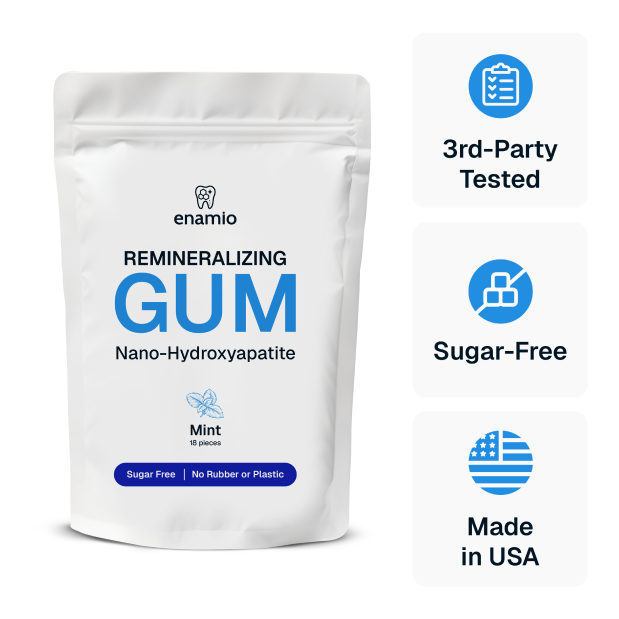
Enamio Remineralizing Gum
Natural sweeteners • 20nm nano-HA • 7 active minerals • pH support
What Happens When You Consume Aspartame
Let's walk through the chemistry. You chew gum with aspartame. Your saliva starts breaking it down immediately. Digestive enzymes (esterase and peptidase) split aspartame into three molecules.
First: phenylalanine. That's 50% of the breakdown. It's an essential amino acid. Your liver converts it to L-tyrosine, then to L-dopa, and finally to catecholamines like dopamine and norepinephrine. Normal biochemistry. Nothing unusual.
Second: aspartic acid. That's 40%. It's a non-essential amino acid. Your body converts it to alanine and oxaloacetate through normal metabolic pathways.
Third: methanol. That's 10%. This one gets more attention. Methanol enters your bloodstream. Alcohol dehydrogenase converts it to formaldehyde. Then aldehyde dehydrogenase converts that to formic acid. Your body eliminates it through normal routes.
The Methanol Question
Some people worry about methanol. Fair concern. But here's perspective: a glass of tomato juice has more methanol than a can of diet soda. Your body handles small amounts of methanol regularly through fruits and vegetables. The dose in aspartame stays well below levels that cause problems in normal consumption.
But here's what matters: none of these breakdown products help your teeth. They just get processed and leave.
2025 Research Adds New Questions
Fresh studies from 2025 examine aspartame from different angles. None of these prove cause and effect in humans. They suggest areas that need more research.
Taiwanese researchers found something interesting in rats. Long-term aspartame exposure from pregnancy through offspring development resulted in delayed puberty in female rat offspring. They also saw mitochondrial dysfunction and increased oxidative stress in ovaries.
Chinese researchers used omics technologies (that's high-tech analysis of biological molecules) to look at gut bacteria and glioblastoma (brain tumor) progression in mice. They found changes in gut bacteria and gene expression that could influence how tumors develop.
Another Chinese study found aspartame may contribute to ischemic stroke incidence in animal models. They started seeing evidence of potential neurotoxicity.
Three things to remember about these studies. One: they're in animals, not humans. Two: the doses are often higher than what people consume. Three: associations don't prove causation.
That said, they add pieces to a puzzle. The scientific consensus right now? Inconsistent results. Some studies suggest problems. Others don't find clear links. The debate continues.
The Oral Health Problem Nobody Discusses
Here's where the conversation about aspartame usually misses the mark. Most discussions focus on systemic safety. Is it safe to drink? Does it cause cancer? What about weight loss?
But when you chew gum, you're creating a different situation. Your oral tissues get direct exposure for 5-20 minutes. Your saliva breaks down aspartame right there in your mouth. The question isn't just about systemic safety. The question is about local effects.
Your mouth has a microbiome. Hundreds of bacterial species living in balance. These bacteria interact with everything you put in your mouth. Some bacteria help. Some cause problems. The balance matters.
pH levels shift constantly based on what you eat and drink. Below pH 5.5, your enamel starts losing minerals (demineralization). Above pH 5.5, your enamel can gain minerals back (remineralization). This cycle runs all day every day.
Your saliva contains calcium and phosphate ions. These minerals naturally support remineralization when conditions are right. Saliva flow matters. Mineral concentration matters. pH matters.
So what does aspartame do in this environment? Not much. It provides sweetness. Your taste receptors register it. But it doesn't participate in any of the processes that determine whether your enamel gets stronger or weaker.
Contrast that with xylitol. Streptococcus mutans (the main cavity-causing bacteria) can't ferment xylitol to make acid. That interrupts the decay process. The bacteria eat xylitol but can't use it for energy. They basically waste their time.
Or look at nano-hydroxyapatite. It's the same mineral your enamel is made from. When nano-HA particles contact your teeth, they bind to the surface. They fill microscopic defects. They integrate into the enamel's crystalline structure. That's active participation in remineralization.
Or L-arginine. It works with beneficial bacteria that have the arginine-deiminase system. These bacteria convert arginine to ammonia. The ammonia neutralizes acid. That raises pH back above 5.5. The environment shifts from demineralization to remineralization.
Aspartame does none of this. It's metabolically inert for oral health. It just tastes sweet and moves on.
Real Talk: The "Safe" vs "Optimal" Gap
FDA approval means "generally recognized as safe at recommended doses." That's not the same as "optimal for your health goals." A lot of ingredients are safe to consume but don't help you. Aspartame fits that category.
You're not avoiding aspartame because it's dangerous at normal levels. You're choosing alternatives because they actively support the reason you're chewing gum in the first place.
That's the difference between doing no harm and doing actual good.
Where else does aspartame show up? Everywhere. Diet sodas, obviously. But also some protein shakes, flavored waters, drink mixes, sugar-free candy, desserts, breath mints, cough drops, and some "light" packaged foods.
For kids and teens, this matters more. Lower body weight means the acceptable daily intake threshold is lower. And sugar-free snacks add up fast when you're not paying attention.
You don't need to track milligrams. Just start with the easiest swap: your daily gum. It sits in your mouth for minutes at a time. It's easy to replace. Make that switch first, then look at the next category if you want.
A Different Approach to Gum
If aspartame offers no oral health benefits, what's the alternative?
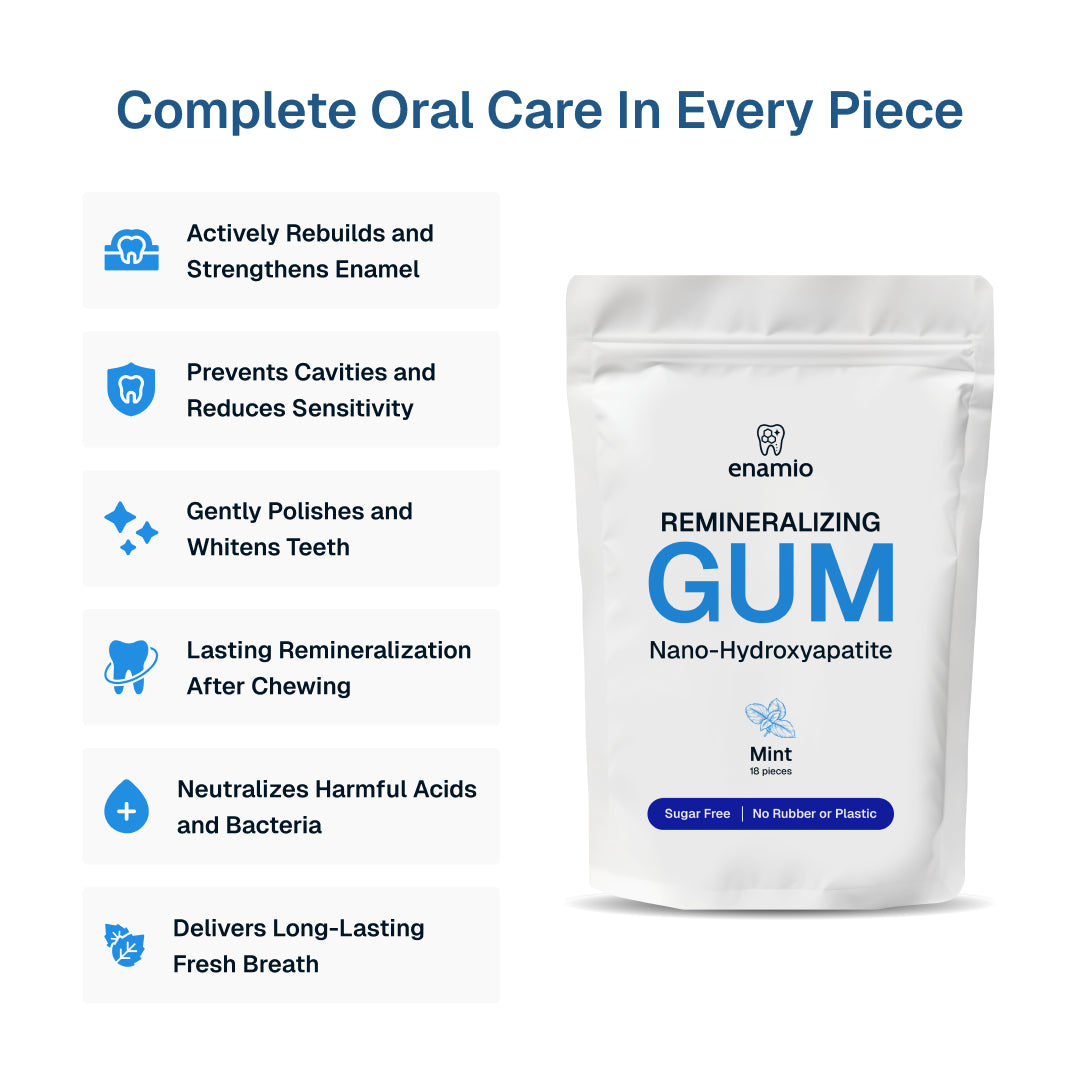
Enamio takes a systems approach. Not just one ingredient. Not just natural sweeteners. A complete formula that addresses multiple factors determining whether your enamel gains or loses minerals.
Seven Active Ingredients Working Together
1. Xylitol USP + Monk Fruit
These provide the sweetness. But xylitol does more than taste good. Cavity-causing bacteria can't ferment it. They try to eat it but can't convert it to energy or acid. That breaks the decay cycle.
A 2025 study from the American Dental Association clarifies xylitol's mechanism. It's not an inhibitor of acid production. It's a non-fermentable sugar substitute. The bacteria literally can't use it to make acid.
Xylitol also stimulates saliva flow. More saliva means more calcium and phosphate ions available for remineralization. Studies show 5-10g daily xylitol intake provides dental benefits. Two pieces of Enamio gum put you in that range.
Monk fruit extract is a high-intensity sweetener. A small amount goes a long way. No sugar, no calories, just natural sweetness.
2. 20nm Carbonate Nano-Hydroxyapatite
Your natural tooth enamel is made of hydroxyapatite crystals. These crystals measure 5-20 nanometers. Enamio uses 20nm carbonate nano-hydroxyapatite particles. That matches the size of your natural enamel crystallites.
Why does size matter? Smaller particles have more surface area. Better adhesion to enamel. Better integration into the crystalline structure. Research shows 10% aqueous slurry of 20nm nano-HA produces surface morphology close to biological enamel with significant increases in mineral content.
An 18-month randomized clinical trial confirmed hydroxyapatite toothpaste shows equivalent efficacy to fluoride for cavity prevention. And the particle size makes a difference. 20nm particles work better than 50nm or 100nm particles.
Most gum brands don't specify particle size. They just say "nano-hydroxyapatite." That's like saying "small." 20nm isn't small. It's the exact size nature uses.
Why Particle Size Gets Its Own Callout
Think about trying to fill a crack in your driveway. You could use gravel, pebbles, or sand. The sand fills the crack better because the particles are smaller. Same principle with nano-HA.
Your enamel has microscopic defects. Smaller particles fill those better. They bind more tightly. They integrate more completely. 20nm particles match what nature already put there.
Enamio specifies 20nm. Not "nano." Not "small." Not "proprietary blend." 20 nanometers. That's transparency.
3. L-Arginine Bicarbonate (ADS Pathway)
This is where pH management happens. L-arginine works with beneficial oral bacteria that have the arginine-deiminase system (ADS). These bacteria convert arginine to citrulline and ammonia.
The ammonia part is key. Ammonia picks up hydrogen ions from acid. That produces ammonium and raises pH. Above pH 5.5, remineralization is favored over demineralization.
Research shows ADS activity is significantly higher in cavity-free people compared to those with active cavities. Both in saliva and plaque samples. The difference is statistically significant (p less than 0.0001).
Clinical studies with 1.5% arginine combined with fluoride demonstrate effectiveness for cavity prevention. Enamio applies this mechanism in gum form.
4. Calcium Glycerophosphate
Remineralization requires both calcium and phosphate ions. Calcium glycerophosphate provides both in bioavailable form. It dissolves in saliva during chewing. That increases the mineral saturation in your oral environment.
More minerals available means more raw material for the remineralization process. Think of it like having more bricks available when you're repairing a wall.
5. Magnesium Citrate + Zinc Gluconate + Bamboo Silica
These support minerals round out the formula. Magnesium serves as a cofactor in mineral metabolism. Zinc offers antimicrobial properties that help control plaque bacteria. Bamboo silica provides trace minerals.
None of these are star players. They're supporting actors. But they complete the system.
6. Matcha Green Tea Extract
Antioxidant support. Trace minerals. A bit of flavor complexity. Matcha isn't the main event, but it adds value.
Why Multiple Ingredients Beat Single Ingredients
Most gum brands pick one angle. Xylitol-only gums prevent acid production but don't provide minerals. Nano-HA-only gums provide structural minerals but don't manage pH. Arginine-only products manage pH but don't provide the calcium and phosphate needed to rebuild enamel.
Enamio addresses multiple factors at once:
- Xylitol prevents bacteria from making acid
- L-arginine raises pH if acid does get produced
- Nano-HA provides structural minerals that bind to enamel
- Calcium glycerophosphate increases mineral saturation
- Monk fruit provides sweetness without synthetic compounds
Each ingredient does a different job. Together, they create an environment that favors remineralization over demineralization.
The Natural Sweetener Difference
Aspartame breaks down into phenylalanine, aspartic acid, and methanol. Your body processes these and moves on. No enamel support.
Xylitol interrupts the bacterial decay process. Monk fruit provides sweetness without feeding bacteria or producing acid. Both work with your mouth's natural systems instead of just passing through.
That's the fundamental difference between artificial and natural sweeteners when oral health is your goal.
Try the Complete System
Natural sweeteners • 20nm specified nano-HA • pH management • 7 active ingredients • Made in USA
How to Choose Better Gum
Two gums can both say "sugar-free" and be completely different products. Here's how to evaluate your options.
What to Look For
Natural Sweeteners Over Artificial
Good options: xylitol, monk fruit, stevia, erythritol. These interact beneficially with oral bacteria or at minimum don't cause problems.
Skip: aspartame, sucralose, acesulfame K. These only provide sweetness with no oral health upside.
Active Remineralizing Ingredients
Look for: nano-hydroxyapatite (check if particle size is specified), calcium compounds (calcium glycerophosphate provides both Ca and P), L-arginine for pH support, magnesium and zinc as supporting minerals.
Particle Size Specification
If a product lists "nano-hydroxyapatite" without specifying particle size, that's a red flag. Size matters for efficacy. 20nm particles match natural enamel crystallites. Larger particles won't integrate as well.
Ingredient Transparency
Avoid "proprietary blends" that hide dosages. You deserve to know exactly what you're chewing and in what quantities.
What to Avoid
- Aspartame-sweetened gum (no enamel benefits)
- Sucralose-based products (artificial with no oral health advantages)
- Gum with only natural base (natural is good, but without actives you're missing remineralization)
- Unspecified "nano-HA" (particle size matters, lack of specification raises questions)
- Single-active approaches (xylitol-only or HA-only miss synergistic benefits)
How to Read Labels
Check for these things:
First ingredients: Base and sweetener appear first. Look for natural options.
Active ingredients: Scan for nano-HA, calcium compounds, arginine, minerals.
Specifications: Does it say "20nm nano-HA" or just "nano-HA"? Specific is better.
What's missing: No aspartame listed? Good. But what IS providing benefits?
A Quick 10-Second Label Scan
Flip the pack over. Find the sweetener line. If you see aspartame, sucralose, or acesulfame K, you're getting sweetness but no enamel support.
If you see xylitol near the top, that's a better sign for dental goals. Then look for actives. If the label is vague about nano-HA or hides behind a proprietary blend, it's hard to know what you're paying for.
Bottom line: the word "sugar-free" is not a guarantee. The ingredient list tells the real story.
A Simple Swap Plan
You don't need to overhaul everything at once. Start with the easiest win: the products you use most often.
Step 1: Replace your daily gum first. It's a small habit that adds up because the sweetener sits in your mouth for minutes.
Step 2: Pick a gum that does something for oral health. Look for xylitol plus a mineral system (like nano-HA and calcium compounds).
Step 3: Keep it simple. If you can't tell what the active ingredients are or how much is in the blend, it's hard to compare products.
Step 4: Give it a few weeks. Oral health habits work through repetition. Most people notice changes gradually.
One tip that makes this easier: keep the gum you want to chew where you already reach for gum. Put a pack in your car, bag, and desk. If your only option is checkout gum, you'll default to it.
When to Chew for Best Results
Timing matters. Here's a simple routine:
- Timing: Chew after meals, within 5-20 minutes when plaque pH drops
- Duration: 5-10 minutes provides benefit without jaw fatigue
- Frequency: 2-3 times daily supports continuous remineralization
- Consistency: Daily use provides cumulative benefits over weeks
Chewing gum doesn't replace brushing and flossing. It's an add-on between cleanings, especially after meals when you can't brush right away.
Enamio vs Other Brands
We believe in transparency. Here's how Enamio compares to other popular brands. This uses publicly available information from product labels.
Why Enamio is different: We're the only brand that specifies particle size (20nm for optimal enamel integration), uses a 7-active mineral system instead of single ingredients, includes pH management through the arginine-deiminase pathway, and provides complete ingredient transparency.
Of the five brands compared, only one besides Enamio includes nano-hydroxyapatite. But they don't specify particle size or include pH management. Three offer natural sweeteners without any remineralizing actives. One uses artificial sweeteners with no oral health benefits.
The gap is clear: you can find natural gum, or you can find remineralizing gum, but finding both with specified particle sizes and pH management has been difficult. That's the space Enamio fills.
Ready to Switch?
Start with 2 pouches for $19.99. That's 36 pieces of gum. Build the habit of chewing after meals. See how your teeth feel after a few weeks.
Common Questions About Aspartame
Is aspartame bad for your teeth?
Aspartame isn't directly bad for teeth in the way sugar is. It doesn't feed cavity-causing bacteria or produce acid. But it doesn't help teeth either. It breaks down into compounds that your body processes and eliminates. No enamel support, no pH buffering, no minerals. For oral health purposes, natural sweeteners like xylitol provide benefits aspartame can't.
Can I chew aspartame gum every day?
You can chew aspartame-sweetened gum daily as long as you stay within the acceptable daily intake of 40 mg/kg body weight. For most people, normal gum consumption stays well below this threshold. But daily use of gum with aspartame means daily exposure to an ingredient that offers no oral health benefits when natural alternatives exist that actually support your enamel.
How do I know if my gum has aspartame?
Check the ingredient list on the package. Aspartame must be listed by name. It often appears near the beginning since it's used in significant amounts for sweetening. Products containing aspartame also carry a phenylketonuria (PKU) warning statement on the label. If you see "sugar-free" but no aspartame listed, the gum likely uses alternative sweeteners like xylitol, sucralose, or stevia.
Why should I avoid aspartame if it's FDA-approved?
FDA approval means "generally recognized as safe" at recommended doses, not "optimal for your health goals." Aspartame provides sweetness without supporting enamel health. When natural alternatives like xylitol and monk fruit offer the same sweetness plus oral health benefits, and when 2025 research continues examining aspartame's long-term effects, choosing natural options makes sense.
Is xylitol gum safe for kids?
For most children who can chew gum safely, xylitol gum is a reasonable choice. Start with shorter chewing times (about 5 minutes) and supervise younger kids to reduce choking risk. If your child has dietary restrictions or medical conditions, ask your clinician first. For dental goals, xylitol combined with remineralizing ingredients like nano-hydroxyapatite provides more than sweetness alone.
What's the difference between aspartame and sucralose?
Both are artificial sweeteners used in sugar-free products. Aspartame breaks down into amino acids and methanol during digestion. Sucralose passes through the body largely unchanged. Neither offers oral health benefits. Neither supports remineralization or manages pH. Both serve only as non-caloric sweeteners. For oral health purposes, natural sweeteners like xylitol represent a better choice than either artificial option.
Does natural gum base matter if the gum has aspartame?
A natural chicle base is better than synthetic polymer bases from an environmental and ingredient transparency perspective. But if that natural gum uses aspartame for sweetening and includes no remineralizing actives, you're getting natural texture without dental health benefits. The ideal combination uses natural base, natural sweeteners, and science-backed active ingredients that support enamel.
Can remineralizing gum reverse cavities?
Remineralizing gum can support early-stage demineralization (white spots) but cannot reverse established cavities with structural damage. It works by providing minerals and managing pH to favor remineralization over demineralization. Think of it as preventive and supportive therapy, not restorative treatment. Regular use as part of comprehensive oral hygiene helps maintain enamel integrity and may prevent progression of very early demineralization.
Sources
- World Health Organization. "Aspartame hazard and risk assessment results released." July 14, 2023.
- International Food Information Council. "Everything You Need to Know About Aspartame." 2023.
- PubMed. "Aspartame and Human Health: A Mini-Review of Carcinogenic and Systemic Effects." 2025.
- World Health Organization. "The Global Status Report on Oral Health 2022." November 2022.
- U.S. Food and Drug Administration. "Aspartame and Other Sweeteners in Food." 2025.
- PMC. "Aspartame Safety as a Food Sweetener and Related Health Hazards." 2023.
- ScienceDirect. "Nanohydroxyapatite in dentistry: A comprehensive review." 2023.
- BMC Oral Health. "Effect of hydroxyapatite nanoparticles on enamel remineralization." 2019.
- PMC / Journal of Nutrition. "Oral Arginine Metabolism May Decrease the Risk for Dental Caries in Children." 2013.
- JADA Foundational Science. "The effect of allulose, sucralose, and xylitol on Streptococcus mutans acid production." January 2025.
- U.S. Food and Drug Administration. "High-Intensity Sweeteners." September 6, 2024.
Written by Enamio Science Review Team
We review current evidence on sweeteners, enamel support, and gum ingredients so you can make simple choices for your oral health.
Published: December 18, 2025
Last reviewed: December 18, 2025
This content is for informational purposes only and is not intended to diagnose, treat, cure, or prevent any disease. The information provided should not replace professional medical advice. Consult your dentist or doctor before making changes to your oral care routine.
