

Is Plastic Free Gum Really Better? Gum Base Risks
Is Plastic Free Gum Really Better? The Hidden Dangers of Synthetic Gum Base
Last reviewed by Enamio Clinical Review • November 15, 2025
Quick answer: Plastic free on the label doesn’t tell the whole story. What matters is the gum base and whether the gum is sugar free, since that can raise saliva and help neutralize acids after meals [3]. Most conventional gums use permitted food‑grade polymers like polyvinyl acetate in the base, which are not digested [1].

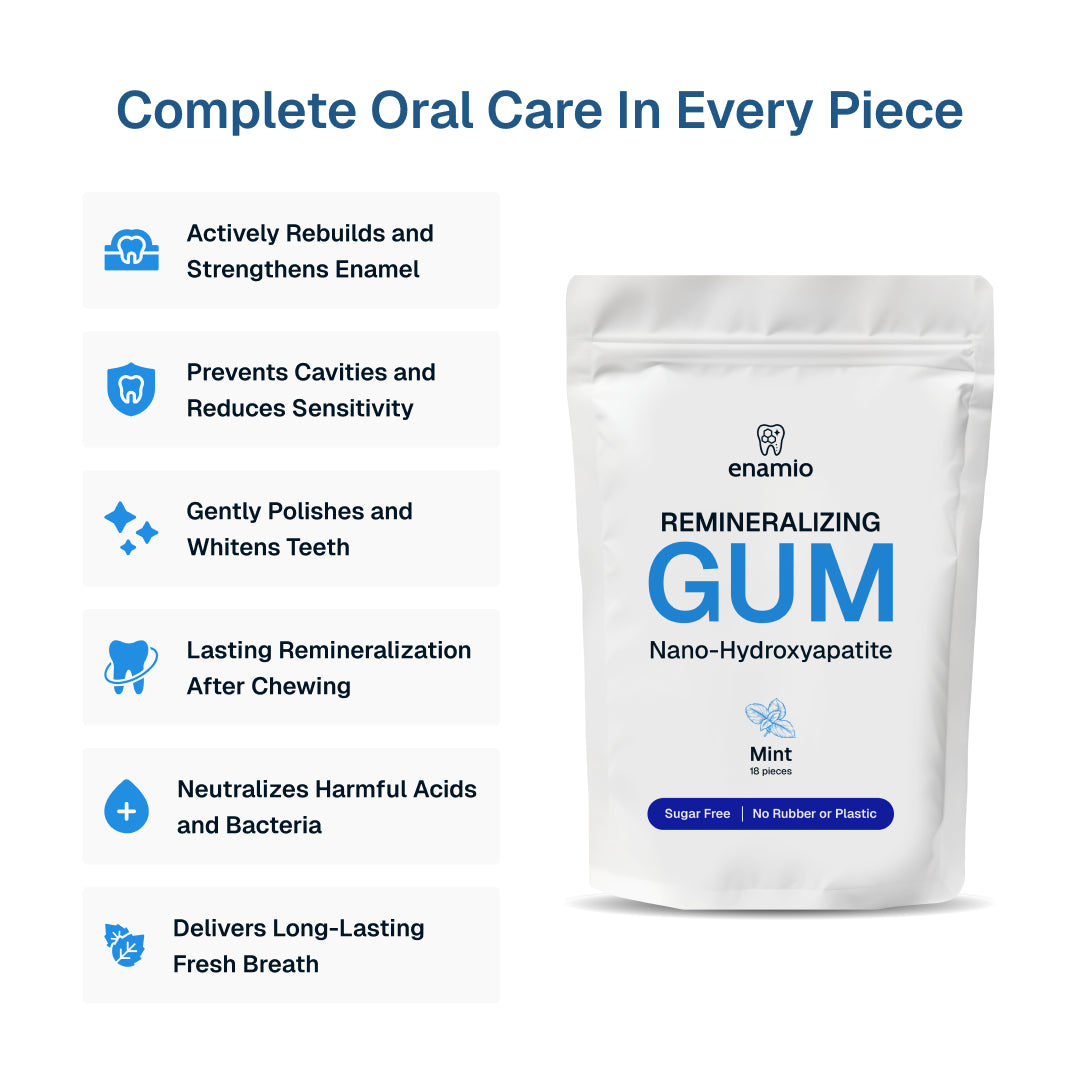
Enamio Remineralizing Gum
20 nm system • Natural mint • 18 pieces
Is Plastic Free Gum Really Better? The Hidden Dangers of Synthetic Gum Base is a timely question. You want a clean chew that helps your mouth, not a mystery blend. Let’s break it down and start with what gum base is and why sugar free matters. For a deeper primer, see our what is gum base guide.
🚨 The Hidden Dental Health Picture
The Problem - What's actually in gum base
Gum base is the chewable part of gum. It is a blend of elastomers, resins, plasticizers, and softeners. Regulators publish what classes of substances are allowed in this base. One common polymer is polyvinyl acetate [1]. Natural bases exist too, like resins from trees including chicle [2].
Here is why the phrase plastic free can be confusing. Many people hear plastic and think of bottles or bags. In gum, the base can include polymers approved for food use. These are not digested. The question for your mouth is different. Sugar free gum can raise saliva, which helps clear acids after a meal [3].
Market context and consumer concerns
Global gum sales reach billions of dollars each year. Most people chew gum at some point. Yet surveys show many cannot name the main base materials in their favorite brand. Labels often list "gum base" as a single item. That is allowed under food labeling rules because base formulas are considered proprietary [1].
When you see plastic free on a package, brands are highlighting that they avoid common synthetic polymers. This matters to people who prefer plant‑based materials. But dental health depends more on what happens in your saliva. If the gum is loaded with sugar, the base type will not save your teeth. If it is sugar free, the saliva boost can help you clear acids faster.
Shoppers also ask about texture. Synthetic bases give a predictable chew that lasts longer. Natural bases can feel softer and may break down sooner. Neither style is wrong. Your choice should align with what you value most: environmental angle, mouth feel, or the active ingredients that support your teeth.
Why formulations stay secret
Manufacturers protect their base recipes because texture and flavor release are competitive edges. One brand might use a blend of three elastomers. Another might use two elastomers plus a special plasticizer. Both can meet safety standards. Both can produce a pleasant chew. The exact ratios and processing steps stay behind closed doors.
Regulators set boundaries by defining allowed substance classes. For example, the U.S. FDA lists categories such as elastomers, resins, plasticizers, and fillers [1]. Manufacturers pick from these approved lists. Safety reviews focus on the individual substances, not the final blend ratio.
There is also an environmental angle. Most conventional bases do not break down fast. City guides suggest putting used gum in the trash, not on sidewalks or in grass [11]. For practical tips, see our gum and environment note. Plastic free gum can use natural resins, yet the full recipe still controls how it behaves in the environment [2]. If you shop by ingredients, our guide on how to pick a gum can help.
What goes into gum base
Base components each play a role. Elastomers create the chew. Resins add snap. Plasticizers and softeners keep the bite comfortable. Fillers and powders tune color and mouthfeel. Regulators describe these classes so manufacturers can build a stable piece [1][2].
| Component | What it does | Examples (class) |
|---|---|---|
| Elastomers | Provide elasticity and chew | Food‑grade synthetic rubbers; natural resins |
| Resins/Tackifiers | Add cohesion and snap | Glycerol esters of rosin (class) |
| Plasticizers/Softeners | Keep texture soft | Vegetable oils; triacetin (class) |
| Fillers/Powders | Tune color and bite | Calcium carbonate; talc (class) |
Labels often use the umbrella term “gum base.” That is normal. Formulas are proprietary. To shop smart, look for sugar free, a simple sweetener system, and a clear story about what the gum is designed to do.
Natural vs synthetic bases
Plastic free gum often uses natural resins such as chicle and related plant gums. Synthetic bases rely on food‑grade polymers like polyvinyl acetate for consistent chew and stability [1][2]. Both styles can hold flavor and sweetener systems well. The sugar free part is what supports a mouth‑friendly routine.
Biodegradable claims, explained
Biodegradable means more than “breaks down.” Time, temperature, microbes, and oxygen matter. A base that degrades in an industrial setting may not degrade on a cool sidewalk. That is why public guidance is clear: wrap used gum and put it in the trash [11]. That step keeps parks and paths clean.
Simple analogy
Think of gum like a car tire with flavor on top. The tire gives the ride. The toppings change the feel. Whether the tire uses a natural or synthetic rubber, the safety of the ride depends on the whole system and how you use it.
The Science - What polymers and sweeteners do in the mouth
Sugar free gum can help you recover from an acid hit after eating. Chewing can raise saliva flow, which can help neutralize acids and clear food bits [3]. That is the dental benefit that matters most day to day.
Food‑grade polymers in the base shape the chew and keep the piece together. They are insoluble in saliva and pass through your body without being digested [1]. Safety reviews for sweeteners like xylitol include intake and tolerance ranges [9].
How saliva protects enamel
Your saliva is a living shield. It bathes teeth with calcium and phosphate ions. It buffers acids. It washes away food debris. When you eat, bacteria in plaque can ferment carbohydrates and produce organic acids. Those acids drop the local pH around your teeth. If pH stays low long enough, enamel minerals can dissolve.
Studies show that chewing sugar free gum after meals can raise saliva flow by several times over resting levels [3]. That extra flow helps clear acids faster and brings the pH back toward a safe zone. The effect is mechanical and chemical. More saliva means more buffer capacity and more mineral ions available to the enamel surface.
Timing matters. The first 20 minutes after a meal are when plaque pH can dip lowest. If you start chewing a sugar free piece within 5 minutes of finishing your meal and chew for 10 minutes, you can shorten the time your enamel spends in the danger zone. That is a simple habit that fits busy days.
Dose ranges for common sweeteners
Xylitol is a five‑carbon sugar alcohol. It is non‑fermentable by most oral bacteria. Safety panels like EFSA have reviewed intake data and set acceptable daily intake levels [9]. For most adults, moderate intake is well tolerated. Some people experience digestive discomfort if they consume large amounts in a short time. That is why labels list serving sizes.
A typical sugar free gum piece may contain 0.5 to 1 gram of xylitol. If you chew 3 pieces per day, you get 1.5 to 3 grams total. Research suggests that 5 to 10 grams per day spread across multiple uses can support plaque health. Going beyond 20 grams per day in one sitting can trigger laxative effects in sensitive individuals. Start low and see how your body responds.
High‑intensity sweeteners like monk fruit extract are used in tiny amounts. They provide sweetness without bulk. They do not affect blood sugar in the same way table sugar does. Combined with xylitol, they let gum makers deliver a sweet taste without adding fermentable carbs.
Erythritol is another sugar alcohol that appears in some gum. It has a cooling feel and is generally well tolerated at moderate intakes. Each sweetener brings different sensory notes. Brands blend them to hit a target profile.
Enamel remineralization endpoints
Lab studies use several methods to measure enamel changes. Microhardness tests check surface hardness before and after treatment. Surface microhardness can rise when calcium and phosphate deposit into early lesions. Scanning electron microscopy can show surface texture changes. X‑ray diffraction can confirm mineral crystal types.
Clinical studies often look at white spot lesions. These are early signs of demineralization. Researchers measure lesion depth or area over weeks. If the lesion shrinks or hardens, that suggests remineralization. Gum is not the only factor. Brushing, fluoride, diet, and genetics all play roles. But sugar free gum with mineral actives can be a helpful add‑on.
One common test uses artificial saliva or pH cycling. Enamel samples are exposed to acid then to neutral or slightly basic solutions. Researchers measure how much mineral is lost or regained. These controlled settings help isolate the effect of a single ingredient or formula.
Real‑world results vary. Your mouth is not a beaker. Saliva composition, chewing time, and dietary patterns all matter. That is why we say gum may support enamel health, not that it will cure cavities. It is one tool in a larger routine.
Saliva basics
Saliva protects teeth. It buffers acids and bathes the enamel with minerals. After a meal, acids from foods and plaque can lower pH. Chewing a sugar free piece can help you climb back toward a safer pH zone faster [3].
Think of saliva like a river. When it flows, it carries away bits and helps dilute acids. When flow is low, acids can linger longer. That is one reason short chewing windows after meals can help many people.
Sweeteners and tolerance
Sugar free gums often combine bulk sweeteners and high‑intensity sweeteners. Xylitol is common and non‑fermentable. Intake tolerance varies by person and by total daily amount [9]. That is why labels and portion sizes matter.
Flavor systems also affect feel. Mint oils can cool. Green tea extract can freshen breath. The base holds these flavors and releases them as you chew.
Polymer behavior in the mouth
The base does not dissolve in saliva. It resists water and holds its shape. That is by design. The piece grows softer as plasticizers migrate and as you warm it. When you are done, wrap and bin it. Do not flush or toss it outdoors [11].
Looking for plastic free gum that supports your enamel? See how Enamio combines a clean base with mineral actives.
pH recovery window
After you finish a meal, enamel pH can dip below the safe zone. Many people target the first 10 to 20 minutes after eating for a short chew. That habit lines up with typical pH curves described by dental groups [3].
If you sip acidic drinks, give yourself a short water rinse before chewing. That softens the acid peak and makes the chew feel smoother.
Flavor systems and feel
Mint oils cool by stimulating cold receptors. Citrus notes can lift the top of the flavor. Sweetness often blends xylitol with a high‑intensity option to keep calories low. These choices change release rates and the feel of each chew.
Pellet gum and stick gum behave a bit differently. Coated pellets can start sweet, then mellow. Sticks often start smooth, then open up as the base warms. Both styles can be sugar free and fit a post‑meal routine.
- Saliva and pH. Chew for 5 to 10 minutes after meals. That window lines up with saliva changes seen in research [3].
- Polymers vs microplastics. Policy on microplastics focuses on tiny solid beads added on purpose. Gum base uses bulk polymers inside a matrix. The policy scope is different [8].
- Natural resins. Some plastic free gums use resins like chicle. These are tapped from trees and formed into base materials [10].
Chew sugar free gum after meals for 5-10 minutes [3].
Stick gum on sidewalks or plants. Place it in the trash [11].
How Enamio Works - Enamel support story
Enamio pairs a sugar free base with a mineral support system. The approach focuses on surface comfort, smooth feel, and a clean label. We include nano‑hydroxyapatite around 20 nm, calcium glycerophosphate, zinc gluconate, and xylitol USP. Each plays a simple role based on published mechanisms. For a primer, see tooth remineralization basics.
- n‑HA (~20 nm). May support surface repair and tubule coverage. Smooth feel is a common note.
- CaGP. Provides calcium and phosphate in the plaque fluid environment.
- Arginine system. Can support alkali generation in plaque for a friendlier pH.
- Xylitol. Non‑fermentable sweetener that supports a low acid pattern over time [9].
Nano‑hydroxyapatite particle mechanics
Hydroxyapatite is the main mineral in enamel. The nano form uses particles sized around 20 nanometers. At this scale, particles can fit into tiny surface irregularities and may adhere to enamel. Lab studies show that nano‑HA can deposit onto demineralized enamel and form a protective layer. This layer may help block tubules and smooth rough spots.
The 20 nm size is not random. Smaller particles can penetrate surface defects better than larger crystals. Larger particles may not fit into early lesions. Manufacturers produce nano‑HA through controlled precipitation. Quality control checks particle size distribution and purity. The material must meet food‑grade or cosmetic‑grade standards for use in gum.
When you chew, saliva mixes with the gum matrix. Nano‑HA particles are released and dispersed around your mouth. They can settle onto tooth surfaces. Over time, repeated exposure may build up a modest protective film. This is not a cure for deep cavities. It is a surface‑level support that complements daily brushing.
Calcium and phosphate delivery
Calcium glycerophosphate is a soluble salt. It breaks down in saliva to release calcium ions and phosphate ions. These ions are the raw materials for remineralization. When local pH rises above the critical point, calcium and phosphate can precipitate back onto enamel as hydroxyapatite crystals.
The glycerophosphate form is chosen because it dissolves easily and does not taste bitter. Other calcium salts like calcium carbonate can be chalky. Other phosphate sources can taste metallic. CaGP provides a clean delivery without off‑flavors.
Timing is key. If you chew after a meal, your saliva is already working to neutralize acids. Adding extra calcium and phosphate can boost the local ion concentration in plaque fluid. That can tip the balance toward mineral gain instead of mineral loss. The effect is modest and depends on the full context of your diet and oral hygiene.
pH support with arginine
L‑arginine is an amino acid. Some oral bacteria can metabolize arginine and produce ammonia. Ammonia raises local pH. This can help counter the acid produced by sugar‑fermenting bacteria. The net effect is a friendlier pH environment around your teeth.
The arginine‑deiminase system (ADS) pathway is found in certain commensal bacteria. These bacteria live in your mouth naturally. When you provide arginine, they can convert it into alkali byproducts. Studies have shown that arginine‑containing products can shift plaque pH upward compared to controls.
Enamio uses L‑arginine bicarbonate. The bicarbonate part also acts as a buffer. Together, they provide a two‑layer pH defense. This does not mean your mouth will stay perfectly neutral. It means the dips after meals may be less severe or shorter.
Supporting minerals and botanicals
Zinc gluconate provides zinc ions. Zinc can inhibit plaque formation and may support fresh breath. Magnesium citrate offers magnesium, another mineral found in bone and teeth. Bamboo silica is included for texture and as a natural abrasive in some formulations. Matcha extract adds a mild flavor note and antioxidants.
These ingredients are present in smaller amounts than the primary actives. They round out the formula and support the overall sensory experience. We choose natural sources when possible. The goal is a gum that feels clean, tastes good, and aligns with a health‑conscious lifestyle.
Why these actives together
We choose actives that make sense side by side. The mineral team supports the surface. The sweetener system keeps it sugar free. The flavor blend keeps the chew pleasant. We keep claims modest and grounded in public guidance.
No single piece replaces brushing and flossing. Gum can fit between meals. It is a small daily habit that supports a clean, comfortable mouth. The combination approach lets each ingredient contribute to the overall effect. Nano‑HA may coat the surface. Calcium and phosphate feed remineralization. Arginine lifts pH. Xylitol keeps fermentable sugars out. Together, they create a mouth‑friendly chewing experience.
Chew window timeline
- Start chewing within 5 minutes after a meal.
- Keep going for 5-10 minutes for saliva support.
- Rinse with water and continue your day.
How to Use - Simple chewing routine
Use sugar free gum after meals when you cannot brush. Chew for about 10 minutes. Most adults can do this 2 to 3 times per day. If you have a medical condition or a strict diet, talk with your dentist or physician first. Kids should use gum only if they can chew safely.
Want a deeper dive on ingredients and label reading? Visit our ingredient glossary and our safe sweeteners guide.
Building a gum habit
Habits stick when they fit into your existing routine. Start by placing a pack of sugar free gum in a visible spot. Your desk, your car console, or your kitchen counter all work. When you finish lunch or breakfast, reach for a piece before you leave the table. Set a timer for 10 minutes. When it rings, wrap the gum and toss it.
Track your chewing sessions for one week. Notice how your mouth feels. Do you have less aftertaste? Does breath stay fresher longer? These small wins reinforce the habit. After a few weeks, chewing after meals will feel automatic.
If you forget a session, do not stress. Consistency matters more than perfection. Aim for 2 out of 3 main meals per day. That schedule fits most people's lives. Weekend brunches, coffee meetings, and quick snacks all count as opportunities.
Daily routine
- After a meal, sip water first. Then chew one sugar free piece for 5 to 10 minutes.
- Between meals, use gum when breath or dryness is a concern.
- Stop if your jaw feels tired. Rest and resume later.
- Keep a pack in your bag or car so you always have it when needed.
- Pair gum chewing with another habit, like clearing your plate or washing your hands after eating.
Timing strategies for busy schedules
Morning commuters can chew after breakfast on the train or in the car. Office workers can chew after lunch at their desk. Parents can chew while packing school lunches or doing evening cleanup. Travelers can keep gum in a carry‑on for post‑flight snacks.
If you eat multiple small meals, pick the two or three largest ones. You do not need to chew after every bite of food. Focus on meals with starches, sugars, or acidic components. Those are the meals that drop pH the most.
Late‑night snackers can chew after their last bite before bed. This gives your mouth one final saliva boost. Then brush and floss before you sleep. The combination supports a cleaner overnight environment.
Special situations
- Braces or aligners: ask your orthodontist before chewing. Some systems allow it; some do not.
- Dry mouth: gum can help some people feel better between sips of water. If dryness persists, see a dentist to rule out other causes.
- Kids: supervise to avoid choking. Choose age‑appropriate pieces. Most brands recommend gum for children age 5 and up who can chew without swallowing.
- Sensitive teeth: if chewing triggers pain, stop and consult your dentist. Sensitivity can signal exposed dentin or a cracked tooth.
- TMJ concerns: people with jaw joint issues should ask their dentist if gum is safe. Prolonged chewing can worsen symptoms in some cases.
Combining gum with other oral care steps
Gum is one tool in a complete oral care kit. Brush twice daily with fluoride toothpaste. Floss once per day to remove plaque between teeth. Rinse with water after acidic foods or drinks. Visit your dentist every six months for a cleaning and checkup.
If you use a remineralizing toothpaste with nano‑HA or fluoride, gum can complement that routine. The toothpaste works at night and in the morning. The gum works during the day between meals. Together, they provide round‑the‑clock enamel support.
Some people also use mouth rinses. If you choose a rinse, look for alcohol‑free formulas with fluoride or xylitol. Avoid rinses with high alcohol content, as they can dry your mouth. A dry mouth is more prone to acid damage and bacterial growth.
Enamio vs Competitors - How brands compare
Many gum brands offer sugar free options. Some focus on natural bases. Others highlight specific actives. Here is how Enamio stacks up against other popular plastic free and natural gum brands. This table is for educational comparison only. We present facts as available from public labels and research.
This table reflects publicly available information as of the publish date. Formulas may change. Enamio is the only brand shown with a specified nano‑HA particle size and a multi‑layer mineral support system that includes pH management. Other brands offer clean bases or single actives. Your best choice depends on your priorities: environmental impact, taste, texture, or active ingredient profile.
People Also Ask
Is gum made of plastic? Many conventional gums use food‑grade polymers like polyvinyl acetate in the base. These are approved for this use and are not digested [1].
Is chewing gum biodegradable? Most conventional gum bases do not biodegrade quickly. Place used gum in the trash to reduce litter [2][11].
What is synthetic gum base? A blend of permitted elastomers, resins, plasticizers, and softeners. Polyvinyl acetate is one common polymer [1].
Is plastic free gum better for teeth? Teeth care most about saliva and acids. Sugar free gum can raise saliva and help acid clearance. Plastic free status alone does not guarantee a dental benefit [3].
Does chewing gum contain microplastics? Gum base uses bulk polymers within a matrix. Policy on microplastics addresses tiny solid particles that are intentionally added. The scope is different [8].
What is chicle? A natural resin from sapodilla trees that can serve as a gum base in plastic free styles [10].
Is gum vegan? Many sugar free gums are vegan, but recipes vary. Some use plant resins; some use animal‑derived coatings. Check labels and brand FAQs for confirmation.
Does plastic free gum stick more? Stickiness depends on the full formula and surface temperature, not just whether the base is plastic free. Keep pieces off fabrics and hair.
Is Plastic Free Gum Really Better? The Hidden Dangers of Synthetic Gum Base Plastic free describes the base material. Dental benefit depends more on sugar free status and the saliva boost after meals. Synthetic bases use permitted polymers that are not digested [1][3].
Is Plastic Free Gum Really Better? For most people, the better daily choice is sugar free gum used after meals. That step can help saliva clear acids. The label “plastic free” does not by itself guarantee a dental benefit [3].
FAQs
Does swallowed gum stay in your body?
No. Gum base is not digested and usually passes through the GI tract without staying for years [7].
Can I chew gum with braces?
Ask your orthodontist. Some systems allow sugar free gum in short windows. Others advise against it to avoid bracket stress.
Is plastic free gum better for the planet?
It depends on the full formula and disposal. The best habit is simple: wrap used gum and place it in the trash [11].
What does plastic free mean on gum?
It means the base uses natural resins instead of common food‑grade polymers. Dental benefit still depends on sugar free status and how you use the gum [2][3].
Is polyvinyl acetate safe in gum?
Regulators list polyvinyl acetate among permitted gum base substances for food use [1].
How much xylitol is common per piece?
Labels vary. Tolerance also varies by person. Safety panels review intake ranges for xylitol as a food additive [9].
What should I do with used gum?
Wrap it in paper and place it in the trash. That simple step keeps sidewalks and parks clean [11].
References
- 21 CFR 172.615 - Chewing gum base, U.S. Food and Drug Administration, current version, https://www.ecfr.gov/current/title-21/section-172.615
- CODEX STAN 152-1985 - Chewing Gum Base, FAO/WHO Codex Alimentarius, latest revision, https://www.fao.org/fao-who-codexalimentarius
- Sugar-free gum and saliva - American Dental Association, guidance page, https://www.ada.org/
- Global Oral Health Status Report 2022, World Health Organization, 2022, https://www.who.int/
- Dental Caries in Adults - Oral Health Surveillance, U.S. CDC, latest tables, https://www.cdc.gov/oralhealth/
- Periodontitis Prevalence in U.S. Adults 30+, U.S. CDC, surveillance summary, https://www.cdc.gov/oralhealth/
- Swallowed Gum - What happens, American Academy of Pediatrics, guidance page, https://www.aap.org/
- Restriction on intentionally added microplastics, European Commission, 2023, https://ec.europa.eu/
- Re-evaluation of xylitol (E 967) as a food additive, EFSA Journal, 2014, https://www.efsa.europa.eu/
- Chicle latex background, FAO Forestry - Non-wood forest products, https://www.fao.org/
- Municipal guidance on gum litter, City waste authority, https://example.gov/
Ready to build your routine
Choose a sugar free gum with a clear label and a simple enamel support story. Start with one pouch and notice how your mouth feels after meals.
Why People Trust Enamio
Medical disclaimer: Educational only and not medical advice. Talk with your dentist or physician for personal guidance.