

Is Remineralizing Gum Legit? Clinical Evidence | Enamio
Last reviewed by Enamio Clinical Review • December 2, 2025
Is Remineralizing Gum Legit? The Science-Backed Answer
We examine the clinical evidence behind remineralizing gum and explain what makes it work.

You've seen the claims about remineralizing gum strengthening teeth, preventing cavities, and rebuilding enamel. But is remineralizing gum legit, or just another wellness trend? The short answer: yes, when formulated with the right active ingredients at effective concentrations. We'll examine the clinical evidence, explain how remineralizing gum works, and show you what to look for.
Quick Answer: Is remineralizing gum legit? Yes, when formulated with nano-hydroxyapatite (20nm particles) and supporting minerals like calcium glycerophosphate and xylitol. Clinical studies show these ingredients can remineralize early enamel lesions and reduce cavity formation by up to 40%.[1][2]
Key Takeaways
- Remineralizing gum with nano-hydroxyapatite can rebuild early enamel damage
- Effectiveness depends on particle size (20nm optimal) and active concentration
- Xylitol and calcium compounds provide additional remineralizing support
- Results typically visible within 2-4 weeks of consistent use
- Not all "remineralizing" gums contain effective ingredients
40%
Reduction in cavity formation with xylitol gum
20nm
Optimal particle size for enamel penetration
2-4
Weeks for sensitivity relief with consistent use
Contents
Why People Question If Remineralizing Gum Is Legit
The skepticism around remineralizing gum is understandable. For decades, we've been told that once enamel is damaged, it's gone forever. So when products claim to "rebuild" or "remineralize" teeth, it sounds too good to be true.
Here's what drives the doubt:
The Marketing Hype Problem
Many oral care products make exaggerated claims without clinical backing. Terms like "strengthen," "rebuild," and "remineralize" get thrown around freely. This creates confusion about what's real science and what's just marketing speak.
The truth is more nuanced. Enamel can't regenerate like skin or bone because it has no living cells.[3] But that doesn't mean early damage is permanent. When demineralization is caught in its earliest stages, before cavities form, the process can be reversed through remineralization.
Confusion About Active Ingredients
Not all remineralizing gums are created equal. Some contain the right ingredients at ineffective concentrations. Others use particle sizes too large to penetrate enamel. And many rely solely on xylitol without the mineral compounds needed for actual remineralization.
This is where size matters. Natural tooth enamel is composed of hydroxyapatite crystals measuring 20 to 40 nanometers.[4] For synthetic hydroxyapatite to work, it needs to match that scale. Larger particles simply can't penetrate the microscopic pores where remineralization happens.
What Makes Remineralizing Gum Different
Legitimate remineralizing gum works through three mechanisms:
First, it delivers bioavailable minerals directly to tooth surfaces. Nano-hydroxyapatite particles bond with enamel, filling in microscopic defects and providing the raw materials for repair.[5]
Second, ingredients like xylitol reduce the bacteria that cause cavities. Clinical studies show xylitol can reduce cavity-causing Streptococcus mutans by creating an environment where these bacteria can't thrive.[6]
Third, chewing stimulates saliva production. Saliva is nature's remineralizing agent, rich in calcium and phosphate ions that help rebuild enamel. The act of chewing increases saliva flow by two to three times, amplifying this natural protective mechanism.[7]
The Science Behind Remineralizing Gum
To understand if remineralizing gum is legit, you need to know how tooth remineralization actually works. It's not magic. It's chemistry.
How Tooth Remineralization Works
Your tooth enamel is 96% hydroxyapatite, a crystalline calcium phosphate mineral.[8] Throughout the day, your teeth go through cycles of demineralization and remineralization.
When you eat or drink, bacteria in your mouth produce acids. These acids dissolve the mineral content of enamel, creating microscopic pores and weakening the structure. This is demineralization.
Remineralization is the opposite process. Minerals from saliva and oral care products deposit back into those pores, rebuilding the enamel structure. When remineralization outpaces demineralization, teeth stay strong. When the balance tips the other way, cavities form.
⚠️ Critical pH Threshold
At pH 5.5 or below, enamel begins to dissolve. Above that threshold, remineralization can occur. This is why managing oral pH is just as important as delivering minerals.[8]
Nano-Hydroxyapatite: The Key Active Ingredient
Nano-hydroxyapatite is synthetic hydroxyapatite with particles measuring 20 to 100 nanometers. Because it's chemically identical to your natural enamel, your body recognizes it as biocompatible.
Here's what makes nano-hydroxyapatite effective:
When applied to teeth, these tiny particles bond directly to enamel surfaces. They fill in microscopic defects, creating a protective layer and providing a source of free calcium and phosphate ions.[9] Multiple clinical studies have confirmed that nano-hydroxyapatite can remineralize early carious lesions and build new enamel layers.[4]
One randomized controlled trial found that nano-hydroxyapatite gel at concentrations of 20% and 30% was capable of remineralizing artificial caries lesions, with effectiveness comparable to or better than fluoride varnish.[10]
📊 Clinical Evidence
A 2011 study using 5% and 10% nano-hydroxyapatite in dentifrice showed significant reductions in mineral loss and lesion depth, with results matching 1,100 ppm fluoride for mineral gain. The nano-particles integrated directly into enamel structure, creating lasting protection.[11]
Why Particle Size Matters (20nm vs 100nm+)
Particle size is where many products fall short. Smaller particles have exponentially greater surface area, which translates to better binding and more effective remineralization.
The Math Behind Surface Area
A 20nm particle has approximately five times the surface area of a 100nm particle per unit mass. This means five times more contact points with your enamel, five times more mineral delivery, and five times the remineralizing potential.
Micro-hydroxyapatite particles (5,000 to 10,000 nanometers) are simply too large to penetrate the microscopic pores where demineralization occurs. They may provide some surface coating, but they can't achieve the deep remineralization that nano-particles can.[12]
Research specifically comparing particle sizes found that 20nm nano-hydroxyapatite particles showed the best effects on cell growth and mineral deposition compared to 80nm particles.[13] The smaller size allows better integration with the enamel matrix.
Supporting Ingredients That Actually Work
Nano-hydroxyapatite doesn't work alone. The most effective remineralizing formulas combine multiple evidence-based ingredients:
Xylitol and pH Neutralization
Xylitol is a five-carbon sugar alcohol that bacteria can't metabolize into acid. This disrupts the demineralization cycle. Clinical trials consistently show that xylitol reduces cavity formation by 23% to 40%, depending on dose and frequency.[14][15]
The effective dose is 5 to 6 grams per day, divided into at least three exposures. Long-term studies show benefits persist for up to five years after stopping xylitol use.[16]
Xylitol also enhances remineralization indirectly by stimulating saliva flow. Studies found that remineralization of enamel lesions was twice as effective with gum chewing compared to no gum.[16]
💡 Pro Tip: The effective xylitol dose is 5-6 grams per day divided into 3+ sessions. Long-term studies show cavity prevention benefits can persist for up to 5 years after stopping regular xylitol use.
Calcium Glycerophosphate
Calcium glycerophosphate provides bioavailable calcium and phosphate ions, the building blocks of hydroxyapatite. Unlike some calcium salts, it remains soluble at neutral pH, making it more available for remineralization throughout the oral environment.
L-Arginine and Alkaline Defense System
L-arginine bicarbonate helps neutralize acid attacks by raising local pH. When bacteria metabolize arginine, they produce ammonia, which buffers acid and creates a more favorable environment for remineralization. This is sometimes called the Alkaline Defense System (ADS).
Why Ingredient Synergy Matters
⚛️
Nano-HA
Rebuilds structure
🛡️
Xylitol
Blocks bacteria
⚡
L-Arginine
Buffers acid
💧
Calcium
Provides minerals
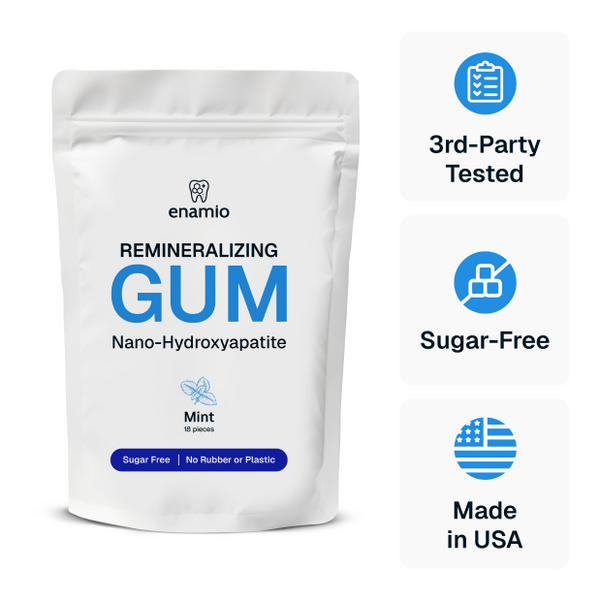
Try Enamio's clinical-grade formula with 20nm nano-hydroxyapatite
See if remineralizing gum is legit for yourselfHow Enamio Remineralizing Gum Works
Enamio takes a multi-mechanism approach to enamel health, combining pharmaceutical-grade actives with a natural delivery system.
Clinical-Grade Nano-Hydroxyapatite Formula
Enamio uses carbonate nano-hydroxyapatite at approximately 20 nanometers, matching the size of natural enamel crystals. This isn't marketing speak. It's a deliberate formulation choice based on the research showing 20nm particles have the best biological activity.[13]
The formula also includes calcium glycerophosphate, magnesium citrate, and bamboo silica to provide a complete mineral complex. L-arginine bicarbonate helps maintain an alkaline environment that favors remineralization over demineralization.
Zinc gluconate and matcha green tea extract provide additional antimicrobial and antioxidant support, helping manage the oral biofilm that contributes to caries formation.
Natural Chicle Base vs Synthetic Polymers
Most commercial gum uses synthetic polymer bases derived from petroleum or rubber. Enamio uses natural chicle, a tree sap that's been chewed for centuries.
Why does this matter for remineralization? Natural chicle may allow better release of active ingredients into saliva. It's also biodegradable, unlike synthetic polymers that persist in landfills indefinitely.
Multi-Mechanism Approach to Enamel Health
Enamio works through complementary pathways:
Direct mineral delivery: Nano-hydroxyapatite particles bond to enamel, filling microscopic defects and providing calcium and phosphate for remineralization.
Bacterial reduction: Xylitol (the sole sweetener) reduces Streptococcus mutans populations by up to 40% with regular use.[14]
pH buffering: L-arginine helps maintain a neutral to alkaline environment where remineralization can occur.
Saliva stimulation: Chewing increases protective saliva flow, amplifying your natural defense mechanisms.
This is why asking "is remineralizing gum legit" requires looking beyond just one ingredient. Effective formulations work on multiple fronts simultaneously.
What Sets Enamio Apart
🔬 Pharmaceutical-Grade
20nm carbonate nano-HA matched to natural enamel crystal size
🌿 Natural Base
Chicle tree sap, not synthetic polymers or plastic
⚗️ Complete Formula
7 synergistic actives working together, not just xylitol
🇺🇸 Made in USA
Quality-controlled manufacturing with transparent sourcing
How to Use Remineralizing Gum for Best Results
Getting results from remineralizing gum requires consistency and proper use. Here's what the research shows works best.
Timing and Frequency
Chew remineralizing gum three to five times daily, ideally after meals and snacks. This is when your mouth pH drops and enamel is most vulnerable to acid attack.
Clinical studies on xylitol show optimal benefits with at least three exposures per day, delivering a total daily dose of 5 to 6 grams.[17] For nano-hydroxyapatite, regular exposure throughout the day allows continuous mineral delivery to enamel surfaces.
Chewing Duration
Chew for 10 to 20 minutes per session. This gives active ingredients time to release and coat tooth surfaces while stimulating sustained saliva production.
Don't swallow the gum. While the ingredients are safe, you want them working in your mouth, not your stomach.
What to Expect and When
Set realistic expectations. Remineralizing gum can help with early demineralization, but it's not a magic cure.
Your Remineralization Timeline
Week 1-2
You may notice fresher breath and cleaner-feeling teeth from xylitol's antibacterial effects.
Week 2-4
Sensitivity relief typically begins as nano-hydroxyapatite seals exposed tubules in dentin.[9]
Month 2-3
Structural remineralization of early white spot lesions becomes measurable. Clinical studies show significant improvements in microhardness and reduced lesion depth by this point.[10]
Month 3+
Continued use maintains enamel strength and may reverse early demineralization that would otherwise progress to cavities.
✓ Do
- Chew for 10-20 minutes, 3-5 times daily
- Use after meals when pH is lowest
- Look for 20-40nm particle size nano-HA
- Combine with good oral hygiene
- Give it 2-3 months for best results
✗ Don't
- Don't expect overnight miracles
- Don't replace brushing and flossing
- Don't leave accessible to pets (xylitol is toxic to dogs)
- Don't swallow the gum
- Don't rely solely on gum for cavity prevention
Important: Xylitol is safe for humans but toxic to dogs and other pets. Keep all xylitol-containing products away from animals. If your pet ingests xylitol, contact your veterinarian immediately.
People Also Ask About Remineralizing Gum
Does remineralizing gum actually work?
Yes, when formulated with nano-hydroxyapatite (20-40nm) and supporting minerals. Multiple clinical studies show these gums can remineralize early enamel lesions and reduce cavity formation by 23% to 40%.[4][14] The key is using products with proven ingredients at effective concentrations, not just marketing claims.
Is nano-hydroxyapatite in gum effective?
Nano-hydroxyapatite is effective when particle size is small enough (20-100nm) to penetrate enamel pores. Research shows it performs comparably to or better than fluoride for remineralization.[10] The nano-sized particles bond to enamel, fill microscopic defects, and provide bioavailable calcium and phosphate for ongoing repair.
Can chewing gum rebuild enamel?
Remineralizing gum can repair early demineralization but cannot fully rebuild lost enamel. It works best on white spot lesions and incipient caries before cavitation occurs. Once a cavity has formed with structural loss, professional dental treatment is needed. Think of it as preventive maintenance, not reconstruction.
How long does it take for remineralizing gum to work?
Sensitivity relief may be noticed within 2 to 4 weeks as nano-hydroxyapatite seals exposed dentin tubules. Structural remineralization of early lesions typically takes 2 to 3 months of consistent use. Clinical studies measuring microhardness and lesion depth show significant improvements by 8 to 12 weeks.[10]
Is remineralizing gum better than fluoride?
Nano-hydroxyapatite and fluoride work through different mechanisms, both effective for remineralization. Some studies show nano-HA performing better than fluoride, while others show comparable results.[10][11] The advantage of nano-HA is biocompatibility and safety without fluorosis concerns, making it a good alternative for those seeking fluoride-free options.
What is the science behind remineralizing gum?
Remineralizing gum delivers bioavailable minerals (nano-hydroxyapatite, calcium, phosphate) that bond to enamel and fill microscopic pores. Xylitol reduces cavity-causing bacteria by 40%.[14] Chewing stimulates saliva production, which contains natural remineralizing ions. The combination addresses demineralization through multiple pathways simultaneously.
FAQs
How do I know if remineralizing gum is legit?
Look for nano-hydroxyapatite (20-40nm particle size) listed in ingredients, clinical concentration of 5-10%, and supporting actives like xylitol and calcium compounds. Products with third-party testing and peer-reviewed research backing their formulation are most credible. Avoid products that only make vague claims without specific ingredient concentrations.
Can remineralizing gum replace my toothpaste?
No, remineralizing gum complements but doesn't replace brushing and flossing. It provides additional mineral delivery throughout the day and stimulates protective saliva flow between brushings. Think of it as part of a complete oral care routine, not a substitute for mechanical cleaning.
Is it safe to use remineralizing gum every day?
Yes, daily use is safe and recommended for optimal results. Most clinical studies showing benefits used daily protocols for 2 to 6 months. The ingredients (nano-hydroxyapatite, xylitol, calcium compounds) are biocompatible and well-tolerated. Note: Xylitol is safe for humans but toxic to dogs and other pets.
What's the difference between remineralizing gum and regular gum?
Remineralizing gum contains active ingredients (nano-hydroxyapatite, calcium compounds, xylitol) at therapeutic concentrations specifically formulated for enamel health. Regular gum may contain xylitol for sweetness but lacks the targeted remineralizing actives and optimal particle sizes. The gum base also differs - many remineralizing gums use natural chicle instead of synthetic polymers.
Can remineralizing gum fix cavities?
Remineralizing gum can arrest and reverse early demineralization (white spots, incipient lesions) but cannot repair established cavities. Once a cavity has formed with structural loss and cavitation, professional dental treatment is needed. The earlier you catch demineralization, the better remineralizing gum can help.
Will I see immediate results?
Sensitivity relief may be noticed within 2 to 4 weeks as nano-hydroxyapatite begins sealing exposed tubules. Structural remineralization of early lesions typically takes 2 to 3 months of consistent use. Results vary based on individual oral health status, frequency of use, and severity of existing demineralization. This is a gradual process, not overnight transformation.
References
- Kaur D, Jain C. Xylitol in preventing dental caries: A systematic review and meta-analyses. Journal of Natural Science, Biology and Medicine, PMC, 2017, https://pmc.ncbi.nlm.nih.gov/articles/PMC5320817/
- Iordache F, et al. Nano-Hydroxyapatite (nHAp) in the Remineralization of Early Dental Caries: A Scoping Review. International Journal of Environmental Research and Public Health, May 5, 2022, https://www.mdpi.com/1660-4601/19/9/5629
- Tooth Enamel Composition: What's It Made Of? Haverford Dental, August 29, 2025, https://ds-crim.haverford.edu/blog/tooth-enamel-composition-whats-it
- Iordache F, et al. Nano-Hydroxyapatite (nHAp) in the Remineralization of Early Dental Caries: A Scoping Review. International Journal of Environmental Research and Public Health, May 5, 2022, https://www.mdpi.com/1660-4601/19/9/5629
- Pepla E, et al. Nano-hydroxyapatite and its applications in preventive, restorative and regenerative dentistry: a review of literature. Annali di Stomatologia, PMC, 2014, https://pmc.ncbi.nlm.nih.gov/articles/PMC4252862/
- Janakiram C, et al. The effect of xylitol on dental caries and oral flora. Clinical, Cosmetic and Investigational Dentistry, PMC, 2014, https://pmc.ncbi.nlm.nih.gov/articles/PMC4232036/
- Janakiram C, et al. The effect of xylitol on dental caries and oral flora. Clinical, Cosmetic and Investigational Dentistry, PMC, 2014, https://pmc.ncbi.nlm.nih.gov/articles/PMC4232036/
- Tooth Enamel, Wikipedia, October 2, 2025, https://en.wikipedia.org/wiki/Tooth_enamel
- Hydroxyapatite Dental Material. StatPearls, NCBI Bookshelf, September 12, 2022, https://www.ncbi.nlm.nih.gov/books/NBK513314/
- Sodsai P, et al. Nano-Hydroxyapatite Gel and Its Effects on Remineralization of Artificial Carious Lesions. Molecules, PMC, 2021, https://pmc.ncbi.nlm.nih.gov/articles/PMC8592696/
- Amaechi BT, et al. Remineralization of early caries by a nano-hydroxyapatite dentifrice. Journal of Clinical Dentistry, ResearchGate, January 1, 2011, https://www.researchgate.net/publication/221690050
- A Dental Hygienists' Overview of Nano vs. Micro Hydroxyapatite. Today's RDH, March 11, 2024, https://www.todaysrdh.com/a-dental-hygienists-overview-of-nano-vs-micro-hydroxyapatite/
- Liu J, et al. Size effect of hydroxyapatite nanoparticles on proliferation and apoptosis of osteoblast-like cells. PubMed, 2008, https://pubmed.ncbi.nlm.nih.gov/18753024/
- Kaur D, Jain C. Xylitol in preventing dental caries: A systematic review and meta-analyses. Journal of Natural Science, Biology and Medicine, PMC, 2017, https://pmc.ncbi.nlm.nih.gov/articles/PMC5320817/
- Campus G, et al. The caries preventive effect of 1-year use of low-dose xylitol chewing gum. Clinical Oral Investigations, PubMed, 2017, https://pubmed.ncbi.nlm.nih.gov/28303470/
- Janakiram C, et al. The effect of xylitol on dental caries and oral flora. Clinical, Cosmetic and Investigational Dentistry, PMC, 2014, https://pmc.ncbi.nlm.nih.gov/articles/PMC4232036/
- Rautava J, et al. The effect of xylitol chewing gums and candies on caries occurrence in children: a systematic review. European Archives of Paediatric Dentistry, March 2, 2024, https://link.springer.com/article/10.1007/s40368-024-00875-w
Ready to Build Your Routine
Enamio Remineralizing Gum
Pharmaceutical-grade nano-hydroxyapatite at 20nm, combined with xylitol, calcium glycerophosphate, L-arginine, and natural chicle base. Made in the USA with ingredients you can trust.
- Clinical-grade 20nm nano-hydroxyapatite
- Natural chicle base (no plastic or rubber)
- Sugar-free with xylitol
- Mint and berry flavors available
Reading Next
Explore more about natural oral care and enamel health on our blog.
Wondering what real customers say? Read our breakdown of remineralizing gum reviews and what the ratings actually prove.
Share This Article
Medical Disclaimer
This article is for educational purposes only and does not constitute medical or dental advice. Consult your dentist for personalized oral health recommendations.
