

How Long to Chew Xylitol Gum
Share
20 minutes after meals, the duration in the EU authorised sugar-free-gum claim [1].
After meals, as the claim states [1].
The cited sources reviewed here do not establish a universal piece count. Study [2] used 4.3 to 9.0 grams of xylitol daily across its xylitol groups, which is a research amount and not a target for you. Study [3] used 3.44, 6.88, or 10.32 grams of xylitol daily in its xylitol groups.
Bedtime is an open question. The cited sources do not establish an added benefit or waiting period after brushing. The saliva review reports negligible flow during sleep [6], and this page does not turn that finding into a bedtime rule.
Xylitol and other polyols can cause gastrointestinal symptoms in some people, and response varies [7]. EU rules require a laxative-effect warning on foods containing more than 10 percent added polyols [8].
Xylitol can be poisonous to dogs, so keep gum away from pets and call a vet fast if a dog eats any [9].
| Question | Sourced answer | What it is based on |
|---|---|---|
| How long per chew | 20 minutes after a meal | EU authorised gum claim [1] |
| When | After meals | EU claim, saliva review [1][6] |
| How often | At least three times a day in the claim. One trial split a fixed daily dose across two to four chewing occasions | EU claim, frequency RCT [1][4] |
| Before bed | Not established by the cited sources. The saliva review reports negligible flow during sleep | Saliva review [6] |
On a phone, swipe the table sideways to see every column.
- 01Why the instructions feel vague
- 02How long to chew xylitol gum
- 03When to chew, and the before-bed question
- 04How many pieces a day, and how often
- 05Can you chew too much
- 06Keep xylitol gum away from dogs
- 07Gum is an add-on, not a fix
- 08Where Enamio fits
- 09People also ask
- 10FAQs
- 11References and next reads
Why the instructions feel vague
Product directions can differ. This guide limits each answer to the conditions and outcomes stated in the cited sources. Where the cited sources do not answer a question, the article says so plainly instead of filling the gap with a guess.
Chewing xylitol gum is an addition to daily care, not a cure. Here's why the product format matters. A Cochrane review found low-quality evidence for a xylitol-containing fluoride toothpaste [5]. Evidence for the other xylitol products was low or very low quality and insufficient to determine a benefit, so the toothpaste finding stays with toothpaste.
This is written for the person who already has a pack. You already chose to try it. Now you're asking how to use it well, without wasting pieces or worrying about doing it wrong. That's a fair question, and it deserves a straight answer built from the sources rather than from habit or marketing copy.
This guide covers chewing time, after-meal use, daily frequency, brushing, and bedtime. It also covers gastrointestinal symptoms. Then it explains what to do after a dog may have swallowed xylitol [9]. Possible ingestion calls for immediate veterinary advice, even when the dog seems well, and section six explains exactly who to call first.
How long to chew xylitol gum
The EU-authorised claim specifies 20 minutes after meals for 2 to 3 grams of sugar-free gum [1]. What about other durations? The claim does not establish that a shorter or longer session gives the same benefit.
The European rule spells out the exact condition, saying the beneficial effect comes from chewing 2 to 3 grams of sugar-free gum for 20 minutes. That chewing should happen at least three times a day after meals [1].
Notice what that claim covers. It is tied to neutralising plaque acids and reducing demineralisation for the gum category. It does not specify a xylitol dose, and it is not specific to xylitol gum or to any single sweetener in the gum [1].
What is xylitol, exactly? Xylitol is a sugar alcohol used to sweeten sugar-free gum and mints. On this page we treat it as a product fact, not a promise about your teeth, and we keep it separate from what the regulation says about gum. The authorised claim covers sugar-free gum as a category, not xylitol on its own [1].
The authorised claim states that qualifying sugar-free gum helps neutralise plaque acids and reduce tooth demineralisation [1]. Saliva matters too. The saliva review states that chewing sugar-free gum stimulates salivary flow [6]. Neither statement establishes an Enamio-specific result, a xylitol dose, or a reason to chew longer.
What about that 2 to 3 grams of gum? It is the weight of the gum itself, not the amount of xylitol inside it [1]. The claim does not tell you a xylitol amount, so check your own pouch for its gum weight and its xylitol content.
Looking at Enamio? Check the current ingredient list and pack options on the Enamio product page. For chewing directions, use your pouch and any instructions from your dentist.
For the authorised claim, use the stated condition of 2 to 3 grams of sugar-free gum for 20 minutes after meals, at least three times daily [1]. Want more background? The xylitol benefits, dose and side effects guide goes further on the sweetener itself.
A practical routine that stays inside the sources
This checklist separates the authorised condition from questions the cited sources leave open. A study isn't your product label.
When a pouch gives a piece count, use that count without converting it into study grams or study occasions. The sources report product weight, xylitol amounts, pieces, and occasions as different measures. None of them supplies a formula for turning one product's directions into another product's schedule. So the pouch wins.
| Step | What to do | Why the boundary matters |
|---|---|---|
| 1. Read your pouch | Use its piece count and product directions. | The cited sources do not establish one universal daily piece count. |
| 2. Keep the claim exact | The authorised condition is 2 to 3 grams of sugar-free gum for 20 minutes after meals, at least three times daily [1]. | The regulation does not establish an equivalent result for a different duration or timing. |
| 3. Do not copy a trial dose | Treat reported grams, pieces, and occasions as study details [2][3][4]. | Those protocols are not consumer targets or Enamio directions. |
| 4. Keep bedtime claims narrow | Follow your dentist and label. The saliva review reports negligible flow during sleep [6]. | The cited sources do not establish an added benefit or waiting period after brushing. |
| 5. Respond to symptoms | Reduce or stop use if gastrointestinal symptoms occur. Seek professional advice if they persist. | Response varies, and the cited sources do not establish one personal gram limit [7]. |
| 6. Store it away from dogs | Keep xylitol products out of reach. Call a vet, emergency clinic, or animal poison control center after possible ingestion [9]. | The FDA says xylitol can be poisonous to dogs. |
Swipe sideways on a phone to read every column of this checklist.
The checklist does not create a new schedule. It shows which parts come from a regulation, from studies, or from your pouch. Where your dentist's instructions differ, follow the dentist rather than this checklist.
One more limit worth naming. None of this proves a set chew time rebuilds enamel or stops decay, and the cited sources do not claim that it does. If you want the remineralization question answered, read whether xylitol gum remineralizes teeth. The evidence on early decay is covered in can you remineralize a cavity.
When to chew, and the before-bed question
The authorised claim specifies 2 to 3 grams of sugar-free gum for 20 minutes after meals, at least three times daily [1]. Snacks are not covered. The cited sources also do not address coffee, chewing before meals, or which meal to prioritise.
What about chewing after brushing or before bed? The cited sources do not establish an added benefit or a required waiting period for either moment. The saliva review reports that salivary flow is negligible during sleep, so follow your dentist and your gum's label on this point [6].
One caveat applies if you have recent or ongoing dental work. If a dentist gave you a specific routine for a filling, a crown, braces, or sensitive teeth, follow that over any timing here. Their plan beats a general guide every time. See when to chew after dental work and chewing gum with braces for those cases.
For travel or a disrupted schedule, the holiday oral-care guide covers packing your usual supplies and planning around your routine.
How many pieces a day, and how often
The cited sources do not establish a universal daily piece count.
The studies below report specific daily xylitol amounts, piece counts, and chewing occasions, each tied to its own population and protocol. Follow your pouch instead.
The 40-month child cohort used 4.3 to 9.0 grams of xylitol daily across its xylitol groups [2]. The dose-response trial used 3.44, 6.88, or 10.32 grams daily [3]. Neither set of study amounts is a consumer target.
A five-week randomized trial assigned 132 participants to xylitol-gum groups or a sorbitol and maltitol control [4]. All groups chewed 12 pieces daily. The xylitol groups received 10.32 grams daily across two, three, or four occasions, while the control group chewed four times daily.
Mutans streptococci in plaque and saliva decreased linearly as chewing occasions increased [4]. The two-occasion change was small and not statistically significant. That makes it a bacterial surrogate, not a cavity outcome or a recommended consumer schedule.
Another 132-participant trial reported lower plaque mutans streptococci in two groups at five weeks and six months [3]. Those groups used 6.88 and 10.32 grams daily, and the outcome was again a bacterial surrogate rather than any count of new cavities.
| Source | Daily xylitol (as reported) | Pieces or occasions a day | What it measured |
|---|---|---|---|
| Makinen cohort [2] | 4.3 to 9.0 g | Supervised use during school hours | Caries in children |
| Milgrom dose-response [3] | 3.44, 6.88 or 10.32 g | 12 pieces | Plaque mutans streptococci |
| Ly frequency RCT [4] | 10.32 g in the xylitol groups | 2, 3 or 4 occasions | Mutans streptococci |
Swipe the table sideways on a phone to see all four columns.
Notice the units. Those figures are grams of xylitol a day and the number of chewing occasions, measured in each study under its own rules. They are not an Enamio dose, and none of them is a per-piece amount you should copy.
The frequency trial describes chewing occasions spread across the day, not a consumer routine [4]. For a practical habit, follow the directions on your pouch rather than copying a study schedule, even when the study numbers look precise.
How should you read the children's result? The 40-month study involved 1,277 children in Belize, and gum use during school hours was supervised [2]. Its result should not be generalized to adults or to Enamio, so treat it as study context.
Enamio's own directions are not consistent across its current materials. Some say one to two pieces daily, while its FAQ says one to three pieces daily, and the pouch you hold is the version to follow. Do not read a xylitol dose into either of those two ranges. See how often to chew remineralizing gum and how to choose a xylitol gum for more.
Comparing formulas? The hydroxyapatite gum brands guide puts label disclosures and product differences side by side.
How to read the numbers without turning them into a prescription
The sources report three different kinds of numbers. The regulation gives grams of sugar-free gum, minutes, and daily timing, all for the gum category rather than for one sweetener [1]. The trials instead report grams of xylitol, numbers of pieces, or chewing occasions [2][3][4].
Start with the noun. Two to three grams in the authorised claim means the gum itself, not the xylitol it contains [1]. The 3.44, 6.88, and 10.32 gram figures describe xylitol given in one trial [3].
Next, check what the researchers measured. The dose-response and frequency trials measured mutans streptococci in plaque or saliva [3][4]. They did not measure whether a reader following the same schedule would avoid cavities, which is the outcome most readers care about.
| Source | What the number describes | What it does not establish |
|---|---|---|
| EU authorised claim [1] | Two to three grams of sugar-free gum for 20 minutes after meals, at least three times daily. | A xylitol dose, piece count, or equivalent result from another duration. |
| Child cohort [2] | A 40-month cohort of 1,277 children in Belize with supervised school-hours gum use. | A personal target for adults or an Enamio-specific result. |
| Dose-response trial [3] | A 132-participant trial with a sorbitol/maltitol control and three xylitol amounts. All groups chewed three pellets four times daily. | A consumer dose, cavity outcome, or universal piece count. |
| Frequency trial [4] | Xylitol groups used 10.32 grams of xylitol and 12 pieces daily across two, three, or four occasions for five weeks. | A comparison of session length, meal timing, or adding more pieces. |
| Cochrane review [5] | Ten studies with 5,903 participants. Evidence was low or very low quality. | Transfer of the toothpaste signal to gum. |
Swipe sideways on a phone to read the full table, including the last column.
The two trials with 132 participants answer different questions, which is easy to miss when the numbers sit side by side. One changed the daily xylitol amount while keeping four chewing occasions a day [3]. The other trial's xylitol groups held 10.32 grams and 12 pieces fixed while it changed the number of daily occasions [4].
That frequency trial compared chewing occasions, not session lengths. Its xylitol groups received the same daily amount across two, three, or four occasions [4].
The dose-response trial also needs a narrow reading, because its headline number describes bacteria in plaque rather than the state of anyone's teeth. It found lower plaque mutans streptococci at five weeks and six months in two groups [3]. That is not a dosing instruction.
The child cohort is different again because it recorded caries over 40 months [2]. Its population, supervision, and study setting remain part of the result, and they travel with the number wherever it is quoted. Strip them away and the figure looks more universal than the source allows.
The Cochrane review provides the wider check.
It included 10 studies and 5,903 participants, and the review authors graded that evidence as low or very low quality [5]. The low-quality toothpaste finding does not establish a gum benefit.
So use a four-part check whenever you see a number. Identify the measured substance, the study population, the protocol, and the outcome before you compare anything with your own pouch. If any part differs, do not convert the figure into a personal target.
Can you chew too much
Xylitol and other polyols can cause gastrointestinal symptoms in some people, and response varies [7]. The review says adaptation may occur. It reports no intestinal pathology from polyol-associated osmotic diarrhoea except in extreme instances [7].
What about labels? EU rules separately require foods with more than 10 percent added polyols to carry a laxative-effect warning [8]. That percentage is a product-composition rule, not a personal intake threshold for you.
Is there a safe daily maximum? The cited sources do not establish one personal gram limit, so follow your pouch and reduce or stop use if symptoms occur. Seek professional advice if they persist. The erythritol gum guide covers how another common sugar alcohol compares with xylitol in gum.
Keep xylitol gum away from dogs
Xylitol can be poisonous to dogs [9]. This is the one safety point on this page that is not about your own mouth at all. It's about where you leave the pack.
The FDA warns that xylitol can be poisonous to dogs. In a dog it can trigger a potent insulin release, which drops blood sugar to dangerous lows [9]. Signs can include vomiting, weakness, staggering, collapse, and seizures.
Xylitol hides in more than gum. The FDA lists mints, baked goods, mouthwash, toothpaste, and sugar-free desserts among its sources, which means the bathroom cabinet counts too [9]. If you keep gum in a bag or a bedside drawer, ask whether a curious dog can reach it.
Keep xylitol products of every kind out of a dog's reach. Store gum up high or in a closed container, and treat a chewed pack like a spill you clean up at once. For households with kids and pets, our guide on xylitol, kids, and pets safety has more. Never apply a human amount to a pet.
Gum is an add-on, not a fix
Chewing gum is an add-on to brushing and flossing, not a replacement for either habit or for regular dental visits.
So what does the review evidence on xylitol products show? A Cochrane review included 10 studies and 5,903 participants, and it found low-quality evidence for a xylitol-containing fluoride toothpaste [5]. Evidence for the other xylitol products was low or very low quality and insufficient to determine a benefit. For how those agents compare on enamel, read hydroxyapatite vs fluoride.
The toothpaste result does not transfer to gum. The bacterial-surrogate findings in studies [3] and [4] also do not establish cavity outcomes, because neither trial set out to count new cavities in its participants.
Keep brushing and cleaning between your teeth. Chewing sugar-free gum stimulates salivary flow [6], but gum is not a dental treatment.
What gum won't do is reverse an existing cavity or replace a dentist visit. If you want the limits spelled out, read what cavity-prevention gum can and cannot do, or the evidence summary in does remineralizing gum work. Book a dentist for pain. A visible hole or a tooth that reacts to hot and cold needs an exam too, not more gum.
Where Enamio fits
Enamio Remineralizing Gum is a sugar-free, fluoride-free gum made with xylitol and nano-hydroxyapatite on a plastic-free chicle base. That's product information, not a health claim. For how many pieces and how long to chew, follow the directions printed on your pouch.
Enamio's product information lists zinc and L-arginine for a fresh-breath routine, alongside four flavors: Mint, Berry, Cinnamon, and Watermelon. Each pouch contains 18 pieces. Check the product page for current pack options and availability before you order.
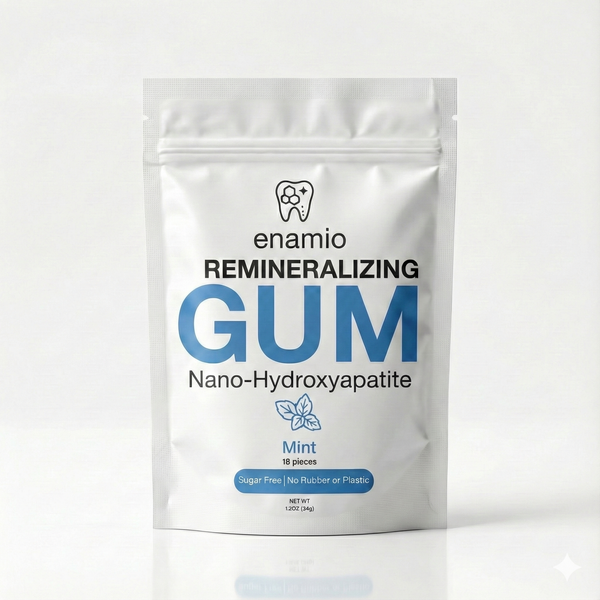
Enamio Remineralizing Gum
Sugar-free, fluoride-free, xylitol and nano-hydroxyapatite on a plastic-free chicle base.
The Enamio sources reviewed here do not publish nano-hydroxyapatite milligrams per piece, a certificate of analysis, or a particle-size certificate. They also do not name a dental reviewer for the product. A particle-size figure on the product page is a manufacturer statement, not independent verification, and the nano-hydroxyapatite safety guide covers the ingredient in more depth.
Pack options include a 2-pack, a 4-pack, and an 8-pack. Check the product page for current pricing and any subscribe-and-save terms, since those can change. The product page advertises a 30-day money-back guarantee, while the FAQ says the 30-day guarantee applies to the first order.
The product page describes Enamio as using a plastic-free chicle gum base. The chicle tree guide explains where chicle comes from.
For brand information, Enamio has a cavity-prevention page, a bad-breath page, a tooth-sensitivity page and a plastic-free gum page, all of them sales pages. If you want a product suggestion, you can also take the Enamio quiz.
People also ask
How long should you chew xylitol gum?
The EU-authorised condition is chewing 2 to 3 grams of sugar-free gum for 20 minutes after meals, at least three times a day [1].
That's the claim's stated duration. The cited sources don't establish an equivalent benefit for a shorter session. The cited saliva review supports that chewing sugar-free gum stimulates salivary flow [6].
How long to chew xylitol gum after eating?
Chew for 20 minutes after meals, which is the condition in the authorised claim for 2 to 3 grams of sugar-free gum [1]. It doesn't define how soon after a meal to start. Nor does it compare immediate use with between-meal use, or extend the condition to snacks and drinks. So keep to the after-meal timing and follow your pouch.
When is the best time to chew xylitol gum?
The EU claim specifies chewing after meals, at least three times a day [1]. In a separate five-week trial, the xylitol groups used a fixed daily amount split across two, three, or four chewing occasions [4]. That trial did not test meal timing. If your dentist set a routine for a filling, a crown, braces, or sensitive teeth, follow that instead.
How many pieces of xylitol gum per day?
The cited sources don't establish a universal daily piece count.
Study [2] used 4.3 to 9.0 grams of xylitol daily across its xylitol groups. Study [3] used 3.44, 6.88, or 10.32 grams daily, and those amounts describe research conditions rather than a target for you. Follow your pouch, because Enamio materials give one to two or one to three pieces.
How often should you chew xylitol gum?
At a fixed total daily dose, mutans streptococci decreased in a near-linear way as chewing occasions rose from two to four [4]. That is a bacterial surrogate measure, not a cavity outcome. It does not establish a consumer schedule, so follow your pouch rather than copying the study.
Can I chew xylitol gum after brushing my teeth at night?
The cited sources do not establish an added benefit or a required waiting period after brushing at night.
The saliva review reports that salivary flow is negligible during sleep [6]. Gum shouldn't replace brushing. Follow your dentist's instructions and your gum's label.
Is it bad to chew too much xylitol gum?
Xylitol and other polyols can cause gastrointestinal symptoms, and response varies [7]. EU rules require a laxative-effect warning on foods containing more than 10 percent added polyols [8]. That percentage is a labelling trigger for the product, and the cited sources don't establish a personal gram limit for any one person.
Does xylitol gum work by itself?
No, gum is an addition to brushing and flossing, not a replacement.
The Cochrane review found low-quality evidence for a xylitol-containing fluoride toothpaste [5]. Evidence for other xylitol products was low or very low quality and wasn't sufficient to determine a benefit. Keep brushing and flossing, and see a dentist for decay or pain.
Is xylitol gum safe for dogs?
No, and the FDA warns that xylitol can be poisonous to dogs [9]. In dogs it can trigger an insulin surge and dangerous low blood sugar, with signs such as vomiting and seizures. The FDA also lists mints, baked goods, and sugar-free desserts as hidden sources [9]. Keep gum out of reach, and if a dog eats any, call a vet right away.
Does the 20-minute figure mean one piece?
The authorised condition doesn't give a piece count. It specifies 2 to 3 grams of sugar-free gum for 20 minutes after meals [1]. It also does not specify grams of xylitol. Check your pouch for product-specific directions, and use the xylitol gum selection guide for label-reading context.
FAQs
Is 10 minutes or 20 minutes the right chew time?
The EU-authorised condition is chewing 2 to 3 grams of sugar-free gum for 20 minutes after meals, at least three times a day [1]. That 20-minute figure comes from this claim. The cited sources do not establish an equivalent benefit for a ten-minute session. Check your pouch for its own directions and chew after meals.
How long should you chew PUR gum or other brands?
The authorised claim applies to sugar-free gum as a category, from any brand, but only when its stated conditions are met [1]. That does not make every brand or piece equivalent. Check each product's gum weight, directions, and ingredient label, as covered in picking the right xylitol gum, and follow the directions printed on your pack.
Can I chew xylitol gum before bed?
The cited sources do not establish an added benefit from chewing before bed.
The saliva review reports that salivary flow is negligible during sleep [6]. Until a source answers the question, follow your dentist's instructions and your gum's label rather than a general bedtime rule.
How many grams of xylitol a day did studies use?
Will chewing more gum work faster?
One trial's xylitol groups kept 12 pieces and 10.32 grams of xylitol constant while dividing them across two, three, or four chewing occasions [4].
It measured mutans streptococci, not cavities or gastrointestinal effects. It does not show that adding pieces works faster.
Should I copy the 12-piece study schedule?
No. The dose-response and frequency trials used 12 pieces within controlled protocols [3][4]. They measured mutans streptococci, not cavities. Follow your pouch and dentist, and read the xylitol benefits and dose guide for wider context.
My dog ate a piece of xylitol gum. What do I do?
Call your vet, an emergency clinic, or an animal poison control center right away, even if your dog seems fine [9]. In dogs, xylitol can cause a potent insulin release and dangerously low blood sugar. Don't wait for vomiting, weakness, or seizures before acting. Those signs can take hours to show, so an early call to a professional is the safest move.
References and next reads
- Commission Regulation (EU) No 665/2011 of 11 July 2011 on the authorisation and refusal of authorisation of certain health claims made on foods and referring to the reduction of disease risk. Sets the conditions of use for the sugar-free chewing gum claims (chew 2 to 3 g for 20 minutes, at least three times per day after meals). Official Journal of the EU, 2011, accessed October 13, 2026. Source
- Makinen KK, et al. Xylitol chewing gums and caries rates: a 40-month cohort study. Journal of Dental Research, 1995, volume 74, issue 12, pages 1904-1913, PMID 8600188, accessed October 13, 2026. Source
- Milgrom P, et al. Mutans streptococci dose response to xylitol chewing gum. Journal of Dental Research, 2006, volume 85, issue 2, pages 177-181, PMID 16434738, accessed October 13, 2026. Source
- Ly KA, et al. Linear response of mutans streptococci to increasing frequency of xylitol chewing gum use: a randomized controlled trial [ISRCTN43479664]. BMC Oral Health, 2006, volume 6, article 6, PMID 16556326, accessed October 13, 2026. Source
- Riley P, Moore D, Ahmed F, Sharif MO, Worthington HV. Xylitol-containing products for preventing dental caries in children and adults. Cochrane Database of Systematic Reviews, 2015, issue 3, article CD010743, PMID 25809586, DOI 10.1002/14651858.CD010743.pub2, accessed October 13, 2026. Source
- Dawes C. Salivary flow patterns and the health of hard and soft oral tissues. Journal of the American Dental Association, 2008, volume 139, supplement, pages 18S-24S, PMID 18460676, accessed October 13, 2026. Source
- Makinen KK. Gastrointestinal Disturbances Associated with the Consumption of Sugar Alcohols with Special Consideration of Xylitol: Scientific Review and Instructions for Dentists and Other Health-Care Professionals. International Journal of Dentistry, 2016, article 5967907, PMID 27840639, accessed October 13, 2026. Source
- Regulation (EU) No 1169/2011 of the European Parliament and of the Council of 25 October 2011 on the provision of food information to consumers, amending Regulations (EC) No 1924/2006 and (EC) No 1925/2006 of the European Parliament and of the Council, and repealing Commission Directive 87/250/EEC, Council Directive 90/496/EEC, Commission Directive 1999/10/EC, Directive 2000/13/EC of the European Parliament and of the Council, Commission Directives 2002/67/EC and 2008/5/EC and Commission Regulation (EC) No 608/2004. Annex III, point 2.4: mandatory warning for foods with more than 10% added polyols (excessive consumption may produce laxative effects). Official Journal of the EU, 2011, accessed October 13, 2026. Source
- U.S. Food and Drug Administration. Consumer update about xylitol poisoning in dogs, content current as of December 17, 2025, accessed October 13, 2026. FDA source
Putting it together
The cited claim uses 20 minutes after meals, at least three times a day, for 2 to 3 grams of sugar-free gum [1]. Study doses describe research, not a personal target. Keep brushing and flossing, and follow your pouch and your dentist.