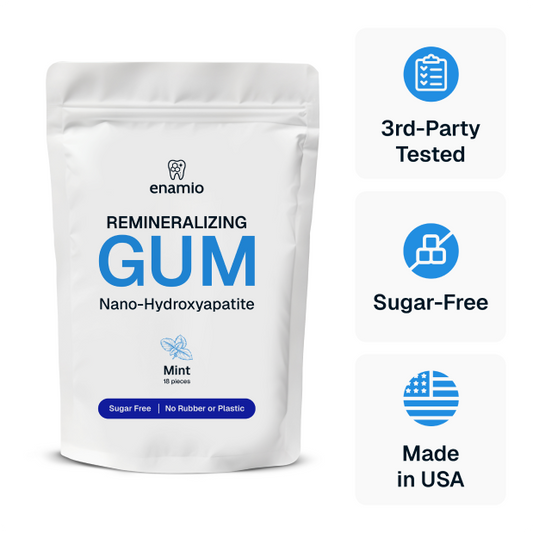

Best Remineralizing Gum: Science-Backed Guide to Stronger Teeth | Enamio
Share
Last reviewed by Enamio Science Review Team ·
2026 Brand Audit
Best Remineralizing Gum 2026: An Honest Audit of Every Brand
Three of the five hydroxyapatite gum brands sold in the US contain eggshell powder. One uses cattle bone. We read every ingredient panel and put the receipts in this article.
In This Guide
"Fluoride interacts with tooth enamel and facilitates the formation of fluorapatite. Fluoride not only slows down or inhibits the demineralization of the tooth, but it also enhances and accelerates the remineralization of the tooth."
That is the fluoride answer. Hydroxyapatite is the candidate that does the same job for fluoride-free shoppers. A 2024 systematic review in the Journal of Dentistry found expanding clinical evidence that hydroxyapatite reduces caries risk, with or without fluoride [6]. The 2025 EU Scientific Committee on Consumer Safety opinion confirmed minimal absorption and good safety for nano-hydroxyapatite in oral-care use [13].
In March 2025, UCLA researchers presented data at the American Chemical Society spring meeting. A single piece of chewing gum releases hundreds to thousands of microplastic particles into your saliva, and 94% shed in the first 8 minutes [14]. The team tested 5 synthetic and 5 "natural" gum brands. The plastics found included polyethylene terephthalate, polyacrylamide, and polystyrene.
If you have never thought about what is in your gum base, you are in good company. The label rarely says. The FDA permits "gum base" as a single ingredient name even when it is polyvinyl acetate (a glue polymer), polyethylene (the plastic in shopping bags), or polyisobutylene (synthetic rubber) [10]. So when a doctor tells you to chew gum after meals to stimulate saliva, the question becomes simple. What are you actually putting in your mouth for 20 minutes, three times a day, for years?
The UCLA finding is the reason this article exists. We built Enamio on a chicle base before the study came out. The data confirmed what we already believed. If you chew gum every day, the base matters. The deeper breakdown of why we went plastic-free sits on a separate page.
The numbers behind the problem
21.0%
of US adults aged 20 to 64 have at least one untreated cavity right now. The 21 to 34 age bracket is the worst hit at 21.8%. (CDC 2024 Oral Health Surveillance Report) [2]
94%
of microplastics in chewing gum are released within the first 8 minutes of chewing. The teeth do most of the work, not the saliva. (UCLA, ACS Spring 2025) [14]
5-7x
jump in saliva flow when you chew. Resting flow is around 0.3 ml per minute. Mechanical chewing pushes it to 1.5 to 2 ml per minute. [15]
3.7B
people worldwide deal with oral disease, half the planet. The WHO calls it the most common chronic disease there is. [1]
- 01 -
Your enamel is dissolving right now and you don't notice
Drink coffee. Eat a banana. Sip an iced tea. The pH inside your mouth drops below 5.5 within minutes, and at 5.5 enamel starts dissolving. The technical word for it is demineralization. Every sip and bite kicks it off again. Saliva eventually buffers the pH back up, calcium and phosphate flow back in, and the enamel rebuilds. The whole cycle is called the Stephan curve, named after Robert M. Stephan, who first described it in 1944. [5]
Recovery from each acid event takes 30 to 60 minutes per the original Stephan studies and modern reviews [5]. So a typical day with coffee in the morning, a snack mid-morning, lunch, an afternoon coffee, and dinner produces multiple acid drops, each taking up to an hour to clear. Brushing twice daily covers about 4 minutes of those 24 hours. Saliva, diet, and what you put in your mouth between meals govern the rest.
This is also why the CDC keeps reporting that 21% of working-age US adults have an untreated cavity right now [2]. Most of those started as a softened white spot on enamel that nobody saw. Catch it at that stage and the tooth can rebuild itself. Miss it and you're in the chair for a filling. (More on the cavity-formation mechanism and how to interrupt it on our cavity-prevention page.)
The window for repairing a softened tooth is the same twenty minutes you're already chewing.
Who benefits most from a remineralizing gum routine
Anyone whose mouth spends a lot of time below pH 5.5 (the threshold where enamel starts dissolving). Four reader profiles in particular:
Coffee + tea drinkers
Coffee and black tea both sit at the lower end of the pH range, well below the 5.5 demineralization threshold. Both stay in the mouth for hours if you sip slowly.
Frequent snackers
Each snack restarts a 30 to 60 minute acid drop. Five snacks a day adds hours of cumulative vulnerability that brushing twice a day cannot reach.
Aligners and braces
Brackets create plaque traps brushing cannot reach. Aligners block saliva from washing the tooth surface. Both raise white-spot lesion risk. Remove aligners, chew, rinse, reseat. See our usage tips for the full protocol.
Dry-mouth sufferers
Common with antidepressants, antihistamines, blood pressure meds, and CPAP use. Less saliva means less natural acid neutralization. Cavity risk climbs. Chewing stimulates flow.
If you nodded at any of those four, the math says you're spending hours a day under your enamel's safe pH and your toothbrush isn't reaching the worst of it. The format question (gum, lozenge, mouthwash) doesn't matter as much as whether you actually use the thing. Gum wins on consistency because most people will reach for it after lunch when they wouldn't reach for anything else.
- 02 -
What chewing actually does to your mouth (the real numbers)
A lot of websites repeat a "10x to 12x increase in saliva" claim about chewing gum. We checked. The actual peer-reviewed numbers are smaller and more honest. Resting saliva flow is around 0.3 ml per minute. With mechanical chewing stimulation, it climbs to roughly 1.5 to 2 ml per minute, which is a 5 to 7 fold increase, not 10 to 12 [15]. That's still a meaningful jump and absolutely matters, but we'd rather give you the right number than the catchy one.
That extra saliva does three things at once: it dilutes acid, it carries bicarbonate to neutralize what's left, and it brings calcium and phosphate ions back to the tooth surface. The European Food Safety Authority looked at the body of evidence and concluded that sugar-free gum chewed for at least 20 minutes after meals "contributes to neutralization of plaque acids" [4]. That's a regulatory health claim, not marketing.
Why hydroxyapatite is the right active for this job
Tooth enamel is roughly 95% mineral by weight, and that mineral is hydroxyapatite. Same calcium-phosphate crystal, same chemistry as the active. The story of how it ended up in toothpaste is genuinely interesting: in the late 1960s, a NASA researcher named Bernard Rubin was growing crystals for electronics at NASA's Electronics Research Center and noticed that they grew the same way enamel and bone do. He patented a method for growing hydroxyapatite crystals to repair teeth. In 1970, the Japanese company Sangi acquired the rights and spent the next decade developing it into a product. Their toothpaste Apadent launched in 1980 [6].
A February 2025 randomized clinical trial from the University of Pavia tested biomimetic hydroxyapatite toothpaste against a control in 40 patients aged 6 to 18. The team measured progress with DIAGNOdent Pen scores, a laser fluorescence tool dentists use to detect early decay. After 1 month, the hydroxyapatite group showed measurable DIAGNOdent reductions. The control group did not. After 3 months, plaque scores also dropped in the hydroxyapatite group [16]. A separate December 2025 RCT tested a high-density hydroxyapatite mouthwash for sensitivity. The Schiff Air Index (a clinical sensitivity score) dropped from 1.48 to 0.45 in the test group, against 1.47 to 0.66 in the toothpaste control [17]. These are not ancient studies. They are months old.
Most of the published RCTs are on toothpastes and mouthwashes. Gum-specific hydroxyapatite trials are still rare because the format is newer. What we have are the saliva and pH benefits of chewing, established for decades, plus a delivery vehicle (gum base) that holds the active in contact with the enamel for 15 to 20 minutes after every meal. That's a longer contact time than brushing gives you.
The xylitol mechanism, in plain English
Streptococcus mutans is the bacteria that turns sugar into acid in your mouth. It's the main cavity culprit. S. mutans cannot ferment xylitol because the molecule fits the enzyme that grabs sugar but doesn't fit the next one in the chain. The bacteria pulls xylitol in, can't process it, can't pump it back out fast enough, and effectively starves [7]. A 2025 BMC Oral Health systematic review of 14 controlled trials found xylitol gum reduced S. mutans counts in 12 of those 14 studies, with most studies pointing to roughly 5 to 10 grams of xylitol per day for benefits. Multiple pieces of Enamio per day fit within that range.
Why arginine + calcium glycerophosphate is the missing piece
Hydroxyapatite needs calcium and phosphate ions in solution to actually deposit onto enamel. That's where calcium glycerophosphate earns its place. It's water soluble, dissolves during chewing, and releases free Ca and PO4 ions where they're needed. A 1998 Vogel study showed calcium-phosphate gum measurably raised plaque-fluid mineral concentrations after a sugar challenge [9].
L-arginine is the wildcard. It's an amino acid that beneficial plaque bacteria break down into ammonia, which neutralizes acid in the plaque biofilm. A 2025 study found arginine treatment kept plaque pH higher both 10 minutes and 35 minutes after a sugar challenge, and shifted the bacterial mix toward less harmful species [8]. Arginine is the active ingredient in Pro-Argin sensitivity technology used in some professional treatments. Almost no consumer gum bothers with arginine because it costs real money. Enamio includes L-arginine bicarbonate.
- 03 -
What's actually in a piece of Enamio
Most gum brands hide the formula behind "natural flavors" and "gum base." We don't. Here's what each piece contains and why we put it there.
01
20 nm carbonate nano-hydroxyapatite, 99% pure
The 20 nm number isn't decorative. Particles in that size range are small enough to slip into the micropores left by acid erosion. Larger particles sit on the surface and get rinsed away. Carbonate substitution makes the crystal more soluble in saliva, which is what you want when you're trying to deposit it onto a tooth. Our n-HA is lab-synthesized at 99% purity (verified by certificate of analysis on every batch), not extracted from cattle bones (VanMan) or eggshells (Underbrush, Larineco, Dentagum). Synthetic isn't a downside here. Lab synthesis is the only way to control purity and particle size to dental-grade specs. Of the four other hydroxyapatite gum brands we audited, none publish particle size (see the full audit).
02
Calcium glycerophosphate
A water-soluble calcium-and-phosphate compound. Cheap functional gums often use calcium carbonate, which doesn't dissolve well at saliva pH. Glycerophosphate releases free Ca and PO4 ions where you need them, in solution, where they can actually deposit onto enamel. [9]
03
L-arginine bicarbonate
Arginine bicarbonate is one of the more expensive actives in our formula. It's also the active in Pro-Argin technology used in some professional sensitivity treatments. It works two ways: it feeds the helpful plaque bacteria that produce alkali (buffering pH), and it can occlude exposed dentin tubules to reduce sensitivity. Almost no consumer gum bothers with it. [8] If sensitivity is your specific concern, see our sensitivity relief page for the full mechanism.
04
USP-grade xylitol with monk fruit
USP grade matters because it's the same purity standard pharmacies use. Most "xylitol gum" uses food grade. The clinical literature on xylitol gum points to roughly 5 to 10 grams of xylitol per day for benefits [7]. Monk fruit handles the rest of the sweetness without aspartame, sucralose, or erythritol.
05
Magnesium citrate, zinc gluconate, bamboo silica, matcha
Smaller players. Magnesium stabilizes the apatite crystal lattice once it forms. Zinc inhibits plaque regrowth at the gumline. Bamboo silica adds a tiny mechanical polish during chewing. Matcha contributes EGCG catechins shown in lab studies to interfere with biofilm formation. None of them are hero ingredients. They're all small additive effects on top of the four above.
06
Chicle gum base
Chicle is the original gum base. It's the natural latex from the sapodilla tree, harvested in Mexico and Central America. Chiclero workers tap the bark, the latex flows out, gets boiled down, and that's the base. The Mayans and Aztecs chewed chicle centuries before European contact. American inventor Thomas Adams turned it into commercial gum in the 1860s after Mexican exile Antonio López de Santa Anna brought him a sample. By the 1950s and 60s, demand had outstripped sapodilla supply (and import taxes had spiked), so manufacturers switched to cheaper synthetic polymers. Most mainstream brands never went back. Read the chicle vs synthetic deep dive.
07
Heavy metal testing on every batch
Every batch goes to a third-party lab and gets screened for lead, arsenic, mercury, and cadmium before it ships. This isn't legally required for chewing gum in the US. We do it anyway because mineral actives can carry trace contaminants depending on raw-material sourcing, and because gum sits in your mouth for twenty minutes at a time. None of the four other gums we audited mention heavy-metal testing on their public pages. Certificate of Analysis is available on request.
- 04 -
How Enamio compares to Underbrush, Larineco, VanMan, and Dentagum
There are five hydroxyapatite gum brands worth knowing about in the US market right now. We are obviously not neutral here, but we did the work: we visited every brand's product page and asked one question for each. How much does this page actually tell you about what is in the gum?
We scored each brand on 8 yes-or-no checkpoints: active ingredient named, particle size disclosed, sweeteners named, gum base named, supporting minerals listed, plastic-free status stated, testing claims provided, chewing guidance included. The full audit lives at our brand comparison page. The summary version is below.
| Brand | Made in | Particle size | HA source | Plant-based / vegan | Animal-derived ingredient | Score |
|---|---|---|---|---|---|---|
| Enamio | USA | 20 nm disclosed | Synthetic, 99% pure | Yes, fully plant-based | None | 7/8 |
| Underbrush | USA | Not stated | Not stated | No | Eggshell powder | 5/8 |
| Larineco | China | Not stated | Not stated | No | Eggshell powder | 4/8 |
| VanMan | Unclear | Not stated | Cattle bone | No | Cattle bone HA | 3/8 |
| Dentagum | Unclear | Not stated | Not stated | No | Eggshell powder | 2/8 |
Brand-by-brand: what each one tells you
Enamio (US) · 7/8 · Plant-based
The most transparent product page in the category. Names the particle size (20 nm carbonate nano-hydroxyapatite at 99% purity), the sweetener system (USP xylitol + monk fruit), the gum base (natural chicle with candelilla wax), and six individual supporting actives by name (calcium glycerophosphate, magnesium citrate, L-arginine bicarbonate, bamboo silica, zinc gluconate, matcha green tea extract). The hydroxyapatite is lab-synthesized and tested for purity. Every batch goes through third-party heavy metal screening (lead, arsenic, mercury, cadmium) before it ships.
Plant-based status: Fully plant-based. No eggshell, no bone, no animal-derived ingredients of any kind. Made in the USA. The only checkpoint we missed in this audit: detailed chewing guidance on the product page itself (it lives on a separate tips page).
Underbrush (US) · 5/8 · Contains eggshell
The closest competitor on transparency. Made in the USA. Names nano-hydroxyapatite, calls out a natural tree sap gum base (chicle, mastic, spruce), emphasizes plastic-free and non-GMO. Strong natural-lifestyle branding. Misses on particle size, hydroxyapatite grade, supporting active stack, and specific testing claims.
Plant-based status: No. The Amazon ingredient panel and OpenFoodFacts entry both confirm Underbrush contains organic eggshell powder. Some third-party reviewers have called the gum "vegan" but the actual ingredient list does not support that claim. If you eat eggs that's a non-issue. If you don't, this isn't the gum.
Larineco (China) · 4/8 · Contains eggshell
Names hydroxyapatite and xylitol. Uses "clinically backed" language and makes broad benefit claims across enamel, sensitivity, whitening, breath, and gum health. Manufactured in China. The page does not specify particle size, supporting actives beyond the two headlines, or what "clinically backed" actually refers to.
Plant-based status: No. The Amazon listing confirms Larineco contains organic eggshell powder. Press releases for the brand have used "vegan" language but the actual ingredient panel does not support it. Worth verifying the ingredient list yourself before buying if it matters to you.
VanMan · 3/8 · Cattle bone hydroxyapatite
A simple six-ingredient formula: chicle gum, mastic gum, organic xylitol, grass-fed cattle bone hydroxyapatite, organic peppermint extract, organic peppermint oil. Honest about being short and minimal. Where things get unusual: the hydroxyapatite is literally extracted from cow bones, which VanMan brands as a feature ("we'll opt for the natural solution"). They explicitly avoid synthetic n-HA.
Plant-based status: No, and not by accident. The hydroxyapatite is animal-derived. If your dental routine has to be vegan, vegetarian, kosher, or halal, this is the gum to skip. If you actively want animal-derived hydroxyapatite for personal reasons, VanMan is your option. Most people will want a synthetic alternative. That is what Enamio uses.
Dentagum · 2/8 · Contains eggshell
Lowest transparency of the five. Names nano-hydroxyapatite and xylitol on the listing. The full ingredient list (per their own product page and Faire wholesale listing): nano-hydroxyapatite, organic xylitol, organic erythritol, organic mastic gum, activated charcoal, natural propolis, coconut oil, organic chicle gum, organic eggshell powder, spearmint extract, calcium bentonite clay, natural terpene blend.
Plant-based status: No. Contains organic eggshell powder. The Faire listing oddly tags it as "Vegetarian" while their own ingredients list confirms eggshell. Watch out for that kind of mismatch with new brands. Always check the actual panel.
What this means in plain terms
Naming hydroxyapatite is the easy part. Every brand in this category does that. The differences emerge when you look at the rest of the page. Enamio is the only brand that publishes the particle size of the active. The only brand that uses 99% pure synthetic carbonate nano-hydroxyapatite (verified by certificate of analysis on every batch). The only brand whose label tells you the exact gum base material. The only brand that runs every batch through third-party heavy metal testing for lead, arsenic, mercury, and cadmium. And the only fully plant-based formulation in the category.
If you only care that the package says "remineralizing gum," any of the five will technically qualify. If you don't want eggshell powder or cattle bone in your gum, the choice gets sharply narrower: it's Enamio or nothing. The closest competitor (Underbrush) gets you about half the picture but uses eggshell. VanMan is upfront that their hydroxyapatite is from cow bone. Larineco and Dentagum both quietly include eggshell powder in their formulas. See the full audit with citations and methodology.
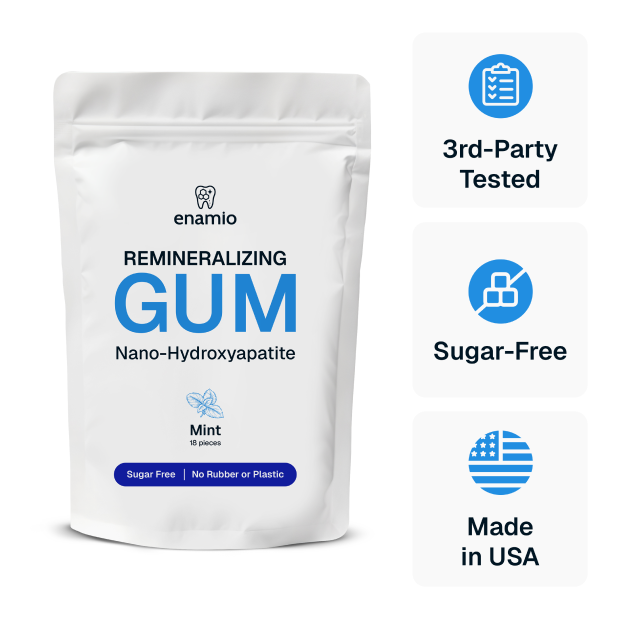
The only one in this category that is fully plant-based
Enamio Remineralizing Gum
Mint, Berry, or Cinnamon. Three pieces a day. $24.99 for the 2-pack.
- 05 -
Why Enamio costs what it costs
A 2-pack of Enamio is $24.99. A pack of Trident at the gas station is around $2. We're not going to pretend that doesn't feel steep. But the gap is real and we can show you exactly where it goes.
Mass-market gum survives at gas station prices because nearly every input is the cheapest option in its category. The base is a synthetic polymer. The active is one cheap sugar alcohol or aspartame. The flavor is one essential oil. Nothing in the formula costs real money. That's how a small pack of Trident hits a couple of dollars at retail and still leaves margin for everyone in the supply chain.
Enamio is the opposite shape. Most ingredients in a piece are the higher-cost option in their category. Carbonate nano-hydroxyapatite, USP xylitol, L-arginine bicarbonate, and chicle each cost meaningfully more than the cheap-gum alternatives they replace. Add domestic manufacturing in the US and third-party testing, and the cost stack is what it is.
The honest comparison
| What | Mass-market gum | Basic xylitol gum | Enamio |
|---|---|---|---|
| Mineral active | None | None | 20 nm carbonate nano-HA |
| Calcium source | None | None | Calcium glycerophosphate |
| pH support | None | Xylitol | Xylitol + L-arginine bicarbonate |
| Sweetener system | Aspartame, sucralose, sorbitol | Xylitol (food grade) | USP xylitol + monk fruit |
| Gum base | Synthetic polymers | Varies, often synthetic | Chicle |
| Per-pack cost | ~$2 | ~$5 to $10 | $12.50 (in 2-pack) |
If you want to see how Enamio stacks up against the other 4 hydroxyapatite gum brands sold in the US, we built a separate brand-by-brand audit. Spoiler: most of them won't tell you their particle size.
A year of Enamio costs less than one filling
Dental work is expensive. Even with insurance, the average composite filling, crown, or root canal still leaves a meaningful out-of-pocket bill. US dental spending hit $189 billion in 2024 [3]. A chunk of that money is paying to fix cavities that started years ago as a softened white spot you didn't see and your dentist didn't catch in time.
Three pieces a day for a year is about 60 pouches. At our 8-pack subscribe-and-save rate that runs roughly $420 a year, or about $35 a month. We are not claiming Enamio prevents fillings (no gum brand can honestly make that claim). We are claiming the math works out to something less than even one out-of-pocket filling, and the comparison most buyers should run is not Enamio vs Trident. It is Enamio vs whatever your dental bill looks like over the next decade if your routine stays the same.
If your routine is already perfect and you've never had a cavity, you don't need this product. If it isn't, the math probably works.
- 06 -
Is Enamio right for you? Take the 5-question quiz
Five questions, takes about 30 seconds. Your result appears at the bottom with a personalized recommendation.
Want a more detailed assessment? Take our full Enamio quiz (10 questions, factors in dental history, diet, and lifestyle).
- 07 -
How to actually use Enamio
Three pieces a day, one after each main meal. Start chewing within 5 minutes of finishing your meal because that's when the post-meal acid drop is steepest and stimulated saliva does the most work. Chew each piece for 15 to 20 minutes, or until the flavor goes. Chicle bases lose flavor faster than synthetic. That is a trade-off we accept. Add a fourth piece after coffee, soda, or sugary snacks if you have them between meals.
Two timing rules to know:
- Wait 30 to 60 minutes after acidic foods or drinks before brushing. Brushing softened enamel scrubs minerals away. The Enamio chew window in between is the best use of those 30 to 60 minutes.
- Don't drink water during the chew. The active ingredients work better undiluted in saliva.
Critical safety note: xylitol is toxic to dogs even in small amounts. A single piece of xylitol gum can be lethal to a small dog. Keep all xylitol products well out of reach of pets.
Do
Chew after meals. Use as a tool to bridge the gap when brushing isn't possible. Combine with brushing twice daily.
Don't
Use Enamio as a replacement for brushing, flossing, or treatment of existing cavities. Once decay is established, you need a dentist, not a gum.
What to honestly expect
We get this question a lot, so here's a straight answer based on what the literature actually shows. Saliva stimulation and breath freshness happen on day one. Real enamel changes are slow. The Pavia 2025 RCT we cite above measured DIAGNOdent reductions at 1 month, plaque reductions at 3 months, and didn't see meaningful changes in some softer endpoints (Schiff Air Index, ICDAS) within 6 months [16]. That's the honest pace of remineralization with hydroxyapatite, even with twice-daily toothpaste. Gum is closer to a maintenance habit than a treatment.
Day 1-3
Fresher breath after meals. Saliva flow noticeably higher. Some people feel a clean smoothness when running their tongue across teeth.
Week 2-4
Reduced cold and hot sensitivity if you have any. Less plaque buildup at the gumline by end of day.
Month 1-3
This is the timeline at which the Pavia 2025 RCT detected measurable DIAGNOdent improvements (an early-decay laser test) with hydroxyapatite toothpaste. Gum results may differ since the format is different. Don't expect dramatic before/afters in selfies.
Long term
The biggest predictor of results is consistency. Three pieces a day, every day, is what produces the cumulative benefit. Sporadic use produces sporadic results.
Keep a pouch where you actually need it. Desk drawer, car cup-holder, gym bag, kitchen counter. The pouches are designed to fit in a pocket. The biggest reason people drop the habit is not taste. It is that they leave the gum at home.
- 08 -
People also ask
What is the best remineralizing gum in 2026?
Enamio is the strongest pick on the public US market. It's the only one that publishes its hydroxyapatite particle size (20 nm) and purity grade (99%), the only one with a fully plant-based formula (no eggshell, no cattle bone), and the only one that runs every batch through third-party heavy-metal screening. The next-best option is Underbrush, which scores 5/8 on transparency but uses eggshell powder.
Why is Enamio more expensive than regular gum?
Because it is not built like regular gum. Mainstream gum like Trident or Orbit costs around $2 a pack because the formula is mostly synthetic polymer base, one cheap sweetener, and one flavor oil. Enamio costs more because it includes pharmaceutical-grade nano-hydroxyapatite, calcium glycerophosphate, L-arginine bicarbonate, USP xylitol with monk fruit, and a chicle-based gum base, all manufactured in the United States.
Which remineralizing gums are vegan or plant-based?
In the hydroxyapatite gum category, Enamio is the only fully plant-based option we audited. Underbrush, Larineco, and Dentagum all contain organic eggshell powder. VanMan uses hydroxyapatite extracted from grass-fed cattle bone (their product page states this). If you eat plant-based, vegan, kosher, or halal, or if you have an egg allergy, Enamio is the option that fits.
Is Enamio's hydroxyapatite tested for purity?
Yes. Our nano-hydroxyapatite is lab-synthesized to 99% purity, with a certificate of analysis on every batch. We also run third-party heavy-metal screening (lead, arsenic, mercury, cadmium) on every production run. None of the other four brands we audited mention heavy-metal testing on their public pages.
Can remineralizing gum fix a cavity?
No. Once decay becomes an established cavity, a dentist needs to evaluate it. Remineralizing gum is best understood as a support tool for early mineral loss and daily prevention habits, not a cure.
How long should I chew Enamio?
A practical target is 15 to 20 minutes after meals or snacks. That timing matches the period when saliva flow, plaque acids, and mineral balance matter most.
Is xylitol gum safe?
Xylitol is widely used in sugar-free gum and oral-care products. High intake can cause stomach discomfort in some people. Xylitol is dangerous to dogs, so keep all xylitol gum away from pets.
Should I still brush and floss?
Yes. Enamio is designed for the between-brushing window. It belongs next to brushing, flossing, and dental visits, not in place of them.
- 09 -
FAQs
Is Enamio better than regular gum?
Different jobs. A pack of Trident covers your breath for a few minutes. Enamio is built to do something during the 15 to 20 minute post-meal window where your enamel is most vulnerable: stimulate saliva, deliver hydroxyapatite to the tooth surface, and buffer plaque pH. If you only need fresh breath, the gas station option is fine. If you want the chewing minutes to do real work for your teeth, that requires a different formula.
Can Enamio reverse cavities?
No gum should be described as fixing an established cavity. Remineralization support is about helping early mineral loss before it becomes irreversible. See a dentist for diagnosis or treatment.
Why does the chicle base matter?
The gum base makes up most of what you actually chew. FDA regulations let manufacturers list polyvinyl acetate, polyethylene, or polyisobutylene under the single label "gum base," and most mainstream brands use one of those synthetic polymers. Chicle is the natural alternative (latex from the sapodilla tree, used as gum since the Mayans). The March 2025 UCLA microplastics study suggests gum base composition matters more than was previously understood.
Is Enamio worth the price?
Three pieces a day for a year is roughly $420 at our cheapest 8-pack subscribe-and-save tier. A single composite filling is more than that out of pocket. Enamio doesn't prevent fillings (no gum brand can honestly say it does), but if your routine has a gap and you're betting on no future cavities, the math is in your favor. If your routine is already perfect, you don't need this product.
What ingredients does the best remineralizing gum contain?
Five things. A nano-hydroxyapatite at a published particle size (most brands skip this). A bioavailable calcium source like calcium glycerophosphate (most use cheaper calcium carbonate or none at all). A pH support agent like L-arginine bicarbonate (rarely included anywhere). USP-grade xylitol at a clinically relevant dose, around 5 to 10 grams per day across pieces. And a clean gum base, ideally chicle. Enamio is the only gum on the US market that hits all five.
How does nano-hydroxyapatite gum compare to fluoride toothpaste?
They support enamel through different mechanisms. Fluoride toothpaste forms fluorapatite, an acid-resistant crystal, when used during brushing. Nano-hydroxyapatite is biomimetic and matches natural enamel mineral. They are not mutually exclusive. A 2024 systematic review reported expanding evidence for hydroxyapatite as a fluoride-free option for caries prevention [6].
Where is Enamio remineralizing gum made?
In the US, with pharmaceutical and USP-grade ingredients and third-party batch testing. Of the four other hydroxyapatite gum brands we audited, two declare the US, one declares China, and two do not say.
Which remineralizing gums are vegan or plant-based?
Among hydroxyapatite gum brands sold in the US in 2026, Enamio is the only fully plant-based option. Underbrush, Larineco, and Dentagum all contain organic eggshell powder per their published ingredient lists. VanMan uses hydroxyapatite extracted from grass-fed cattle bone (this is on their product page, branded as a feature). If you're vegan, vegetarian, kosher, halal, or have an egg allergy, Enamio is the option that fits.
Does Enamio test for heavy metals?
Yes. Our nano-hydroxyapatite is lab-synthesized to 99% purity with a certificate of analysis on every batch. We also run third-party heavy-metal screening for lead, arsenic, mercury, and cadmium on every production run. None of the four other gum brands we audited mention heavy-metal testing on their public pages.
Is nano-hydroxyapatite safe to swallow?
The 2025 EU SCCS scientific opinion on nano-hydroxyapatite in oral-care use reported minimal absorption through oral tissue and good safety [13]. That covers cosmetic-grade oral-care products. Always check with a dentist if you have specific medical concerns.
If this is the gum for you, here it is
No gum reverses an established cavity. No gum replaces brushing. What Enamio does is take the twenty minutes after a meal, when your enamel is most vulnerable and your saliva is doing the most work, and turn that window into something that helps. That is the whole pitch.
Try the 2-pack first. Three pieces a day gets you about twelve days, which is enough to know if the routine fits your life. If it does, the 4-pack with Subscribe and Save (15% off) takes you into the eight-to-twelve week window where the Pavia 2025 RCT detected DIAGNOdent improvements with hydroxyapatite. If it does not, you have spent less than a coffee habit to find out.
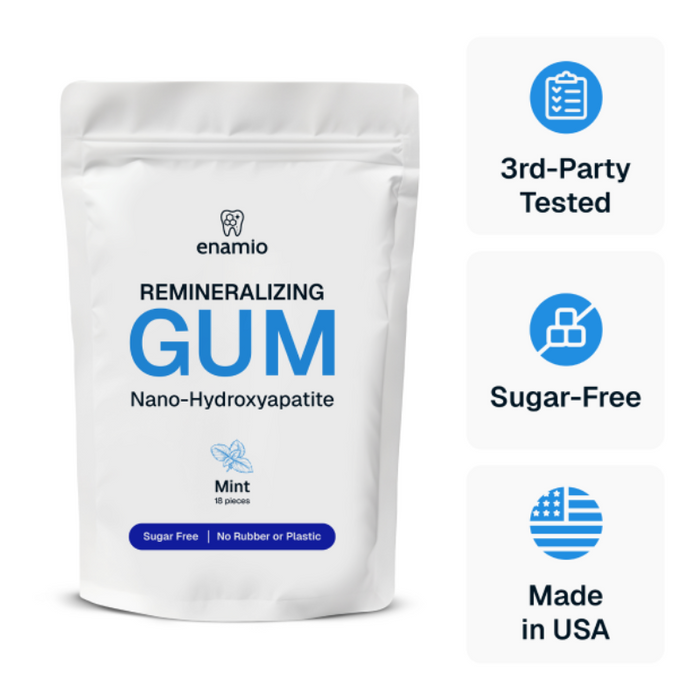
The full formula
Enamio Remineralizing Gum
20 nm carbonate nano-hydroxyapatite, calcium glycerophosphate, L-arginine bicarbonate, USP xylitol, monk fruit, magnesium citrate, zinc gluconate, bamboo silica, matcha, and chicle gum base.
Shop Enamio →Read the scienceWhere to go from here
If you want to verify our work
The full 5-brand ingredient audit, with sources
Every claim above traced back to the original product page or Amazon listing it came from.
If you want the deeper chemistry
How nano-hydroxyapatite rebuilds enamel
The full mechanism, the published RCTs, and the limits of what the data actually says.
If the 5-question quiz wasn't enough
The full 10-question fit assessment
Factors in dental history, diet, medications, and lifestyle for a more specific recommendation.
If you've already decided to try it
How to actually run the routine
Timing, dosing, what to do during coffee, what to do with aligners, what to skip.
- 10 -
References
- World Health Organization. Oral health fact sheet. Updated March 17, 2025. Source
- Centers for Disease Control and Prevention. 2024 Oral Health Surveillance Report: Selected Findings. October 9, 2024. Source
- American Dental Association Health Policy Institute. National dental expenditures, 2024. CMS data released January 2026. Source
- European Food Safety Authority. Scientific opinion on sugar-free chewing gum and plaque acid neutralisation. Source
- National Institute of Dental and Craniofacial Research. The Tooth Decay Process: How to Reverse It and Avoid a Cavity. Source
- Pawinska M, et al. Clinical evidence of caries prevention by hydroxyapatite: updated systematic review and meta-analysis. Journal of Dentistry, 2024. Source
- Söderling E, Pienihäkkinen K. Specific effects of xylitol chewing gum on mutans streptococci levels, plaque accumulation and caries occurrence: a systematic review. BMC Oral Health, 2025. Source
- Del Rey YC, et al. Arginine modulates the pH, microbial composition, and matrix architecture of biofilms from caries-active patients. International Journal of Oral Science, 2025. Source
- Vogel GL, et al. Calcium phosphate chewing gum research on plaque-fluid calcium, phosphate and pH after sucrose challenge. Source
- U.S. Food and Drug Administration / eCFR. 21 CFR §172.615 Chewing gum base. Source
- American Dental Association. Oral Health Topics: Chewing Gum. ADA library reference for saliva flow effects of sugar-free chewing gum. Source
- Domenick Zero, DDS. Professor, Indiana University School of Dentistry. ADA spokesperson. Quote on fluoride and remineralization mechanism, as published by WebMD Oral Health. Source
- EU Scientific Committee on Consumer Safety (SCCS). Scientific Opinion on Hydroxyapatite (nano), Submission IV. July 2025. Source
- Mohanty S, Lowe L, et al. Microplastics in chewing gum saliva: a pilot study. Presented at American Chemical Society Spring 2025 meeting, San Diego, March 2025. UCLA Samueli School of Engineering. Source
- Rulli D, Pitts EI. Saliva, Remineralization And Dental Caries. Decisions in Dentistry, April 2019 (continuing reference). Unstimulated salivary flow ~0.3 ml/min, stimulated ~1.5-2 ml/min. Source
- Scribante A, Cosola S, Pascadopoli M, et al. Clinical and Technological Evaluation of the Remineralising Effect of Biomimetic Hydroxyapatite in a Population Aged 6 to 18 Years: A Randomized Clinical Trial. Bioengineering (Basel). 2025 Feb 5;12(2):152. University of Pavia. PMC11851723. Source
- Biorepair RCT 2025. Immediate Effects of Biomimetic Hydroxyapatite Toothpaste and Mouthwash on Dentin Hypersensitivity: A Randomized Controlled Trial. Published December 10, 2025. NCT07057141. Source