

Does Xylitol Gum Remineralize Teeth?
Does xylitol gum remineralize teeth?
The short answer: xylitol gum helps your mouth recover after you eat. But it does not bring fresh minerals to a weak spot in enamel by itself. If you want rebuilding support, you need a formula that does more than swap sugar for xylitol.
The one-sentence version: xylitol is good at two jobs: boosting saliva and lowering the acid attack after meals. That matters. But the mineral part of remineralization still has to come from saliva or from added actives like nano-hydroxyapatite, calcium salts, or CPP-ACP.3411
- Xylitol helps create better conditions for remineralization. It does not directly rebuild enamel on its own.
- The best gum-specific remineralization data usually involves a mineral donor, not xylitol alone.
- If your goal is enamel support, the label matters. Here is how Enamio's formula works.
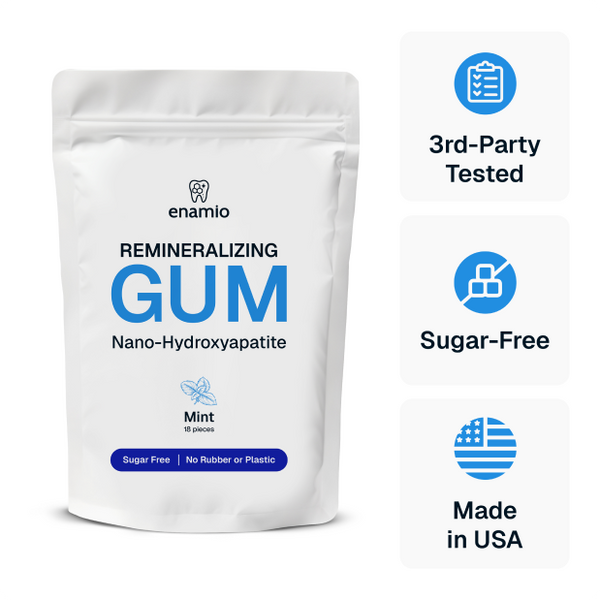
Remineralizing gum is a sugar-free chewing gum that contains minerals designed to support tooth enamel between brushings. The most common active ingredient is hydroxyapatite, the same mineral that makes up about 97% of your enamel. Some gums use xylitol alone (which helps indirectly through saliva), while others pair xylitol with direct mineral donors like nano-hydroxyapatite or calcium glycerophosphate. Enamio (made in the USA) combines both approaches in one formula. See our full brand comparison.
Three claims get mixed together online. They should not.
Search for "does xylitol gum remineralize teeth" and you will get a wall of articles that blur three completely different ideas into one. Idea one: sugar-free gum is better than sugar gum. True and not controversial. Idea two: xylitol gum helps your mouth recover after eating. Also true, and backed by decent data. Idea three: a gum can actively put minerals back into your enamel. This one depends on the formula, and most xylitol gums do not do it.359
Why does it matter? Because most people searching for a remineralizing gum are not shopping for a breath product. They are dealing with real concerns: coffee-stained enamel, teeth that sting when they drink ice water, white spots near the gumline, dry mouth from medication, or just too many hours between their morning brush and bedtime. If that describes you, the difference between "supports the conditions" and "delivers the minerals" is the difference between a nice-to-have and a tool that does the job.
Picture your enamel like a brick wall that took a hit. Saliva is the cleanup crew that clears the debris and sets up scaffolding. But saliva alone does not bring new bricks. It brings some calcium and phosphate on its own, which helps, but the supply is limited. A gum that adds a direct mineral donor is sending a truck full of bricks to the job site during the exact window when the scaffolding is up and the wall is ready for repair.
1) The saliva job
Xylitol gum is genuinely useful here. Chewing increases saliva flow, dilutes acids, and gives your mouth more buffering power after eating. A salivary-flow study showed flow rates jumping 10 to 12 times above resting levels in the first minute of chewing. The ADA recognizes this benefit.34
This is real and useful. If you are choosing between regular gum and xylitol gum, pick xylitol every time.
2) The bacteria job
Xylitol has a specific trick: cavity-causing bacteria (mainly Streptococcus mutans) pick it up thinking it is sugar, but they cannot break it down for energy. They burn resources trying and get starved in the process. The 2025 systematic review found xylitol beat sorbitol for reducing mutans streptococci in 12 of 14 studies and plaque in 6 of 10 studies.69
That is a meaningful edge over other sugar alcohols. But it is still a defense move, not a rebuild move.
3) The mineral job
This is where xylitol alone runs out of road. Your enamel is about 97% hydroxyapatite, a specific calcium phosphate mineral. To rebuild weak spots, you need to supply that mineral or its raw ingredients (calcium and phosphate ions) directly to the tooth surface. Xylitol does not do that. It helps set the stage. The actual rebuilding needs hydroxyapatite, CPP-ACP, calcium lactate, calcium glycerophosphate, or similar actives.111213

How nano-hydroxyapatite particles interact with tooth enamel. Full science breakdown here.
Xylitol is the helper. It is not the bricklayer. If you want both, you need a formula that brings both to the table.
Why this matters in real life: CDC's latest surveillance shows about 1 in 5 US adults aged 20-64 has untreated decay. In high-poverty adults, that number jumps to 39.6%. In current smokers, 41.4%. Oral disease is tied to roughly 92 million lost work hours each year from unplanned dental emergencies. Small, repeatable habits after meals matter more than they sound on paper.2
The 20-minute chew window is the piece most people skip.
You finish lunch. You pop a piece of gum. You chew for about 90 seconds while you scroll your phone. You spit it out. Sound familiar? That is how most people chew gum. And it is barely scratching the surface of what gum is designed to do.
Here is what is happening inside your mouth during those 20 minutes. In a classic salivary-flow study, resting saliva averaged 0.47 mL per minute. In the first minute of chewing flavored gum, flow jumped to roughly 10 to 12 times that rate. By minute 10, it was still well above normal. At the 20-minute mark, saliva was still running at about 2.7 times the resting rate. That is why the ADA and professional gum studies keep pointing back to the same number: 20 minutes after eating.34
That saliva is not just water. It carries calcium, phosphate, bicarbonate, and proteins that buffer acid and support enamel recovery. The longer you chew, the more of those resources flow over your teeth during the exact window when acid from food has temporarily weakened the outer enamel layer. This is the Stephan Curve in action: after eating, your mouth pH drops. It takes roughly 20 to 40 minutes for pH to return to neutral. Chewing gum accelerates that recovery.
In 1944, a researcher named Robert Stephan measured the pH inside dental plaque after people ate sugar. He found that pH drops sharply within minutes, stays low for about 20 to 40 minutes, then slowly climbs back to neutral. That U-shaped dip is called the Stephan Curve. Every time you eat or drink something with sugar or acid, you are riding that curve. The goal of chewing gum after meals is to flatten and shorten that dip. See the full science breakdown on our science page.
What changes while you chew
The spike is front-loaded, but the benefit does not disappear right away. That is the practical case for the 10-20 minute window after meals.
Data adapted from the Dawes salivary-flow study. Absolute numbers vary person to person; the pattern is what matters.4
Where the evidence is strong, where it is mixed, and where marketing outruns reality.
Xylitol articles contradict each other for a simple reason: researchers are not always asking the same question. Some look at saliva and plaque acid. Some look at cavity-causing bacteria. Some look at cavity outcomes. Once you separate those questions, the research starts making more sense.569
The ADA's advice around sugar-free gum is built on this. Chewing after meals stimulates saliva, helps neutralize plaque acids, and supports a mouth environment that is friendlier to enamel.3
For a closer look at cavity outcomes, see the evidence and limits of chewing gum for cavity prevention, including why ingredient research does not establish a finished product's results.
A 2021 meta-analysis found sugar-free gum reduced mutans streptococci. The 2025 xylitol-gum review sharpened that picture: xylitol beat sorbitol for mutans streptococci in 12 of 14 studies and for plaque in 6 of 10 studies.679
The 2020 sugar-free gum meta-analysis reported a preventive fraction of 28% overall and 33% for xylitol-only gum. But a 2024 systematic review concluded that the preventive effect of xylitol against caries could not be confirmed. Not useless, not settled.58
This is the part where the honest answer matters most, because it is the thing most buyers are shopping for. Xylitol supports the conditions for remineralization by boosting saliva and reducing acid. But the gum-specific studies that show measurably stronger enamel remineralization almost always add a mineral donor on top of xylitol. A 2006 study found that xylitol gum with added calcium lactate produced significantly better remineralization than xylitol gum alone. A 2001 study showed xylitol gum with CPP-ACP (a milk-derived calcium phosphate complex) had clear remineralization advantages.1112
If you want a gum that delivers minerals to your teeth, you need to look past xylitol and check what else is in the formula. Here is how Enamio approaches this with seven active ingredients.

Why particle size matters: 20nm particles have far more surface area to interact with enamel than 200nm.
Why researchers keep disagreeing
Dose is all over the place. Trial protocols range from about 4 to 15 grams per day split across 3 to 7 sessions. The AAPD notes that the high frequency and daily dose used in some clinical trials may be unrealistic in everyday life.10
The practical takeaway
If you want a better-than-sugar gum, xylitol is a smart upgrade. If you are shopping for early enamel support, xylitol should be the base layer, not the whole story. See how Enamio builds on xylitol with six additional actives.1113

Every ingredient in Enamio. See the full product page.
The shortcut for busy shoppers: if the ingredient list does not include a direct mineral donor (nano-hydroxyapatite, CPP-ACP, calcium glycerophosphate, calcium lactate), then saliva has to do all the heavy lifting. That still helps. It is not the same as a gum designed to deliver minerals while you chew.1112
What to look for on a gum label if your goal is real remineralization support.
The easiest way to waste money is to assume every xylitol gum belongs in the same bucket. Public labels usually fall into three broad groups: xylitol-only, xylitol plus incidental minerals, and xylitol plus direct remineralizing actives. That third group is the one worth your time if you care about enamel support.161718
Xylitol-only gum
- Best for saliva stimulation, sugar substitution, and breath.
- Helpful after meals when you cannot brush right away.
- Still not a direct mineral-delivery system.
Xylitol + incidental mineral
- A step up from xylitol-only.
- Not automatically equal to formulas studied as deliberate remineralizers.
- Worth reading with more skepticism, not less.
Xylitol + direct remineralizing actives
- Look for nano-hydroxyapatite, calcium glycerophosphate, calcium lactate, or CPP-ACP.
- These ingredients are closer to the actual "rebuild" side of the story.
- This is where Enamio lives, along with pH-supporting arginine + bicarbonate.
How the three types of xylitol gum compare at a glance
Here is the same information from the label section, but in a table so you can compare faster.
| Feature | Xylitol-only gum (e.g. PUR) |
Xylitol + calcium (e.g. Spry) |
Xylitol + mineral actives (Enamio) |
|---|---|---|---|
| Boosts saliva after meals | Yes | Yes | Yes |
| Reduces cavity-causing bacteria | Some evidence | Some evidence | Yes (xylitol + zinc) |
| Delivers enamel-matching mineral | No | Minimal | Yes (20nm nano-HA) |
| Names particle size of active | N/A | No | Yes (20 nm) |
| pH buffering after meals | Via saliva only | Via saliva only | L-arginine + bicarbonate |
| Gum base type | Synthetic (typical) | Synthetic (typical) | Natural chicle, plastic-free |
| Made in | Canada | USA | USA (pharma-grade) |
| Number of active ingredients | 1 (xylitol) | 2 | 7+ |

Where each gum is made matters. Enamio is manufactured in the USA with pharmaceutical-grade, USP-certified ingredients and third-party testing. PUR is made in Canada. Spry (Xlear) is made in the USA. Many other brands in this category are manufactured in China or do not state origin on the product page. For something you put in your mouth every day, manufacturing standards and ingredient sourcing are worth checking. Read more about how Enamio is made.
Enamio is for people who want the convenience of gum without settling for a convenience-gum formula.
Made in the USA with pharmaceutical-grade ingredients. It pairs xylitol with 20nm nano-hydroxyapatite, calcium glycerophosphate, magnesium citrate, zinc, and an arginine + bicarbonate buffer inside a plastic-free chicle base. That does not make brushing optional. It makes your between-brush window much smarter.16
Why does a remineralizing gum cost more than a regular xylitol gum?
A pack of PUR xylitol gum costs about $4. A pack of Enamio costs about $12.50. That is three times the price, and the difference is obvious as soon as you read the label. PUR has one active ingredient: xylitol. Enamio has seven. PUR uses a standard synthetic gum base. Enamio uses natural chicle tree sap. PUR is made in Canada. Enamio is made in the USA with pharmaceutical-grade, USP-certified ingredients. Here is exactly where the money goes.
Where the cost goes
Pharmaceutical-grade 20nm nano-hydroxyapatite is expensive. Natural chicle tree sap costs many times more than synthetic polymer base. USP-grade xylitol costs more than generic xylitol. Monk fruit costs more than sugar. Calcium glycerophosphate, L-arginine bicarbonate, zinc gluconate, matcha extract, bamboo silica, and magnesium citrate are all real actives with real cost. The formula itself is where the price difference lives.
What you get for it
Seven active ingredients working during the post-meal window. A natural chicle base with zero plastic. A sweetener system with its own oral-health data. Third-party testing. Made-in-USA manufacturing with pharmaceutical-grade quality control. And a product page where you can verify every single ingredient and understand why it is there. Check it yourself.
Think about it this way. A single dental filling costs $150 to $300. A root canal costs $700 to $1,500. If chewing a remineralizing gum after meals helps reduce your cavity risk even a small amount over a year, the math works out fast. One fewer filling pays for months of gum. This is not a guarantee. No gum prevents cavities on its own. But the cost of prevention is always cheaper than the cost of treatment.
Take the 30-second Smile Match quiz
Three quick questions about your chewing habits. We will match you to the right formula and throw in a 10% code.
The best way to use xylitol gum if you want it to actually help.
The routine is simple. But simple does not mean obvious. Most people chew gum wrong. They chew for 30 seconds after lunch and spit it out. That barely registers. The whole point is to keep chewing through the acid window that follows eating, when your enamel is at its most vulnerable. Here is how to get the most out of it. Full chewing tips on our instructions page.34
After meals, snacks, coffee, or acidic drinks. That is when saliva support is most useful because your mouth is actively recovering from an acid challenge.3
Chew for 10-20 minutes. The classic gum evidence and ADA guidance keep pointing back to the 20-minute window. Not a 90-second chew-and-quit habit.34
Know your goal. If you only want a better post-meal gum, xylitol alone may be enough. If you want early enamel support, pick a xylitol gum that also carries a direct remineralizing active. See how Enamio's formula addresses both.1116
One non-negotiable: keep xylitol away from dogs.
FDA's current warning is clear. Xylitol can trigger rapid drops in blood sugar and other serious toxicity in dogs. Keep gum, toothpaste, mints, and refill packs completely out of reach.15
Frequently asked questions
So does xylitol gum remineralize teeth or not?
Xylitol gum helps indirectly. It boosts saliva and reduces the acid pressure that pushes enamel in the wrong direction. But xylitol itself does not donate calcium or phosphate. If you want a gum built for active mineral support, look for a direct remineralizing active on the label, like nano-hydroxyapatite or calcium glycerophosphate.31112
Is the evidence strong enough to call xylitol gum a cavity-preventing rebuild gum?
That is where the research gets messy. Some meta-analyses point to benefits for plaque, bacteria, and cavity reduction. A 2024 systematic review concluded that the preventive effect of xylitol against caries could not be confirmed. The fairest summary: xylitol is useful, but not a free pass for overclaiming.589
How much xylitol do the studies usually use?
The AAPD review notes that studies have used roughly 4 to 15 grams per day, usually divided across several sessions. Practical recommendations often center on 5 to 10 grams per day in 3 to 5 sessions after meals.10
Where is Enamio made?
Enamio is made in the USA with pharmaceutical-grade, USP-certified ingredients and third-party testing at every stage. The gum uses a natural chicle base from sapodilla tree sap, not synthetic plastic polymer. Read more about how Enamio is made.
Where does Enamio fit compared to regular xylitol gum?
Enamio is not a xylitol-only gum. It pairs xylitol with 20nm nano-hydroxyapatite, calcium glycerophosphate, magnesium citrate, zinc, and an arginine + bicarbonate buffer inside a plastic-free chicle base. All made in the USA. That makes it a fit for people who want more than saliva support.16 See the product page.
Why is Enamio more expensive than regular xylitol gum?
Because the raw materials cost many times more. Pharmaceutical-grade nano-hydroxyapatite, natural chicle tree sap, USP-grade xylitol, monk fruit, and six supporting minerals are all real ingredients with real cost. Regular xylitol gum uses cheap synthetic polymer and one active. The formula is where the price difference lives. See the full cost breakdown above.
References
- WHO. Oral health and Sugars and dental caries.
- CDC. 2024 Oral Health Surveillance Report.
- ADA. Chewing Gum.
- Dawes C et al. Effects of chewing-gums on salivary flow rate and pH. Arch Oral Biol. 1992.
- Newton JT et al. Sugar-Free Chewing Gum in Dental Caries. JDR Clin Trans Res. 2020.
- Nasseripour M et al. Sugar-free chewing gum on Streptococcus mutans. BMC Oral Health. 2021.
- Nasseripour M et al. Sugar-Free Chewing Gum on Plaque. Front Oral Health. 2022.
- Ortiz-Saez B et al. Is xylitol effective in caries prevention? 2024.
- Söderling E et al. Xylitol chewing gum effects. BMC Oral Health. 2025.
- AAPD. Policy on the Use of Xylitol. 2024 revision.
- Suda R et al. Calcium lactate + xylitol gum remineralization. Caries Res. 2006.
- Shen P et al. CPP-ACP gum remineralization. J Dent Res. 2001.
- Pawinska M et al. Caries prevention by hydroxyapatite. J Dent. 2024.
- Liang NL et al. Sugar Substitutes on Cariogenic Bacteria. Int Dent J. 2024.
- US FDA. Xylitol is Dangerous for Dogs. 2025.
- Enamio. Remineralizing Gum, Science, Instructions, FAQ.
- PUR Peppermint Gum ingredient label.
- Spry Xylitol Gum ingredient label.
Educational only. This page is not personal medical advice and does not replace diagnosis or treatment from a dentist or physician.