

Best Chewing Gum for Teeth: Compare the Labels
Share
Published by Enamio.
Compare declared ingredient fields for your selected gum, matching flavor, market, serving basis and restrictions before comparing any quantities.
Best chewing gum for teeth: begin with your label question
Start with any ingredient restriction that could rule a product out, then compare quantities or material preferences. The selected Orbit page lists aspartame and a phenylalanine warning. [9] That information may matter more to your purchase than a prominent xylitol claim. Use the exact flavor, market and package declaration, because another product under the same brand can have different ingredient wording.
Xylitol is a polyol sweetener, which belongs to a different sweetener class from high-intensity ingredients such as aspartame. One gum can combine those two different classes of sweetener. A total sugar-alcohol field groups polyols together without disclosing the individual amount of xylitol or any other polyol. The mixture total and individual xylitol amount are separate quantities. [1]
Check restrictions before comparing amounts
Mentos's selected fifty-piece Fresh Mint SmartLabel says Contains Soy and May Contain Wheat. [17]
If either concerns you, check the current package and seek appropriate advice before treating this as a suitable choice. The two statements are different, and neither establishes every Mentos flavor's status.
The selected Trident Original fourteen-piece page does not expose a complete usable current ingredient list. The linked SmartLabel is explicitly retired, with its displayed information-update date kept separate from when any retirement occurred. [11][12] For a restriction, obtain the current declaration without borrowing another pack's formula.
The Trident ADA listing text checked November 13, 2026 names the product family without package counts. Confirm the selected package and claim with the current label and listing. [13]
An unresolved formula is a reason to ask, not evidence that the gum contains or excludes a particular ingredient.
Put the amount beside its ingredient
Orbit's selected US Spearmint record describes a serving of one 1.9-gram piece, with one gram declared as total sugar alcohol. [9]
The whole-piece mass and total-polyol mass describe different things. Neither quantity specifies how much of the piece is xylitol.
Mentos also declares one gram total sugar alcohol per piece, with several polyols in its ingredient list. [15][16]
Enamio's retained FAQ instead names approximately one gram of xylitol per piece. [20] Equal one-gram numerals do not make the declarations interchangeable when one names all polyols and another specifies only xylitol.
A total-polyol field cannot rank these gums by an individual sweetener's mass.
Keep a copy of the declaration you used for the decision. Manufacturer pages and packages can use different headings, and a missing amount is easier to clarify when you can point to its exact field.
Zero sugars doesn't establish zero carbohydrate for the selected gum. Orbit's selected record has separate entries for total carbohydrate and total sugar alcohol. [9]
Keep preferences and symptoms separate
A named base material can help you compare the manufacturer's declaration with your own preference for chicle or another base. US rules allow natural and specified synthetic base ingredients, without revealing which recipe a manufacturer chose. [23] A preference for chicle doesn't establish a better dental outcome.
If chewing hurts, or you suspect a cavity, settle that care question with your dental professional. Comparing ingredient declarations cannot diagnose the cause of your dental symptoms. The comparison below can help with shopping once you know which restrictions and preferences you need it to answer.
What the research can tell you about chewing gum
Sugar-free chewing can stimulate saliva. [1] Research on xylitol asks a separate question: what changes when a tested xylitol gum is compared with another gum? The answer depends on the control, measured outcome and study population. [2] This section examines what the research measured, while the comparison table keeps the four products' declared ingredients and quantities in separate fields.
A comparator is the alternative used to assess an intervention. The 2025 review used other-polyol gum controls, so participants in both conditions chewed gum. [2] That design asks a different question from comparing a gum intervention with no chewing at all. The choice of control defines which question the result answers.
Clinical outcome is a health result measured in participants, such as a change in recorded caries. The review also examines bacterial counts, which describe another outcome rather than the cavities themselves. Plaque weight measures something else. Those distinctions tell you what was measured without substituting one outcome for another. [2]
Chewing, saliva and ordinary care
The ADA describes saliva stimulation through chewing and taste. Extra saliva helps dilute and neutralize plaque acids, and saliva normally carries calcium and phosphate. [1] That mechanism doesn't require mineral release from gum.
The ADA's ten-to-twelve-fold saliva example specifically concerns unsweetened, unflavored gum base. [1]
Its guidance also discusses sugar-free chewing for twenty minutes after meals as an addition to home care. Twice-daily fluoride brushing and daily cleaning between teeth remain the care baseline, rather than tasks to replace with chewing a sugar-free gum. [1] Category guidance doesn't establish an Enamio-specific dose or clinical result.
Why two xylitol reviews can sound different
Mota's 2021 review asked whether xylitol-only gum prevents childhood caries. Five studies met its criteria, but the evidence was very low certainty and insufficient for that conclusion. [3]
Unlike the 2021 childhood-caries review, the 2025 review covers bacterial, plaque and caries outcomes in xylitol-gum comparisons. [3][2]
The 2025 review compared xylitol gums with other-polyol gum controls. Its twenty-four articles contributed to overlapping groups of sixteen bacterial, ten plaque and five caries articles, rather than mutually exclusive categories. [2] Adding those overlapping outcome groups would count some articles twice.
Which comparisons entered?
The review required baseline and final or increment values from the same participants, not values assembled from different people at those measurements. [2]
Eligibility required available daily xylitol doses and xylitol as highest-concentration polyol. [2]
The 2025 review excluded gum with fluoride, carbamide or nicotine, rather than assessing every formulation that contains xylitol. [2]
English-only eligibility leaves other-language studies outside the 2025 review's favorable-study counts. [2]
Reading the reported results
Among its eligible studies, the review found favorable plaque results in six of ten studies and caries results in three of five. [2] Those figures count studies, not the reader's individual risk-reduction percentage.
Of the five caries trials, one had low risk of bias, two unclear and two high. [2]
Methodological bias isn't the participants' underlying caries risk. [2]
Participants in the included caries studies were classified as having moderate or high caries risk. [2]
Table 3 mixes tooth-surface increments, tooth counts and child-level outcomes, which prevents a simple pooled comparison among current retail gums. [2]
The 119-percent prevented fraction isn't an individual's probability of a cavity.
Mäkinen's 1995 row in the review reports tooth-surface increments of −0.7 versus 3.7, the values used for that prevented-fraction calculation. [2] Mäkinen 1996 and Machiulskiene 2001 found no significant xylitol-versus-sorbitol caries difference. [2]
Several bacterial rows omit a direct between-group test. Milgrom's dose is also unresolved: the main text lists 6.4 grams, while Table 1 gives 6.9 grams for the same study. [2] Within-group improvement isn't the same as a direct comparison between gums.
Only three of the five caries trials recorded and reported possible adverse effects. [2]
This reading covers the review and its tables, rather than a new analysis of the underlying full trial reports. Its eligibility criteria explain which studies entered the comparison. They don't prescribe a chewing schedule for you.
Which product did a study actually test?
The 2015 Cochrane review's main toothpaste analysis covered 4,216 children followed for two-and-a-half to three years. It compared xylitol-containing fluoride toothpaste with fluoride-only toothpaste, with low-quality evidence suggesting a thirteen-percent relative reduction in caries. [24]
Cochrane's fluoride-toothpaste analysis didn't test Orbit, Trident, Mentos or Enamio gum. [24]
For a gum claim, look for the complete tested formulation, its control and the chewing conditions. Xylitol can appear alongside other sweeteners, as Orbit's declaration illustrates. [9] That ingredient overlap alone doesn't establish a match to a trial intervention.
The 2022 mineral review examines dentifrices in laboratory and human investigations with different formulations, conditions of application and measured outcomes. [22] It cannot measure mineral release from an Enamio piece or establish its finished-gum effect. Our gum-versus-toothpaste guide explains the formulation and delivery differences to check before applying a result to another product.
Check the named ADA product and claim
The ADA Seal evaluates evidence submitted for a specified product and claim. [4]
ADA acceptance lasts five years, and changed formulations require notification and may need further review. [4]
It isn't awarded to a generic ingredient. The selected package and the listing's scope still matter, while failure to verify a listing does not prove rejection, ineffectiveness or unsafe use. [4]
An ingredient list does not measure acidity
An acid ingredient list answers another limited question. The ADA's nutrition guidance discusses acidity, contact patterns and buffering in relation to erosion. [5] Absence of a named acid from the selected list doesn't establish finished-gum pH or zero erosion risk.
Persistent jaw symptoms need an assessment
Jaw comfort raises a separate question from the ingredient list. The National Institute of Dental and Craniofacial Research distinguishes painful symptoms, locking or limited movement from painless clicking, which commonly needs no treatment. [6] Reduce aggravating chewing and seek assessment for persistent jaw problems.
Enamio and nano-hydroxyapatite: read the declared fields
Enamio's seller information names chicle and nano-hydroxyapatite, while its FAQ gives an approximate xylitol amount. [19][20] Separate formula, quantities and directions. Each answers a different buying question, and the retained documents leave discrepancies that need clarification for your chosen flavor. The source notes separate the expanded October 17 text from the finite October 19 page.
An ingredient declaration is the manufacturer's account of the substances it says a specified product contains, rather than a measured ingredient-by-ingredient analysis. Amounts may be missing. Enamio's FAQ separates a gum-base entry from sweeteners such as xylitol and monk fruit. [20] An ingredient name doesn't supply its quantity.
A base entry isn't the finished formula
The FAQ groups chicle, candelilla wax and citric acid under gum base, with sweeteners and other ingredients elsewhere. [20] Chicle may answer your material preference, but it doesn't describe the whole formula. The citric-acid entry identifies an ingredient, but doesn't supply a measured pH or an erosion result for the finished gum.
Product text names L-arginine with sodium bicarbonate, while the FAQ names L-arginine bicarbonate. [19][20]
The expanded product text also names calcium glycerophosphate and a mint combination described with menthol. [19] The FAQ mentions mint or berry. [20]
The FAQ names zinc gluconate in its general formula, and zinc gluconate dihydrate in its detailed ingredient list. [20]
Enamio's differing ingredient descriptions don't prove a changed recipe. Its retained product-page and FAQ texts don't independently authenticate the complete formula inside a customer's current pouch. [19][20]
Quote the terms you need clarified beside your chosen flavor, rather than combining the different names into a reconstructed formula. Our ingredient guide helps organize questions about the formula's names.
Ingredient statements and product evidence
Enamio's retained FAQ gives an approximate amount of one gram of xylitol for each piece of gum. [20]
The approximate xylitol declaration does not establish that your chosen flavor matches a study's formulation or chewing schedule.
The seller's twenty-nanometer statement describes particle size instead. [19]
Particle size and clinical outcomes answer different questions about the ingredient and the finished chewing gum. A size report needs the measured sample, method and dimension identified. Release asks what leaves the gum. The size-specification guide can help organize that particle question, while release evidence must concern the specific, identified finished gum.
The inspected seller records do not independently verify a product-matched particle report or mineral-release measurement for the gum you're considering. Their scope is finite. They can't exclude additional testing documents elsewhere or establish a match between the product, exposure and clinical claim being considered.
Which directions describe your selected product?
The retained product page says one to two pieces daily, while the separately retained FAQ says one to three. [19][20]
Ask Enamio which applies to your flavor, quoting both counts. Keep the dated answer with your package information. Don't average the statements with a research schedule or let seller directions override personal dental instructions.
Enamio's cavity-prevention page presents its positioning for that specific oral-health concern. Breath has a separate shopping page. Treat both as seller information, whose claims still need relevant product-matched evidence.
Identify the flavor before asking for its declaration
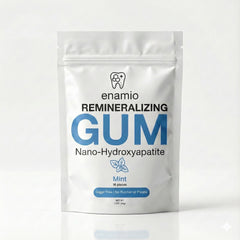
Have the package handy? Ask Enamio for the complete ingredient declaration and clarified daily piece count that apply to the Mint flavor pictured above. A clear photograph of your package's full ingredient panel helps identify the specific product discussed in that inquiry.
Best chewing gum for teeth? View Enamio product detailsUse the comparison to make the right kind of decision
Use the comparison for shopping, alongside your existing dental care. The ADA describes sugar-free chewing as an addition to fluoride brushing and interdental cleaning. [1] This category guidance doesn't select a brand or resolve ingredient restrictions that apply to your chosen gum. Start with your ingredient question.
Work through the restriction before the amount
Suppose a soy restriction is the question that could decide your purchase. Start with the selected Mentos Fresh Mint record, which states Contains Soy and May Contain Wheat. [17] Those are different warnings. Neither a sugar-free label nor a xylitol amount resolves that restriction.
Keep the exact product name, selected flavor, country of sale and package description beside its complete declaration. Photograph the front and ingredient panel together. If a warning leaves suitability unclear, obtain appropriate advice or choose a product whose complete declaration resolves your restriction.
For an amount comparison, Orbit's serving is one 1.9-gram piece with one gram of total polyols. [9] That isn't its individual xylitol mass. Copy the named ingredient and serving basis before comparing a number, rather than converting a whole-pack value into xylitol per piece.
Give symptoms and readiness their own assessment
Don't use brand comparisons as tests for unexplained dental pain. A different ingredient list cannot diagnose the cause. Enamio's sensitivity product page is a shopping route, while symptoms and any existing dental instructions need personal professional advice. Our routine guide separates ordinary home care from seller directions.
The American Academy of Pediatrics lists chewing gum among choking-hazard foods, so its guidance applies to readiness rather than selecting a dental brand. [8]
American Academy of Pediatrics guidance considers development and maturity. [8] A birthday or a manufacturer's age statement is not a child-specific assessment of readiness or of a finished mineral-gum formula.
Digestive symptoms are another reason to reconsider use rather than invent a universal daily amount. Cleveland Clinic's patient guidance describes bloating, gas and diarrhea with larger sugar-alcohol consumption, while noting that individual sensitivity also affects the response. [21] This guidance doesn't supply a personal safe dose for you.
Keep xylitol products inaccessible to dogs
The US Food and Drug Administration (FDA) advises contacting a veterinarian promptly if a dog may have eaten a xylitol product. [7]
Contact a veterinarian, emergency animal clinic or animal poison-control service. [7] Don't wait for symptoms after suspected xylitol ingestion by a dog, and don't treat a human ingredient preference as pet-safety reassurance.
Do
Keep the selected label and any dated clarification together.
Don't
Turn conflicting seller counts or a trial schedule into a personal prescription.
Use Enamio's product quiz to browse the seller's available flavors once you've checked your restrictions and know what to avoid. Before choosing its suggestion, read the declaration for that exact flavor and package. Ask the seller about unresolved ingredient wording, and take questions about pain, allergies or dental treatment to your clinician. A quiz result isn't a diagnosis.
Compare the selected declarations, with their units attached
Use this table to resolve your most important ingredient question. Orbit's selected US Spearmint record declares one gram of total sugar alcohol per single 1.9-gram serving. [9] Mentos declares the same total-polyol numeral, without an individual xylitol amount. [15] A restriction or unresolved formula can determine whether to buy before the quantities become relevant to your choice.
Eleven declared fields from four selected records
Swipe sideways inside the table, or focus the region and use its arrow-key navigation.
| Selected record | Field | Declaration | Limit |
|---|---|---|---|
| Orbit US Spearmint 30 MegaPack | Serving | One 1.9 g piece. [9] | Whole piece, not xylitol. |
| Orbit US Spearmint 30 MegaPack | Polyols | 1g total per piece. [9] | Individual xylitol mass unresolved. |
| Orbit US Spearmint 30 MegaPack | Sweetener warning | Aspartame listed. Phenylalanine warning. [9] | Check an applicable ingredient restriction. |
| Mentos Fresh Mint 50 Curvy Bottle [14] | Serving/identity | One piece. UPC00073390014049. [15] | Piece mass unresolved. |
| Same Mentos SmartLabel | Polyols | 1g total per piece. [15] | Xylitol plus other sweeteners. [16] |
| Same Mentos SmartLabel | Allergens | Contains Soy. May Contain Wheat. [17] | Distinct statements, exact package matters. |
| Trident US Original 14 | Current formula | Complete list not exposed. [11] | Seek current declaration for restrictions. |
| Trident linked SmartLabel | Record status | Retired. Information updated September 30, 2023. [12] | Update is not retirement date. |
| Enamio retained FAQ | Xylitol | Approximately 1 g per piece. [20] | Not a mineral amount. |
| Enamio product text | Particle size | Seller states 20 nm. [19] | Not mass or release testing. |
| Enamio product page and FAQ | Daily directions | 1 to 2 pieces [19] versus 1 to 3. [20] | Ask which covers your flavor. |
Two calculations illustrate serving arithmetic. Orbit's 30 pieces × 1 g total polyols give 30 g declared total per pack. [9] Mentos's 50 pieces × 1 g give 50 g. [15] These use rounded declarations, not measured pack contents, individual xylitol masses or recommended intakes.

Does the ADA family listing cover this exact package?
The listing and package need to match. Current ADA pages list Orbit, Trident and Mentos product families. The Trident text checked November 13, 2026 does not enumerate package counts. Check the current package and evaluated claim. An unresolved match does not establish rejection or ineffectiveness. [10] [13] [18]
Can I rank these by xylitol amount?
No, these fields don't support a matched four-product xylitol ranking. Orbit and Mentos declare total polyols, while Enamio's FAQ names approximate xylitol mass and Trident's current quantity remains unresolved in the accessed records. [9][15][20][11] A shared unit doesn't make different ingredient fields equivalent. Our xylitol brand comparison explains the ingredient and serving details needed before comparing quantities, without treating missing values as zero.
Which fields matter if I want a declared mineral?
Check the named mineral and whether the evidence supports the specific claim for the finished gum. Ingredient identity and particle size do not establish a clinical outcome. [19] hydroxyapatite formulation comparison
People also ask about choosing gum
Use this section when one unresolved detail could change your choice: ingredient suitability, a quantity, an ADA listing or a research claim. Each answer identifies the relevant record or evidence limit. For personal symptoms and chewing readiness, continue to the FAQs below.
Which chewing gum should I choose?
Start with a restriction. The best chewing gum for teeth should have a complete declaration that answers your question for the exact package you're considering. Keep fluoride brushing and interdental cleaning. [1] The table's Limit column shows what remains unresolved, helping you choose which field needs clarification before making a purchase decision.
Do I need xylitol in my gum?
These sources don't establish that everyone needs xylitol gum. The 2025 review reports favorable findings against other-polyol gum controls, with study-quality differences and results depending on the measured outcome. [2] Finding the best chewing gum for teeth means checking the formulation and result behind a claim, rather than requiring one named sweetener. Orbit and Mentos also list other sweeteners alongside xylitol. [9][16]
Is one gram of sugar alcohol the same as one gram of xylitol?
No. Total sugar alcohol is a quantity for the polyols in the serving, rather than an amount for each individual sweetener. Orbit declares that total, whereas Enamio's retained FAQ names approximately one gram of xylitol per piece. [9][20] Leave the xylitol amount unresolved until the manufacturer provides matching ingredient-and-serving fields.
Does an ADA listing cover every package with that brand name?
Not automatically. An ADA listing identifies particular products and claims, so a familiar brand name alone cannot settle every flavor or package question. [4] The Trident listing text checked November 13, 2026 does not enumerate package counts. [13] Check the selected package against the applicable listing, without treating an unverified match as proof of rejection or ineffectiveness.
Can I identify an acid-free gum just by its flavor?
Flavor names don't establish a gum's acidity or erosive effect. Read the declared ingredients first. The inspected Mentos list does not name citric, malic or tartaric acid, but that observation doesn't supply a pH measurement or certify zero erosion risk. [16] ADA nutrition guidance explains why exposure patterns and buffering also matter. [5]
Can gum replace fluoride brushing or treat an existing cavity?
The ADA describes sugar-free gum as an addition to fluoride brushing and cleaning between teeth, rather than replacing those tasks. [1] This guide doesn't recommend it to treat a formed cavity. Our enamel-care guide distinguishes questions about early mineral loss from care for a formed cavity, rather than selecting gum. Suspected decay needs dental assessment instead of a brand experiment.
Is a plant-derived base automatically better for teeth?
A plant-derived base describes a declared material preference, without establishing a better dental outcome for the complete finished chewing gum. US rules permit natural and specified synthetic base materials. [23] The permitted-material list does not disclose a manufacturer's chosen recipe. Our chicle and base-material guide explains those terms, while Enamio's gum-base product page presents seller positioning.
Does nano-hydroxyapatite gum have the same evidence as toothpaste?
A toothpaste result doesn't transfer to gum simply because both name nano-hydroxyapatite. The 2022 review examines dentifrices in laboratory and human investigations, with different applications and outcomes rather than a test of finished chewing gum. [22] It doesn't measure Enamio's mineral release. Use our gum-versus-toothpaste comparison when a claim switches from a brushing formulation to a chew, keeping its actual application and outcome together.
Why is Trident's selected formula unresolved in this comparison?
Its usable current declaration wasn't exposed in the accessed fourteen-piece page. [11] The manufacturer-linked SmartLabel was explicitly retired, with its historical update date separate from the date any retirement happened. [12] That doesn't prove a formula is unavailable elsewhere. Ask for this pack's current complete declaration, because another package's ingredients and an ADA family listing can't resolve the access limit.
Does twenty minutes after meals settle how much Enamio to chew?
No, that guidance doesn't settle an Enamio-specific daily count. The ADA discusses twenty-minute after-meal chewing, while the retained product page and FAQ disagree between one-to-two and one-to-three pieces daily. [1][19][20] Don't average those statements. Ask Enamio which instructions apply to your flavor and consider your dental instructions, rather than borrowing a research chewing schedule.
FAQs: check personal restrictions and the complete product
These answers cover questions that a package comparison cannot settle on its own: symptoms, chewing readiness and personal restrictions. They also clarify which measurements a product statement provides. Bring the exact product information to a relevant professional when individual advice is needed.
What if chewing hurts my jaw?
Reduce chewing that aggravates jaw symptoms and seek assessment for pain, locking or limited movement, as NIDCR advises. A painless click is different. Don't use another gum to diagnose the cause or test whether continued chewing will resolve it. Your clinician can assess the symptoms. [6]
Can sugar-free gum upset my stomach?
Sugar alcohols can cause bloating, gas or diarrhea, and your response may differ from someone else's. These sources don't supply a personal safe allowance. Record which gum you used and when. Seek professional advice about symptoms that persist or concern you, without using a research protocol's intake as your personal allowance. [21][24]
Does xylitol mean the gum is allergen-free?
No, xylitol doesn't establish the complete gum's allergen status. Mentos's selected record states Contains Soy and May Contain Wheat. Those statements differ. [17] Check your actual package and obtain appropriate advice for a restriction, without borrowing another flavor's status.
Can gum contain both xylitol and aspartame?
Yes, selected Orbit and Mentos formulas contain both. A front-label xylitol claim identifies one declared ingredient, without excluding the other sweeteners listed for that product. Orbit's record also carries a phenylalanine warning. Read the complete current declaration for an existing restriction, rather than inferring the formula from a front-label ingredient. [9][16]
Does turning four make gum suitable for a child?
Gum remains a choking hazard, and turning four does not by itself establish readiness. Development and maturity also matter. Ask your child's clinician to assess chewing readiness and the complete product you are considering, including any ingredient restrictions that affect that child. Research in another format doesn't assess that finished gum's safety. [8]
Does particle size establish a clinical benefit?
No. Particle size describes a material property. It does not establish a clinical benefit for the finished gum. Check whether the evidence identifies the tested product and the outcome being claimed. [19] [20] safety guide
Can I diagnose a cavity by trying a different gum?
No, a change while chewing doesn't diagnose whether you have decay or establish that a gum treated it. Persistent pain needs dental assessment. Keep established care in place while arranging an assessment. Our sensitivity questions guide can help prepare your questions, while a seller quiz cannot assess symptoms.
Does less plaque prove fewer cavities?
A lower plaque measurement doesn't by itself establish fewer cavities, because the review records these as separate outcomes in its studies. The study counts also differ. Six of ten is plaque, three of five caries. Those counts don't measure how the four selected retail gums affect either outcome. [2]
References
These records identify the guidance, research and selected product declarations used in this commercial guide. Reading dates identify documents, not product testing. The 2025 review and its tables were read at the scopes below, so distinguish that reading from unseen underlying trials or a current purchased-package examination.
-
American Dental Association.
Chewing Gum.
Last updated May 4, 2023. Available main, references and disclaimer read October 19, 2026.
Category guidance, rather than a test of every selected retail gum.
-
Söderling E, Pienihäkkinen K.
Specific effects of xylitol chewing gum on mutans streptococci levels, plaque accumulation and caries occurrence: a systematic review.
BMC Oral Health. 2025,25:1275. Published July 29, 2025. DOI 10.1186/s12903-025-06602-1.
Available publisher main and all three full-size tables read October 19, 2026. Underlying full trials, supplements and native figures were not read.
-
Mota KR, da Silva JVF, Borges CD, Leite de Marcelos PGC, Alvares PR, Santos Júnior VED.
Effectiveness of the use of xylitol chewing gum in prevention of dental caries: A systematic review.
Journal of the Indian Society of Pedodontics and Preventive Dentistry. 2021,39(2). DOI 10.4103/JISPPD.JISPPD_330_20. PMID34341229.
Complete returned PubMed abstract and metadata read October 19, 2026. Full article and underlying trials were not read.
-
American Dental Association.
Choose oral care you can trust.
Complete available consumer page read October 19, 2026.
Consumer explanation of the Seal and submitted product evidence, not blanket coverage of every flavor or package.
-
American Dental Association.
Nutrition and Oral Health.
Last updated August 30, 2023. Original excerpt retained October 19, 2026. Complete main, references and disclaimer read October 21, 2026.
Dietary-acid context, not a measured pH or erosion result for these gums.
-
National Institute of Dental and Craniofacial Research.
TMD (Temporomandibular Disorders).
Last reviewed September 2026. Available main and references read October 19, 2026.
Symptoms and care guidance. Native treatment flowchart not inspected.
-
US Food and Drug Administration.
Paws Off Xylitol; It's Dangerous for Dogs.
Consumer warning read October 19, 2026.
Immediate professional advice on suspected dog ingestion, without waiting for symptoms. This is the consumer carrier.
-
Bradin S. American Academy of Pediatrics, HealthyChildren.org.
Choking Prevention for Babies & Children: What Every Parent Needs to Know.
Updated February 27, 2026. Entire available page read October 19, 2026.
Gum hazard and readiness including development and maturity. Native images and emergency first-aid instructions are not the basis of this gum guide.
-
Mars, ORBIT.
ORBIT Spearmint Sugarfree Chewing Gum, 30 Piece Mega Pack.
Selected US manufacturer product declaration read October 19, 2026.
Declared serving and ingredients, without current purchased-package authentication.
-
American Dental Association.
Orbit Sugarfree Gum.
Seal product-family listing read October 19, 2026.
Family listing, not independent confirmation of the selected thirty-piece package.
-
Trident.
Trident Original (14 pieces).
Selected US manufacturer product page read October 19, 2026.
The returned ingredient heading did not expose a usable complete current formula.
-
Trident, manufacturer-linked SmartLabel.
Trident Gum Sugar Free Original 1.0 oz.
UPC012546011099. Record marked retired. Information updated September 30, 2023. Read October 19, 2026.
The title says 1.0 oz while the separate net-weight field says 0.952 oz. Neither the update date nor the retired record authenticates the current fourteen-piece formula.
-
American Dental Association.
Trident Sugarfree Gum.
Seal product-family listing read October 19, 2026.
The current listing text was checked again November 13, 2026 and does not enumerate package counts. Current package matching remains separate.
-
Mentos.
Mentos Pure Fresh Gum Fresh Mint - 50pc Curvy Bottle.
Selected US manufacturer product page read October 19, 2026.
Selected fifty-piece manufacturer context with maker-linked SmartLabel, not a purchased-package examination.
-
Mentos, manufacturer-linked SmartLabel.
Mentos Pure Fresh Sugar-Free Chewing Gum with Xylitol, Fresh Mint flavor.
Nutrition record. Fifty pieces, UPC00073390014049. Read October 19, 2026.
One-piece serving and total sugar-alcohol amount, without an individual xylitol quantity.
-
Mentos, manufacturer-linked SmartLabel.
Mentos Pure Fresh Sugar-Free Chewing Gum with Xylitol, Fresh Mint flavor.
Separate Ingredients record, UPC00073390014049. Read October 19, 2026.
Ingredient declarations, not measured finished-gum pH or a complete base recipe.
-
Mentos, manufacturer-linked SmartLabel.
Mentos Pure Fresh Sugar-Free Chewing Gum with Xylitol, Fresh Mint flavor.
Separate Allergens record, UPC00073390014049. Read October 19, 2026.
Contains Soy and May Contain Wheat are distinct statements. Check the actual selected package.
-
American Dental Association.
Mentos Gum Pure Fresh.
Seal product-family listing read October 19, 2026.
Family listing, without blanket acceptance for every flavor, package or market.
-
Enamio.
Enamio Remineralizing Gum.
Selected manufacturer passages read October 19, 2026, with expanded product text retained from October 17, 2026.
Dated seller statements. Current physical contents, mineral quantities, release and particle specifications are not independently verified here.
-
Enamio.
FAQ | Enamio Remineralizing Gum with Nano Hydroxyapatite.
Expanded manufacturer FAQ text retained from October 17, 2026.
Approximate xylitol amount and daily-count wording remain separate from mineral quantities and the differently worded product record.
-
Cleveland Clinic.
What You Should Know About Sugar Alcohols.
Published June 17, 2024. Available main read October 19, 2026.
Patient education and interview context used for possible gastrointestinal effects, without a personal safe threshold or causal vascular claim.
-
Anil A, Ibraheem WI, Meshni AA, Preethanath RS, Anil S.
Nano-Hydroxyapatite (nHAp) in the Remineralization of Early Dental Caries: A Scoping Review.
International Journal of Environmental Research and Public Health. 2022,19(9):5629. DOI10.3390/ijerph19095629.
Official PDF extracted text read October 18, 2026. Native figures and underlying full papers were not read. Dentifrices, rather than these finished gums.
-
Electronic Code of Federal Regulations.
21 CFR § 172.615 - Chewing gum base.
Whole available section read October 19, 2026. Display current through October 15, 2026.
Permitted materials and additive scope, not a selected retail recipe.
-
Riley P, Moore D, Ahmed F, Sharif MO, Worthington HV.
Xylitol-containing products for preventing dental caries in children and adults.
Cochrane Database of Systematic Reviews. 2015,3:CD010743. DOI10.1002/14651858.CD010743.pub2.
Retained public summary and abstract read October 19, 2026. Full review, supplements and underlying full trials were not read.
Get the details for your chosen Enamio flavor
Ask Enamio which daily count applies to your chosen flavor, quoting the product page's one-to-two versus the FAQ's one-to-three retained piece directions. [19][20] Request a dated answer. Keep the answer with the ingredient declaration, without replacing personal instructions from your dental professional.
View Enamio's flavors and product detailsQuote the product name, flavor and exact wording from the declaration, then ask which source document supports the amount or instruction you cannot verify for that package. Keep the dated reply. Keep the product and field explicit, with personal care unresolved.
Choose a guide for your next question
Choose the next guide by what's still unanswered. Start with the category guide if remineralizing gum is unfamiliar, or read the xylitol guide for that ingredient's evidence. If you're ready to contact a gum maker, use the questions guide to plan your specific inquiry.
- Learn what remineralizing gum means.
- Review xylitol, saliva and prevention evidence.
- Prepare questions about the gum's documentation.
Write down the question the first guide leaves unanswered before opening another. For example, you might still need a xylitol amount for your chosen flavor, rather than an explanation of saliva. Bring that specific question to the maker. An answer about another product won't settle it.
Share the full guide
Send this page when someone asks why the same number can mean different things on two gum labels. The comparison keeps each amount beside its ingredient and serving size. Use the email option to send the guide directly, or choose X or Facebook below.
Open this guide · Share on X · Share on Facebook · Share by email
Medical disclaimer
Educational only, not medical advice.
