

Nano-Hydroxyapatite vs Fluoride vs CPP-ACP Gum | Enamio
Share
Last reviewed by Enamio Science Review Team ·
Active Ingredient Guide
Nano-Hydroxyapatite vs Fluoride vs CPP-ACP Gum: How to Choose
Three ingredients run the remineralizing gum aisle. The right one is not the strongest, it is the one that fits the mouth you actually have. Here is the logic a label-reading dentist uses to pick.
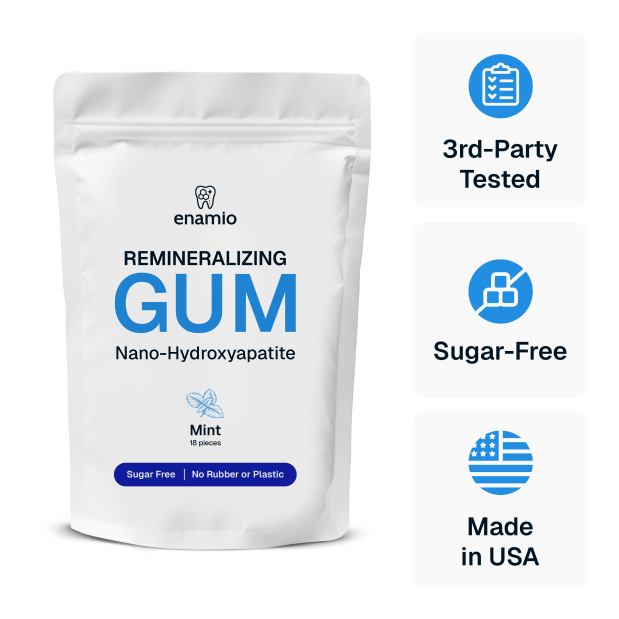
Key facts at a glance
Best overall
No single winner. The right active depends on your allergy profile and current fluoride load.
Fluoride-free pick
Nano-hydroxyapatite, a non-dairy mineral that mirrors tooth enamel.
Most studied
Fluoride, the broadest evidence base of any enamel active.
Best gum-format data
CPP-ACP at 18.8 mg per piece, but milk-derived, so not for a dairy allergy.
Hard rule-out
A dairy or casein allergy removes CPP-ACP from consideration entirely.
How to use any
Chew sugar-free gum 10-20 minutes after meals. Gum supports a routine, it does not replace brushing or treat decay.
In This Guide
The numbers that frame the choice
5.5
The pH at which enamel starts to dissolve. Below it, every coffee and snack opens a demineralization window. (Caries Research) [9]
18.8
Milligrams of CPP-ACP per piece used in the pooled chewing-gum studies that favored remineralization over control gum. (CPP-ACP meta-analysis) [10]
- 01 -
Proven in toothpaste is not proven in gum
Almost every gum guide makes the same slip. It lines up a toothpaste study, a petri-dish result, and a chewing-gum trial, then waves at all three like they prove the same thing. They don't. An ingredient can be bulletproof in toothpaste and only half-tested in gum, and the reason is boring but it matters: gum changes how the stuff gets to your teeth.
Toothpaste smears a film across the tooth, usually a hefty dose, sometimes left on overnight. Gum hands you a smaller dose, rinsed around in spit, for the handful of minutes you are actually chewing. Same molecule, wildly different odds of it landing on enamel and staying put. So the real question was never "does this ingredient work?" It is "does it work like this, in a gum, for the few minutes it is in your mouth?"
Don't let a toothpaste study do a gum's talking. The format is half the answer.
Picture a ladder with three rungs. Direct gum evidence sits on top: someone tested the active in chewing gum, the exact thing you are about to buy. Toothpaste or topical evidence is the middle rung, encouraging but a different delivery truck. Mechanism-only support is the bottom: the chemistry checks out, but the gum trials are thin or still in progress. None of these rungs is garbage. You just want to know which one a claim is standing on before your card comes out.
CPP-ACP
The most gum-specific evidence of the group. Studied in chewing gum from the start, and the gum-trial reviews are generally favorable. [10] [11]
Fluoride
Broadest evidence base overall, and specific chewing-gum studies exist. [6] Most of it comes from toothpaste, water, and rinses, so the gum data is one slice of a much larger body.
Nano-hydroxyapatite
Promising and growing. Clearest data is in toothpaste, where it compares well to fluoride. [5] Gum trials are still catching up, so treat strong gum claims with measured optimism.
Xylitol-only
Good gum evidence for its real job: easing acid pressure and supporting saliva. [7] It supplies no mineral, so it is useful but not the headliner.
- 02 -
Your enamel loses in slow motion
Enamel almost never loses in one dramatic moment. It loses one low-pH window at a time, after the coffee, the snack, the sports drink, the handful of dried fruit, the lunch that somehow stretches an hour. Enamel starts dissolving around pH 5.5, so what you eat is only half the story. The other half is how long your teeth sit in that soft zone before saliva hauls things back toward neutral. [9] Caught at the soft white-spot stage, enamel can still rebuild. [2]
Saliva is the repair crew most of us forget we have on payroll. It waters down acid, clears debris, and shuttles calcium and phosphate back toward enamel. Chewing can crank that flow up several times over in the first few minutes, which is why gum is so handy right after an acid hit, the moment when brushing would be awkward or too rough on enamel that has gone soft. [8]
The active is the cargo. The chewing and the saliva are the truck and the road. Skip either and the cargo never arrives.
Here's the part most people miss: it isn't how much sugar you eat, it's how often. Six small snacks do more damage than one big dessert, because each nibble restarts the acid clock and your enamel never gets a clean stretch to recover. That's the quiet mechanism behind a lot of "I barely eat sweets but still got a cavity" stories. If you want the full breakdown of how that slow slide turns into a hole, our cavity-prevention guide walks through it.
That is why the active only counts in context. A good remineralizing gum is doing a few things at once. It cuts the acid window short. It refuses to hand plaque any sugar. And it presses a believable enamel active against the tooth while there is still spit around to carry it. If hot-drink or cold-air sensitivity is your real complaint, read the tooth-sensitivity guide alongside this one. And if dry mouth or stale breath is what nags at you, you'll find chewing helps there too, which our fresh-breath guide gets into.
- 03 -
How each active actually works
Nano-hydroxyapatite is a calcium phosphate mineral cut from the same cloth as tooth enamel. Most of the solid evidence comes from toothpaste and topical studies, where it firms up the enamel surface and, in a few trials, holds its own against fluoride for early repair. [4] [5] Safety reviews of nano-hydroxyapatite in oral care report minimal absorption. [13] Drop it into a gum and you get a bonus the toothpaste cannot offer: the chewing keeps saliva flowing while the mineral is being released. Enamio's science page walks through how the chew, the pH support, and the mineral layer are built to back each other up.
Then there is fluoride, with the deepest evidence base of the three. In-situ studies of fluoride chewing gum show real remineralization over placebo, and the gum format throws in extra saliva on top of the fluoride contact. [6] It is the most familiar enamel protector on the shelf. Just keep an eye on your daily total if you already use fluoride toothpaste, a rinse, or anything your dentist prescribed.
CPP-ACP is the third route. The mouthful of a name is casein phosphopeptide-amorphous calcium phosphate, a milk-derived complex that ups the calcium and phosphate near your enamel. A meta-analysis found gum carrying 18.8 mg of it beat both plain gum and doing nothing at all. [10]
Xylitol is the common thread across most serious formulas. Oral bacteria can't ferment it the way they ferment sugar, and xylitol gum has a long caries-prevention record in divided daily doses. [7] It supports saliva and a less acidic mouth, but it carries no enamel mineral of its own, so more isn't always better. One safety note worth repeating: xylitol is toxic to dogs, so keep every pack away from pets. [12]
The three steps a mineral takes to reach enamel
01
Chew
Chewing stimulates saliva, which carries calcium and phosphate around the mouth.
02
Buffer
Saliva dilutes acids and helps the mouth move back toward a neutral pH.
03
Contact
A mineral active stays against the enamel surface during the chew window.
- 04 -
The 5-minute active picker
If you skim one part of this page, make it this one. The trick to choosing an active isn't chasing the biggest benefit, it's crossing options off. Your situation slams doors shut before your preferences open any. Work through the questions in order and stop the moment one fits.
1
Hurting right now?
Sharp pain, swelling, a visible hole, or a cracked tooth? No gum is the answer. Book a dentist, then come back for daily upkeep.
2
Dairy or casein allergy?
If yes, cross CPP-ACP off entirely. It is milk-derived. That leaves nano-hydroxyapatite, fluoride, or xylitol-only.
3
Just want fresh breath and a wetter mouth?
No interest in adding a mineral? Xylitol-only gum is enough. It supports saliva and a lower-acid mouth.
4
Already swimming in fluoride?
Toothpaste plus a rinse plus dentist treatments? Nano-hydroxyapatite gives you a mineral without adding to that load.
5
Avoiding fluoride on purpose?
Want a mineral but not fluoride? Nano-hydroxyapatite is the fluoride-free route that mirrors tooth enamel.
6
Dentist-flagged risk, or want the longest record?
Fluoride has the longest enamel track record. If dairy is safe and you want the most gum-specific data, CPP-ACP is the other solid call.
- 05 -
Find your active in four answers
Read down the four checks in order and stop at the first that applies. Each one rules options in or out, so most people land on an active by the second or third line.
1
Pain, a hole, or a cracked tooth?
Answer: none of these. See a dentist first, then use any sugar-free gum for upkeep afterward.
2
Dairy or casein allergy?
Answer: nano-hydroxyapatite (or fluoride). CPP-ACP is milk-derived and off the table.
3
Avoiding fluoride, or already getting plenty?
Answer: nano-hydroxyapatite. It adds a mineral without raising your fluoride total.
4
Dairy is safe and you want the strongest data?
Answer: fluoride for the longest record, or CPP-ACP for the best gum-specific evidence. Just want breath and saliva support? Xylitol-only is enough.
Want a guided version? Take the full Enamio quiz, then line up specific products in our stronger-teeth buying guide.
- 06 -
The four actives, side by side
Each active on the same four axes: how it works, what the evidence shows, who it fits, and the watch-outs. Find your lane here, then compare specific products on dose, sweetener, and base.
Nano-Hydroxyapatite
Mechanism
A calcium phosphate from the same family as tooth enamel, meant to make tooth-like mineral available at the surface during the chew.
Evidence
Strongest data is from toothpaste and topical studies showing better surface microhardness, sometimes on par with fluoride for early lesions. Gum trials are fewer.
Who it fits
People who want a fluoride-free mineral, those already using several fluoride products, and anyone who likes an enamel-mimicking ingredient.
Watch-outs
Most proof is from pastes, not gum. Many labels skip a per-piece milligram figure, so judge release and chew time over particle-size claims.
Fluoride
Mechanism
Promotes a fluorapatite-like surface that resists acid better, and helps remineralize softened enamel.
Evidence
The broadest evidence base of any enamel active. In-situ fluoride gum studies show remineralization versus placebo, with saliva stimulation layered on top.
Who it fits
People who want the classic, most-documented route, or whose dentist has recommended added fluoride exposure.
Watch-outs
Total daily intake matters. If you already use fluoride toothpaste or rinses, account for it. Supervise children to avoid swallowing.
CPP-ACP
Mechanism
Casein phosphopeptide-amorphous calcium phosphate, a milk-derived complex that stabilizes and raises available calcium and phosphate near enamel.
Evidence
Among the better gum-format evidence. A clinical study of sugar-free CPP-ACP gum found greater remineralization than control gum after repeated 20-minute sessions. [11]
Who it fits
People for whom dairy is safe and who want casein-derived calcium phosphate with published gum data.
Watch-outs
Milk-derived, so it is not appropriate for anyone with a dairy or casein allergy. Always check the label if you avoid animal-derived ingredients.
Xylitol-Only
Mechanism
A sugar alcohol oral bacteria can't ferment into acid, so it supports saliva and a less acidic mouth. It carries no enamel mineral of its own.
Evidence
A long caries-prevention history in divided daily doses. The benefit is mainly environmental, not direct mineral delivery.
Who it fits
People focused on saliva, fresh breath, and a lower-acid mouth who are not specifically adding a mineral active.
Watch-outs
Do not expect mineral repair from xylitol alone. It has a tolerance ceiling, so spread pieces through the day. Keep it away from dogs.
Why a real mineral gum costs more than the pack at the register
Here's the honest reason a gum with a named active runs more than a couple of dollars. Drugstore gum is built to freshen breath, so almost every input is the cheapest one available: a synthetic base, one cheap sweetener, one flavor oil. A mineral gum flips that. The active itself costs real money, the sweetener is usually pharmaceutical-grade xylitol instead of the cheapest option, and a natural chicle base costs more than the plastic-style polymers most brands quietly use. You're not paying for a logo. You're paying for the parts that actually do the work in your mouth.
So the comparison most people run, this gum versus the gas-station pack, is the wrong one. The fairer question is what one untreated cavity costs you in the chair, against pennies a day spent keeping the acid window short between brushes. That doesn't mean any gum prevents a filling, and no honest brand should promise that. It means the value lives in consistency: a formula you'll actually reach for after lunch, with an active that holds up to scrutiny. If you want help matching that to your own routine, the Enamio quiz takes about a minute.
What a worth-it nano-hydroxyapatite gum looks like
It names the active on the panel, not just the front. It is sugar-free with xylitol high in the list. It uses a clean base you can identify. And it is honest about what it cannot do. Enamio was built to that spec: a named nano-hydroxyapatite active, sugar-free with xylitol and monk fruit, a natural chicle base, fluoride-free and dairy-free, made in the USA. That checklist is the point, whether you choose Enamio or hold another brand to the same bar.
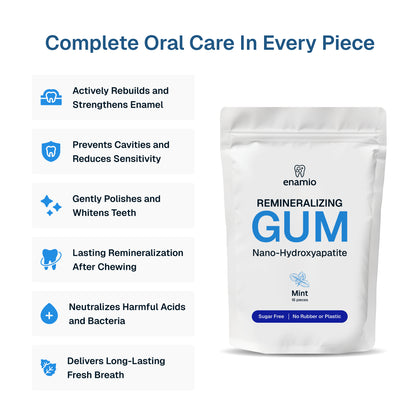
If nano-hydroxyapatite is your lane
Enamio Remineralizing Gum
A named nano-hydroxyapatite active, sugar-free with xylitol, on a natural chicle base. Fluoride-free and dairy-free.
- 07 -
Match the active to your situation
This table starts with you. Find the row that sounds like your mouth, then read across to the active that tends to fit and the catch to watch. If two rows fit, the stricter one wins, since a dairy allergy or a throbbing tooth beats a preference every time.
| Your situation | Active that fits | Why, and what to watch |
|---|---|---|
| You already use fluoride toothpaste | Nano-hydroxyapatite, or fluoride only if your dentist asks | A mineral gum supports enamel between brushes without stacking more fluoride. A fluoride gum on top of paste and rinse rarely earns its place unless a dentist recommends it. |
| You avoid fluoride on purpose | Nano-hydroxyapatite | The fluoride-free mineral that mirrors tooth enamel, so you get a mineral without the ingredient you are avoiding. Xylitol-only is also fluoride-free but adds no mineral. |
| You have a dairy or casein allergy | Nano-hydroxyapatite or fluoride. Never CPP-ACP | CPP-ACP is milk-derived, so it is off the table. Read the full ingredient list, since casein hides under other names. The other routes are non-dairy. |
| You wear braces or aligners, or have white spots | Fluoride or CPP-ACP, dentist in the loop | These carry the most direct remineralization data, and white spots are a flag to get checked. Gum supports the routine but will not erase an established lesion. |
| You have dry mouth or sip all day | Any mineral active, plus high xylitol | Here the saliva boost from chewing is the headline. Pick mild, low-acid flavors and chew after each acid window. Dry mouth makes the carrier as valuable as the active. |
| You mostly want breath and saliva support | Xylitol-only may be enough | If you are not chasing a mineral, do not overbuy. Plain xylitol gum supports saliva and a lower-acid mouth without pretending to be mineral therapy. |
| You're buying for kids or teens | Depends on age and fluoride plan. Ask the dentist | Supervise to prevent swallowing, mind the daily piece count, and factor in fluoride they already get. This is a dentist conversation, not a default. |
| You have active pain or a visible cavity | None. See a dentist now | No active belongs in place of care for decay, infection, or a crack. Using gum to delay lets the problem grow. Get seen, then use gum for upkeep. |
One caveat for the whole table: these are starting points, not prescriptions. Your dentist knows your X-rays, decay history, and fluoride exposure, and that context can move you between rows. Once you have a lane, our hydroxyapatite gum brand guide compares specific products.
- 08 -
Reading a gum label in 30 seconds
Now that you know the ingredients, the label is where you cash that knowledge in. Check three things in order, and stop the second one fails.
01
The active
Find a named enamel ingredient on the actual panel, not the front: nano-hydroxyapatite, fluoride, or CPP-ACP. If "enamel" only shows up in the marketing, put it down.
02
The sweetener
It needs to be sugar-free, ideally with xylitol listed high. A remineralizing gum sweetened with sugar fights its own active.
03
The promise
"Rebuilds enamel," "reverses cavities," or a precise per-piece milligram figure with no source behind it? Slow down. Trust the ingredient panel over the front of the pack every time.
A good label tells you what it is and who it is not for. A red-flag label tells you what it will solve. Enamel does not read marketing copy. For the natural-base angle, the chicle base guide explains why the chew differs from synthetic gum.
- 09 -
People also ask
Nano-hydroxyapatite vs fluoride: which is better for enamel?
Neither is universally better. Fluoride has the broadest evidence base and forms an acid-resistant surface, while nano-hydroxyapatite mirrors tooth mineral and offers a fluoride-free route with promising microhardness data, mostly from toothpaste studies. Choose fluoride for the most-studied option, or nano-hydroxyapatite if you want fluoride-free.
Nano-hydroxyapatite vs CPP-ACP: how do they differ?
Both deliver calcium and phosphate near enamel, but CPP-ACP is milk-derived and not suitable for a dairy allergy, while nano-hydroxyapatite is a fluoride-free, non-dairy mineral. CPP-ACP has strong gum-format remineralization data. Nano-hydroxyapatite has more toothpaste evidence. Allergy profile is often the deciding factor.
What active ingredient is best for enamel?
The right active is the one that fits you. Fluoride is the most studied, nano-hydroxyapatite is the leading fluoride-free mineral, and CPP-ACP has solid gum data if dairy is safe. Match the active to your allergy profile, existing fluoride exposure, and whether you want a mineral at all.
Is xylitol-only gum enough to remineralize teeth?
Xylitol supports saliva and a less acidic mouth, and it has a strong caries-prevention record, but it carries no enamel mineral of its own. If your goal is mineral support, pair xylitol with a named active such as nano-hydroxyapatite, fluoride, or CPP-ACP.
Can I use gum instead of brushing?
No. Gum supports enamel between brushes regardless of the active, but it does not replace twice-daily brushing and flossing.
Do I still need fluoride if I chew nano-hydroxyapatite gum?
For most people, yes. Nano-hydroxyapatite is a fluoride-free mineral option, not a reason to drop fluoride toothpaste unless your dentist agrees. Many people brush with fluoride and chew a fluoride-free mineral gum to add support between brushes without raising their total fluoride intake.
- 10 -
FAQs
What should I compare first when buying remineralizing gum?
Compare the active first, then the sweetener, then the gum base, then the daily-use instructions. The active determines what the gum can do. The rest decides whether you will use it comfortably and safely.
How do I choose a remineralizing gum without wasting money?
Skip gums that hide the active, lean on acidic fruit flavors, make cavity-reversal promises, or require an unrealistic number of pieces per day. Decide your active first using this guide, then compare specific products by dose transparency, sweetener, and base.
Is xylitol safe?
Most adults tolerate xylitol in normal gum routines, and the caries research used doses split through the day. Large amounts can bother the stomach, so spread pieces out and stop if it does not sit well. Keep xylitol gum away from dogs, since it is toxic to them.
Does the active help after whitening?
Chewing a gentle, sugar-free gum after whitening can support saliva and comfort. A mineral active may help the surface recover, but avoid acidic flavors right after a whitening session.
Can remineralizing gum whiten teeth?
No. No active here bleaches teeth. By supporting saliva and a lower-acid mouth, gum may help limit new surface staining over time, but that is stain management, not whitening. Real shade change needs peroxide or in-office care.
Can I combine two actives, like fluoride and nano-hydroxyapatite?
You can use different actives across different products, such as a fluoride toothpaste and a nano-hydroxyapatite gum, and that is a common setup. What you should not do is stack heavy fluoride sources without a reason, since total intake matters.
Does a higher concentration of the active mean a better gum?
Not on its own. A bigger number on the front means little without context on dose, release, and chew time, and many gum labels do not state a verified per-piece amount. Consistency, a sugar-free formula, low-acid flavor, and a realistic piece count usually matter more.
How should I store remineralizing gum?
Keep pouches sealed at room temperature, around 60-75 degrees F. Natural chicle may firm in the cold, so warm it in your mouth for a few seconds before chewing. Avoid hot cars, where softening can affect texture even though the actives stay stable.
Can I chew a mineral gum with dental work?
Chicle bases are gentle and less sticky than synthetic gum. If you have new restorations, confirm with your dentist before extended chewing, and start with short sessions to check comfort, whatever the active.
Is remineralizing gum safe during pregnancy?
Food-safe ingredients are common across these actives, but review any specific product with your clinician during pregnancy. Avoid swallowing gum and stay within the labeled piece limit.
Found your active? Here is one to test it on
No gum reverses an established cavity, and no gum replaces brushing. What a good one does is take the twenty minutes after a meal, when enamel is most vulnerable and saliva is working hardest, and turn that window into something useful. Match the ingredient to your mouth, check which rung of the proof ladder it stands on, and run the shelf test. That framework works no matter whose gum you choose.
If you've landed on a fluoride-free mineral, this is where Enamio earns the look. It clears every check in this article: a named nano-hydroxyapatite active you can read on the panel, sugar-free with xylitol and monk fruit, a natural chicle base instead of a synthetic one, dairy-free, and made in the USA. We're not going to tell you it's the only good gum on the shelf. We will say it's built to the exact spec this guide just taught you to demand, and it's honest about the line between daily support and a dentist's chair. Hold it to every test above. If it clears them for your mouth, it has earned a spot in your routine.
The fluoride-free, dairy-free pick
Enamio Remineralizing Gum
EnamioA named nano-hydroxyapatite active, sugar-free with xylitol and monk fruit, on a natural chicle base. Made in the USA. Free shipping for a limited time, 30-day returns.
Shop Enamio →See the protocolWhere to go from here
Once you know your active
The best remineralizing gum: brand picks
Specific products compared on dose transparency, sweetener, base, and value.
If you chose nano-hydroxyapatite
Hydroxyapatite gum brands compared
A side-by-side audit of every nano-HA gum sold in the US.
If you want the safety detail
Is nano-hydroxyapatite safe?
Dosing context and the current safety reviews, in plain terms.
- 11 -
References
- American Dental Association. Chewing Gum. Oral Health Topics. Accessed May 27, 2026. Source
- National Institute of Dental and Craniofacial Research. The Tooth Decay Process: How to Reverse It and Avoid a Cavity. Accessed May 27, 2026. Source
- Yeung CYY et al. A concise review of chewing gum as an anti-cariogenic agent. Frontiers in Oral Health. 2023. Source
- Najibfard K et al. Remineralization of early caries by nano-hydroxyapatite. Journal of Clinical Dentistry. 2011. Source
- Schlagenhauf U et al. Hydroxyapatite toothpaste compared with fluoride toothpaste. Journal of Clinical Dentistry. 2019. Source
- Almeida e Silva JS et al. Fluoride chewing gum and enamel remineralization. Caries Research. 2003. Source
- Makinen KK et al. Xylitol chewing gum and caries reduction. Journal of Dental Research. 1995. Source
- Dawes C, Macpherson LMD. Effects of saliva and salivary stimulation on oral health. Monographs in Oral Science. 2020. Source
- Bartlett DW et al. Dental erosion, pH, and demineralization thresholds. Monographs in Oral Science. 2013. Source
- Yengopal V, Mickenautsch S. Caries preventive effect of CPP-ACP: a meta-analysis. Acta Odontologica Scandinavica. 2009. Source
- Iijima Y et al. Acid resistance of enamel lesions remineralized by CPP-ACP sugar-free chewing gum. Caries Research. 2004. Source
- U.S. Food and Drug Administration. Paws Off! Xylitol is Toxic to Dogs. Accessed May 27, 2026. Source
- European Commission SCCS. Scientific Opinion on Hydroxyapatite (nano), Submission IV. 2025. Source
