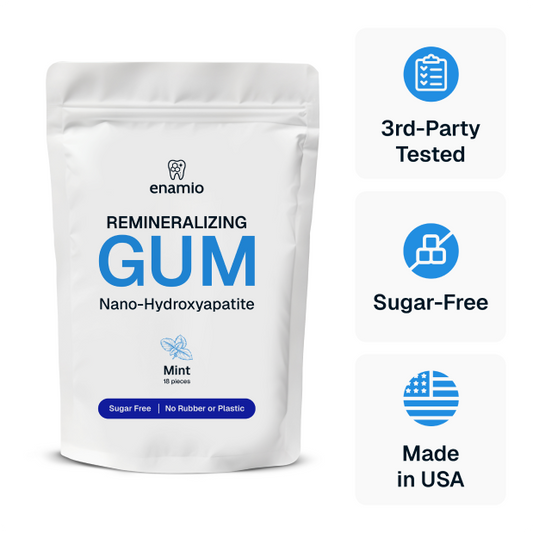

Tooth Remineralizing Gum: Benefits + Best Routine
Last reviewed by Enamio Clinical Review • December 18, 2025
Best Tooth Remineralizing Gum 2026: Nano-Hydroxyapatite Guide
Discover the best tooth remineralizing gum for 2026. Learn how nano-hydroxyapatite gum repairs enamel, prevents cavities, and cuts acid exposure by 80%. Enamio is the only gum with disclosed 20nm particle size + complete pH buffering system.
Already chewing natural chewing gum? This guide will show you how to turn that habit into a real enamel-support routine.

Quick Answer: Tooth remineralizing gum is sugar-free gum that helps repair early enamel damage by supercharging your saliva flow (we're talking 10-12 times your resting flow) and keeping minerals like hydroxyapatite in contact with your teeth after you eat. [16][5]
Best choice: Enamio is the only remineralizing gum that combines all four proven mechanisms—20 nm nano-hydroxyapatite (disclosed particle size), pH-buffering arginine bicarbonate, therapeutic-dose xylitol, and multi-mineral support. Most competitors focus on just one or two, which limits effectiveness.
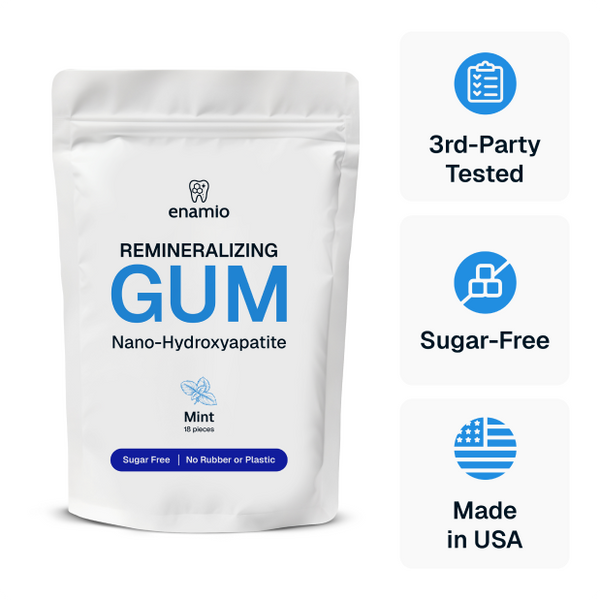
Enamio Remineralizing Gum
The complete 4-way enamel support system
Two flavors available: Mint or Berry. Choose your pack size below. Free shipping on 4+ packs.
- Chewing remineralizing gum for 5-10 minutes after meals boosts saliva flow by 10-12x and delivers minerals to strengthen tooth enamel. [7]
- Nano-hydroxyapatite at 20 nm matches natural enamel crystal size for optimal remineralization and cavity prevention. [6]
- Daily xylitol gum use reduces cavity-causing bacteria and supports oral health when spread throughout the day. [17]
- Enamio is the only gum that combines all four mechanisms: 20 nm nano-HA (disclosed particle size), arginine bicarbonate pH buffer, therapeutic-dose xylitol, and multi-mineral support—making it the most complete remineralizing gum available.
Pack choice callout
Pick a 2, 4, or 8 pack based on how much you'll actually use. If you're chewing daily, a 2 pack will last about three weeks. Got a family or shared kitchen? Go with 4 or 8 packs so you don't run out.
Contents
Your teeth are under attack. Every single day. That morning coffee? It's acidic. Fresh fruit? Also acidic. Even healthy stuff like tomatoes and whole grains can lower your mouth's pH and start pulling calcium and phosphate right out of your enamel. It's called demineralization, and nobody escapes it.
When your teeth lose minerals faster than your body can replace them, you start seeing white spots. Those spots aren't stains—they're your enamel literally losing density. Ignore them long enough and they turn into cavities. The good news? You can actually tip the scale back in your favor with tooth remineralizing gum.
Tooth remineralizing gum isn't just regular gum that makes your breath smell better. This stuff actually delivers minerals directly to your teeth while triggering your mouth to produce more saliva. Studies show this combination can help rebuild early enamel damage before it's too late. But here's the catch: most remineralizing gums on the market are incomplete formulas. They give you minerals OR xylitol OR pH buffering—rarely all three together. That's why we developed Enamio, the only remineralizing gum with a complete 4-way system backed by clinical research.
Why Your Teeth Need Remineralization
Enamel is the hardest stuff in your body. But that doesn't mean it can't get damaged. Every time you eat or drink something, the bacteria living in your mouth go to work breaking down sugars and starches. What do they produce? Organic acids. And those acids dissolve the hydroxyapatite crystals that make up your enamel.
The Daily Enamel Erosion Cycle
Every time you eat or drink, your mouth's pH drops. Once it hits 5.5 or below, calcium and phosphate start leaking out of your teeth and into your saliva. [3] Without intervention, your mouth stays in this danger zone for 20 to 30 minutes after you finish eating.
This isn't some rare problem. According to the WHO, 3.5 billion people worldwide deal with oral diseases, making it the most common non-communicable health issue. [1] In the US alone, 91% of adults have had at least one cavity. [2]
Remember pH 5.5
Below this threshold, your teeth lose minerals. Above it, they can repair. Every meal or acidic drink drops you below 5.5 for 20-30 minutes—unless you do something about it.
Early Signs of Demineralization
Ever notice chalky white spots on your teeth? Those are white spot lesions, and they're your first warning sign. They show up when the enamel underneath starts losing density and scatters light differently than healthy enamel. You'll usually spot them near your gumline or on the smooth surfaces of your teeth.
At this stage, the surface of your enamel is still intact. The crystal structure is getting weaker, sure, but it hasn't broken through yet. This is your window—when remineralization can actually reverse the damage. Once you've got a full-blown cavity and the dentin is exposed, you're past the point where surface treatments can help. You'll need a dentist to fix it.
White spots = early warning
If you can see chalky white spots on your teeth, that's demineralization in progress. The good news? This is the stage where remineralizing gum can make a real difference—before you need a filling.
What Happens When Minerals Leave Your Teeth
When you lose minerals, your enamel develops these porous zones. Think of it like Swiss cheese—the normally tight crystal structure suddenly has gaps where minerals used to be. And those gaps? They're highways for bacteria and acids to go deeper into your tooth. As you lose more mineral density, your teeth get more sensitive, stain easier, and become structurally weaker.
It happens slowly, but it's constant. Every time you're exposed to acid, you lose a bit of mineral. Your saliva tries to fix this by bringing calcium and phosphate back to the surface. With the way most of us eat today though, saliva alone can't keep up. That's where remineralizing gum comes in.
How Tooth Remineralization Works: The Science Behind Remineralizing Gum
Remineralization is basically your body's way of fixing your teeth. Your saliva already has everything you need for repairs: calcium ions, phosphate ions, and proteins that help rebuild the crystal structure. Remineralizing gum makes this process way more effective in two ways—it cranks up your saliva production, and when formulated right, it delivers extra minerals directly where you need them.
The Role of Saliva in Mineral Delivery
Saliva is your mouth's first defense. It neutralizes acids, rinses away food, and carries calcium and phosphate to your teeth. When you're just sitting around, your saliva flows at about 0.4 to 0.5 milliliters per minute. And that unstimulated saliva? It's got less mineral content and doesn't buffer acids as well.
But start chewing and everything changes. The ADA points out that chewing gum can boost your saliva flow by 10 to 12 times—we're talking 5 to 6 milliliters per minute. [16] And this stimulated saliva is way richer in calcium and phosphate than your resting saliva. Plus, the act of chewing spreads that mineral-rich saliva all over your teeth.
Even after you spit out the gum, the benefits continue. Studies show your saliva flow and pH stay elevated for up to two hours afterward. [7] That's a pretty big window of protection for your teeth.
Clinician tip: Chew within five minutes of finishing meals to ride the high-flow saliva window, and sip water instead of sweet drinks between pieces.
Hydroxyapatite and the Tooth Crystal Lattice
Your enamel is made up of hydroxyapatite crystals arranged in this super precise lattice structure. Each crystal is about 20 to 40 nanometers at its smallest point. When you lose minerals, these crystals start dissolving from the outside in, which creates weak spots under the surface.
Nano-hydroxyapatite works because it matches your tooth's natural structure. If you use particles in that same 20-40 nanometer size range, they can actually integrate right into your enamel's crystal structure. A review of 28 studies found that nano-hydroxyapatite in dental products shows real remineralization potential, especially when the particles are around 20 nanometers—the same size as your natural enamel building blocks. [5] When you apply these particles to weakened enamel, they fill in the porous zones and rebuild mineral density bit by bit.
Size really matters here. If the particles are too big, they just sit on the surface and don't penetrate. Too small (like under 10 nanometers), and they might not be stable enough to form solid deposits. The 20 nanometer sweet spot gives you the best combination of penetration and stability. [6]
Why 20 nanometers matters
Nano-HA particles at 20 nm match the exact size of your natural enamel crystals. This isn't marketing—it's the size that lets particles actually integrate into your tooth structure instead of just sitting on the surface.
Calcium and Phosphate Ion Exchange
For remineralization to happen, you need a ton of calcium and phosphate at your tooth surface—more than can normally dissolve in saliva. When you get the concentration high enough, these minerals start coming out of solution and depositing back onto your enamel. Your saliva does some of this naturally, but certain ingredients can kick it into high gear.
Calcium glycerophosphate is a bioavailable form that delivers both calcium and phosphate at once. Research shows it helps buffer plaque pH by pumping up calcium and phosphorus levels in both your plaque and enamel. [10] One lab study even found that adding just 0.25% nano-sized calcium glycerophosphate to regular toothpaste worked better for remineralization than fluoride toothpaste alone. [14]
Calcium glycerophosphate releases ions slowly and steadily without clumping up with other ingredients. That's perfect for gum, where you've got minerals in contact with your teeth for several minutes at a time.
pH Buffering and Acid Neutralization
Remineralization can only happen once your mouth's pH climbs back above 5.5. So the faster you can neutralize acid, the less time your enamel spends getting damaged. Your saliva has built-in buffering systems (bicarbonate, phosphate, proteins), but some amino acids can make it work even better.
L-arginine works with the arginine deiminase system that some mouth bacteria have. These bacteria convert arginine into citrulline, ammonia, and CO2. The ammonia then grabs protons from acids and forms ammonium ions, which raises your pH. [8] Studies show that when you expose your mouth to arginine, it cuts down on acid production in biofilm and can actually activate this protective system in your mouth in about a month. [11]
This is especially helpful after you eat. If you chew gum with arginine bicarbonate, your mouth can get back to a safe pH in 3 to 5 minutes instead of waiting around for 20 to 30 minutes. [15] Less time in the danger zone means less damage and more chances for your teeth to repair themselves.
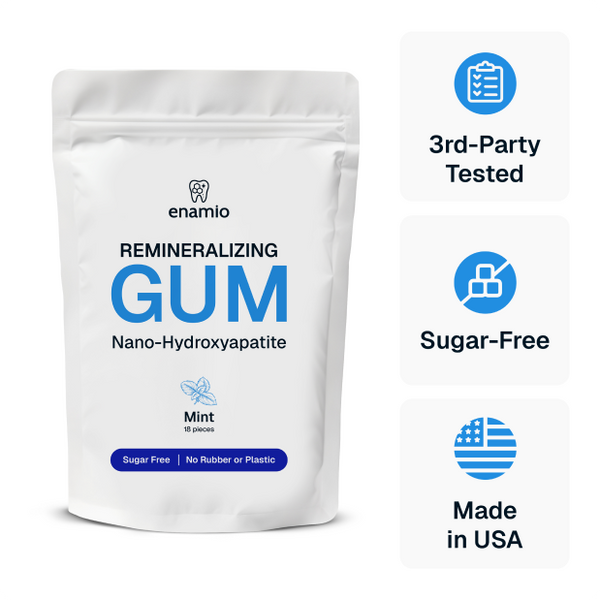
On-the-go mineral support
Keep a pouch in your bag so you can chew right after meals or coffee and shorten your acid window.
Use the buy box above when you are ready to pick a pack size.
How Enamio Works: The Mineral System
Enamio doesn't just focus on one thing—it attacks the problem from multiple angles. We combine nano-hydroxyapatite with pH-buffering ingredients, calcium sources, and bacterial management compounds. Each piece has a job to do in getting your enamel back in shape.
Formula snapshot: Nano-HA (20 nm) for enamel integration, arginine bicarbonate for pH recovery, calcium glycerophosphate and magnesium for mineral supply, xylitol for bacterial balance, plus botanicals for texture and freshness.
Nano-Hydroxyapatite (20 nm Carbonate Form) for Enamel Repair
We use carbonate-substituted nano-hydroxyapatite at 20 nanometers in our tooth remineralizing gum. Why that specific size? Because it matches the natural building blocks of your enamel, which means it can actually integrate into the weak spots and support enamel remineralization. [6]
The carbonate part matters too. Your natural enamel isn't pure hydroxyapatite—it's a carbonate-substituted version where some phosphate groups get swapped out for carbonate. That makes the crystals slightly more soluble and more responsive when your body tries to fix them. By matching this exact chemistry, our nano-HA can slip right into your existing enamel structure.
Lab studies are pretty impressive. A 10% nano-HA formula with 20 nm particles boosted enamel microhardness by 47% over 28 days on demineralized teeth. [6] Sure, gum delivers less per chew than toothpaste, but you're chewing for several minutes and (ideally) doing it every day. That sustained contact adds up. Want to know more about safety? Read our complete nano-hydroxyapatite safety guide covering regulatory approval and clinical research.
Calcium Glycerophosphate and Magnesium Citrate
Calcium glycerophosphate is our go-to calcium and phosphate source because your body can actually absorb it, and it doesn't clump up into useless precipitates. Research shows it can seriously boost remineralization by ramping up the ion concentration right where you need it—at your tooth surface. [10] [14]
Magnesium citrate pulls double duty. The magnesium can actually fit into your hydroxyapatite structure, and the citrate keeps calcium dissolved while you're chewing. Some research even suggests magnesium might help strengthen the new mineral deposits, though we'd love to see more clinical data on that.
When you put these together, you get mineral-loaded saliva while you chew and for a bit after. The gum base releases ions slowly, so your teeth get a steady supply for several minutes. That's enough time for minerals to deposit where they need to go.
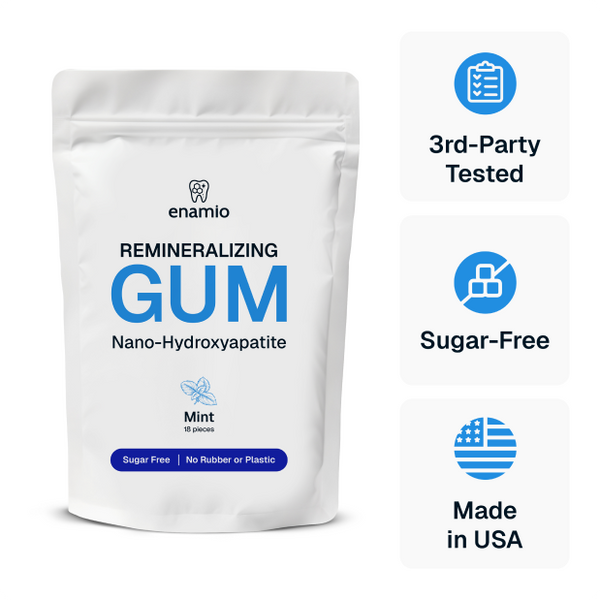
Mineral stack in one chew
Calcium glycerophosphate, magnesium citrate, and nano-HA work together while you chew.
L-Arginine Bicarbonate for pH Support
L-arginine bicarbonate goes after the acid problem directly. It activates something called the arginine deiminase system in your plaque bacteria, which helps neutralize acids as they're being made. Studies found that toothpaste with 1.5% arginine bicarbonate cut new cavities by 21% over a year compared to regular fluoride toothpaste. [8]
The bicarbonate buffers acid right away, while the arginine does its thing at the bacterial level. You get fast pH recovery that keeps going because it's actually changing how your bacteria behave. Clinical data shows arginine can raise plaque pH in minutes and shift cavity-causing biofilms to a healthier state in about four weeks. [11]
We include L-arginine bicarbonate at a level that works well with the mineral ingredients. We're not saying it treats disease, but the research is pretty clear that arginine creates a less acidic environment in your mouth—and that's exactly what you want for remineralization to happen.
Xylitol Remineralizing Gum for Cavity Prevention and Bacterial Control
Xylitol is a natural sugar alcohol that cavity-causing bacteria can't ferment into acid. Streptococcus mutans—the main cavity-causing culprit—tries to eat xylitol but ends up making toxic byproducts that inhibit its own growth. Use xylitol gum regularly and your mouth bacteria actually shift toward less harmful species, reducing your cavity risk.
One clinical trial with 132 people tested xylitol gum at different doses: 3.44, 6.88, and 10.32 grams per day. At the two higher doses, mutans streptococci in plaque dropped to one-tenth of baseline after five weeks and stayed eight to nine times lower at six months. [9] Another study showed xylitol knocks down S. mutans without hurting the good bacteria. [12]
We use USP-grade xylitol as our main sweetener. If you use Enamio at the frequency we recommend, you'll hit that effective daily range. The bacterial control works alongside the mineral delivery—you're hitting decay from both angles at once. Want more details on dosing and safety? Read our complete xylitol guide covering benefits, optimal dosing, and safety research.
Xylitol dosing sweet spot
The research shows 6-10 grams of xylitol daily is where you see real bacterial changes. Chewing 3-4 pieces of xylitol gum after meals gets you into that range without overdoing it.
Sweetener callout
This tooth remineralizing gum uses monk fruit and xylitol instead of sugar or artificial sweeteners. That keeps pH impact low while delivering the mineral system every time you chew.
Botanical Support (Matcha, Bamboo Silica, Zinc)
We've also included three botanical and mineral ingredients that help with function and mouthfeel. Matcha green tea extract brings polyphenols (especially epigallocatechin gallate) that have antimicrobial and antioxidant properties. The evidence isn't as strong as what we have for nano-HA or xylitol, but some research suggests green tea catechins can help balance your oral biofilm and keep your breath fresh.
Bamboo silica gives a gentle polish and improves the gum base texture. It's a natural mineral that helps with surface cleaning without being as abrasive as synthetic alternatives.
Zinc gluconate is our bioavailable zinc source. Zinc kills microbes and might help keep plaque down. Some studies suggest it's good for gum tissue too, though we need more clinical trials to nail down the exact dose-response. We include it as part of the overall mineral system.
These are supporting ingredients, not primary actives. They don't replace the main remineralizing ingredients, but they round out the formula. We want to support your teeth and gums from multiple angles, not just one.
Strengthen Your Enamel, Anytime
Try Enamio's complete mineral system with 20 nm nano-HA, arginine pH support, and xylitol.
Shop Remineralizing GumHow to Use Tooth Remineralizing Gum for Best Results
Timing matters. So does technique. If you want tooth remineralizing gum to actually work, chew it right after meals for maximum pH-buffering. Go for at least five to ten minutes to keep that saliva flowing and minerals delivering. And remember—remineralizing gum is part of your oral care routine, not a replacement for brushing and flossing.
Best Times to Chew (Post-Meal Protocol)
The sweet spot is within five minutes after you eat or drink. That's when your pH tanks below the safe zone and demineralization kicks off. If you chew during this window, you can neutralize those acids in 3 to 5 minutes instead of waiting 20 to 30 minutes. [15]
Finish your meal and pop a piece right away. Had coffee or OJ? Same deal—chew immediately to cut down how long your enamel sits in that acidic bath. You want to shrink the damage window and expand the repair window.
You can also chew between meals if you want extra mineral delivery. A mid-morning or mid-afternoon piece can keep your pH more neutral all day. That said, gum can't replace brushing and flossing. Gum can't scrub away plaque—you still need the mechanical action.
The 5-minute window
Your mouth's pH drops immediately after eating and stays acidic for 20-30 minutes. Chewing gum within 5 minutes can neutralize that acid in just 3-5 minutes—cutting the damage window by 80%.
Routine reset: Keep a small stash at your desk, gym bag, and car so you never miss the post-meal window. Pair each chew with a glass of water to speed pH recovery.
Recommended Chewing Duration (5-10 Minutes)
Research shows saliva flow benefits max out around ten minutes of chewing. Your flow stays high while you're chewing and tapers off after. [7] If you quit before five minutes, you might not fully stimulate your salivary glands or get enough active ingredients out of the gum.
Five to ten minutes is the sweet spot—effective but not annoying. Going longer doesn't help much and might just make your jaw tired. If you prefer shorter sessions, at least hit that five-minute mark to ensure you're producing enough saliva.
Pro tip: set a timer or chew while you clean up after eating. After a few days, it becomes habit.
Daily Frequency Guidelines
Most xylitol gum studies use three to four sessions per day. That frequency gets you into the effective range of 6 to 10 grams of xylitol daily while hitting multiple meals. [9] Chew after breakfast, lunch, and dinner and you've got three chances to deliver minerals and buffer pH.
If you're high-risk for cavities or you snack on acidic stuff a lot, chew more often. Some people chew after every drink or snack. There's no hard limit as long as you don't overdo xylitol. Most adults handle up to 50 grams a day without stomach issues, though you only need 6-10 grams for oral health benefits.
New to xylitol? Start with two pieces a day and work your way up. Your gut needs time to adjust. Side effects like bloating or loose stools are rare at normal gum-chewing amounts, but they can happen if you go from zero to high doses overnight.
Ready for your daily rotation
Grab a 4 or 8 pack so each meal has a chew ready for pH recovery and mineral delivery.
Aim for consistency. The easiest routine is one chew after meals.
Combining with Brushing and Flossing
Remineralizing gum is an add-on, not a substitute. Brushing twice a day gets rid of plaque biofilm that gum can't touch. Flossing cleans between your teeth where gum never reaches. You need all of this together to create the best environment for remineralization.
Use the gum between brushing sessions. A typical day looks like this: brush in the morning, chew after breakfast, chew after lunch, chew after dinner, brush before bed. That's five chances for remineralization while you're still controlling plaque mechanically.
Using fluoride toothpaste? You can still use nano-hydroxyapatite gum. They work through different mechanisms and don't mess with each other. Some people go fluoride-free and use nano-HA toothpaste and gum together. Both approaches work as long as you're consistent.
Chew for 5-10 minutes after meals to maximize pH buffering and mineral delivery.
Skip brushing and flossing. Gum can't replace mechanical plaque removal.
Best Tooth Remineralizing Gum: Enamio vs Competitors
The tooth remineralizing gum category is still pretty new, so formulations vary widely. Most brands focus on one aspect—either minerals OR xylitol OR pH buffering—but not all three. Enamio is the only remineralizing gum that combines clinically-researched nano-HA at the optimal 20 nm size, multi-mineral delivery, pH support, and xylitol in one formula.
You'll see brands like Underbrush, Spry, PUR, Simply Gum, Glee Gum, and True Gum when you search around. Most fall into one of two categories: xylitol gums with no minerals, or mineral gums with vague "hydroxyapatite" claims but no particle size disclosure (which means you have no idea if it can actually penetrate your enamel).
Enamio is the only remineralizing gum that discloses the exact particle size (20 nm)—the same size as your natural enamel crystals. That 20 nanometer spec isn't random—studies show particles at that size actually integrate into your enamel's crystal structure instead of just sitting on the surface. [6] If a brand won't tell you the particle size, there's a reason.
Why Enamio is different
✓ Only gum with disclosed 20 nm particle size – Competitors hide this because larger particles don't penetrate enamel
✓ 4-way protection system – Minerals + pH buffering + bacterial control + saliva stimulation (competitors pick 1-2)
✓ Research-backed dosing – Arginine bicarbonate at clinically-effective levels, not trace amounts
✓ No artificial sweeteners – Xylitol + monk fruit instead of aspartame or sucralose
Any sugar-free gum will boost saliva. But if you're serious about enamel remineralization—not just fresh breath—you need the complete system. You need minerals that can actually penetrate, pH buffering that cuts acid exposure by 80%, and xylitol at therapeutic doses. That's Enamio.
What to look for on the label
Check for: (1) A disclosed mineral active—look for "nano-hydroxyapatite" with a particle size listed, or calcium phosphate compounds. (2) Xylitol as the primary sweetener, not just a minor ingredient. (3) No long list of artificial additives or vague "natural flavors" without specifics.
People Also Ask
What is tooth remineralizing gum and how does it work?
Tooth remineralizing gum is sugar-free chewing gum formulated with minerals like nano-hydroxyapatite to help repair tooth enamel. It works by boosting saliva flow (which naturally contains calcium and phosphate) and delivering additional minerals directly to your teeth while you chew. [16] [5] The most effective formulas—like Enamio—combine nano-HA with pH buffering and xylitol for complete enamel support.
Does tooth remineralizing gum actually work for cavities?
Tooth remineralizing gum works for early enamel mineral loss and white spot lesions—not full cavities. Chewing sugar-free remineralizing gum supports your saliva's natural repair process, and ingredients like nano-hydroxyapatite have solid research backing for cavity prevention and early enamel repair. [16] [5] For best results, choose a gum like Enamio that discloses the exact nano-HA particle size (20 nm) and includes pH-buffering ingredients—most brands skip these crucial details.
How long does tooth remineralizing gum take to work?
You'll get saliva and acid-buffering benefits right away while you're chewing. But if you want to see changes in sensitivity or those early white spots, you'll need to stick with it for weeks. How fast you see results depends on your diet, whether you have dry mouth, and how consistently you chew after meals. [16] [5]
Does xylitol gum help prevent cavities and tooth decay?
Yes, xylitol gum can help prevent cavities when you use it as part of your daily oral health routine, especially if you spread out the doses during the day. Xylitol reduces cavity-causing bacteria in your mouth. The research shows varying strength, so consistency is key for cavity prevention. [17]
Is nano-hydroxyapatite safe for teeth?
Yes, nano-hydroxyapatite is safe for teeth. Hydroxyapatite is literally the same mineral your tooth enamel is made of. Dental research calls it "biomimetic," meaning it matches what your body already has. [5] [6] Enamio uses pharmaceutical-grade nano-HA at 20 nm—the clinically-proven size for enamel integration. Always choose products from reputable brands that disclose particle size and use tested ingredients.
Can you remineralize a cavity with remineralizing gum?
You can remineralize early-stage tooth decay (white spot lesions) where the enamel surface is still intact. But once you have an actual cavity with a break in the enamel or decay that reaches the dentin, remineralizing gum won't fix it. You'll need professional dental treatment. [3]
Frequently Asked Questions
How often should I chew tooth remineralizing gum?
Most studies use 3-4 sessions per day, usually after meals. That helps you spread xylitol throughout the day and gives your teeth multiple chances to grab those minerals. New to xylitol? Start with 2-3 pieces daily and work your way up.
Is tooth remineralizing gum safe for kids?
Sugar-free gum is definitely better than sugar gum. But wait until your kid can chew gum without swallowing it. Start with 1-2 pieces a day to see how they tolerate it. If your child's at high risk for cavities, check with your pediatric dentist about what makes sense for them.
Can I chew remineralizing gum if I have dental work like fillings or crowns?
Yes, you're safe with fillings, crowns, bridges, and most dental work. The gum base isn't sticky and won't damage or pull out your restorations if you chew normally. The minerals can actually help the natural tooth around your dental work. Got temporary restorations, fresh crowns, or braces? Check with your dentist first. And if you have TMJ or jaw pain, go easy or keep chewing sessions short.
Will remineralizing gum replace my toothpaste?
No, it's an add-on, not a substitute. You still need to brush with toothpaste (fluoride or nano-HA) to get rid of plaque biofilm. Floss to clean between teeth. Gum just delivers minerals and buffers pH between brushing sessions. A solid routine means brushing twice a day, flossing daily, and chewing remineralizing gum after meals. Each tool does its own thing.
How is nano-hydroxyapatite different from fluoride?
Both help with remineralization but in different ways. Fluoride converts your enamel surface into a more acid-resistant form. Nano-hydroxyapatite deposits a biomimetic mineral onto weakened enamel. Some people use fluoride toothpaste and mineral gum together. Others go completely fluoride-free. Both can work.
Does tooth remineralizing gum have side effects?
Most people handle sugar-free gum just fine. The main thing to watch for is mild stomach upset if you ramp up xylitol too quickly. Start low, go slow, and stop if you feel off. Got jaw pain or TMJ? Keep your sessions shorter.
The Bottom Line: Why Most Remineralizing Gums Fall Short
After reviewing the research on tooth remineralization, here's what's clear: most "remineralizing" gums on the market are incomplete formulas.
They either give you xylitol with no minerals, or minerals with unknown particle sizes that can't penetrate your enamel, or they skip pH buffering entirely. Without all three components working together—mineral delivery + pH control + bacterial management—you're not getting true remineralization support.
Enamio is the only gum that addresses all three mechanisms with research-backed ingredients at effective doses. The 20 nm nano-HA particle size isn't marketing fluff—it's the exact size that lets particles integrate into your enamel crystal structure. The arginine bicarbonate pH buffer cuts your acid exposure window by 80%. The therapeutic-dose xylitol shifts your oral bacteria toward healthier species.
If you've got white spots on your teeth, if you drink coffee or acidic drinks regularly, if you want to support your enamel between brushing sessions—don't settle for incomplete formulas. Get the complete system.
References
- Global Oral Health Status Report 2022, World Health Organization (WHO), November 2022, https://www.who.int/news-room/fact-sheets/detail/oral-health
- Dental Caries in Adults (Age 20 to 64), National Institute of Dental and Craniofacial Research (NIDCR), 2019, https://www.nidcr.nih.gov/research/data-statistics/dental-caries/adults
- The Delicate Balance of Remineralization and Demineralization, Decisions in Dentistry, 2024, https://decisionsindentistry.com/article/delicate-balance-remineralization-demineralization/
- Effects of Chewing Different Flavored Gums on Salivary Flow Rate and pH, International Journal of Dentistry (PMC), 2012, https://pmc.ncbi.nlm.nih.gov/articles/PMC3312213/
- Nano-Hydroxyapatite (nHAp) in the Remineralization of Early Dental Caries: A Scoping Review, International Journal of Environmental Research and Public Health (PMC), May 2022, https://pmc.ncbi.nlm.nih.gov/articles/PMC9102186/
- Enamel Surface Remineralization: Using Synthetic Nanohydroxyapatite, Journal of Dental Research (PMC), 2013, https://pmc.ncbi.nlm.nih.gov/articles/PMC3636833/
- The Effects of Prolonged Gum Chewing on Salivary Flow Rate and Composition, Archives of Oral Biology (PubMed), 2004, https://pubmed.ncbi.nlm.nih.gov/15196984/
- The Role and Impact of Arginine on Dental Caries Therapeutics, American Dental Association (ADA), 2024, https://pages.ada.org/jadaplus_arginine/the-role-and-impact-of-arginine-on-dental-caries-therapeutics
- Mutans Streptococci Dose Response to Xylitol Chewing Gum, Journal of Dental Research (PMC), 2006, https://www.ncbi.nlm.nih.gov/pmc/articles/PMC2225984/
- The Remineralization Effect of Calcium Glycerophosphate in Fluoride Mouth Rinse, Journal of International Society of Preventive & Community Dentistry (PMC), 2023, https://pmc.ncbi.nlm.nih.gov/articles/PMC10729885/
- The Effect of Arginine on Oral Biofilm Communities, Molecular Oral Microbiology (PMC), 2014, https://www.ncbi.nlm.nih.gov/pmc/articles/PMC7003997/
- Effect of Xylitol on Cariogenic and Beneficial Oral Streptococci, BMC Oral Health (PMC), 2012, https://pmc.ncbi.nlm.nih.gov/articles/PMC3434645/
- Impact of Demineralization Time on Enamel Microhardness, Journal of Dentistry (PMC), 2024, https://pmc.ncbi.nlm.nih.gov/articles/PMC11931587/
- Biomineralization and Remineralizing Potential of Nanosized Beta-Calcium Glycerophosphate, Odontology (Springer), 2024, https://link.springer.com/article/10.1007/s10266-024-00927-z
- The Oral Health Benefits of Sugarfree Gum, BDJ Team (British Dental Journal), 2015, https://www.nature.com/articles/bdjteam2015151
- Chewing Gum, American Dental Association (ADA), Last Updated May 4, 2023, https://www.ada.org/resources/ada-library/oral-health-topics/chewing-gum
- Xylitol-containing products for preventing dental caries in children and adults, Cochrane Database of Systematic Reviews (PubMed record), March 26, 2015, https://pubmed.ncbi.nlm.nih.gov/25809586/
Start Rebuilding Your Enamel Today
Get the only remineralizing gum with disclosed 20 nm nano-HA particle size and a complete 4-way protection system.
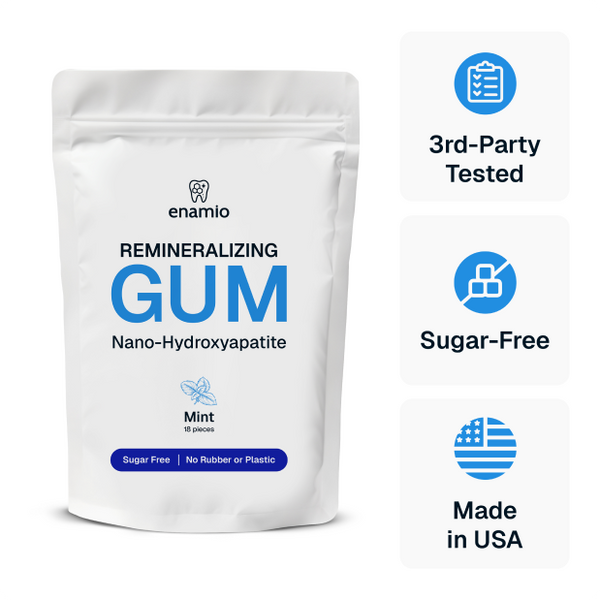
Enamio Remineralizing Gum
The complete enamel support system: 20 nm nano-hydroxyapatite + calcium glycerophosphate + arginine bicarbonate pH buffer + therapeutic-dose xylitol. Two natural flavors (mint & berry), sweetened with monk fruit. Zero artificial ingredients.
What you get:
✓ 15 pieces per pouch (15-20 day supply per pouch)
✓ Cuts acid exposure window by 80% when chewed after meals
✓ Research-backed ingredients at effective doses
✓ Works between brushing sessions to keep teeth in repair mode
Starting at $19.99 for a 2-pack (choose your pack size and flavor on the product page)
Reading Next
Is Nano-Hydroxyapatite Safe?
What the safety research says, where it stands with regulators, and its clinical track record in oral care.
Xylitol for Oral Health: Benefits, Dosage & Safety
A simple dose guide, key safety info, and how to make it part of your daily routine.
Share
Medical Disclaimer
This article is for educational purposes only and does not constitute medical or dental advice. Remineralizing gum is not intended to diagnose, treat, cure, or prevent any disease. Individual results may vary. Consult your dentist before starting any new oral care regimen, especially if you have existing dental conditions or concerns.
About This Article
Written by Enamio Science Review Team
Our team reviews current evidence on remineralization, nano-hydroxyapatite, xylitol, and safer sweeteners so you can make informed choices about your oral health.