
Why Does Remineralizing Gum Crumble When You Chew? And How Enamio Fixed It
Why Does Remineralizing Gum Crumble When You Chew? The Real Science—and How Enamio Fixed It
If you’ve ever wondered “why is reminerialising gum crumbeling when i chew” (or “why is remineralizing gum crumbling when I chew?”), you’re not alone. This guide explains the materials science behind natural gum bases, how mineral loads can affect texture, and why Enamio Remineralizing Gum chews like a classic—without plastic or rubber.
- Natural resins like chicle and mastic can feel brittle at first; the right balance of waxes + plasticizers prevents crumbling. [6–8]
- High mineral loading (e.g., hydroxyapatite powders) can turn gum chalky unless particle size and binders are optimized. [5,10,15]
- Enamio’s base is plant-derived (chicle + candelilla) made to match traditional chew while delivering nano-hydroxyapatite (~20–50 nm) for enamel support. [3–5]
- Real-world perk: sugar-free chewing increases saliva flow and helps pH recovery after meals—key for enamel health. [1–2,14]
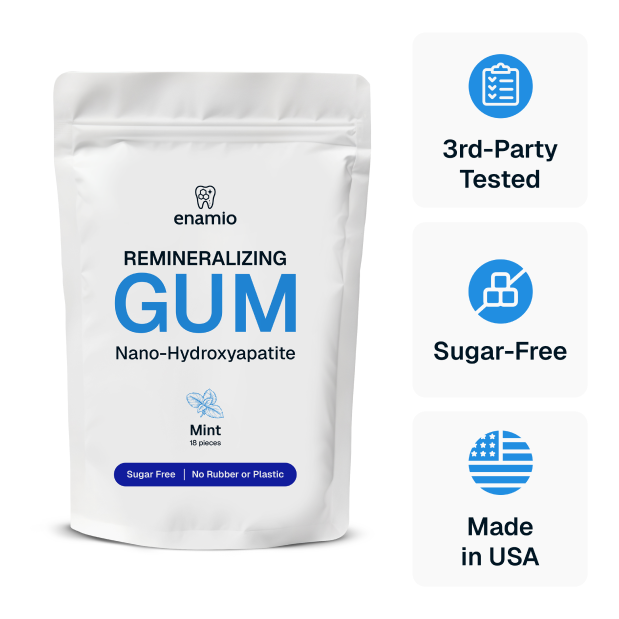
Image: Enamio Remineralizing Gum (plant-based base; nano-hydroxyapatite)
Problem: Why natural-base gums can crumble
Short version: Natural plant resins (e.g., chicle, mastic, spruce) behave differently than modern synthetic elastomers. Without the right balance of waxes and plasticizers (moisture-retaining softeners like glycerin), a gum can start brittle, break into pieces, or feel chalky before it warms and coheres. [6–8,16]
Two extra factors often get overlooked:
- Mineral payloads (like hydroxyapatite or calcium salts) are powders. Too large a particle size or too high a loading creates a composite that fractures early in the chew. [5,15]
- Ambient humidity & storage change gum softness: lower humidity + too little plasticizer risks crumbling; higher humidity can make it sticky. [6–8]
For example, mastic resin (famously used as a natural chew) is known to crumble initially before warming into cohesion—this is expected behavior of the resin, not a defect. [9]
The Science: Base, plasticizers, particle size & pH ecology
1) Gum base architecture
All gum bases—natural or synthetic—combine resins (the chew), waxes (soften), and elastomers (flex). [16] Natural bases can feel “glassy” when cold; proper wax/plasticizer ratios keep them cohesive during the first minute of chewing. [6–8]
2) Plasticizers prevent crumbling
Glycerin is commonly used to hold moisture and reduce brittleness—i.e., to stop a gum from crumbling. [7] In pharmaceutical gum research, glycerin and related plasticizers are standard for texture control and cohesiveness. [6]
3) Mineral powders change mouthfeel
Remineralizing actives like nano-hydroxyapatite (n-HA) and calcium salts are powders dispersed in the base. If particles are too large or poorly bound, the chew can feel gritty or crumble under shear. Studies show that enamel’s basic building blocks are nanoscale (≈ 20–40 nm), and n-HA in the ~20–50 nm range adheres best to microscopic defects. [3–5]
Clinical and in vitro evidence suggests HAp/n-HA can support sensitivity relief and surface repair; one controlled trial found HAp-gum significantly reduced dentin hypersensitivity versus placebo. [5]
4) Saliva, pH & biome
Chewing any sugar-free gum boosts salivary flow and raises pH—helpful after meals. Reports cite ~10–12× peak increases above resting flow in healthy adults. [1–2,14] Formulas with xylitol can reduce plaque levels and caries risk in higher-risk groups. [10,13]
Enamio goes further: L-arginine fuels the arginine deiminase system (ADS) in commensal bacteria to produce ammonia and stabilize plaque pH; Ca-glycerophosphate and magnesium support mineral availability; zinc helps curb biofilm activity and malodor. [10–12,18]
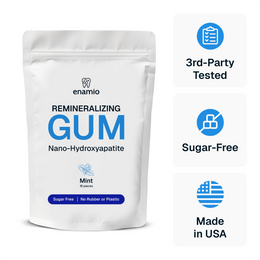
Try Enamio — The Classic Chew, Upgraded
Plant-based base (chicle + candelilla) engineered for non-crumbly chew + the highest concentration of nano-hydroxyapatite of any gum—plus xylitol, CaGP, arginine, zinc, and matcha extract.
Shop Enamio Remineralizing GumHow Enamio Fixes the Crumble—Without Compromising the Science
- Precision base tuning: natural chicle + candelilla wax balanced with humectants to maintain cohesion from the first bite through a full chew cycle. [6–8,16]
- Right-sized minerals: carbonate n-HA (~20–50 nm) to match enamel nanodefects and avoid gritty feel; blended with Ca-glycerophosphate and magnesium citrate for bio-available ions. [3–5,11]
- pH ecology support: L-arginine bicarbonate for ADS alkalinity; xylitol USP to reduce cariogenic load; zinc gluconate for biofilm and breath control; matcha extract antioxidants. [10–12,18]
- Flavor & feel: natural mint oils, carefully screened so they don’t disrupt base cohesion.
Want the deep dive? Explore our primers on nano-hydroxyapatite gum science, xylitol & enamel, ingredient benefits, and whether remineralizing gum really works.
How to Use Remineralising Gum for Best Texture & Results
- Start at room temp. Very cold gum can feel brittle at the first bite; room temp helps the base cohere faster. [6–8]
- Hydrate first. A few sips of water plus chewing boosts stimulated saliva and pH. [1–2]
- Chew 10–20 minutes. Saliva flow remains above baseline across the session; many studies show sustained pH benefits. [14]
- Consistency wins. For xylitol benefits, aim for several small exposures per day (total ≈ 5–10 g/day in clinical literature). [10,13]
Comparison: Enamio vs. Natural-Base Alternatives
Notes: Public ingredient claims are sourced from brand sites; texture experience varies by user and batch. We reference mastic/chicle behavior broadly in the literature. [7–9,16–17]
*Sources: Underbrush product page, Refresh Gum site. See also literature notes on mastic behavior. [9]
People Also Ask
- Why is reminerialising gum crumbeling when I chew?
- Is crumbling normal with mastic/chicle gums?
- Does nano-hydroxyapatite make gum chalky?
- How do I stop natural gum from crumbling?
- Which remineralizing gum chews like traditional gum?
- How often should I chew for enamel support?
Why is reminerialising gum crumbeling when I chew?
Is crumbling normal with mastic/chicle gums?
Does nano-hydroxyapatite make gum chalky?
How do I stop natural gum from crumbling?
Which remineralizing gum chews like traditional gum?
How often should I chew for enamel support?
Quick Stats That Matter
What’s Inside Enamio (and Why It Matters)
- Gum base: chicle + candelilla wax + a touch of citric acid (plant-based, plastic-free)
- Sweeteners: xylitol USP + monk fruit
- Remineralizing actives: carbonate nano-hydroxyapatite (~20 nm), calcium glycerophosphate, magnesium citrate, L-arginine bicarbonate, bamboo silica, zinc gluconate
- Biofilm/antioxidants & flavor: matcha green tea extract, natural mint oils
Learn more: Full ingredient explainer • Which gum actually helps enamel? • Can you rebuild tooth enamel?
Related Reading
Does Remineralizing Gum Actually Work?
Clinically grounded overview of gum-based enamel support.
Nano-Hydroxyapatite Gum: Why Particle Size Matters
How 20–50 nm particles interact with enamel microdefects.
How to Use Remineralizing Gum (2025)
Practical steps for after-meal pH support.
References
- BDJ Team: Oral health benefits of sugar-free gum (2015) — 10–12× saliva flow increase. [1]
- American Dental Association: Chewing Gum. [2]
- Hydroxyapatite in Oral Care Products—Review (2021). [3]
- n-HAp in Remineralization—Review (2022). [4]
- Clinical study: HAp-chewing gum & dentin hypersensitivity (2014). [5]
- Medicated chewing gum formulation review (2015). [6]
- What is chewing gum made of? (2025) — glycerin helps prevent crumbling. [7]
- Science in School: Polymer balance & gum falling apart (2008). [8]
- Chewing instructions: raw mastic can crumble first. [9]
- Systematic review: xylitol gum reduces plaque. [10]
- Ca-glycerophosphate remineralization (2023). [11]
- Zinc & oral health: plaque/calculus/odor (2020). [12]
- Meta-analysis: xylitol dose & frequency (2022). [13]
- Prolonged chewing: flow & pH above baseline (2004). [14]
- Recommended ~20 nm n-HA dimension (2020). [15]
- Underbrush product page (natural resins noted). [16]
- Refresh Gum homepage. [17]
- ADA JADA+ Arginine & pH stabilization (2024). [18]
Educational content only; not medical advice. Talk to your dentist for personalized care.
