xylitol gum: science, dosing, and the better way to rebuild | Enamio
xylitol gum: the complete 2025 guide to what works and what to buy
What xylitol gum can do for your teeth, what it cannot, and how to choose a science-first option that actually supports enamel.
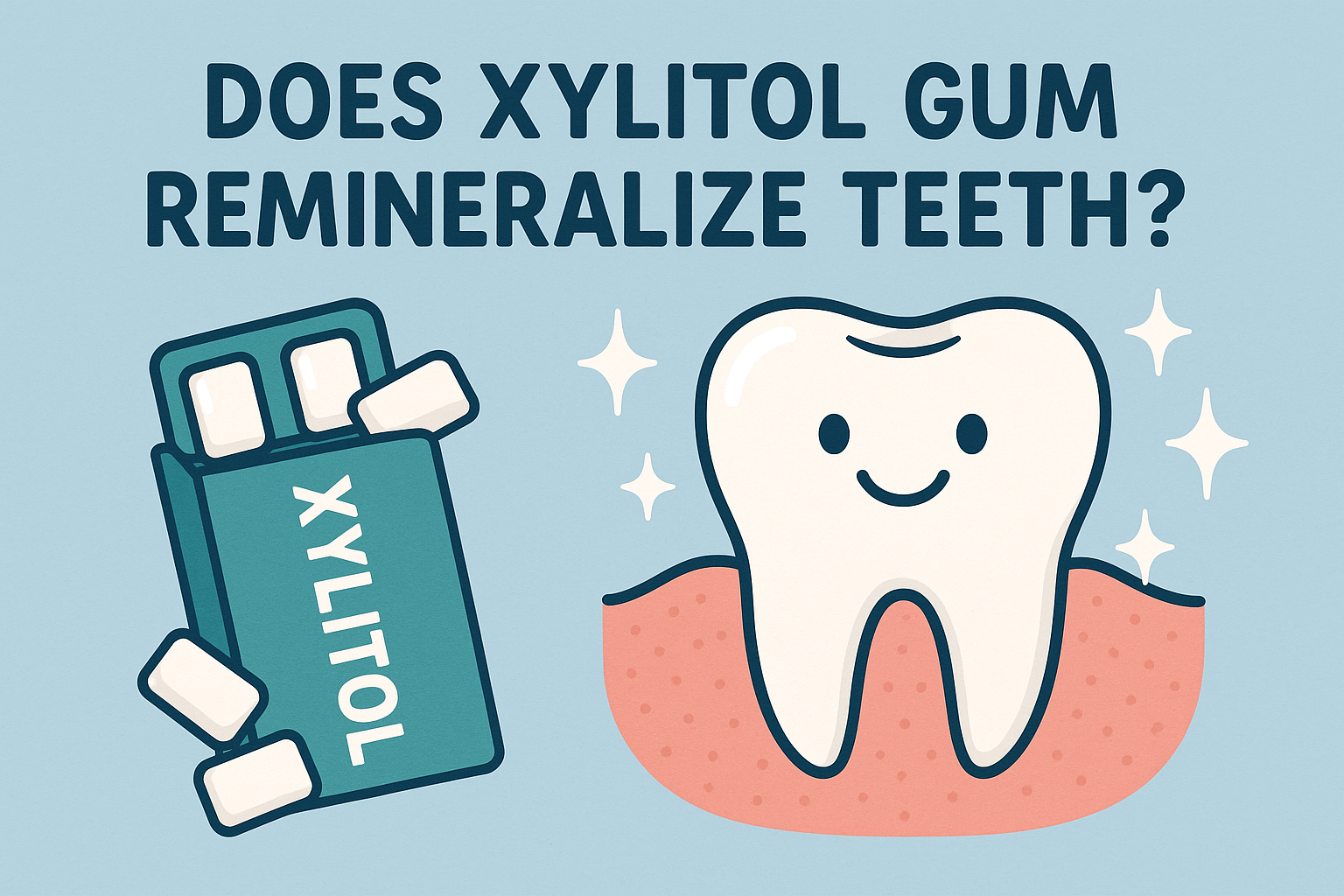
Want a fast verdict first? Read our short explainer, Does Xylitol Gum Remineralize Teeth?
The Problem: acid attacks strip minerals faster than most habits replace them
After you eat, plaque bacteria ferment carbs and drop pH. When pH sits near or below ~5.5, enamel loses calcium and phosphate[3]. You want that low‑pH time short, and you want minerals in the saliva pool for a net gain.
Here is why this matters. The classic Stephan curve shows a fast fall after sugar, then a slow recovery. Chewing sugar‑free gum speeds that rebound by raising saliva and buffers[1].
The Science: what xylitol gum does, and what it does not do
What xylitol gum does and does not do
- Raises saliva and helps neutralize plaque acids after meals. European authorities accept that sugar‑free gum neutralizes plaque acids, which supports caries prevention[2].
- Is not fermented by cariogenic bacteria, so less acid forms than with sugar. ADA resources align with using sugar‑free gum after meals for about 20 minutes[1].
- Does not supply enamel minerals by itself. Remineralization needs calcium and phosphate from saliva or added actives like hydroxyapatite or calcium salts[6].
Evidence snapshots help set expectations. A large adult RCT of xylitol lozenges showed a small, non‑significant caries reduction over 33 months[4]. Reviews of xylitol products show mixed effects by format and dose[5]. Chewing still helps pH recovery[1], but mineral donors boost outcomes.
Why pairing xylitol with mineral donors matters
- Nano‑hydroxyapatite (n‑HA): Multiple randomized trials report fluoride‑free hydroxyapatite toothpaste can be non‑inferior to standard fluoride toothpaste for preventing early lesions[7][8]. It supplies enamel‑matching minerals that can integrate into micro‑defects.
- Calcium glycerophosphate (CaGP): In situ gum studies show calcium phosphates enhance remineralization compared with sugar‑free gum alone[6].
- Arginine (ADS): Arginine‑based formulas can raise plaque pH and may reduce caries in clinical settings; a 2025 press summary reported reductions with 8% arginine dentifrice[9].
How Enamio Works: stacked actives for the post-meal window
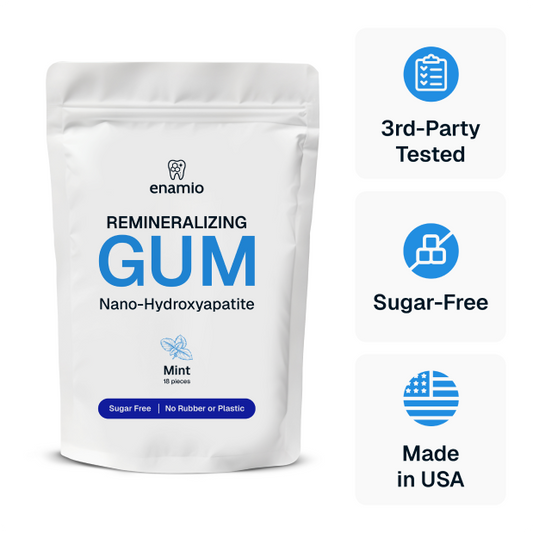
Enamio was built for the 15–20 minute window after meals. We pair ~20 nm carbonate nano‑hydroxyapatite with calcium glycerophosphate and L‑arginine bicarbonate to supply and keep minerals bioavailable while you chew. Xylitol USP supports saliva and a lower‑acid environment. Matcha green tea extract and zinc gluconate support a healthier biofilm, while magnesium citrate and bamboo silica round out the mineral matrix and gentle polish.
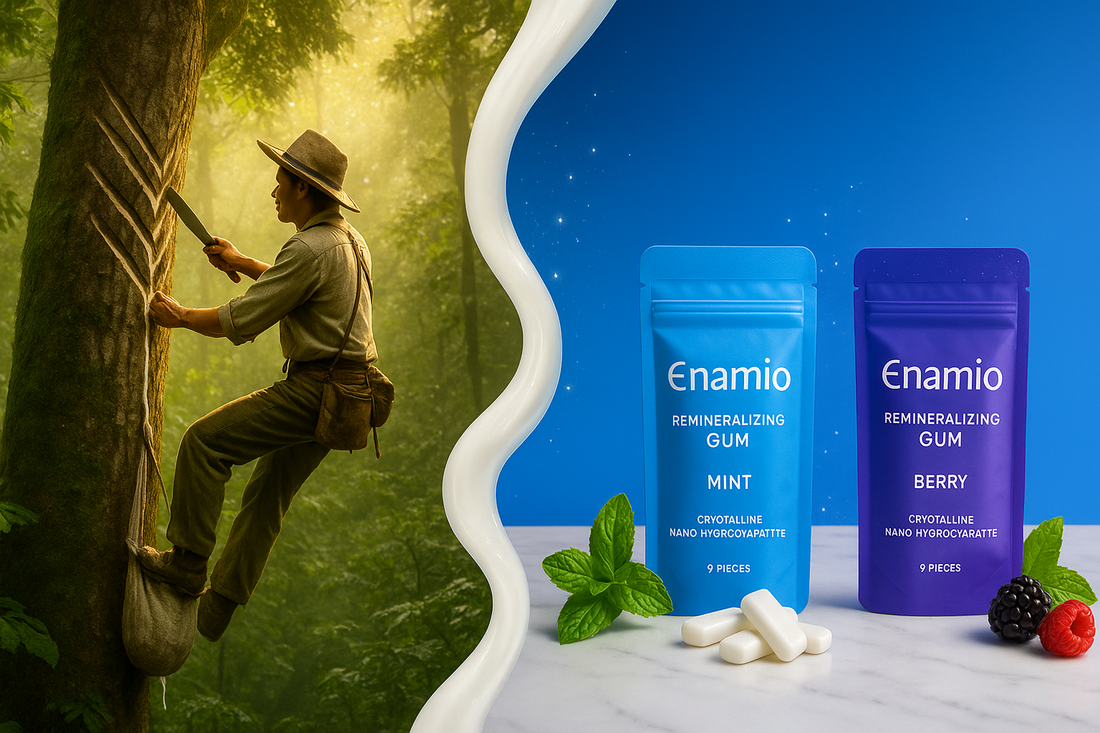
We use a natural chicle + candelilla base with no plastics or synthetic rubber. The result is a clean chew that delivers minerals when your mouth is primed to use them. For the underlying science on n‑HA, CaGP, and arginine, see the references below[7][6][9].
Strengthen Your Enamel, Anytime
Shop Enamio xylitol gumHow to Use xylitol gum for real-world results
- Timing: After meals or acidic drinks. Chew ~20 minutes to support pH recovery and saliva flow[1].
- Dose: Many studies use total xylitol intakes around 4–15 g/day spread across the day. Start low if you are GI‑sensitive[10].
- Stack the actives: Use Enamio during that post‑meal window so n‑HA and CaGP are present while saliva flows[7][6].
- Safety notes: Xylitol can cause GI upset at higher, one‑time doses. Xylitol is dangerous for dogs. Store all xylitol gum securely[10][12].
Want a playbook for daily use? See our How to Use Remineralizing Gum guide and our n‑HA gum science explainer.
Enamio vs Competitors
Labels tell the story. We looked at base materials, sweeteners, and whether a gum adds mineral donors or pH buffers. Ingredient sources are linked below each brand row.
| Brand | Base / Sweetener | Key Active(s) | Mechanism & Evidence | Practical Benefit |
|---|---|---|---|---|
| Enamio | Chicle + candelilla / Xylitol + monk fruit | ~20 nm n‑HA, CaGP, arginine, Mg, Zn, bamboo silica, matcha | n‑HA supplies enamel‑matching mineral; CaGP donates Ca/P; arginine supports higher plaque pH; sugar‑free chew raises saliva[7][6][9][1]. | Best choice if you want xylitol plus direct mineral delivery during the post‑meal window. |
| Nathan & Sons Underbrush | Plant gum base / polyols | Lists nano‑hydroxyapatite and natural resins | Brand listings describe n‑HA; open product records show erythritol among sweeteners. No published RCTs on this gum located[13]. | Mineral‑themed formula; confirm actives and amounts on label. |
| Underbrush (site) | Plant gum base / polyols | Remineralizing “multi‑functional” gum per product page | Site markets enamel support and plastic‑free base. Ingredient images mention natural gums and minerals[13]. | Plastic‑free message; verify exact actives per flavor batch. |
| Refresh Gum | Plastic‑free base / Xylitol + stevia | Flavor botanicals; some flavors include matcha | Plant‑based sweeteners and plastic‑free claims; no mineral donors listed[14]. | Good for a clean label and xylitol; not a mineral‑donor gum. |
| Simply Gum (Sugar‑Free) | Chicle base / Xylitol | No mineral donors listed | Transparency on chicle base; sugar‑free line sweetened with xylitol[14]. | Plastic‑free base with xylitol; not designed for mineral delivery. |
| Glee Gum (Sugar‑Free) | Chicle base / Xylitol | No mineral donors listed | Lists xylitol from birch/beech; classic line uses sugar[14]. | Xylitol format; check your sweetener preference and base. |
| True Gum | Plastic‑free base / Xylitol + stevia | No mineral donors listed | Plastic‑free, palm‑oil‑free; sweetened with xylitol[14]. | Clean base; not a remineralizing stack. |
| Spry | Gum base / Xylitol | No mineral donors listed | Widely available xylitol gum; ingredient lists show standard base and xylitol[14]. | Budget‑friendly xylitol chew; lacks mineral actives. |
| PUR | Gum base / Xylitol | No mineral donors listed | Aspartame‑free xylitol gum; common accessory ingredients[14]. | Aspartame‑free option; no added enamel minerals. |
Want a deeper science read? Try our evidence guide to the best remineralizing gum and our roundup of gums that help repair enamel.
People Also Ask
Is xylitol gum good for teeth? Yes, when you chew it after meals, sugar‑free gum raises saliva and helps neutralize acids. That can lower caries risk as part of a normal hygiene routine. For direct mineral delivery, choose a gum that adds n‑HA or calcium salts[1][2].
Can xylitol gum reverse cavities? Xylitol alone does not rebuild enamel. It helps the conditions for repair. Early lesions need minerals from saliva or actives like n‑HA or CaGP[7][6].
How much xylitol gum per day? Studies and pediatric policy statements often use about 4–15 g/day split into several chews. Tolerance varies. Start low and spread doses through the day[10].
How long should I chew? About 20 minutes after meals aligns with ADA guidance for sugar‑free gum. That timing supports pH recovery and saliva flow[1].
Is xylitol gum safe for kids? Xylitol is widely used in pediatric products, but dosing and format matter. Follow your dentist’s advice and product directions. Keep all xylitol away from dogs[10][12].
What is better than plain xylitol gum? A gum that pairs xylitol with mineral donors like nano‑hydroxyapatite or calcium salts, plus a gentle pH buffer such as arginine, can deliver more direct enamel support[7][6][9].
FAQs
Does Enamio contain plastic or synthetic rubber?
Is nano‑hydroxyapatite safe to chew daily?
Do I still need fluoride toothpaste?

Reading Next
- What Is the Best Remineralizing Gum? — evidence and label cues that matter.
- Nano‑Hydroxyapatite Gum: The Science‑Backed Way — how n‑HA supports enamel.
- How to Use Remineralizing Gum — simple protocols for everyday life.
References
- Chewing Gum, American Dental Association (MouthHealthy), 2023, https://www.mouthhealthy.org/all-topics-a-z/chewing-gum
- Scientific Opinion on the substantiation of health claims related to sugar‑free chewing gum and plaque acid neutralisation, European Food Safety Authority (EFSA Journal), 2010–2011, https://www.efsa.europa.eu/en/efsajournal/pub/1776 and https://www.efsa.europa.eu/en/efsajournal/pub/2266
- Dawes C. What Is the Critical pH and Why Does a Tooth Dissolve in Acid?, Journal of the Canadian Dental Association, 2003, https://www.cda-adc.ca/jcda/vol-69/issue-11/722.pdf
- Hayes C. et al. Xylitol for Adult Caries Trial (X‑ACT), Journal of the American Dental Association, 2013, https://jada.ada.org/article/S0002-8177(14)60565-1/fulltext
- Twetman S., et al. Xylitol‑containing products for preventing dental caries, Cochrane Library, 2015, https://www.cochranelibrary.com/cdsr/doi/10.1002/14651858.CD010743.pub2/full
- Itthagarun A., et al. Remineralizing effects of calcium phosphate chewing gums, Caries Research, 2005, https://pubmed.ncbi.nlm.nih.gov/15914989/
- Schlagenhauf U., et al. Non‑fluoridated microcrystalline hydroxyapatite toothpaste is not inferior to fluoride toothpaste, 2019, https://pmc.ncbi.nlm.nih.gov/articles/PMC6590169/
- Paszyńska E., et al. Hydroxyapatite toothpaste caries‑preventing effect in adults, 2023, https://pmc.ncbi.nlm.nih.gov/articles/PMC10393266/
- IADR. Arginine Dentifrices Significantly Reduce Childhood Caries (press summary), 2025, https://www.iadr.org
- American Academy of Pediatric Dentistry. Policy on Use of Xylitol in Pediatric Dentistry, 2022, https://www.aapd.org/media/policies_guidelines/p_xylitol.pdf
- U.S. Food and Drug Administration. Paws Off: Xylitol is Dangerous for Dogs, 2025, https://www.fda.gov/animal-veterinary/animal-health-literacy/paws-xylitol-toxic-dogs
- Underbrush / Nathan & Sons brand pages and listings (manufacturer and marketplace product pages), 2024–2025.
- Competitor manufacturer pages (Simply Gum, True Gum, Glee Gum, Refresh, PUR, Spry), 2024–2025.
Ready to upgrade from plain xylitol?
Get xylitol plus enamel‑matching minerals in every chew.
Buy Enamio GumKeep learning:
Educational only; not medical advice.