

Best Remineralizing Gum for Sensitive Teeth: An Honest Guide
Share
Published by Enamio ·
Sensitive teeth · Evidence-led guide
What the label should say, what the science really shows, and where a gum stops being enough.
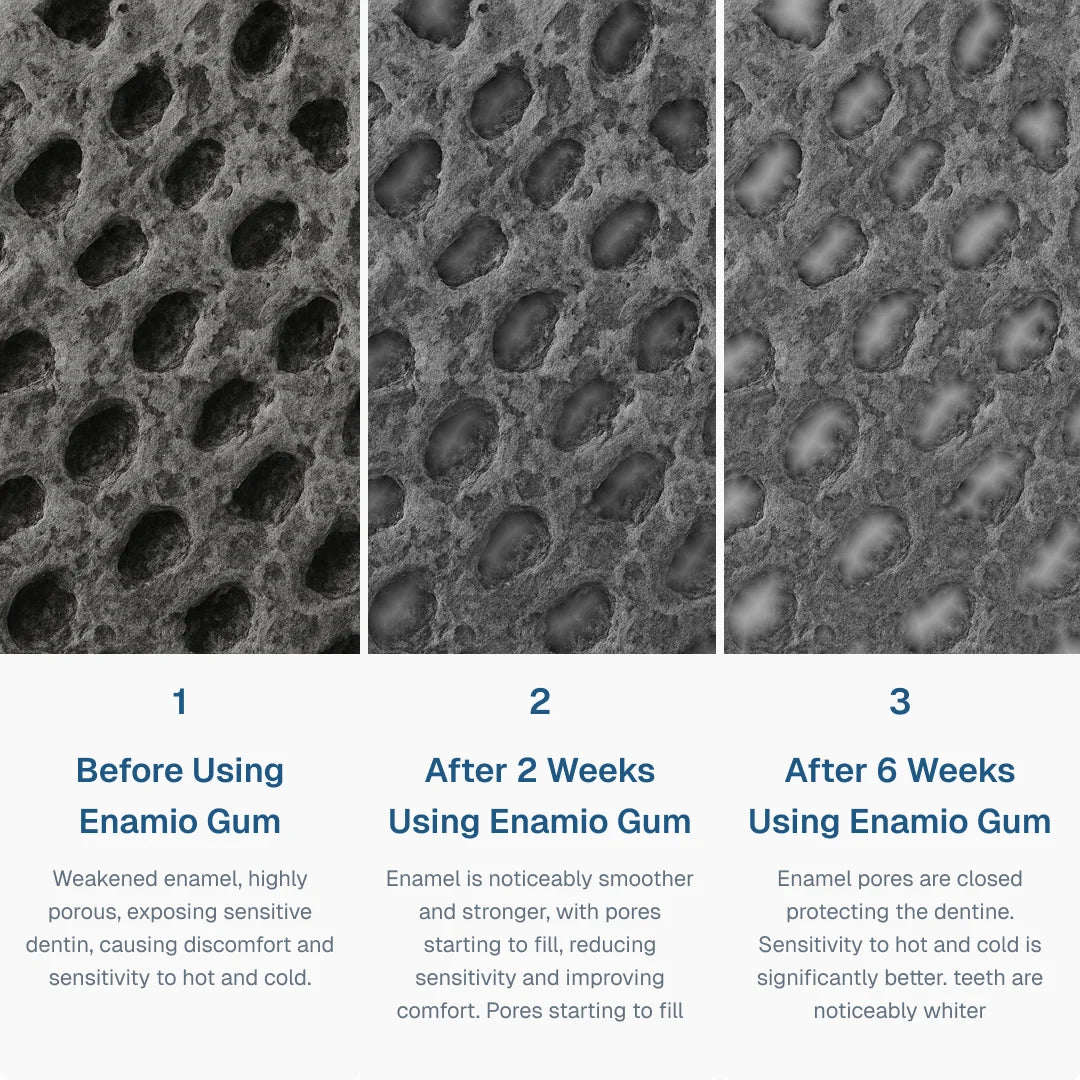
That first sip of iced coffee. The zing when cold ice cream lands on a back tooth. If your teeth flinch at cold, sweet, or sour, you're in good company, and you've probably wondered whether a chewing gum can really help. This guide covers the best remineralizing gum for sensitive teeth, what the science does and doesn't prove, and how to read a label so you pick one that actually fits your mouth.
Quick answer
For sensitive teeth, the best remineralizing gum is a sugar-free one that pairs nano-hydroxyapatite with xylitol and skips added sugar and harsh fruit acids. [5][8][11]
Want the brand's own take first? Here's how Enamio approaches tooth sensitivity relief, then see where Enamio lands on the best remineralizing gum for sensitive teeth checklist if you already know what you're after.
Key Takeaways
- Sensitivity starts when exposed dentin tubules carry cold and sweet to the nerve. [1]
- Look for nano-hydroxyapatite plus xylitol, sugar-free, and no prominent sour or acidic coating. [5][8][11]
- Enamio uses roughly 20 nm nano-hydroxyapatite, arginine, and xylitol in a chicle base. [14]
- No gum reverses a cavity or receding gums, so keep seeing your dentist. [3][6]
In this guide
- 01 -
Why sensitive teeth twinge in the first place
Sensitive teeth twinge because worn enamel or receded gums expose the dentin underneath, and that dentin is full of tiny channels that run straight to the nerve. Dentin tubules are those microscopic tubes inside the tooth. When cold, sweet, or acid reaches them, the fluid inside shifts, the nerve reads that movement as pain, and you get the zing. Dentists call this the hydrodynamic theory, and it's the accepted explanation for everyday sensitivity. [1]
You're far from the only one dealing with it. Reviews put dentin hypersensitivity somewhere around a quarter to a third of adults, with a careful meta-analysis landing on a best estimate near 11.5 percent and a study average of 33.5 percent. [1][2] The range is wide because studies ask the question differently. It tends to peak between ages 30 and 40.
This matters for what you do next, because sensitivity has more than one cause.
~1 in 3
Adults report tooth sensitivity, by study average [2]
pH 5.5
Point where enamel starts to dissolve [11]
30-40
Age range where sensitivity peaks [2]
Enamel wear thins your natural armor. Gum recession slides the gumline down and uncovers root surfaces that never had enamel to begin with. Acid erosion from citrus, soda, or reflux softens the surface. Add abrasion from hard brushing, a cracked tooth, or actual decay, and any of them can open the door to those tubules. [1][3][4]
Why does that matter for gum? Because a gum can help with the wear-and-acid side of the story, and it can do nothing for a crack or a cavity. Knowing your trigger, whether it's the cold, the sweet, or the sour, points you toward the right fix instead of the loudest label.
There's a quick self-check worth doing before you buy anything. Is the twinge fleeting, spread across several teeth, and tied to cold or sweet? That fits everyday dentin sensitivity, the kind daily habits can support. Is it sharp, lingering, or stuck in one tooth? That's a different signal, and it belongs in a dentist's chair, not a checkout cart. [3]
- 02 -
How remineralization actually relates to sensitivity
Two different things reduce sensitivity, and keeping them separate makes label-reading much easier. One is occlusion, which means physically sealing the open tubules so fluid stops moving. The other is remineralization. Remineralization is the process of redepositing calcium and phosphate into softened enamel, which hardens the surface and can calm the signals underneath. [6][11] You want an ingredient that helps with both, and one keeps coming up in the research.
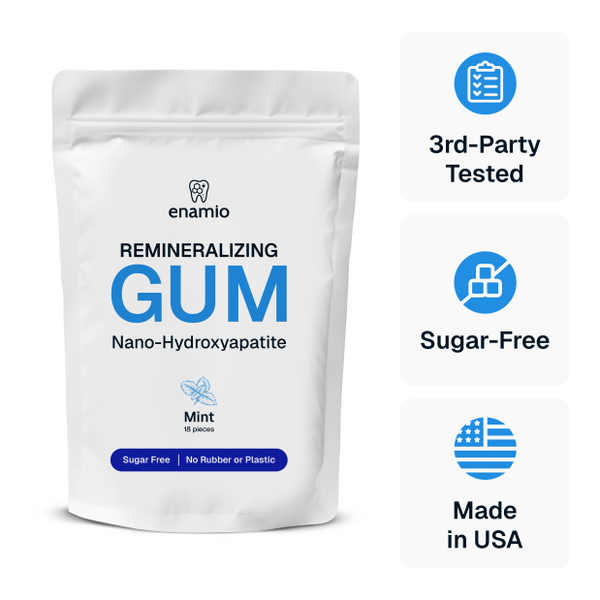
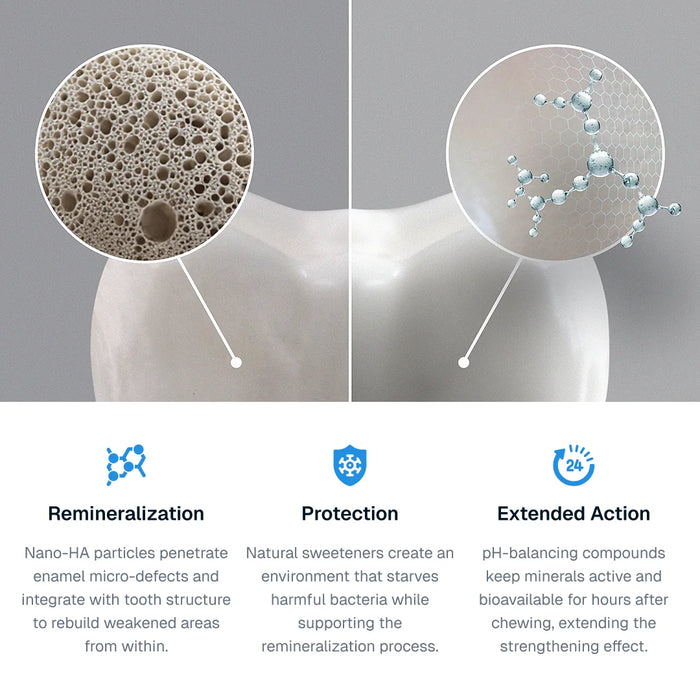
Nano-hydroxyapatite is a lab-made version of the mineral your enamel is mostly built from, shrunk to particles small enough to settle into tiny gaps. In oral-care research it has been shown to occlude open dentin tubules and support remineralization of early enamel lesions. [5][6] The particles are small, roughly 20 nanometers in the carbonate form Enamio uses, which puts them in the same size range as the natural enamel crystals that measure about 20 to 40 nanometers. [14][6] That resemblance is part of why researchers took interest in it, though a similar size on its own doesn't prove how well it performs once it's in your mouth. If you want the safety picture, we cover whether nano-hydroxyapatite is safe in its own guide.
What do the numbers say?
In a meta-analysis of 44 clinical trials, hydroxyapatite oral-care products, mostly toothpaste rather than finished gum, reduced dentin hypersensitivity by 39.5 percent versus placebo and edged out fluoride by 23 percent. [5] That's a strong result, and it comes with an important caveat about where the evidence was actually gathered.
Occlusion seals the channel. Remineralization hardens the surface. The best gums try to do a little of both.
Where that number comes from
The 39.5 percent and 23 percent figures are pooled from 44 trials of hydroxyapatite in oral-care products, mostly toothpaste, not finished chewing gum. [5] Two of that review's authors report ties to the hydroxyapatite oral-care industry, so we read the size of the effect with that in mind. We report them as an ingredient-level result and apply them to a gum only as reasoning, not proof.
Most sensitivity-endpoint evidence for hydroxyapatite and arginine comes from dentifrices and controlled laboratory or in-situ models. [5][6][7] Xylitol and saliva do have chewing-gum studies, but those examine bacterial, plaque, caries, or pH outcomes rather than Enamio's finished formula or tooth-sensitivity endpoints. [8][9] Delivering these actives in gum is mechanistically reasonable, since chewing extends the contact time between minerals and teeth. Our July 19, 2026 review found no published finished-formula chewing-gum trial with tooth-sensitivity endpoints. So a good gum is sensible daily support, not a proven treatment. If you're weighing the whole category, our take on whether remineralizing gum actually works goes deeper, and the skeptic-friendly read on whether remineralizing gum is legit tackles the doubts head on.
Where arginine and xylitol come in
Arginine is associated with sealing dentin tubules, which is one reason it shows up in sensitivity research. Studied as an 8 percent arginine and calcium carbonate paste, it helped deposit a calcium-phosphate plug in the tubules that held up against acid. [7] Enamio uses arginine bicarbonate in a gum, a different vehicle, so we say associated with, not proven in this product.
Xylitol plays a different role. It's a sugar alcohol that acid-producing bacteria can't ferment, so it starves them instead of feeding them. In one systematic review, 12 of 14 studies found xylitol gum significantly lowered cavity-causing bacteria compared with sorbitol gum. [8] This is ingredient-level evidence from xylitol-gum studies on bacterial counts, not a trial of Enamio or a finished-gum sensitivity result. It won't seal a tubule on its own, which is exactly why the strongest picks pair it with hydroxyapatite. Curious why we lean on it? Here's why xylitol earns its place.
Then there's saliva, the part you already make. Chewing sugar-free gum after meals sharply raises saliva flow, which buffers acid and carries calcium and phosphate back toward enamel. [9] That matters because enamel starts to dissolve below about pH 5.5, the point where the fluid around your teeth stops protecting them. [11] Faster pH recovery means more time in the safe zone. For the bigger picture on restoring surface mineral, see our enamel remineralization guide and how remineralization supports enamel over time.
- 03 -
What makes Enamio fit sensitive teeth
Enamio pairs roughly 20 nm nano-hydroxyapatite with calcium glycerophosphate, L-arginine bicarbonate, and xylitol in a sugar-free chicle base. [14] Each active maps to a mechanism from the science section above, so nothing here is a new claim. It's the same evidence, packed into something you chew after lunch.
Think of it as a few jobs sharing one piece of gum. The mineral is included to support remineralization and is associated, at ingredient level, with tubule occlusion. The xylitol starves acid bacteria instead of feeding them, and the act of chewing runs the saliva pump. Because it is sugar-free, that acid-starving effect is not undercut by added sugar, and the plastic-free chicle base is simply what carries it all.
1
2
The label deserves a straight description. Enamio is sugar-free with a plastic-free chicle base, and that base does include a small amount of citric acid as a minor processing component, so we won't call it acid-free. That's different from a candy-style gum loaded with sugar or a sour, acidic flavor coating, which is the kind you actually want to skip. If the base itself is what draws you in, here's more on the plastic-free chicle base we use.
Fluoride-free is a factual point, not a knock on fluoride. Some people simply prefer a fluoride-free routine, and hydroxyapatite gives them a mineral option. Enamio also adds zinc gluconate, which mainly supports breath rather than sensitivity, so we keep those lanes separate.
Does the delivery format change the science? Partly. The format extends contact through repeated chewing and a longer saliva tail, which is why the mineral-in-gum idea holds together on paper. What it can't do is turn a toothpaste study into a gum guarantee. [6]
So Enamio maps onto the sensitivity checklist as a daily support habit. It is built to support enamel remineralization and to help within a sensitivity-relief routine, not to work as a desensitizing drug.
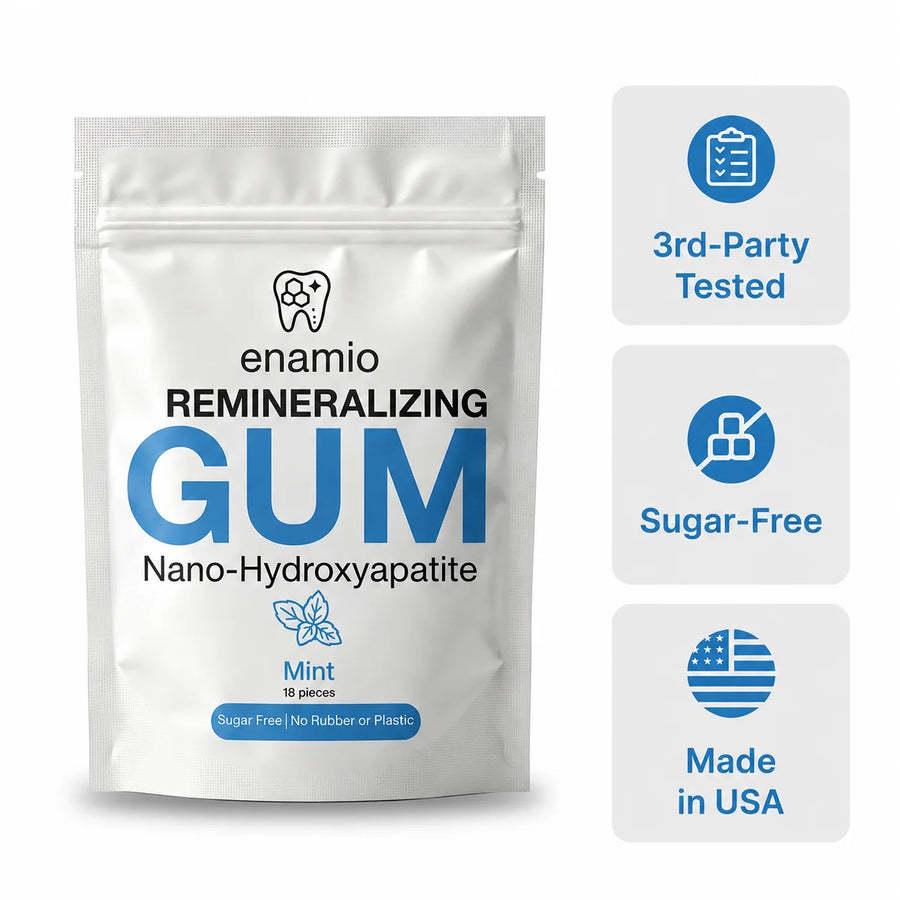
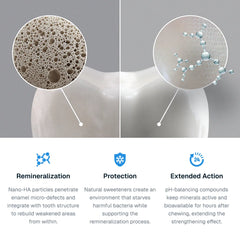
Enamio Remineralizing Gum
by Enamio
Sugar-free chicle gum with roughly 20 nm nano-hydroxyapatite, calcium glycerophosphate, L-arginine bicarbonate, and xylitol. Chew it after meals for daily sensitivity support.
- 04 -
Using gum for sensitive teeth, day to day
Chewing sugar-free gum after meals increases saliva flow and supports pH recovery. [9][10] That extra saliva buffers acid and helps carry calcium and phosphate back toward enamel, which widens the window your teeth get to recover in. Follow the product label for how many pieces to chew and for how long.
✓ Do
Chew after meals, most days, as a steady habit, and follow the label for how long to chew.
✗ Don't
Nurse sweet or sour drinks for a long stretch, and ease off if chewing bothers your jaw.
Gum works best as a partner to the basics, not a replacement. Keep brushing with a soft brush, go easy on acidic snacking, and let the after-meal chew fill the gaps between brushings. The same saliva boost that carries minerals also means fresher breath, since Enamio adds zinc to help neutralize odor compounds.
Want a step-by-step version you can stick on the fridge? We wrote a full chewing routine that covers timing, how long to chew, and what to pair it with.
Strengthen your enamel, anytime
A sugar-free chew you can carry, built around tooth-mineral-like nano-hydroxyapatite.
Shop the remineralizing gum- 05 -
How to choose the best remineralizing gum for sensitive teeth
For sensitive teeth, the label decides the fit, not the front-of-pack banner. Look for nano-hydroxyapatite and xylitol, confirm the gum is sugar-free, and skip anything built on sugar or wearing a prominent added fruit acid or a harsh, sour coating. Sugar-free does not mean the finished gum is acid-free, so judge the flavor and coating rather than the front label. Enamel dissolves below about pH 5.5, so an acidic gum can undercut the benefit you came for. [5][8][11] A gum that says "for sensitive teeth" but leads with sugar and sour flavor isn't the one.
1
Find the mineral
Nano-hydroxyapatite is the active that can occlude tubules and support remineralization. If it's not on the label, the gum is a saliva booster, not a mineral one. [5]
2
Confirm sugar-free, ideally with xylitol
Sugar feeds the acid-making bacteria you're trying to starve. Xylitol does the opposite, and it's the better-studied polyol for this. [8]
3
Watch the acid and the flavor
Avoid gums built on sugar or with a prominent added fruit acid or sour coating. Sugar-free alone does not make the finished gum acid-free, so weigh the flavor and coating too. [11]
4
Match it to your trigger
Cold, sweet, acid, or recession each behave a little differently. The table below shows what an ingredient can and can't do for each one.
Sweetener choice is a fair question too, since not every sugar-free gum uses xylitol. We break down why we choose xylitol over erythritol if you want the reasoning. And if you're comparing across the whole shelf, not just for sensitivity, start with our general best remineralizing gum guide.
Your trigger, the mechanism, and what a gum can and can't do
Compiled by Enamio from sources [1][3][5][6][7][8][9][11][12][13]. Every row traces to a cited source. Accessed July 19, 2026. The "can help" column reflects toothpaste and lab evidence applied to a gum vehicle, so keep the finished-gum caveat in mind.
| Trigger or cause | What is happening | Ingredient that can help | What it can't do | Source |
|---|---|---|---|---|
| Cold drink twinge | Cold moves fluid in open dentin tubules, reaching the nerve | Nano-hydroxyapatite can occlude tubules, and chewing adds saliva that dilutes the stimulus | Won't numb the tooth or fix the exposure instantly | [1][5][9] |
| Sweet sensitivity | Sugar pulls tubule fluid by osmosis | Occlusion plus a remineralized surface reduce the signal | Doesn't stop sugar reaching an open cavity | [1][5][6] |
| Acidic foods and drinks | pH drops below about 5.5 and enamel softens | Xylitol and saliva buffer acid, so wait then chew to aid recovery | Can't undo erosion already lost, or neutralize a very acidic diet alone | [9][11] |
| Everyday enamel wear | Thinner enamel exposes the dentin below | Nano-hydroxyapatite supports remineralization of early softened enamel | Can't regrow lost enamel thickness or reverse a cavity | [1][3][6] |
| Gum recession at the gumline | Root dentin tubules open where gum has pulled back | Nano-hydroxyapatite or arginine occlusion may reduce the signal at exposed dentin | Does not reverse recession, gum tissue won't grow back from chewing | [1][3][7] |
| Post-whitening sensitivity | Whitening commonly causes temporary sensitivity | A gentle sugar-free gum without a prominent sour or acidic flavor coating supports the saliva and mineral window while it settles | Doesn't treat the cause, and it usually resolves on its own in days to weeks | [9][12][13] |
| A sugary gum making it worse | Sugar feeds acid-producing bacteria, lowering pH | Choosing sugar-free with xylitol avoids feeding acid production from added sugar | A sugar-free label alone adds no minerals, so also look for hydroxyapatite | [8][9] |
| Sharp, lingering, one-tooth pain | May signal decay, a crack, or a pulp problem | None, this is a red flag | Gum can't diagnose or treat it, see a dentist | [3][4][6] |
Read the table as a decision aid. Every "can help" is paired with a clear "can't do," and the mineral evidence behind it comes from toothpaste and lab studies, not a finished gum. [5]
- 06 -
When gum isn't enough, see a dentist
Gum is a support habit, not a diagnosis. See a dentist if your sensitivity is severe, frequent, lasts more than a few seconds, or sits in one specific tooth, because that pattern can point to decay, a cracked tooth, a worn filling, or gum disease. [3][4] Those need a real exam. No gum can treat them, and waiting can make them worse.
There is a real ceiling to this. No chewing gum reverses a cavity or regrows receded gum tissue. Nano-hydroxyapatite supports remineralization of early, softened enamel, not cavitated decay, and recession permanently uncovers root surfaces that never had enamel. [3][6] If you're curious about the true limits, we spell out what enamel can and cannot rebuild.
Whitening is the common gray area. Post-whitening sensitivity is the most frequent side effect of bleaching and is usually temporary, so a gentle sugar-free gum without a prominent sour or acidic flavor coating is a reasonable support while your teeth settle. [12][13] Skip the sour flavors during that window, and check with your dentist if it lingers past a couple of weeks.
There is no fixed timeline here. Sensitivity that eases in dentifrice trials took two to eight weeks of steady use before relief showed up, and a gum has no published trial of its own, so nobody can promise you a date. [5] If a few weeks of consistent, sensible use changes nothing, that's your cue to get a professional look rather than chew harder.
None of this is a reason to skip the daily habit. It's a reason to keep the habit in its lane. For the fuller picture on the condition itself, see our tooth sensitivity relief page.
- 07 -
People also ask
What is the best remineralizing gum for sensitive teeth?
The best remineralizing gum for sensitive teeth is a sugar-free one that pairs nano-hydroxyapatite with xylitol and skips added sugar and harsh fruit acids. In a meta-analysis of 44 trials, hydroxyapatite oral-care products, mostly toothpaste rather than a finished gum, cut dentin-hypersensitivity scores by 39.5 percent versus placebo. [5] Read the ingredient panel for those actives, not just a "for sensitive teeth" banner.
Does remineralizing gum help sensitive teeth?
Remineralizing gum can support sensitive teeth by delivering minerals and saliva that reduce the stimulus reaching the nerve, though it isn't a cure. Hydroxyapatite can occlude the open dentin tubules behind cold and sweet twinges. [1][5] Treat it as a daily support habit alongside good brushing and regular dental care.
What causes sensitive teeth?
Sensitive teeth happen when worn enamel or receded gums expose dentin tubules that carry stimuli to the nerve. About a quarter to a third of adults report dentin hypersensitivity, most often triggered by cold, sweet, or acidic things. [1][2] Pinning down your trigger points to the right fix.
Can chewing gum make sensitivity worse?
Gum can worsen sensitivity if it contains sugar or added fruit acids, or if heavy chewing strains a sore jaw. Enamel starts dissolving below about pH 5.5, so an acidic gum works against you. [11] Pick a sugar-free gum without a prominent sour or acidic coating, and ease off if chewing bothers your jaw.
Is xylitol gum good for sensitive teeth?
Xylitol gum helps by cutting acid-producing bacteria and boosting saliva, but it doesn't seal tubules on its own. In one review, 12 of 14 studies found xylitol gum significantly lowered cavity-causing bacteria versus sorbitol. [8] This is ingredient-level evidence from xylitol-gum studies on bacterial counts, not a trial of Enamio or a finished-gum sensitivity result. Pair xylitol with hydroxyapatite for both fewer acids and tubule support.
What should you avoid in gum if your teeth are sensitive?
Avoid gum with sugar, a prominent added citric or malic acid, or a harsh, sour flavor coating. Below roughly pH 5.5, acids pull minerals out of enamel. [11] Sugar-free is the baseline, but it does not mean the finished gum is acid-free, so also skip a prominent sour or acidic coating.
How long does gum take to help sensitivity?
There's no guaranteed timeline. Hydroxyapatite toothpaste trials ran two to eight weeks before measuring relief, and gum isn't yet proven in a finished-product study. [5] If your pain is sharp, lingering, or in one tooth, see a dentist rather than waiting it out.
Can gum help sensitivity after whitening?
A gentle sugar-free gum without a prominent sour or acidic flavor coating is a reasonable support for temporary post-whitening sensitivity. Sensitivity is the most common whitening side effect and is usually short-lived. [12][13] Skip acidic flavors while teeth settle, and ask your dentist if it lingers.
- 08 -
FAQs
Is nano-hydroxyapatite safe for daily use?
Nano-hydroxyapatite comes from the same mineral family your enamel is built from, and it is widely used in everyday oral-care products. For the full safety picture, including how reviewers have looked at it, see our guide to whether nano-hydroxyapatite is safe. Supervise young children while they chew, and follow label directions.
Is Enamio gum acid-free?
No, and we won't claim it is. Enamio is sugar-free with a plastic-free chicle base, and the gum base includes a small amount of citric acid as a minor processing component. That's different from a sugary gum with a prominent sour coating, which is the kind sensitive teeth should avoid. The actives that matter for sensitivity are the nano-hydroxyapatite, arginine, and xylitol.
Does fluoride-free mean the gum is less effective?
Fluoride-free status alone does not establish that this gum is more or less effective. Hydroxyapatite uses a different mineral pathway to remineralization and tubule occlusion, but the cited comparison, where hydroxyapatite came out about 23 percent ahead of fluoride, comes mostly from dentifrice products, not Enamio gum. [5] Fluoride-free is a preference, not a shortcut. If your dentist recommends fluoride for your situation, follow that advice.
How is remineralizing gum different from a regular mint gum?
A regular gum mostly freshens breath and boosts saliva. A remineralizing gum adds tooth-mineral-like nano-hydroxyapatite so the same chewing window also delivers mineral to enamel. [6] Both raise saliva, but only the mineral one is built to support a sensitivity-relief routine.
How many pieces should I chew a day?
Chewing sugar-free gum after meals is a sensible way to support saliva flow and pH recovery. [9] For how many pieces to chew and for how long, follow Enamio's usage instructions and tips and the label. Consistency matters more than volume, and ease off if you have jaw or TMJ discomfort.
- 09 -
References
- Splieth CH, Tachou A. Epidemiology of dentin hypersensitivity. Clinical Oral Investigations. 2013. Accessed July 19, 2026. Source
- Favaro Zeola L, Soares PV, Cunha-Cruz J. Prevalence of dentin hypersensitivity: systematic review and meta-analysis. Journal of Dentistry. 2019. Accessed July 19, 2026. Source
- American Dental Association. Sensitive Teeth (Heat and Cold Sensitivity). MouthHealthy. 2024. Accessed July 19, 2026. Source
- Journal of the American Dental Association. Sensitive teeth, patient page. JADA. 2014. Accessed July 19, 2026. Source
- Limeback H, Enax J, Meyer F. Clinical evidence of biomimetic hydroxyapatite in oral care products for reducing dentin hypersensitivity: an updated systematic review and meta-analysis. Biomimetics (Basel). 2023. Accessed July 19, 2026. Source
- Anil A, Ibraheem WI, Meshni AA, Preethanath RS, Anil S. Nano-hydroxyapatite (nHAp) in the remineralization of early dental caries: a scoping review. International Journal of Environmental Research and Public Health. 2022. Accessed July 19, 2026. Source
- Cummins D. A breakthrough therapy for dentin hypersensitivity: how dental products containing 8% arginine and calcium carbonate work to deliver relief. Journal of Clinical Dentistry. 2009. Accessed July 19, 2026. Source
- BMC Oral Health. Specific effects of xylitol chewing gum on mutans streptococci levels, plaque accumulation and caries occurrence: a systematic review. 2025. Accessed July 19, 2026. Source
- Mickenautsch S, Leal SC, Yengopal V, et al. Sugar-free chewing gum and dental caries: a systematic review. Journal of Applied Oral Science. 2007. Accessed July 19, 2026. Source
- BDJ Team (Nature). The oral health benefits of sugarfree gum. 2015. Accessed July 19, 2026. Source
- dentalcare.com professional education. The role of critical pH in the caries process. Evergreen. Accessed July 19, 2026. Source
- British Dental Journal. Hydrogen peroxide tooth-whitening (bleaching) products: review of adverse effects and safety issues. 2006. Accessed July 19, 2026. Source
- American Dental Association. Whitening, oral health topics. Current. Accessed July 19, 2026. Source
- Enamio. Nano-Hydroxyapatite Remineralizing Gum, product and ingredient information (manufacturer product facts: carbonate nano-hydroxyapatite ~20 nm, calcium glycerophosphate, L-arginine bicarbonate, xylitol, chicle base). Accessed July 19, 2026. Source
Ready to build your routine
If your teeth flinch at cold or sweet, a sugar-free gum with tooth-mineral-like nano-hydroxyapatite is a low-effort daily support you can carry anywhere. It is built to support enamel remineralization and to help within a sensitivity-relief routine. It won't reverse a cavity, and it isn't a stand-in for your dentist.
Our pick for sensitive teeth
Enamio Remineralizing Gum
by Enamio
Sugar-free chicle gum with roughly 20 nm nano-hydroxyapatite, calcium glycerophosphate, L-arginine bicarbonate, and xylitol. Chew after meals and acidic drinks for steady daily support.
Where to go from here
Start here
Our tooth sensitivity relief approach
The bigger picture on what causes sensitivity and how Enamio fits.
Compare the shelf
The general best remineralizing gum guide
Broader than sensitivity, for when you want the full category view.
Safety first
Is nano-hydroxyapatite safe?
The evidence on the main active, in plain language.
Not sure yet
Find the routine that fits your sensitivity
Take the short quiz to match a routine to your triggers.