

Tooth Sensitivity
Share
Enamio oral-care guides
Published by Enamio
New here? Start with early white-spot lesions versus a true cavity to understand the distinction before comparing products.
Key Takeaways
- Tooth sensitivity has several possible causes [1].
- Pain duration alone cannot rule out decay or a crack.
- Lingering temperature sensitivity needs professional evaluation [6].
- Read the full toothache emergency criteria in Key Facts below.
- Ask a dentist about new, persistent or recurring sensitivity [4].
Key facts at a glance
Common triggers
Sensitivity can follow hot or cold foods, brushing or flossing, as the ADA describes [1].
Can a cavity be painless?
Early decay can be painless, so the absence of pain doesn't rule it out [2].
Useful detail
Report what triggered the pain, where you felt it, how long it lasted, and any pain during biting.
Who identifies it
A dentist through an exam and, when appropriate, X-rays or other tests.
When it is urgent
With toothache, contact a dentist about fever or cheek or jaw swelling. Toothache with eye or neck swelling, or mouth or neck swelling making breathing, swallowing or speaking difficult, needs emergency care [5].
In this guide
- 01 -
What tooth sensitivity actually is
Tooth sensitivity is pain triggered by hot or cold food, brushing, or flossing, rather than a diagnosis of the tooth's underlying problem [1].
Enamel protects the crown above the gumline, while cementum protects the root below it [1]. Dentin lies underneath the enamel and cementum, and the ADA describes it as less dense than either of those protective coverings [1].
It contains microscopic tubules, which the ADA describes as small hollow tubes or canals [1]. Uncovered dentin can let heat, cold, acidic foods, or sticky foods reach nerves through its tubules [1]. Gum recession can also expose dentin [1].
The ADA lists cavities, fractured teeth, worn fillings, gum disease, worn enamel, and exposed roots as possible causes [1]. “Sensitive” names the symptom, while exposed dentin describes a specific anatomical finding.
Ask your dentist which brushing and between-teeth cleaning steps you should follow around the sore tooth while you are arranging a professional examination [1]. Read the daily dental-care guide.
The numbers that matter
10-30%
was the prevalence range cited in a 2016 narrative review [9].
Over 2 days
is one reason the NHS gives for seeing a dentist about toothache [5].
Sensitivity alone doesn't identify its cause.
That historical range doesn't estimate whether your particular sensitive tooth has decay or needs a filling [9].
What happens if the dentist finds pulp inflammation?
Pulpitis means inflammation inside the tooth, with reversible and irreversible forms described by Cleveland Clinic [4]. Reversible pulpitis can recover when the dentist repairs and seals the tooth, while advanced irreversible inflammation leaves the pulp unable to recover. These names don't select a home treatment.
Cleveland Clinic describes removing decay and sealing a tooth for reversible pulpitis [4]. Irreversible pulpitis requires treatment to remove pulp tissue, through root canal treatment or removal of the tooth [4]. A twinge's duration doesn't select among these treatments.
Why might treatment involve more than toothpaste?
The ADA lists several treatment approaches because the underlying problems differ [1]. A crown, inlay or bonding may correct a flaw or decay associated with sensitivity. When gum tissue is lost, the ADA describes a surgical graft to protect the exposed root and reduce sensitivity [1]. The exposed root and damaged tooth structure involve different treatment choices.
A recommendation for a restoration has a different purpose from a desensitizing toothpaste recommendation. One concerns a structural flaw or decay, while the other helps block transmission of sensation from the tooth surface to the nerve [1]. Does the proposal address damage, root exposure, or sensation?
Dentists may consider root canal treatment when severe, persistent sensitivity resists other treatments, according to the ADA [1].
- 02 -
Does tooth sensitivity mean a cavity, or something else?
Cold sensitivity appears in descriptions of decay, cracks, exposed dentin, and pulp inflammation [1] [2] [3] [4]. Read across the table for what each source actually describes, rather than choosing the first condition that mentions cold.
A cavity is a hole that can form after acids made by mouth bacteria attack enamel [2]. Exposed dentin names a different finding. It describes loss of the covering over another layer, so the terms aren't interchangeable in a conversation about sensitivity.
If recession is part of the explanation, ask the dentist which root surface is exposed. The ADA connects recession with exposed dentin [1]. Read more about gum recession as a sensitivity cause for that specific anatomical context.
NIDCR describes a check-up that may identify staining, holes or soft or sticky areas, with X-rays that can show decay [2]. Keep those findings separate from the symptom you reported, so you can ask which finding supports the dentist's explanation.
| Condition | Typical trigger | After the trigger stops | Pattern or location | What the source says to do |
|---|---|---|---|---|
| Dentin hypersensitivity | Hot or cold foods, brushing, or flossing can cause pain [1]. | Not specified on the ADA page. | Dentin may be exposed when enamel or cementum is lost, or when gums recede [1]. | Ask your dentist about ongoing sensitivity [1]. |
| Dental caries (cavity) | May be silent early. Advancing decay can react to sweets, heat, or cold [2]. | Not specified on the NIDCR page. | A check-up may find staining, a hole, or soft or sticky areas. An X-ray can show decay [2]. | Seen at a check-up, where a dentist can "take an x-ray, which can show decay" [2]. |
| Cracked tooth | Chewing or biting, and "temperature extremes" [3]. | "Erratic pain when chewing, possibly with the release of biting pressure" [3]. | The pain may come and go, and a dentist may have difficulty locating the tooth [3]. | A dentist "may have difficulty locating" it, so get it checked [3]. |
| Reversible pulpitis | Cold or sweets [4]. | Cold or sweet sensitivity goes away quickly [4]. | Early, and reversible if the tooth is repaired and sealed [4]. | Talk to a dentist about new sensitivity [4]. |
| Irreversible pulpitis | Heat, cold, or sweets [4]. | "Sensitivity to heat, cold or sweets that lasts more than a few seconds" [4]. | "Throbbing, aching or sharp," and sore when a dentist taps it [4]. | See a dentist promptly [4]. |
Swipe the table sideways on a phone to see every column.
A matching trigger doesn't identify the cause of the pain or turn a timing description into a rule-out test.
Cold appears in several rows, yet the ADA and NIDCR pages don't specify a post-trigger duration [1] [2]. “Not specified” records an omission. An omitted duration cannot exclude lingering pain, nor can another condition's threshold fill the original cited page's missing information.
AAE describes erratic pain in cracked teeth, sometimes when biting pressure is released [3]. “During chewing” and “on release” can help describe what already happened, without deliberately biting to reproduce pain.
For pulpitis, Cleveland Clinic contrasts cold or sweet sensitivity that goes away quickly with sensitivity lasting more than a few seconds [4]. Cleveland Clinic describes the lingering pain as throbbing, aching or sharp. Ask which professional test would help the dentist establish whether the tooth's pulp is inflamed.
The early-stage question concerns enamel condition. Read when early spots can still harden for the distinction between intact early damage and a formed hole.
Why can a cavity be painless?
Early decay usually has no symptoms, according to NIDCR [2]. As it advances, toothache or sensitivity to sweets, heat, or cold can develop. A painless tooth doesn't rule out decay. This is the reason to keep regular check-ups, rather than using pain as your screening method.
NIDCR separates early mineral loss from a formed hole: repeated acid exposure can leave white spots where enamel loses minerals [2]. At that early stage, minerals from saliva and fluoride can help enamel repair itself. Continued losses can eventually break it down into a cavity.
Once there's a cavity, NIDCR describes removing decayed tooth tissue and restoring the tooth with filling material [2]. That is a different task from restoring minerals to early enamel damage. Gum doesn't fill a hole. Ask which stage the examination found before discussing products or prevention.
NIDCR describes an X-ray showing decay [2], while Cleveland Clinic describes several professional tests for pulpitis [4]. Ask what a proposed test would clarify about your tooth, and how it fits your symptoms and the examination findings.
What do professional pulp tests assess?
A temperature test examines the tooth's response to a controlled hot or cold stimulus [4]. It belongs in the dental office. Cleveland Clinic describes prolonged sensitivity in irreversible pulpitis and absent sensitivity when pulp tissue has died [4].
During electric pulp testing, the dentist uses a small electrical pulse to assess whether pulp tissue is still alive [4]. Living pulp tissue responds to that electrical stimulation, Cleveland Clinic explains. Dead pulp does not respond, whereas an X-ray can reveal structural defects or signs of infection [4].
- 03 -
What to report, and when to see a dentist
Don't use duration as a home diagnosis. Record how long pain lasts, what triggers it, where it occurs, and whether biting changes it. A dentist can use that history during an examination.
AAE says ongoing pain is a reason to see a dentist or endodontist [6]. Cleveland Clinic advises talking to a dentist about any tooth pain or new sensitivity to hot, cold, or sweet foods [4].
✓ Do
Note how long the pain lasts, and whether it's one tooth or several. Describe the pattern without trying to diagnose it.
✗ Don't
Don't wait for toothache with swelling or fever to pass before contacting a dentist. The NHS lists these as reasons for dental care [5].
Cleveland Clinic distinguishes sensitivity that goes away quickly from sensitivity lasting more than a few seconds in its pulpitis guidance [4]. It does not rule out a cavity or crack.
AAE's tooth-pain guidance describes lingering pain as typically lasting more than 30 seconds after hot or cold food [6]. Describe whether pain stopped after the drink or continued once it was gone. Those observations help the dentist interpret the timing alongside examination findings, without turning either source's duration into a home rule-out test.
A cracked tooth can mimic a cavity, including erratic chewing pain or pain when biting pressure is released [3]. Get chewing pain assessed. Describe the biting or release pattern to the dentist using what happened, without repeatedly recreating the painful bite.
Recent dental work can temporarily inflame the pulp [6]. AAE advises dental evaluation if this sensitivity persists or worsens after two to four weeks [6].
Your treating dentist's instructions take priority over general online timing tables. Contact the treating office sooner if it gave you a different recovery plan or if symptoms are worsening.
Contact a dentist promptly for ongoing pain, pain that begins without a trigger, or pain that keeps you awake. AAE notes that a cracked tooth may eventually hurt by itself [3].
AAE also describes tooth pain interfering with sleep and says ongoing pain warrants dental care [6]. Report sleep disruption. It gives the practice another concrete detail alongside the trigger and duration, without proving one diagnosis.
For more context after a procedure, see the guide to sensitivity after dental work. Follow the treating dentist's instructions first.
Will every visit require a new X-ray?
The ADA says a dentist reviews your history and examines your mouth before deciding whether X-rays are needed [12]. Age, oral health, disease risk and symptoms influence imaging frequency. The interval depends on those individual factors, rather than a fixed rule based only on appointment frequency. A new patient's images may establish a baseline for comparison with later changes [12].
Your new dentist may find your earlier dental images useful. When you change practices, the ADA says the new dentist may request copies from the previous office instead of ordering new images [12]. Ask both practices to help transfer your earlier images. That lets the practice review what is available before deciding which additional diagnostic information it needs.
An image can reveal damage that the visible examination misses [12]. The ADA lists new cavities and impacted teeth among the findings that may remain hidden during a visual dental examination [12]. An image doesn't measure how strong the painful sensation felt to you.
Why the crack type changes the discussion
AAE separates several crack types that can require different treatment approaches after examination. A visible line isn't a diagnosis. Craze lines affect only the outer enamel, while a fractured cusp involves a piece breaking from the chewing surface [3]. The latter often occurs around a filling.
AAE says a fractured cusp rarely harms the pulp and may be protected with a filling or crown [3]. Deeper cracks raise different questions. A cracked tooth extends toward the root but hasn't separated, whereas a split tooth has separable segments [3]. With a split tooth, saving any portion depends on the crack's position and extent [3].
Vertical root fractures start in the root and run toward the chewing surface, reversing the direction described for cracked teeth. AAE describes extraction or, in selected cases, surgery to remove the fractured part [3]. These fractures can initially show few symptoms, with infection of the surrounding bone or gum sometimes leading to their discovery [3]. Ask which finding supports the named type.
- 04 -
Do desensitizing toothpastes work?
A 2018 review evaluated desensitizing toothpastes in 53 randomized trials covering 4,796 adults with dentin hypersensitivity [7]. The control was another toothpaste. It lacked a desensitizing component, so this comparison concerns toothpaste rather than chewing gum.
Potassium, stannous fluoride, calcium sodium phosphosilicate, arginine, and nano-hydroxyapatite toothpastes relieved symptoms in that review [7]. Two categories weren't advised. Those were strontium and amorphous calcium phosphate toothpastes, as stated in the abstract [7].
The review rated amorphous calcium phosphate evidence “very low-quality evidence.” It rated strontium, potassium plus strontium, and potassium plus stannous fluoride “low-quality evidence” [7].
The review rated evidence for the other five tested toothpaste categories as moderate quality [7]. The authors called for higher-quality studies to confirm these findings, leaving uncertainty about the results for a toothpaste.
The 2019 review included six randomized trials with four weeks of follow-up [8]. It evaluated nano-hydroxyapatite-containing desensitizing treatments. The abstract doesn't establish that every intervention was toothpaste or support applying its results to every formulation.
That review reported better results for evaporative and tactile stimuli than treatments without nano-hydroxyapatite or placebo/negative controls [8]. It found no difference for cold stimuli.
The review assessed pain-assessment stimuli primarily, with treatment comparisons and at-home versus in-office use as secondary outcomes [8]. Its pooled results received high-quality evidence. Secondary outcomes received moderate-quality evidence, and the authors required long-term trials before definitive recommendations [8].
Hu searched five databases for studies published through November 27, 2017 [7]. Alencar searched seven databases on April 27, 2018 [8]. Those dates describe each review's evidence search, not a new comparison of the gums sold today.
The ADA describes desensitizing toothpaste as containing compounds that help block transmission of sensation from the surface of a tooth to the nerve [1]. Several applications are usually needed before sensitivity is reduced, rather than guaranteed relief with a single toothpaste use. Its patient page does not set one application count for every toothpaste. Ask your dentist how to assess the recommended product and when to report continuing symptoms.
The ADA also describes fluoride gel as an in-office technique that strengthens enamel and reduces transmission of sensations [1]. That is a dental-office treatment description, not a gum claim. It sits alongside other options selected for different causes of sensitivity. Ask why a proposed option fits the examination findings rather than choosing from the list yourself.
Ask which concern the recommended toothpaste is intended to address. Is it intended to reduce dentin-hypersensitivity symptoms, support decay prevention, or address a different concern the dentist found? Bring the product name or label so the conversation is about that formulation, rather than the ingredient name alone.
For prevention, see daily enamel-support basics. Your dentist can explain how preventive care fits alongside treatment for the affected tooth.
- 05 -
What to do while arranging care
Temporary comfort and ordinary prevention serve different purposes
NHS guidance for toothache while waiting for an appointment recommends soft foods and avoiding chewing with the sore tooth [5]. It also advises avoiding foods that are sweet, very hot, or very cold. These suggestions address discomfort while arranging care. They do not determine the cause or replace the appointment.
NHS toothache guidance recommends asking a pharmacist for advice about painkillers while you are arranging dental care [5]. A medicine conversation should start with your own treatment history. Share existing treatment instructions with the professional advising you, rather than borrowing someone else's dental routine or dose.
Keep sore-tooth comfort separate from your general prevention routine. NHS toothache advice says to use a soft toothbrush and avoid flossing around the sore tooth [5]. NIDCR's prevention advice recommends regularly cleaning between teeth [2]. Ask your dentist how to handle the painful area while keeping the rest of your routine appropriate.
Temporary relief doesn't answer whether treatment is needed. NHS advises dental care for toothache lasting over two days or unrelieved by painkillers [5]. Tell the office what changed after anything you tried for comfort, and keep following its appointment and recovery instructions.
For decay prevention, NIDCR recommends twice-daily brushing with fluoride toothpaste, regular cleaning between teeth, regular dental check-ups and professional cleanings [2].
That prevention advice doesn't replace instructions for a tooth that's already sore. NIDCR also recommends limiting sugary drinks and foods high in sugars and starches, within its published guidance on decay prevention [2]. These are prevention steps, not a way to diagnose or repair a cavity at home.
For ingredient context, read nano-hydroxyapatite ingredient and safety limits. Product information describes an item for sale, while advice about a painful tooth needs your dentist's assessment.
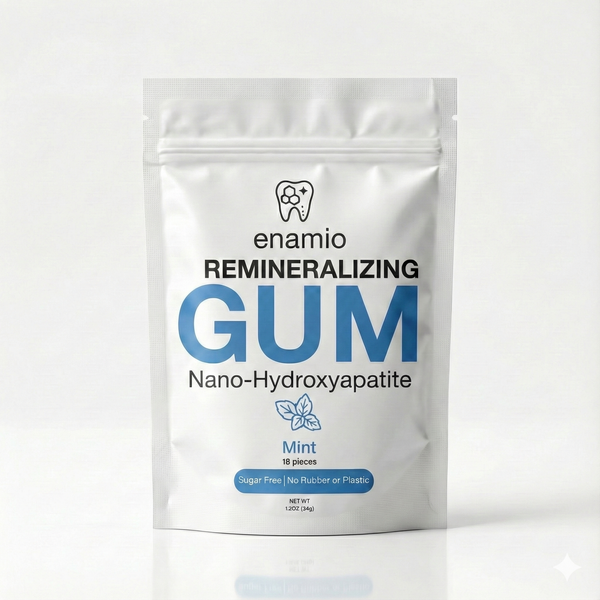
Enamio gum isn't a treatment for tooth sensitivity or cavities (product information). Website directions differ between one to two and one to three pieces daily, so follow your pouch's current instructions. The 20 nm wording is attributed to the manufacturer here. The manufacturer description does not establish finished-gum sensitivity relief. No CoA, particle report or named dental reviewer was authenticated in this review.
Why mention a persistently dry mouth?
Mention persistent mouth dryness when you contact the dental practice, along with the tooth symptoms that prompted you to arrange the appointment. Saliva washes away food and provides minerals that help protect teeth [11]. NIDCR links persistent dryness with increased decay risk and difficulty chewing, swallowing or talking, and says it isn't normal aging [11].
NIDCR lists medicine effects, Sjögren's disease, diabetes, cancer treatments and nerve damage among possible causes of a dry mouth [11]. Occasional dryness can accompany stress, but persistent symptoms deserve a dental or medical evaluation. A dentist or doctor reviews medical history and medicines, and may recommend a saliva measurement or blood tests to investigate the cause [11].
Bring your current medication information if your mouth often feels dry. If a medicine causes dryness, its prescriber handles adjustments [11]. Saliva substitutes or other treatments may be considered according to the cause, without identifying why one particular tooth is sensitive [11].
Frequency is a prevention question
NIDCR's guide for parents of school-age children explains why food frequency matters alongside food choice [10]. Bacteria use sugars and starches to produce acids. Frequent exposures allow repeated acid attacks, while saliva supplies minerals and fluoride helps enamel regain what it has lost [10]. That explains decay progression, not a pain timetable.
The guide recommends limiting between-meal snacks so teeth have time to repair between repeated acid attacks [10]. The guide also suggests saving sugary treats and drinks for special occasions [10]. After bedtime brushing, the guide advises avoiding sugary food and drinks, because saliva flow falls during sleep and limits repair [10]. Describe the bedtime pattern alongside daytime snacks when discussing a child's prevention routine.
Questions about the dental visit
How does a dentist check for decay?
A dentist can look for staining, soft or sticky areas, and holes, and an X-ray can also show decay [2]. These findings can be checked at a regular dental visit. NIDCR distinguishes early enamel changes that may respond to fluoride from a formed cavity commonly restored with filling material [2]. A tooth does not need a visible hole before a dentist can assess it.
Which tests assess pulp inflammation?
Cleveland Clinic describes professional pulpitis assessments including temperature tests, tooth tapping, electric pulp testing and dental X-rays, each addressing a clinical question [4]. These aren't instructions for testing at home. Ask what a proposed test would establish before assuming its result names every possible sensitivity cause. Describe what happened, without repeating painful tapping or hot and cold exposures.
Does tooth sensitivity mean a cavity when biting hurts?
Not necessarily: a crack may cause pain while chewing and when the biting pressure is released, according to the AAE [3]. AAE notes that intermittent pain can make the affected tooth difficult to locate. Treatment depends on the crack's type, location and extent, so the biting pattern alone cannot decide whether a crown, root canal or extraction applies [3]. Don't repeatedly reproduce a painful bite.
What can a dental X-ray establish?
An X-ray can show decay, according to NIDCR [2]. That doesn't mean every sensitivity problem needs one, or that a decay image identifies every possible source of pain. Cleveland Clinic describes other professional tests when assessing pulpitis [4]. Ask what the image showed and which explanation it supports, then clarify whether a different professional test is needed.
Does tooth sensitivity mean a cavity if cold water hurts?
Cold water can hurt with decay, a crack, exposed dentin or pulp inflammation, so cold does not identify a cavity [1] [2] [3] [4]. The ADA explains how exposed dentin allows temperature to reach nerves inside a tooth [1]. Cleveland Clinic describes cold sensitivity in both reversible and irreversible pulpitis, with different response patterns during professional assessment of the tooth [4]. Avoid deliberately repeating a painful cold-water test.
What should I mention about recent dental treatment?
Mention recent dental treatment and when sensitivity began. AAE explains that dental work can temporarily inflame pulp, causing temperature sensitivity, and discusses a two-to-four-week period in that recent-treatment context [6]. Your treating office's instructions take priority. Bring those instructions so the practice can interpret the timing, without postponing contact about worsening pain or waiting through emergency swelling.
How can I make a useful booking record?
Describe the symptoms you actually experienced. Report the onset, triggers, location and duration to the practice, including biting pain, sleep disruption or pain without a trigger [3] [6]. If you can't identify a trigger or tooth, keep that uncertainty in the record. Keep recent-treatment instructions alongside that history, allowing the practice to determine the appointment without a diagnosis or a self-selected urgency label.
Can a dentist preserve a cracked tooth?
Some cracked teeth can be preserved with treatment [3]. AAE describes root canal treatment and a crown when a crack reaches the pulp, with choices depending on type, location and extent [3]. A painful bite doesn't reveal those details. Ask which option fits the examined tooth and why, rather than assuming extraction or preservation from the symptom alone.
Why does crack depth matter?
AAE states that a cracked tooth cannot be saved if its crack extends below the gum line [3]. That depth requires professional assessment. Neither the strength of a twinge nor its duration tells you where a crack ends or which treatment applies. If the dentist uses this description, ask where the crack extends and what examination findings established it, keeping symptoms separate.
Which crack-type questions should I ask?
Ask which structural problem the dentist identified. AAE distinguishes fractured cusps, cracked teeth, split teeth and vertical root fractures, with treatment depending on type, location and extent [3]. The purpose of that question is to understand the examination, rather than choose your own diagnosis. Record the finding and recommended treatment together.
FAQs
Should I see a dentist for mild tooth sensitivity?
For mild tooth sensitivity, discuss your concerns with a dentist, as the ADA advises [1]. Cleveland Clinic advises a dental conversation for any tooth pain or new sensitivity to hot, cold, or sweet foods [4]. Even if pain ends quickly, that pattern doesn't prove that the cause is harmless or exclude decay, a crack, or another possible dental cause. Describe the symptoms and ask the practice about an appropriate appointment.
Is sudden tooth sensitivity an emergency?
New sensitivity calls for a dental conversation, while NHS guidance separately identifies toothache with fever, biting pain, or cheek or jaw swelling [4] [5]. Report those signs when contacting the dentist. For toothache with eye or neck swelling, or mouth or neck swelling making breathing, swallowing or speaking difficult, seek emergency care [5]. Call 911 in the US or local emergency services immediately.
How long should tooth sensitivity last before I seek care?
NHS advises dental care for toothache lasting over two days or unrelieved by painkillers, without treating that threshold as permission to delay [5]. Follow your dentist's instructions. AAE's lingering-pain description uses typically over 30 seconds after hot or cold food, while Cleveland Clinic's irreversible-pulpitis description uses more than a few seconds [6] [4]. Neither offers a home test excluding decay or a crack.
Can nano-hydroxyapatite toothpaste help sensitivity?
Hu's 2018 review found symptom relief with nano-hydroxyapatite toothpaste versus toothpaste without a desensitizing component, with moderate-quality evidence for that category [7]. That doesn't establish a gum result. Alencar's 2019 review covered nano-hydroxyapatite-containing desensitizing treatments, without establishing that every intervention was toothpaste, and results differed across evaporative, tactile and cold stimuli [8]. Long-term trials were still needed before definitive recommendations.
What does sensitivity after dental treatment mean?
AAE says recent dental work can temporarily inflame the pulp and cause sensitivity to hot or cold foods [6]. Its general guidance mentions two to four weeks, followed by evaluation if sensitivity persists or worsens. That advice is specific to the recent-treatment scenario. It is not permission to wait through emergency swelling or ignore worsening pain.
Can sensitive teeth come from exposed roots?
An exposed tooth root is among the ADA's possible causes, and gum recession can expose dentin [1]. Dentin contains microscopic tubules. Temperature and certain foods can reach nerves inside the tooth through them, but that doesn't identify recession in your case. A dentist can evaluate the tooth and gum tissue.
References
- American Dental Association. Sensitive Teeth. Publication date not stated, accessed October 13, 2026. Source
- National Institute of Dental and Craniofacial Research. Tooth Decay. Reviewed September 2025, accessed October 13, 2026. Source
- American Association of Endodontists. Cracked Teeth. Publication date not stated, accessed October 13, 2026. Source
- Cleveland Clinic. Pulpitis: Types, Symptoms & Treatment. Updated July 18, 2022, accessed October 13, 2026. Source
- NHS. Toothache. Reviewed July 1, 2024, accessed October 13, 2026, with emergency advice rechecked October 17, 2026. Source
- American Association of Endodontists. Tooth Pain. Publication date not stated, accessed October 13, 2026. Source
- Hu ML, Zheng G, Zhang YD, Yan X, Li XC, Lin H. Effect of desensitizing toothpastes on dentine hypersensitivity: A systematic review and meta-analysis. Journal of Dentistry, 2018, volume 75, pages 12 to 21, PMID 29787782, accessed October 13, 2026. Source
- de Melo Alencar C, de Paula BLF, Guanipa Ortiz MI, Barauna Magno M, Martins Silva C, Cople Maia L. Clinical efficacy of nano-hydroxyapatite in dentin hypersensitivity: A systematic review and meta-analysis. Journal of Dentistry, 2019, volume 82, pages 11 to 21, PMID 30611773, accessed October 13, 2026. Source
- Clark D, Levin L. Non-surgical management of tooth hypersensitivity. International Dental Journal, 2016, volume 66, issue 5, pages 249 to 256, PMID 27301300, accessed October 13, 2026. Source
- National Institute of Dental and Craniofacial Research. The Tooth Decay Process: How to Reverse It and Avoid a Cavity. Parent-focused guide, reviewed January 2025, accessed October 16, 2026. Source
- National Institute of Dental and Craniofacial Research. Dry Mouth. Reviewed October 2024, accessed October 16, 2026. Source
- American Dental Association. X-rays. Publication date not stated, accessed October 16, 2026. Source
Keep the examination and follow-up plan together
Leave the appointment with a record of what the dentist found and what happens next. Your booking note captures what you experienced before the examination supplied a clinical explanation. This record keeps the explanation, treatment choice and the office's follow-up instructions together, so you aren't reconstructing them from memory.
Use the prompts below to record the dentist's explanation of the finding, treatment and follow-up. Leave unanswered questions blank. Before leaving, ask the office to clarify any instructions you couldn't confidently explain back.
- The finding: which tooth or area was examined, what the dentist called the problem, and which finding supports that explanation.
- The treatment: what is being repaired or removed, and why. Add any alternatives discussed.
- The product instruction: the name of any recommended toothpaste or medicine, its intended purpose, and the exact instructions the professional gave you.
- The follow-up: when to update the office. Write down which changes it wants you to report and how to contact it.
- The remaining question: anything you still don't understand about the finding, the plan, or the next appointment.
For a follow-up call, compare your earlier record with changes in triggers, location, duration, biting symptoms or sleep disruption. Have the office's original plan available, including any follow-up timing or contact instructions. Explain which steps you've followed so the practice can consider your symptoms alongside its treatment plan.
If symptoms change before a scheduled visit, call the practice. Toothache with eye or neck swelling, or mouth or neck swelling making breathing, swallowing or speaking difficult, needs emergency care [5]. Don't wait for an existing appointment. Call emergency services, using 911 in the US or your local emergency number.
Further reading
For additional context on early decay, read the difference between early decay and a cavity. For ingredient questions, see the nano-hydroxyapatite safety discussion. Use the professional sources above for medical guidance and ask your dentist about your own symptoms.
If your dentist has confirmed that chewing suits you, our hydroxyapatite gum brand comparison can help with a separate shopping question: what manufacturers disclose about their formulas. It does not diagnose sensitivity or rank products as treatments for a painful tooth.
This is educational information. For tooth pain and sensitivity, ask your dentist and follow the treating office's instructions rather than using this as an individual treatment plan. It doesn't provide a diagnosis.
