

How to Remineralize Teeth
Share
How to remineralize teeth: fluoride may help early intact lesions. Lost structure cannot regrow, and suspected decay needs dental assessment.
Published by Enamio · Source scope is listed in the references
Enamel science, without the hype
A sourced guide to early enamel damage, the daily habits supported by dental guidance, and the limits of transferring study results to your teeth.
Key facts at a glance
Critical pH
Calcium and phosphate in the fluid touching enamel help determine its critical pH. [1]
First-line tool
The ADA recommends brushing with fluoride toothpaste twice daily for routine cavity prevention. [5]
Gum evidence
For the sugar-free gum category, EFSA evaluated plaque-acid neutralization under a condition of chewing for at least twenty minutes after eating or drinking. That category-level condition does not specify how many Enamio pieces an individual should chew. [8]
Honest limit
Early lesions with remaining intact tissue may remineralize, whereas lost structure cannot regrow and needs a dentist's assessment. [4]
How long
One CPP-ACP gum experiment used a fourteen-day in situ protocol. Its specimen outcome is not a clock for recovery of your tooth. [11]
In this guide
- 01 -
The acid problem: why enamel loses minerals

A tooth sits in a changing chemical environment. Mineral can leave enamel when the fluid touching it favors dissolution, or return when the conditions favor mineral gain. Calcium, phosphate and acidity all contribute to that balance. [1] A pH reading cannot also tell you the concentrations of calcium and phosphate, which help determine whether a solution favors mineral loss.
Demineralization means mineral loss from tooth tissue. In decay, plaque bacteria produce acids from fermentable carbohydrates. Dietary acids can contact the tooth directly, which is a different process discussed in our dental erosion guide. [1][2] The source of the acid changes the question you bring to the dental appointment.
What about pH 5.5? Dawes explains why enamel has no single critical pH independent of the fluid's calcium and phosphate concentrations. Saliva and plaque fluid differ in composition, so their readings cannot be substituted for one another. [1]
Timing adds another dimension. The Stephan curve describes plaque pH falling and recovering after exposure to fermentable carbohydrate, rather than providing one universal trace for every mouth. [2] A drink finished with lunch and one sipped through the afternoon represent different patterns to record. Write down when you eat or drink and how long the exposure lasts, instead of building a safe-food list from a single number.
Saliva contributes calcium and phosphate. Reduced salivary function removes a protective factor, while fluoride and plaque control have their own roles in the balance described by Featherstone. [1][3] If dryness persists, note when it began and discuss it with your dentist or clinician. The useful question is what changed, rather than which extra product to add first.
For dietary acids, the Oral Health Foundation recommends keeping exposure to mealtimes and avoiding prolonged contact with teeth. [10] Swishing or holding a drink in the mouth extends that contact. A short record can separate this habit from missed brushing or repeated sugar exposure, giving the discussion something more precise than “my diet is healthy.”
An entry saying “one drink” misses whether it was sweetened or whether that same serving stayed beside you for hours. Use a brief note for a typical day to record the type of exposure, its timing, and anything that repeatedly made your normal brushing routine difficult. Leave a new mark's depth and activity for the dental examination, rather than adding a home diagnosis to your notes. Bring those notes when discussing a recent change to diet or persistent dry mouth, and mark which details you know rather than filling gaps from memory.
- 02 -
What remineralization can and cannot do
Remineralization means mineral gain within remaining tooth tissue. Early enamel damage can sometimes reharden when enough of that tissue remains and the balance between mineral loss and gain becomes favorable. [1][3] Gum, paste and diet cannot rebuild the outline missing from a hole or worn edge.

Appearance cannot establish a diagnosis or lesion activity without the wider assessment made during a clinical examination. A white spot may need assessment for early decay. Discoloration can have other causes, and lesion activity requires a professional examination. [12] Describe the location and any pain, sensitivity, roughness or food trapping without interpreting them as a diagnosis.
Arrest describes stopped progression, without establishing mineral gain or restoration. It does not establish that a tooth has regained its original shape, that a mark must disappear, or that every part of a lesion has remineralized. [12] Ask which recorded finding your dentist will compare at follow-up, separately from whether symptoms improve.
What remineralization can and cannot do, by stage of damage.
Scroll horizontally to read the evidence and limitations.
| Stage of damage | Can minerals help? | What it needs |
|---|---|---|
| Early white spot, non-cavitated | Mineral gain may be possible. Arrest describes stopped progression. | Fluoride toothpaste, saliva support, fewer repeated acid exposures, and dentist-directed care. [3][5] |
| Softened but intact enamel | Rehardening may be possible while tissue remains. | Saliva and minerals over time |
| Lost enamel structure, worn or eroded | No. Structure doesn't regrow. | A dentist assesses the options |
| Cavitated cavity, hole through enamel | Minerals cannot regrow the missing shape. | Assessment of decay control and whether a restoration is needed |
If a dentist finds an early white spot, non-restorative care may still be possible. A dentist must assess a suspected cavity and discuss whether disease control, restoration or both fit the finding.
- 03 -
The science: how minerals go back in
Remineralization uses tissue that remains. Saliva supplies calcium and phosphate, while fluoride supports early remineralization and resistance to acid damage. [1][3] For adults brushing at home, the ADA recommends fluoride toothpaste twice daily for at least two minutes each time, or as their doctor or dentist directs. [5] That daily action is easier to define than a date on which a particular lesion will recover.
Hydroxyapatite is a calcium-phosphate mineral found in enamel, and oral-care products can contain manufactured particles of it. [4] In these product descriptions, nano refers to a particle-size category. A particle-size statement does not also state concentration, contact time or the amount released from a product.
Different designs can answer different questions about mineral content and clinical decay. Clinical trials can follow people for new lesions, while in situ studies place enamel specimens in the mouth for controlled measurements. [6][7] Mineral content or hardness describes a specimen's response. It does not count how many people avoided cavities.
The 2024 hydroxyapatite review retrieved eighteen studies, with five clinical trials and eight in situ trials entering its meta-analysis. Its question covered toothpastes, mouthwashes and gels, compared with placebo, no intervention or fluoride-containing controls. [6] The pooled evidence concerns the formats in that search question, so it is not a clinical test of the finished Enamio chewing product. The mixture of clinical outcomes and proxies also matters when reading the review's favorable conclusion.
Its financial disclosures are explicit. Meyer and Enax were Dr Kurt Wolff employees, and all authors reported travel grants from that company. The other authors declared no financial interests in it. [6] These are review-author disclosures, rather than an account of every included trial's funding.
The 2022 narrative review lists Enax and Meyer as company affiliates while declaring no conflicts of interest. [4] Affiliation and the published declaration are separate pieces of information. Its funding statement names an NSERC grant, a separate disclosure from both the company affiliations and the authors' published conflict declaration.
Gum research also includes other calcium systems. Reynolds and colleagues compared mouthrinse or sugar-free gum formulations in randomized, double-blind in situ studies, with the gum result concerning CPP-ACP. [7] CPP-ACP contains casein phosphopeptides and was not listed in the two inspected Enamio texts. Use our mineral-gum terminology guide for category definitions, and gum versus toothpaste to separate the everyday roles of chewing and brushing.
The 2022 review describes a trial in high-caries-risk patients receiving fixed orthodontic treatment, comparing hydroxyapatite toothpaste with a 1,400-ppm fluoride toothpaste. By day 168, at least one new ICDAS lesion had developed in 54.7 percent of the hydroxyapatite group and 60.9 percent of the fluoride group. [4] That endpoint included changes at code 1, rather than counting only physical holes. According to the review, examiners assessed buccal tooth surfaces at repeated visits using ICDAS criteria, rather than measuring mineral content directly.
The difference between groups was not statistically significant. [4] That comparison concerns those patients and toothpastes, without establishing a universal winner or an Enamio-gum effect.
- 04 -
How to remineralize teeth: tools and evidence
The ADA recommends fluoride toothpaste as part of daily cavity prevention. [5] EFSA's sugar-free gum opinion supports plaque-acid neutralization under the condition of at least 20 minutes after eating or drinking. [8] That condition is not an Enamio use schedule.
Daily-care tools, their source contexts, and the limits of what each cited finding can establish.
Scroll horizontally to read the evidence and limitations.
| Tool | What it does | Evidence context | Source | Honest caveat |
|---|---|---|---|---|
| Fluoride toothpaste | Strengthens enamel and helps early acid damage | ADA prevention advice | [5] | Won't regrow lost structure or fill a hole |
| Saliva plus sugar-free gum | Chewing stimulates saliva, which supports oral mineral balance. | Saliva physiology | [1][3] | Saliva support does not establish Enamio lesion remineralization. |
| Hydroxyapatite oral-care products | Studied for caries-related outcomes using different formulations and study designs. | Review of different oral-care formulations | [6] | Toothpaste, mouthwash, and gel evidence does not establish finished-gum efficacy. [6] |
| CPP-ACP | Studied for remineralization of enamel specimens under specified in situ protocols | Randomized, double-blind in situ studies | [7] | The cited research tested mouthrinse or gum, not paste. CPP-ACP was not listed in the inspected Enamio texts. |
| Xylitol | Sweetener evaluated in differing products for caries-prevention outcomes | Cochrane low to very low certainty | [9] | Evidence for products other than xylitol-containing fluoride toothpaste was insufficient. [9] |
| Diet and acid-frequency control | Limit acidic foods and drinks to mealtimes and follow brushing guidance. | Patient guidance on erosion prevention | [10] | Supports the other tools, not a stand-alone fix |
What the table does not rank
The rows answer different care questions. Daily brushing advice and a controlled specimen experiment are not competing entries in a product league table. [5][7] Start with the row relevant to the decision in your care plan.
Cochrane's xylitol review shows why the comparator matters. Ten studies analysed 5,903 participants, with seven judged at high risk of bias. Its low-quality evidence favoring ten percent xylitol in fluoride toothpaste came from 4,216 children followed for two-and-a-half to three years. Evidence for other xylitol products was insufficient to determine a preventive benefit. [9]
For the chewing-specific questions, the gum evidence review separates tested formulations and outcomes. Our xylitol gum guide follows the sweetener question separately from the effects of chewing, so an ingredient result is not mistaken for a gum result.
- 05 -
How Enamio fits a daily routine
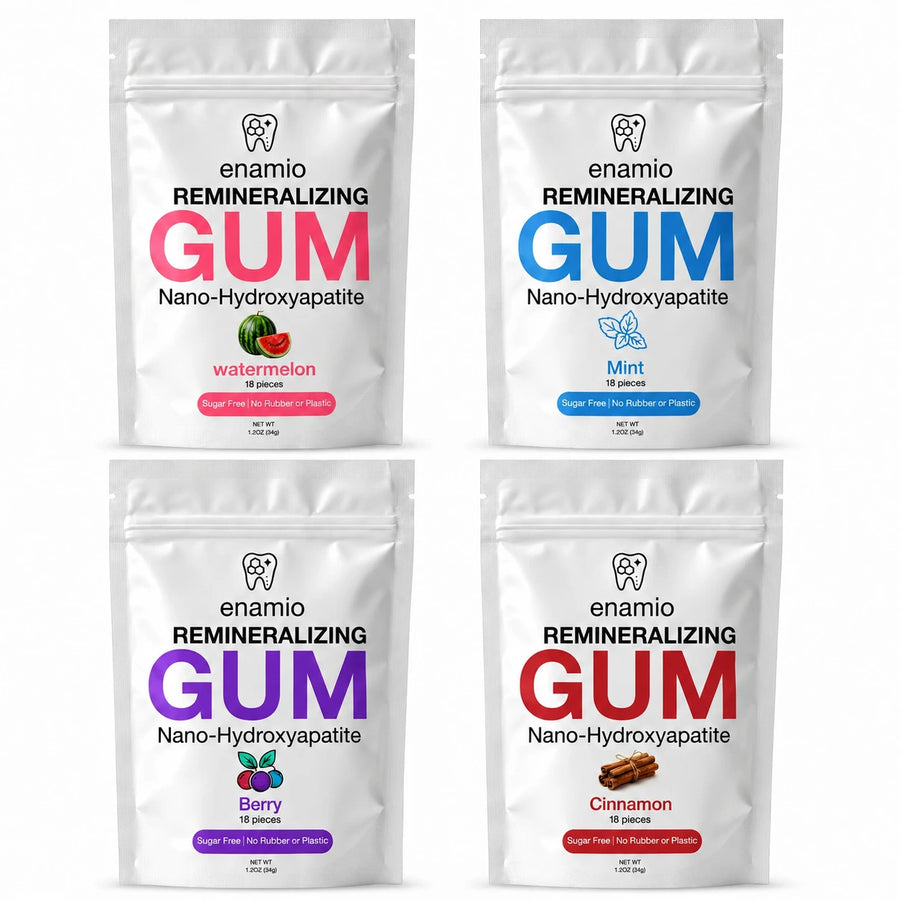
Enamio is an optional chewing product in this routine. Its product-page and FAQ texts inspected on October 17, 2026 described a sugar-free, fluoride-free gum containing nano-hydroxyapatite and xylitol. The twice-daily fluoride brushing recommended by the ADA remains a separate action. [5]
Before choosing a gum, ask what you want chewing to add to the routine you already follow. Saliva stimulation is the general gum mechanism discussed in the sources. EFSA's plaque-acid condition for the sugar-free category was at least twenty minutes after eating or drinking. [8] That condition does not provide an Enamio dose, and the science section explains the separate mineral-study questions.
What the inspected product information establishes
In those two inspected texts, the listed ingredients included nano-hydroxyapatite, xylitol, zinc and L-arginine, with the gum base described as plastic-free chicle. They did not disclose nano-hydroxyapatite mass per piece or provide a finished-Enamio-gum trial. The manufacturer's 20 nm figure remains a particle-size statement, unverified here.
The inspection found neither a public finished-product certificate of analysis nor a particle-size certificate in those texts. Those observations describe only the product-page and FAQ texts inspected on that date, not every manufacturer document or private record. The references below support general science, and this article names no individual dental reviewer.
Nanometres describe size, while milligrams describe mass. One cannot substitute for the other when comparing labels. A particle-size number does not tell you how much hydroxyapatite a piece contains.
Read directions as a separate field. The inspected product page said one to two pieces daily, whereas the FAQ said one to three. Do not average those ranges. Follow the pouch and ask your dentist about uncertain use, bringing both the label and the conflicting wording to the discussion.
A small product record can make that conversation easier. Copy the product name, ingredient list, stated serving or use amount, and any restriction printed on your pack. Keep an amount per piece separate from an amount per serving. Record which document supplied each number so a different serving definition does not silently change the comparison.
Consider two hypothetical labels, one giving particle size and the other giving mass per serving. Those are not comparable quantities. A comparison also needs the serving's piece count and mass basis, so a missing field should remain blank rather than become an assumed dose.
If a certificate is supplied, check which finished product or material it identifies and the date on it. A document identifying a raw ingredient does not by itself identify the finished product or the batch in a pouch merely carrying that same ingredient name. Keep the document's stated scope in the record, rather than labeling any laboratory document a clinical trial.
For a study claim, add three fields to the record: the tested product, its comparator and the measured outcome. Was the outcome saliva flow, a specimen measurement or new decay in participants? The same words on a front label do not answer those questions. For examples of how to separate those endpoints, use our gum evidence review while keeping your own product record beside the article.
Taste and portability can still matter to a purchase. Decide whether you would want the gum for chewing before assigning value to an additional tooth-related promise. This article has not authenticated current prices, quantities, shipping offers or flavor availability, so compare those details directly with the seller's current purchase page. Record the terms you actually see if you decide to order.
Manufacturer pages organize different product topics: gum-base materials, cavity-prevention positioning, fresh-breath positioning and tooth-sensitivity positioning. These are seller descriptions. Use them to locate a statement, rather than treating the page title as a diagnosis or a measured lesion result.
Suitability comes before fitting chewing into the day. Leave it out if it hurts, and discuss persistent jaw symptoms with your dentist. For a child's visit, bring the particular gum's ingredient list and directions, and ask whether chewing that product suits the child's individual circumstances. The children's gum guide helps organize those questions without turning this adult routine into a child-use instruction.
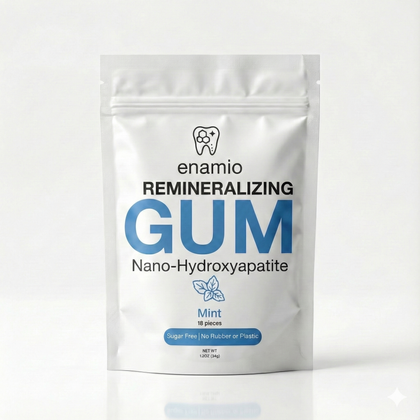
Optional chewing
Enamio Remineralizing Gum
See the manufacturer's current ingredient information, directions and purchase options. Before ordering, compare the seller's ingredient information and directions with the pack you intend to use, noting any difference that needs clarification.
- 06 -
A daily routine that fits real life
Pick two brushing times that fit the way your day actually runs, and identify the practical interruption that most often makes you miss one. The ADA advises two minutes with fluoride toothpaste each time. [5] Put the toothbrush and toothpaste where that brushing session will actually happen. Separate brushing, acid timing and chewing.
Use it alongside your dentist's individual care plan.
Use this daily-routine table alongside your dentist's advice and the directions on your pouch.
Scroll horizontally to read the full routine.
| When | What to do | Why it helps |
|---|---|---|
| Morning | Brush with fluoride toothpaste for two minutes | ADA daily brushing advice [5] |
| Between brushings | Use sugar-free gum only as directed, and sip water | Chewing stimulates saliva |
| After acidic food or drink | Wait at least one hour before brushing | Follows the Oral Health Foundation's guidance after acidic foods and drinks. [10] |
| Evening | Brush with fluoride toothpaste for two minutes | Maintains the twice-daily foundation [5] |
| As advised | See your dentist | A professional can assess early lesions |
In its dental-erosion guidance, the Oral Health Foundation advises waiting at least one hour after eating or drinking before brushing. [10] Plan the brushing time around that advice, with individual instructions from your dentist taking precedence.
Leave space in the plan for chewing only when it suits you. Leave it out if it hurts, and discuss persistent jaw symptoms rather than treating discomfort as part of an effective routine. For product-frequency questions, our gum-use guide explains how the chewing interval in a research protocol differs from the directions supplied on the particular pack you are considering.
Do
Follow the directions on your chosen gum, while maintaining twice-daily fluoride brushing and the individual care plan agreed with your dentist.
Don't
Nurse sweet or acidic drinks for hours and graze all afternoon.
For a child, the ADA separates toothpaste advice by age. For children under three, the ADA advises brushing as soon as baby teeth appear, using an amount of fluoride toothpaste about the size of a grain of rice. For ages three to six, its guidance specifies a pea-sized amount and brushing twice daily for at least two minutes. [5]
An adult should supervise children aged three to six so they use the right amount and do not swallow too much toothpaste. [5] Those toothpaste age bands do not establish whether gum is appropriate. Ask about the particular gum independently of the child's toothpaste instructions. Use our children's gum guide to prepare the product questions, then ask the child's clinician which concerns need an individual answer before chewing.
Older children and teens remain on twice-daily fluoride brushing in the ADA's guidance. [5] If you keep a family routine chart, give each person a separate row for toothpaste instructions and the care plan agreed with their dentist.
- 07 -
How long does it take to remineralize teeth?
There is no universal recovery date. For an identified lesion, ask when it should be reassessed and what change the dentist will look for. Write that date beside the care plan, rather than using comfort or color as your deadline.
The often-quoted fourteen-day example was an experiment. Iijima and colleagues tested CPP-ACP gum in a randomized, double-blind crossover in situ study, with twenty-minute chewing periods four times daily. Investigators later exposed the enamel specimens to an acid challenge. [11] This was not a fourteen-day Enamio treatment trial.
Make the review date useful
Record the tooth or surface, the advised care and the finding that would lead to a change of plan. Bring this care record to the next review of that tooth. Seek advice earlier for new symptoms or a changing surface, without waiting for a product's advertised timetable.
- 08 -
Signs a dentist looks for
A visible mark needs clinical interpretation before it can inform a decision about lesion care. The ICCMS guide uses several clinical observations to assess lesion activity, including surface appearance, tactile findings, plaque accumulation and nearby gum health. [12] A spot's color alone cannot establish whether it is active, and a photograph cannot reproduce a clinical examination. Do not probe or scrape the surface yourself.
Describe changes at the appointment, including where they appeared and whether they have persisted. Explain where you noticed a white spot, darker area, roughness, food trapping or sensitivity, and whether it has changed since your last visit. Those observations help frame the question. They do not establish mineral gain, lesion depth or the need for a particular treatment without assessment.
An inactive lesion may remain visible. Inactive enamel lesions may be white, brown or black. The guide considers those colors alongside other clinical features when assessing activity. [12] For discomfort, read what sensitivity can and cannot tell you about a cavity before assuming that relief confirms repair.
- 09 -
Foods and habits that help or hurt
Look at the pattern across a day. Repeated sugar exposure can contribute to bacterial acid challenges, whereas dietary acids can act directly on teeth. [2][10] Neither a food label nor the word natural tells you that an individual lesion has gained minerals.
When a drink lasts all afternoon
Does a drink sit beside you while you work? Note how long it lasts, rather than recording only that you had one serving. The Oral Health Foundation recommends acidic foods and drinks at mealtimes, avoiding swishing or holding them in the mouth. [10]
After a meal, that source suggests milk or cheese to help neutralize acid. [10] This is acid-exposure advice, rather than a food treatment for a cavity. The daily routine collects its brushing-timing advice, and our gum and cavity-prevention guide addresses the separate chewing question.
- 10 -
People also ask
Can you remineralize teeth naturally?
Early intact enamel may regain minerals through saliva. [1] That process does not regrow missing structure or replace fluoride toothpaste. The ADA recommends brushing twice daily with fluoride toothpaste, rather than choosing care from a natural label without considering the affected tooth. [5] Ask a dentist to identify a new mark before changing your care.
How long does it take to remineralize teeth?
There is no universal mineral-gain timeline. The fourteen-day CPP-ACP experiment assessed enamel specimens under a controlled in situ protocol. [11] Its different active, delivery conditions and measured outcomes cannot predict when your tooth will improve or establish a duration claim for Enamio. Agree on follow-up, with earlier advice if symptoms or the surface change.
What are the signs of tooth remineralization?
Appearance alone cannot confirm mineral gain. Research can measure mineral content or hardness, whereas a photograph records how a surface looks. [4] Your dentist can assess the lesion and decide which clinical findings should be compared over time, using more than color alone. [12] Bring notes or photographs, and keep the appointment even if the mark looks unchanged.
Can you rebuild tooth enamel that is gone?
Missing enamel structure does not regrow. Remineralization concerns mineral gain in tissue that remains, rather than replacement of a worn edge or an open hole. [1] Controlling further damage and replacing shape raise different care questions. Ask which problem your dental plan addresses before interpreting a mineral claim as regrowth.
What foods remineralize teeth?
No food regrows missing enamel. The Oral Health Foundation suggests milk or cheese after meals to help neutralize acid. [10] That advice concerns acid exposure, without establishing that a food reverses an individual lesion or can replace appropriate fluoride care. Limit acidic foods and drinks to mealtimes, and discuss the affected tooth with your dentist.
Does fluoride or hydroxyapatite remineralize better?
There is no universal winner across products and outcomes. A 2022 review describes a 168-day orthodontic toothpaste trial in which hydroxyapatite and 1,400-ppm fluoride groups did not differ significantly. [4] Its orthodontic population and tested toothpastes limit what that comparison says about other care, including Enamio gum. Choose toothpaste with your dentist, using our ingredient guide for formulation questions. [5]
Can gum remineralize teeth?
Chewing sugar-free gum can stimulate saliva. [1] EFSA evaluated plaque-acid neutralization under a condition of at least twenty minutes after eating or drinking. [8] That category-level condition does not supply an Enamio dose or establish that its nano-hydroxyapatite reaches enamel and produces a measured lesion result. Choose chewing as an optional activity and follow your particular product's directions.
Can you remineralize teeth without fluoride?
Saliva can supply minerals without fluoride. [3] That does not establish equivalent protection from every fluoride-free product or suitability for every person's lesion. The ADA recommends fluoride toothpaste for daily prevention, while hydroxyapatite toothpaste studies examine particular formulations rather than all fluoride-free care. [5][4] Discuss why you want to avoid fluoride and your cavity risk before changing care.
Can you reverse a cavity by remineralizing?
Early intact enamel may regain minerals. [1] An open hole needs professional assessment of disease control and whether restoring missing shape is appropriate for that particular tooth and surface. [12] The word cavity is often used loosely, so ask what your dentist actually found. Our guide to intact lesions versus physical cavities explains the distinction without treating a gum as a substitute for care.
Does dry mouth affect remineralization?
Reduced salivary function removes a protective factor. [3] A dry feeling does not identify its cause or measure mineral gain in a tooth. Tell your dentist or clinician when it began and what else changed, including medicine use, without stopping a medicine on your own. Chewing does not establish that the underlying cause has been identified or addressed.
Does hydroxyapatite toothpaste evidence apply to gum?
Toothpaste evidence concerns a particular formulation. The 2024 review assessed toothpastes, mouthwashes and gels, without establishing an Enamio-gum effect. [6] Differences in concentration, particles, contact conditions and delivery mean that an ingredient shared by two products cannot transfer an outcome between them. Check which product and outcome were studied before using the result to guide care.
Should I test a white spot at home?
Do not scrape a white spot. A home photograph cannot establish the lesion's depth, surface integrity or activity. The ICCMS guide instead uses multiple professional observations, so a matching color or an apparently intact surface does not settle the diagnosis. [12] Arrange an examination for a new or changing mark, including one that does not hurt.
FAQs
Can you rebuild tooth enamel naturally?
Is nano-hydroxyapatite safe for daily use?
Daily-use safety is product-specific. The cited review evaluated hydroxyapatite toothpastes, mouthwashes, and gels, not Enamio. [6] Its findings do not establish safety for every particle specification or finished product. Check the current label with your dentist, using the hydroxyapatite safety guide to frame questions about your particular product.
Can gum replace fluoride toothpaste?
How do I know if my teeth are remineralizing?
You cannot confirm it reliably at home. A dentist can examine the surface and compare recorded clinical findings over time to assess the lesion. [12]
Bring photographs to support the clinical examination. Book a visit for a new white spot, color change, rough area, pain, or sensitivity.
Do I really need to wait before brushing after acidic food?
In its dental-erosion guidance, the Oral Health Foundation advises waiting at least one hour after eating or drinking before brushing your teeth. [10] This is erosion guidance rather than a measured remineralization deadline. Its other advice includes keeping acidic foods and drinks to mealtimes. It recommends swallowing drinks rather than holding them in your mouth, reducing contact with the teeth. [10]
Is remineralizing gum worth it?
Consider whether ordinary sugar-free chewing meets your goal. Dawes describes the saliva response to gum within the mineral environment around teeth. [1] The material reviewed here does not establish an extra Enamio mineral-gain benefit for which a buyer could calculate value. [6]
Compare taste, convenience and cost as purchase preferences, keeping a promised lesion outcome separate.
How many pieces of Enamio should I use?
The product page inspected October 17, 2026 said one to two pieces daily, while the FAQ said one to three. Do not combine those ranges. Follow the directions on your pouch and ask your dentist if your needs are unclear. Stop chewing if it causes jaw pain.
What did the inspected product pages leave unresolved?
The product-page and FAQ texts inspected October 17, 2026 did not provide nano-hydroxyapatite mass per piece or a finished-Enamio-gum trial. That inspection found neither a public finished-product certificate of analysis nor a particle-size certificate. The 20 nm figure remains a manufacturer statement. Toothpaste, mouthwash, and gel findings do not establish an effect for this finished gum.
Can Enamio replace a dental visit?
No. A gum cannot determine whether a spot is non-cavitated or whether enamel structure is lost. New pain, sensitivity, a visible hole, or a changing spot needs professional evaluation. Report what changed and when it began.
References
-
Dawes C. What Is the Critical pH and Why Does a Tooth Dissolve in Acid?
Journal of the Canadian Dental Association, 2003, source text rechecked October 17, 2026.
-
Bowen WH. The Stephan Curve revisited.
Odontology, 2013, PMID 23224410, metadata and abstract rechecked October 17, 2026.
-
Featherstone JDB. The continuum of dental caries--evidence for a dynamic disease process.
Journal of Dental Research, 2004, PMID 15286120, DOI 10.1177/154405910408301S08, metadata and abstract rechecked October 17, 2026.
-
O'Hagan-Wong K, Enax J, Meyer F, Ganss B. The use of hydroxyapatite toothpaste to prevent dental caries.
Odontology, 2022, article text rechecked October 17, 2026.
-
American Dental Association. How fluoride helps to prevent tooth decay.
MouthHealthy, patient guidance, source text rechecked October 17, 2026.
-
Pawinska M, Paszynska E, Amaechi BT, Meyer F, Enax J, Limeback H. Clinical evidence of caries prevention by hydroxyapatite: An updated systematic review and meta-analysis.
Journal of Dentistry, 2024, PMID 39471896, DOI 10.1016/j.jdent.2024.105429, metadata, abstract and conflict statement rechecked October 17, 2026.
-
Reynolds EC, Cai F, Shen P, Walker GD. Retention in plaque and remineralization of enamel lesions by various forms of calcium in a mouthrinse or sugar-free chewing gum.
Journal of Dental Research, 2003, PMID 12598550, DOI 10.1177/154405910308200311, metadata and abstract rechecked October 17, 2026.
-
EFSA Panel on Dietetic Products, Nutrition and Allergies. Scientific Opinion on the substantiation of health claims related to sugar-free chewing gum and dental and oral health, including gum and tooth protection and strength (ID 1149), plaque acid neutralisation (ID 1150), maintenance of tooth mineralisation (ID 1151), reduction of oral dryness (ID 1240), and maintenance of the normal body weight (ID 1152) pursuant to Article 13(1) of Regulation (EC) No 1924/2006.
EFSA Journal, 2009, 7(9), 1271, DOI 10.2903/j.efsa.2009.1271, retained opinion text rechecked October 16, 2026.
-
Riley P, Moore D, Ahmed F, Sharif MO, Worthington HV. Xylitol-containing products for preventing dental caries in children and adults.
Cochrane Database of Systematic Reviews, 2015, Issue 3, CD010743, PMID 25809586, metadata and full structured abstract rechecked October 17, 2026.
-
Oral Health Foundation. Dental erosion.
Patient guidance published February 10, 2017, updated April 17, 2026, source text rechecked October 17, 2026.
-
Iijima Y, Cai F, Shen P, Walker G, Reynolds C, Reynolds EC. Acid resistance of enamel subsurface lesions remineralized by a sugar-free chewing gum containing casein phosphopeptide-amorphous calcium phosphate.
Caries Research, 2004, PMID 15528910, DOI 10.1159/000080585, metadata and abstract rechecked October 17, 2026.
-
Pitts NB, Ismail AI, Martignon S, and colleagues. ICCMS™ Guide for Practitioners and Educators.
December 2014, pages 19-23 and Appendix D, page 54, retained guidance inspected October 17, 2026.
-
National Institute of Dental and Craniofacial Research. The Tooth Decay Process: How to Reverse It and Avoid a Cavity.
Last reviewed January 2025. Mechanism, early-decay and formed-cavity passages read November 6, 2026 for the original schematic and caption. NIDCR did not create or endorse this illustration.
Ready to build your routine
Keep fluoride toothpaste, routine brushing and appropriate dental care as the foundation of your plan. Enamio is an optional sugar-free gum, not a demonstrated treatment for an enamel lesion. View Enamio ingredients and pack options. Follow your pouch directions and your dentist's advice.
The after-meal adjunct
Enamio Remineralizing Gum
The manufacturer describes its gum as sugar-free and fluoride-free, with nano-hydroxyapatite and a chicle-based gum base. Check the current label and seller page for ingredients, directions and pack details before choosing a product.
Where to go from here
If you're shopping around
How the main remineralizing gums compare
An Enamio-published comparison of ingredient disclosures, product formats, and evidence limitations.
Not sure where to start
Enamio product quiz
Open Enamio's quiz. A questionnaire cannot replace dental assessment of a suspected lesion.
Educational only. Not medical advice. Ask your dentist about pain, active decay, pregnancy, allergies, or new dental work.