

Mineral Gum Basics
Share
The short answer
Remineralizing gum is sugar-free gum containing a named mineral ingredient, such as nano-hydroxyapatite or CPP-ACP.
Sources checked October 15, 2026
Oral care basics
What is remineralizing gum, and how does it differ from the sugar-free gum you already chew? Start by checking the ingredient list before comparing the evidence.
Key facts at a glance
Early mineral loss
NIDCR distinguishes early mineral loss from a permanent cavity requiring a filling. [2]
Chew time
For qualifying sugar-free gum, chewing for at least 20 minutes after eating or drinking helps neutralize plaque acid under the EU claim. [3]
Mineral actives
Nano-hydroxyapatite, CPP-ACP, and calcium phosphates are mineral ingredients, while xylitol is a sweetener. [5][6][1]
Evidence limit
The 2024 hydroxyapatite review included toothpaste, mouthwash, and gel studies, but no finished chewing-gum trial. [8]
In this guide
How we built this guide
This guide separates government guidance and regulatory conditions from experimental findings and manufacturer statements, keeping each source beside the question it can answer. The review [1] and ADA overview [4] explain tissues and chewing, respectively.
- 01 -
What is remineralizing gum?
Remineralizing gum is sugar-free chewing gum whose ingredient list names a mineral such as nano-hydroxyapatite or CPP-ACP. The term describes what you can check on a label, while chewing itself stimulates saliva. [4] Start there.
This guide uses "mineral gum" as shorthand for the category. When a pack uses the term, looking for a named mineral ingredient gives you a more precise description than the front label alone. Read the full name. A general phrase such as "dental minerals" leaves the actual ingredient unspecified.
Compare the exact front-label wording with the full ingredient list.
If the front says "mineral gum," the list should let you identify which mineral the maker names.
For example, Enamio lists nano-hydroxyapatite and xylitol. [10] The first identifies a mineral ingredient, while the second identifies a sweetener. Its product page also lists calcium glycerophosphate, so the mineral description need not be a single ingredient.
CPP-ACP is another name you will encounter in gum research. It stands for casein phosphopeptide-amorphous calcium phosphate, the complex studied in the 2001 enamel-slab experiment discussed below. [6] A calcium-phosphate salt and a CPP-ACP complex aren't interchangeable ingredient names.
The word "remineralizing" describes a biological process of mineral loss and return.
Teeth lose and regain minerals throughout the day, with saliva minerals and fluoride involved in that balance. [2] That is the process behind the category name, rather than a description of what every finished gum has demonstrated.
Keep a product note identifying both the label and its source.
Record the ingredient name, any disclosed amount, and the page or pouch so a later label change is easier to check. Don't estimate quantities from a brand name. An ingredient list still answers the presence question when the maker has not published an amount for the product.
Then read the research title for its format: gum, toothpaste, mouthwash, or gel. The evidence section below identifies participants, enamel samples, and measured endpoints, so you can see exactly what each experiment tested. Gum remains an addition to twice-daily fluoride brushing and daily cleaning between teeth. [4]
- 02 -
How does remineralizing gum work?
Chewing stimulates saliva, which helps dilute and neutralize plaque acids even when a gum contains no added mineral. [4] That evidence concerns the chewing action, rather than a mineral-enriched formula. Knowing that a gum contains a mineral doesn't tell you its released amount, tooth contact, or finished-product effect.
Demineralization is mineral loss from enamel during acid attacks. Remineralization is the return of minerals to enamel, which NIDCR describes as a natural balance involving saliva minerals and fluoride. [2] Those biological descriptions do not measure any finished gum's effect.
Table 1 of the 2016 review, Nanomaterials for Tissue Engineering In Dentistry, lists enamel as 97% inorganic material by weight and dentin as 70%. [1] Those composition values describe dental tissues.
They don't measure the amount released by gum or establish a product's effectiveness.
The trigger is acid. NIDCR explains that bacteria use sugars and starches to produce acids that attack enamel. [2] Repeated exposure can favor mineral loss. This guide doesn't assign one universal pH threshold to every mouth.
On its Chewing Gum topic page, the ADA gives healthy people's average resting saliva flow as 0.3 to 0.4 milliliters a minute. [4] That is the unstimulated comparison. Simply chewing unsweetened, unflavored gum base raises flow tenfold to twelvefold against that baseline in the ADA's description. The ADA describes gum-base chewing here, rather than an Enamio measurement.
The EU-authorized plaque-acid claim applies to qualifying sugar-free gum. [3] The general plaque-acid entry 485/1150 requires SUGARS FREE eligibility and consumer information about chewing for at least 20 minutes after eating or drinking.
It sets no mineral dose.
Saliva carries calcium and phosphate ions that can contribute to enamel remineralization. [4] The ions are already part of saliva, so general chewing evidence need not involve a mineral-enriched recipe. Nano-hydroxyapatite belongs to the calcium-phosphate mineral family found in enamel, but chemical identity does not measure its release from gum. [1]
Chewing lifts saliva, which neutralizes acid and carries minerals back toward the enamel surface.
Remineralization can restore minerals to remaining enamel, but it does not rebuild tooth structure that has already been lost. [2] A visible hole or persistent pain needs a dentist's assessment.
Start with the format tested: was it gum, toothpaste, mouthwash, or gel? Saliva flow and mineral change in a prepared enamel slab are different endpoints, so keep the model beside the result. The evidence section separates those different models before discussing their results.
- 03 -
What is it made of? The common ingredients
The category depends on a named mineral, so look for nano-hydroxyapatite, CPP-ACP, or another calcium-phosphate source in the ingredient list.
Xylitol is a sugar alcohol used as a sweetener, not an enamel mineral. [5] Enamio lists it alongside nano-hydroxyapatite. [10] Read the label for the mineral first, then check the sweetener and gum base.
Nano-hydroxyapatite
A nanoscale form of hydroxyapatite, the calcium-phosphate mineral found in enamel, although identifying that material does not establish what a gum releases. [1]
CPP-ACP
Casein phosphopeptide-amorphous calcium phosphate, the mineral complex tested in the cited gum study. [6]
Calcium phosphates
A mineral ingredient family that includes calcium glycerophosphate, but its presence on Enamio's product page does not establish release from gum or a clinical effect. [10]
Xylitol
A sweetener, not an enamel mineral. The cited 2024 review of nine human trials could not confirm that xylitol prevents dental caries. [5]
Check the gum base and sweeteners alongside the named mineral. Enamio describes its base as plastic-free chicle and lists xylitol and monk fruit. [10]
Our mineral-source comparison separates ingredient origin from allergen disclosures: a separately listed eggshell ingredient does not identify the source of the gum's hydroxyapatite.
Enamio is one worked example.
Its product page lists nano-hydroxyapatite, xylitol, chicle, calcium glycerophosphate, magnesium citrate, zinc gluconate, L-arginine, bamboo silica, monk fruit, and green tea. [10] The product page describes sugar-free Enamio gum. [10]
The FAQ states that Enamio is fluoride-free. [12] On October 15, 2026, the PDP's flavor selector shows Mint, Berry, Cinnamon, and Watermelon. [10]
The product page states that its nano-hydroxyapatite particle size is 20 nm, without supplying a public measurement certificate. [10]
That particle-size figure is a manufacturer statement about its own ingredient. The PDP and FAQ inspected October 15, 2026 supplied neither a nano-hydroxyapatite amount per piece nor a public particle-size certificate.
In those two manufacturer-page captures from October 15, 2026, we also found neither a public certificate of analysis nor a named dental reviewer. The FAQ quantifies its xylitol: about 1 g per piece. [12]
The mineral-amount explanation shows why list position cannot tell you how much nano-hydroxyapatite one piece contains.
The two web pages provide conflicting daily directions for this product. On October 15, 2026, Enamio's PDP says one to two pieces daily, while its FAQ says one to three. [10][12] Follow the directions printed on the pouch you currently have. Ask your dentist when your needs differ, and do not treat either web range as a clinically validated mineral dose.
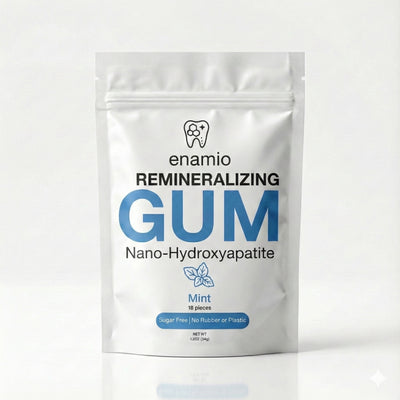
Enamio's Mint pouch illustrates the category: gum labeled with nano-hydroxyapatite. Packaging identifies the product without demonstrating mineral release or a clinical outcome.
- 04 -
What remineralizing gum can and can't do
Chewing sugar-free gum stimulates saliva, but a claimed added-mineral outcome needs evidence matching the ingredient, finished formula, study model and measured result. [4] The CPP-ACP study tested enamel slabs, [6] while hydroxyapatite research tested toothpaste. [7]
Neither study is an Enamio clinical result, because ingredient research and finished-product research answer different questions. A toothpaste study can show that hydroxyapatite is relevant to enamel remineralization, but it can't establish the effect of a particular gum, dose, or schedule. It tested toothpaste. The 2024 review covered toothpaste, mouthwash and gel studies, without a finished chewing-gum trial in its included set. [8]
Our sensitivity guide separates desensitizing toothpaste trials from gum claims. Its toothpaste evidence does not establish sensitivity relief from chewing gum.
How to read a product claim
Before interpreting a result, check whether the researchers tested that specific finished product or a different material. A toothpaste experiment, for example, does not test the gum's mineral release or its chewing schedule. Write down the model and measured outcome beside the claim. Use the eight-question documentation checklist to compare label disclosures, not clinical performance.
The table separates chewing effects, ingredient research, and finished-product evidence because the same ingredient name can appear in studies answering very different questions.
Compare the source-specific evidence and limits in the table below, swiping horizontally on a phone to reveal every column.
| Mechanism or ingredient | What was studied and found | Evidence limit | Source |
|---|---|---|---|
| Saliva from sugar-free gum | Chewing sugar-free gum for at least 20 minutes after eating or drinking helps neutralize plaque acid | EU-authorized claim | [3][4] |
| Xylitol | Nine human trials reviewed. Caries prevention could not be confirmed. | Prevention not confirmed by this review | [5] |
| CPP-ACP gum | Measured remineralization of demineralized human-enamel slabs in removable palatal appliances | CPP-ACP in-situ model, not patients' natural lesions or Enamio | [6] |
| Hydroxyapatite toothpaste | Enamel remineralization was studied in an in-situ toothpaste experiment | Different format from gum, not a finished-gum result | [7] |
| Finished nano-hydroxyapatite gum | Not assessed by the cited 2024 review | The review covered toothpaste, mouthwash, and gel | [8] |
| Rebuilding missing tooth structure | Remineralization does not regrow the missing structure of a cavitated tooth | Not a gum treatment claim | [2] |
Read the model column before comparing results. In an in-situ study, researchers place prepared enamel samples in participants' mouths and measure those samples after exposure. [6] [7] Those measurements concern prepared samples exposed to a human oral setting.
In the 2001 CPP-ACP experiment, 30 participants wore palatal appliances holding six human-enamel half-slabs with demineralized subsurface lesions. [6]
Each session combined 20 minutes of chewing with another 20 minutes of appliance retention, keeping the prepared samples in the mouth. Four daily sessions tested prepared slabs over 14 days.
The reported increase was relative to control gum and tied to the tested CPP-ACP amounts. [6] That CPP-ACP result doesn't validate a nano-hydroxyapatite gum or calcium-glycerophosphate formula. Copying only the study's chewing time would lose the ingredient, amount, and model that define its result.
The 2019 toothpaste study used human primary-tooth enamel blocks in appliances worn by adults. [7] It compared 10% hydroxyapatite microclusters with 500 ppm amine-fluoride toothpaste. Thirty-two adults enrolled and thirty completed the study. Despite the title's reference to children, this wasn't a trial of children chewing gum.
Sound and lesion-bearing blocks were tested separately.
Each block type occupied a two-week period, within treatment phases that began with a one-week washout followed by four weeks of toothpaste use. [7] The investigators measured mineral loss and lesion depth.
In the 2019 toothpaste experiment, baseline sections from lesion-bearing blocks provided the comparison for both post-test mineral loss and lesion depth.
The 2024 hydroxyapatite review also declares commercial relationships. Two authors were senior scientists employed at Dr Kurt Wolff, and all authors received travel grants from the same oral-care company. [8] Those disclosures belong beside its scope. They don't convert its findings into gum evidence or automatically invalidate them.
Keep brushing.
Please see a dentist for a visible hole or pain. NIDCR explains that early mineral loss differs from a cavity, which is permanent damage requiring a filling. [2] That distinction doesn't establish a gum treatment for either stage.
- 05 -
Who is remineralizing gum for?
After lunch is one possible moment for a sugar-free chew that follows the pouch directions and fits your usual routine.
Chewing increases saliva and helps dilute and neutralize plaque acids. [4] Choose a comfortable moment to chew while keeping your usual twice-daily fluoride brushing and daily cleaning between teeth as the core routine.
For someone who snacks repeatedly, the wider routine deserves attention too. NIDCR explains that bacteria produce acids whenever we eat or drink something containing sugar or starch. [2] Consider those eating and drinking patterns when discussing prevention with your dentist, rather than asking a gum ingredient to answer every routine question.
Ask your dentist about persistent dry mouth and its cause. Bring the product label and describe what you want help with, so the conversation starts with your symptoms and the actual formula.
Buying because a tooth hurts?
The cited studies do not establish sensitivity relief from Enamio, and our guide to sensitivity and cavities explains why symptoms alone cannot identify decay. Ask a dentist about the cause.
Material preferences create a different shopping question.
A reader avoiding synthetic gum base can check for chicle, while a reader avoiding a particular sweetener needs the complete ingredient list. Vegan status is a separate check. The chicle ingredient FAQ explains why the base and the whole formula require separate checks.
A base preference is a label question. If a tooth hurts, ask a dentist about the care you need before comparing gum ingredients. The two questions call for different next steps.
For recent dental work, braces, or a sore jaw, ask your dentist whether chewing suits your situation before making it a habit.
Ask your dentist before giving gum to young children. Start with their needs and current care when deciding whether chewing gum suits them.
- 06 -
How is it different from regular sugar-free gum?
Ordinary sugar-free gum and mineral gum share the chewing action that stimulates saliva, but you identify their formula differences on the ingredient list. [4]
Check the sweetener and look for a named mineral ingredient.
Compare the mineral line separately from the sweetener line. Xylitol alone does not identify an added calcium-phosphate ingredient, even when the front label emphasizes dental care.
Xylitol gum is gum sweetened with xylitol. Xylitol is a sugar alcohol, and the formula can also list other sweeteners without changing what the xylitol ingredient name means. [5] Check the actual recipe. Enamio's product page lists xylitol and monk fruit alongside nano-hydroxyapatite and calcium glycerophosphate, a specific example with separate sweetener and mineral names. [10]
Xylitol grams describe the sweetener.
The xylitol label comparison distinguishes disclosed grams from an ingredient listing, which is useful when comparing packs with different label detail. Enamio's FAQ states about one gram of xylitol per piece. [12] The PDP and FAQ disclose no nano-hydroxyapatite amount per piece in the October 15, 2026 captures.
Read the measured outcome rather than the sweetener name. After reviewing nine human trials, the 2024 systematic review's authors concluded that xylitol's preventive effect against dental caries could not be confirmed. [5] That is their conclusion. Its risk-of-bias assessment is not a moderate efficacy grade or a dosing instruction for your pack.
Check the exact flavor and format. Our recipe-specific sweetener examples show how products sharing a brand name can have different ingredient lists.
- 07 -
How to use remineralizing gum
Follow the current pouch and your dentist's advice on amount and duration.
For Enamio, the two inspected web pages disagree: the October 15, 2026 PDP says one to two pieces daily for 20 minutes each. [10] The FAQ says one to three pieces daily. [12]
Ask about the conflicting web directions instead of averaging them into a new daily range.
Send both inspected page URLs and a current pouch photo when asking the manufacturer which instruction applies to your pack and its directions.
Ask for a written reply. It should identify your pack and state which instruction replaces the conflicting wording on the two pages. Keep that reply with the pouch.
The EU sugar-free-gum plaque-acid entry is a regulatory condition, not a brand instruction. It applies only to gum meeting the SUGARS FREE nutrition-claim conditions under Regulation (EC) No 1924/2006. [3] Consumers must be told that the benefit is obtained by chewing for at least 20 minutes after eating or drinking.
Read the eligibility requirement and consumer-information wording of that condition together.
Neither part supplies a daily number of pieces or a nano-hydroxyapatite amount. The fact that a manufacturer also mentions 20 minutes does not turn its daily range into an EU-validated mineral dose.
Do
Follow the gum label while keeping twice-daily fluoride brushing and daily cleaning between your teeth. [4]
Keep in mind
Gum cannot replace brushing, and jaw pain means stop chewing.
An after-meal reminder can help you remember the pouch instructions without inventing a larger chewing schedule. Before making gum a daily habit with braces or recent dental work, ask your dentist whether it suits your situation. Stop if chewing makes your jaw sore.
Preparing for an appointment? The questions about the dental visit explain what to report and ask about professional tests. Take the pouch or a clear label photo if you want advice about a particular gum, rather than relying on its category name.
Studies here assess saliva or enamel changes. A sensation after one piece does not verify mineral change. The practical question is simpler: can you follow the label after a meal without jaw discomfort while keeping the rest of your oral-care routine unchanged?
Which ingredient does the number describe?
Enamio's FAQ gives about one gram of xylitol per piece. [12] Our guide to reading xylitol grams explains why a total sugar-alcohol figure can include several sweeteners. Don't assign that total to nano-hydroxyapatite.
- 08 -
Which remineralizing gum should you try first?
Start with the label rather than the brand name. A useful first gum names its mineral in the ingredient list (nano-hydroxyapatite or another calcium phosphate), is sugar-free, and states its sweetener amount. Then choose on what matters to you: sweetener (xylitol only, or xylitol with stevia, erythritol or monk fruit), base (chicle or synthetic) and price per piece. Our best remineralizing gum guide compares the brands side by side.
Keep the claim in proportion: sugar-free gum after meals is an addition to brushing with fluoride toothpaste and cleaning between teeth, not a replacement. Ask your dentist if you have sensitivity, a diagnosed cavity or a dietary restriction.
People also ask
What does remineralizing gum do?
Chewing stimulates saliva, whereas an ingredient list identifies what the maker puts into the recipe without measuring its effect in your mouth. [4] It doesn't diagnose decay. NIDCR distinguishes early mineral loss from the permanent damage of a cavity requiring a filling. [2] Neither distinction, on its own, establishes that a particular gum treats early mineral loss or a cavity in a patient's tooth.
What is remineralizing gum made of?
Check all three parts of a mineral-gum formula: the named mineral ingredient, the sweetener used, and the base that holds the recipe together. Enamio lists nano-hydroxyapatite, xylitol, chicle, zinc and L-arginine. [10] CPP-ACP or another calcium phosphate identifies a different mineral ingredient, while xylitol and monk fruit remain sweeteners.
What does "mineral active" mean on a gum label?
It identifies a mineral, not clinical efficacy. That is a label distinction, and Enamio lists xylitol as a sweetener and zinc separately. [10] A zinc listing cannot establish what the finished gum does for breath.
Is remineralizing gum the same as regular sugar-free gum?
Both gums stimulate saliva through chewing, while the formula distinction is a named mineral ingredient such as nano-hydroxyapatite or CPP-ACP. [4] The listing establishes neither mineral delivery, a separate chewing-time window nor efficacy.
Is remineralizing gum the same as xylitol gum?
Not quite: xylitol describes a sweetener, while a mineral-gum label should identify a mineral ingredient. Enamio lists both xylitol and nano-hydroxyapatite. [10] A xylitol-only formula doesn't contain an added mineral merely because it uses that sweetener.
Does remineralizing gum actually work?
That depends on the effect claimed: chewing stimulates saliva, but ingredient presence alone doesn't establish a clinical result. [4]
Match the study first. The cited CPP-ACP gum experiment measured prepared enamel slabs in appliances, not patients' natural lesions or an Enamio result. [6] The 2024 hydroxyapatite review covered toothpaste, mouthwash and gel, so its included evidence cannot validate a finished gum's cavity, sensitivity or whitening outcome. [8]
How long do you need to chew it?
The EU condition is at least 20 minutes after eating or drinking. [3] That condition does not establish a minimum nano-hydroxyapatite dose or show that longer chewing improves a finished gum's mineral effect. Follow the product's directions on amount and duration.
Can remineralizing gum replace brushing or toothpaste?
No, gum is an addition to your brushing and interdental routine, so keep both. The ADA's routine is twice-daily fluoride-toothpaste brushing plus daily cleaning between teeth, with gum remaining an addition to that care. [4] If you need another toothpaste, ask your dentist which choice and instructions fit your situation.
Is nano-hydroxyapatite in gum safe?
The EU safety committee assessed defined rod-shaped nano-hydroxyapatite for use in toothpaste and mouthwash, with limits tied to the material and its concentration. [9] The opinion doesn't evaluate every gum formula or specification. Check the product label, ask a dentist about children or special circumstances, and keep every xylitol product away from dogs. [11]
Is remineralizing gum good for your teeth?
The general evidence concerns chewing and saliva, rather than a guaranteed result for every mineral formula. Keep the claim specific. Under the EU conditions, qualifying sugar-free gum chewed after eating or drinking helps neutralize plaque acid. [3] Its added mineral does not replace brushing or dental care.
Does remineralizing gum help with sensitive teeth?
The cited studies do not establish that chewing a finished nano-hydroxyapatite gum relieves tooth sensitivity in people with symptoms.
A gum label cannot explain why a tooth hurts, so ask a dentist about persistent or worsening pain. See care while arranging a dental visit for guidance.
Is remineralizing gum the same as fluoride?
No, fluoride and nano-hydroxyapatite are separate ingredients, and the category name does not identify every product's recipe.
Check the specific label. Enamio's FAQ states that it is fluoride-free [12], while its product page lists nano-hydroxyapatite [10]. Gum remains an addition to twice-daily fluoride-toothpaste brushing, as the ADA explains, so ask your dentist which toothpaste fits your needs. [4]
- 09 -
FAQs
What is mineral gum?
This guide uses "mineral gum" for sugar-free gum containing a named mineral ingredient, without treating that wording as a standard recipe. Find the mineral name. Enamio lists nano-hydroxyapatite and xylitol, which identify a mineral and sweetener separately. [10] A xylitol listing alone does not identify an added calcium-phosphate ingredient, so read the full formula and directions before choosing a pack.
Is remineralizing gum safe to chew or swallow?
A gum's safety depends on its complete formula, the amount used, particle specification, allergies, and the person actually chewing it. The EU opinion covers specified nano-hydroxyapatite in toothpaste and mouthwash, not every chewing gum. [9] Gum is meant to be chewed and discarded, so ask a dentist about young children or repeated swallowing. Keep every xylitol product away from dogs. [11]
What should I do if my dog eats xylitol gum?
Contact your veterinarian or an animal poison control service immediately after a suspected xylitol exposure, including when your dog still seems fine. Act before symptoms appear. The FDA warns that xylitol poisoning can start within 20 minutes, with signs including vomiting, weakness, collapse, difficulty walking, shaking, or seizures. [11] Store all xylitol gum where pets cannot reach it.
Is nano-hydroxyapatite safe?
The 2025 SCCS opinion assessed specified nano-hydroxyapatite in toothpaste and mouthwash under stated particle and concentration limits. [9] It doesn't establish a gum safety guarantee or certify Enamio's material.
Nano, micro and non-nano labels are explained in the particle-wording guide, alongside the documentation questions those words leave open. Check the defined material. The SCCS conclusion covers specified rod-shaped particles without coatings or surface modifications, and excludes material containing needle-shaped particles. [9]
How often should you chew remineralizing gum?
Follow your current pouch and dentist's advice. On October 15, 2026, Enamio's PDP says one to two pieces daily for 20 minutes each, while its FAQ says one to three. [10][12] Neither range is a validated mineral dose. The EU condition concerns qualifying sugar-free gum chewed for at least 20 minutes after eating or drinking. [3]
Does remineralizing gum have fluoride?
A category name cannot tell you whether a particular gum contains fluoride. Read the formula. Enamio's FAQ states that it is fluoride-free [12], while its product page separately lists nano-hydroxyapatite. [10] Those are Enamio's manufacturer disclosures, so check another product's own label instead of carrying this recipe across brands.
Keep using the toothpaste your dentist recommends.
A fluoride-free gum label does not tell you to stop a fluoride routine recommended by your dentist.
Does remineralizing gum whiten teeth or reverse cavities?
No whitening or cavity-treatment benefit follows from the category name alone. A visible hole or persistent pain needs dental assessment. Remineralization cannot regrow missing tooth structure, as NIDCR's decay-process guidance distinguishes early mineral loss from a permanent cavity. [2] A mineral listing does not prove a finished-gum whitening result.
References
-
Nanomaterials for Tissue Engineering In Dentistry.
Nanomaterials (2016), volume 6(7), article 134, DOI 10.3390/nano6070134 · Full text · Accessed October 15, 2026.
-
The Tooth Decay Process: How to Reverse It and Avoid a Cavity.
National Institute of Dental and Craniofacial Research, last reviewed January 2025 · Patient guidance · Accessed October 15, 2026.
-
EU Register on nutrition and health claims.
European Commission, general sugar-free-gum plaque-acid entry 485/1150, Commission Regulation (EU) 432/2012 of May 16, 2012 · Complete register · Accessed October 15, 2026.
-
Chewing Gum.
American Dental Association, oral-health topic page, last updated May 4, 2023 · ADA overview · Accessed October 15, 2026.
-
Is xylitol effective in the prevention of dental caries? A systematic review.
Journal of clinical and experimental dentistry (October 2024), volume 16(10), pages e1307-e1315, PMID 39544205, DOI 10.4317/jced.62008 · Full text · Accessed October 15, 2026.
-
Remineralization of enamel subsurface lesions by sugar-free chewing gum containing casein phosphopeptide-amorphous calcium phosphate.
Journal of dental research (December 2001), volume 80(12), pages 2066-2070, PMID 11808763, DOI 10.1177/00220345010800120801 · Study abstract · Accessed October 15, 2026.
-
Comparative efficacy of a hydroxyapatite and a fluoride toothpaste for prevention and remineralization of dental caries in children.
BDJ open (December 9, 2019), volume 5, article 18, PMID 31839988, DOI 10.1038/s41405-019-0026-8 · Full text · Accessed October 15, 2026.
-
Clinical evidence of caries prevention by hydroxyapatite: An updated systematic review and meta-analysis.
Journal of dentistry (December 2024), volume 151, article 105429, PMID 39471896, DOI 10.1016/j.jdent.2024.105429 · Review abstract and disclosures · Accessed October 15, 2026.
-
SCCS - Scientific Opinion on Hydroxyapatite (nano) - Submission IV.
Scientific Committee on Consumer Safety, SCCS/1677/25, adopted June 26, 2025 · Official 2025 opinion · Accessed October 15, 2026.
-
Enamio Remineralizing Gum.
Enamio product page, manufacturer-stated facts inspected October 15, 2026 · Product-information link below · Product claims aren't clinical evidence.
-
Paws Off! Xylitol is Toxic to Dogs.
Food and Drug Administration, content current as of February 14, 2025 · FDA pet warning · Accessed October 15, 2026.
-
FAQ | Enamio Remineralizing Gum with Nano Hydroxyapatite.
Enamio FAQ, manufacturer statements inspected October 15, 2026 · Brand disclosure.
The dated FAQ discloses about one gram of xylitol per piece, fluoride content and a daily range differing from the PDP. Outcome claims are not evidence.
Ready to build your routine
If you're considering remineralizing gum, compare the named ingredients and current directions with the study limits above. Enamio provides an ingredient list, which identifies its formula without establishing a finished-gum clinical result.
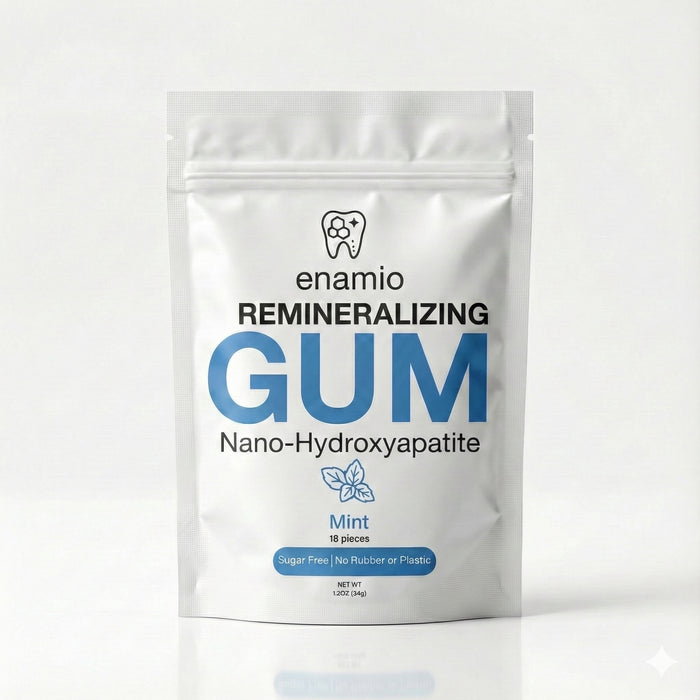
A worked example of the category
Enamio Remineralizing Gum
The manufacturer lists nano-hydroxyapatite and xylitol in a plastic-free chicle base, describing the formula without establishing a clinical result for the finished gum.
Check current ingredients, pouch directions, availability and order terms before buying.
Product informationWhere to go from here
Need the biological explanation? NIDCR's decay-process guidance [2] distinguishes early mineral loss from a cavity, while the ADA overview [4] describes general chewing and saliva. For safety, read the 2025 SCCS opinion [9]. Its defined toothpaste and mouthwash scope is not gum certification.
Bring questions about symptoms and your current oral-care routine to the dentist who advises you. For questions about an undisclosed ingredient amount or missing document, the label-first buying questions show what to ask the manufacturer.
Enamio product pages
Looking for Enamio's own product information? Browse its cavity-prevention page or tooth-sensitivity page with the study limits above in mind. A page name doesn't establish a finished-gum benefit.
For other shopping questions, Enamio has plastic-free gum information and a breath product page. Its product quiz is another shopping tool, while questions about pain or persistent symptoms belong with your dentist.
This guide is educational and does not provide medical advice. Ask your dentist about pain, active decay, pregnancy, allergies, or new dental work.
Written by the Enamio editorial team
Our editors review evidence on remineralization and sugar-free sweeteners, separating what studies measured from the ingredient disclosures readers can check on a gum label. Each numerical claim links to its source.
Sources checked: .