

Gum vs Toothpaste
Share
Quick answer: gum vs toothpaste
The remineralizing gum vs toothpaste evidence here comes from four studies, and each asked a different question.
Adult toothpaste: no DMFS increase over eighteen months. [4]
Orthodontic toothpaste: new ICDAS lesions in 11- to 25-year-olds during 168 days of braces care. [5]
Experimental gum: dentin sensitivity after one and two weeks. [7]
In-situ toothpaste: mineral change in primary-tooth blocks carried by adults. [6]
01
Remineralizing gum vs toothpaste at a glance
This table compares the jobs and evidence boundaries of each format without scoring one as universally superior.
Swipe horizontally to read every column on a small screen.
Comparison table: format, routine role, direct hydroxyapatite evidence, and what remains unknown
| Question | Toothpaste | Remineralizing gum |
|---|---|---|
| Main format job | Works during brushing, which also disrupts plaque. | Chewing stimulates saliva. An ingredient list does not establish how much mineral leaves a finished gum. |
| Routine position | Fluoride toothpaste is the ADA daily baseline for most people. | Gum is an adjunct and does not replace brushing or interdental cleaning. |
| Direct hydroxyapatite studies reviewed here | Several trials tested defined hydroxyapatite toothpastes against defined fluoride toothpastes. | One accessible study tested calcium hydroxyapatite gum for dentin sensitivity, not caries. |
| What those results establish | They establish results for the stated toothpaste, population, duration, comparator, and endpoint. | They establish only the stated gum result for its sensitivity endpoints and studied participants. |
| What remains unknown | A toothpaste result cannot predict a finished gum’s release, contact, dose, or outcome. | Finished gums need product-matched evidence for enamel or caries claims. |
Choose the row that matches your decision. Brushing, a sensitivity result, and an optional chew are different jobs, not substitutes for one another.
Why a toothpaste percentage is not a gum dose
A percentage in toothpaste and an amount per gum piece describe different things. An ingredient name won't convert one into the other.
Ten percent hydroxyapatite describes the concentration in a tested paste, while milligrams per piece would describe how much mineral a gum contains. Neither number, by itself, tells you how much reaches a tooth. A release measurement would ask a further question: what leaves the gum during a defined chewing procedure?
Concentration is only the starting point.
The sensitivity experiment compared another pair of complete products: a gum containing calcium hydroxyapatite and dicalcium phosphate dihydrate against otherwise identical gum without them. Both minerals were added together, so the result belongs to that combination rather than an isolated hydroxyapatite ingredient. [7]
Hydroxyapatite, fluoride, xylitol, and CPP-ACP also shouldn't share one potency scale simply because their names appear on oral-care labels.
For fluoride, the unit has a specific basis. The adult control supplied 1,450 ppm fluoride as sodium fluoride, while the enamel-block control supplied 500 ppm fluoride as amine fluoride. These figures describe fluoride, not the mass of the whole fluoride compound. Calling both products fluoride toothpaste doesn't make their concentrations identical. [4] [6]
What can the label tell you?
The published amount and particle-document fields help identify a formula, but they don't establish that a smaller particle or larger amount works better in people.
Fluoride toothpaste stays in the brushing routine
Keep fluoride toothpaste in twice-daily brushing and clean between teeth daily. The American Dental Association recommends two minutes for each brushing session. Gum is an adjunct to that routine, not a substitute for brushing or for cleaning between teeth. [1] [2]
Chewing isn't another way to brush.
Brushing physically disrupts plaque on tooth surfaces. Chewing stimulates saliva, which helps dilute and neutralize acids produced by plaque bacteria, so keep your brushing sessions if you choose sugar-free gum. [1] [2]
The home-care routine beyond product choice puts brushing alongside food exposures and dental follow-up. Shopping doesn't replace that care.
An experimental brushing schedule isn't a new general recommendation. The adult trial used three-minute sessions, which describe that study's protocol rather than replacing the ADA's two-minute guidance. They don't set a gum contact-time rule either. [4]
A toothpaste's taste or texture can make brushing unpleasant enough that you want to discuss a different product with your dentist. This article can't examine your mouth, choose a treatment plan, or decide that a chew should replace brushing.
Choosing a fluoride-free paste changes the brushing product.
Adding an optional gum leaves that product decision separate. The toothpaste-active comparison is useful for the first question, while a gum study must address what the added chew actually changes.
What the toothpaste trials actually tested
Three cited trials compared defined hydroxyapatite toothpastes with fluoride toothpastes, using different populations and care protocols. Their results answer three specific questions. Each result belongs to its tested toothpaste and protocol. [4] [5] [6]
If you only need the routine, skip to how the formats fit a routine.
Adults: caries outcomes over 18 months
What did the adult trial find? Its primary outcome was the proportion of participants without an increase in decayed, missing, or filled tooth surfaces, abbreviated DMFS. [4]
In the per-protocol analysis, 75 of 84 hydroxyapatite participants, or 89.3%, had no DMFS increase. The fluoride result was 76 of 87 participants, or 87.4%.
The one-sided 95% confidence interval had an upper limit of 6.84 percentage points, below the prespecified 20-percentage-point noninferiority margin. The interval included zero, and the publication states that superiority cannot be assumed. [4]
A stable DMFS score isn't a percentage of enamel repaired.
Who could join? The trial randomized 194 adults aged 18 to 45, each needing at least ten caries-free molars and premolars. Untreated caries and conditions or medications interfering with saliva were exclusion criteria. [4]
The result doesn't describe someone choosing a mineral product for an untreated tooth. Its intention-to-treat analysis included 189 people, while 171 entered the per-protocol analysis, so read each percentage with its analysis population.
Participants used 10% hydroxyapatite toothpaste or toothpaste containing 1,450 ppm fluoride, supplied as sodium fluoride. Both groups received electric toothbrushes and brushed twice daily after meals for three minutes, with examinations at baseline and on study days 182, 364, and 546. [4]
The background formulations matched apart from the main actives, and xylitol appeared in both pastes. Other fluoride- or hydroxyapatite-containing oral-care products were prohibited. Professional cleaning occurred at the baseline and final visits, without fluoride application afterward. [4]
The result belongs to those conditions.
Dr Kurt Wolff and both universities funded the study: Poznan University of Medical Sciences and Medical University in Bialystok. Three authors were company employees. The remaining authors declared no potential commercial or financial conflicts. [4]
Braces: a specialized caries setting
The 2019 orthodontic trial recruited 150 participants aged 11 to 25 with fixed appliances and high caries activity. Its analyses included 147 by intention to treat and 133 per protocol. [5]
Follow-up lasted 168 days.
The test paste contained 10% microcrystalline hydroxyapatite. The control supplied 1,400 ppm fluoride using amine and stannous fluoride.
Both groups received powered toothbrushes, and both were trained to use approximately one gram of toothpaste twice daily during the study. Their care also included repeated professional cleaning and topical 1% chlorhexidine gel. [5]
That extra care is part of the result. For broader routine questions, care habits alongside professional follow-up are more relevant than copying the study's chlorhexidine procedure.
Researchers scored new vestibular lesions with the International Caries Detection and Assessment System, or ICDAS. While still blinded, they changed the primary threshold from code two to code one because the original outcome occurred less often than anticipated. Code two remained an additional secondary outcome, and the original 20-point noninferiority margin was retained. [5]
The reported rounded upper one-sided 95% confidence limits were eight percentage points per protocol and nine by intention to treat, below twenty. Changing the primary outcome matters when interpreting that margin. The abstract, table, and narrative also contain conflicting fluoride-control percentages, which are omitted here rather than arbitrarily selected.
Dr Kurt Wolff exclusively funded the study and supplied the test dentifrice. Both remain part of the result. [5]
Enamel blocks: adults carrying primary-tooth samples
Despite the title referring to children, the 2019 in-situ experiment enrolled 32 adults, and thirty completed it wearing appliances holding human primary-tooth enamel blocks. [6]
The teeth being measured were specimens.
Microradiography measured mineral loss and lesion depth in sound blocks and blocks with artificial initial lesions.
The comparison used 10% hydroxyapatite microclusters and toothpaste containing 500 ppm fluoride, supplied as amine fluoride. Reported median crystallite dimensions were about 80 by 30 nanometers. [6]
Participants brushed around the appliances, not directly over the blocks, and the design also included washout periods. The abstract describes fourteen days per arm, while the methods describe two four-week treatment phases with separate two-week sound-block and lesion-block exposures.
Participants brushed twice daily for two minutes, rinsed with ten milliliters of water, and avoided food or drink for at least thirty minutes afterward. Other oral-hygiene products, including gum, were prohibited, and the specimens encountered toothpaste indirectly within this controlled oral environment. [6]
Between-group differences were not statistically significant.
Probability values were .81 for remineralization and .68 for lesion-depth reduction. The 95% confidence interval was negative 8.8% to positive 6.5% for remineralization, and negative 6.8% to positive 4.1% for lesion-depth reduction. The analysis used a 20% noninferiority criterion. [6]
The captured report gives no separate funding statement, declares no competing interests, and reports no adverse effects. Those fields don't turn specimen measurements into natural childhood lesions or cavities avoided. The difference between lesion change and missing structure explains why the condition of an intact surface remains a clinical question.
How much does noninferiority tell you?
Noninferiority asks whether a product crosses an allowed difference from its comparator, and the margin defines that question. It doesn't begin by asking which product wins.
The orthodontic trial used twenty points too. Its changed primary outcome and specialized care setting make it a different comparison. The adjacent guide explains noninferiority and fluoride-comparator context. A smaller-looking upper limit doesn't rank toothpaste studies, much less identify a gum benefit. [5]
What the gum trial measured
The cited clinical hydroxyapatite gum trial measured dentin sensitivity over two weeks, not enamel mineral gain, caries incidence, or gum versus toothpaste. [7]
The 2014 sensitivity experiment
This controlled, double-blind trial enrolled 107 people and used a random table for allocation. One hundred completed it, with fifty in each analyzed group. Participants chewed two pieces three times daily, a schedule that describes the unnamed experimental gum rather than an instruction for a retail product. [7]
The active gum contained calcium hydroxyapatite and dicalcium phosphate dihydrate, while the otherwise identical control lacked both ingredients.
Researchers assessed tactile, air-blast, cold-water, and subjective sensitivity after one and two weeks. The two-week clinical-index reductions were as follows. [7]
- Tactile: 54% in the fifty active-gum completers and 30% in the fifty control-gum completers.
- Air-blast: 66% in the active group and 25% in the control group.
- Cold-water: 49% for active gum and 31% for control gum.
Those are within-group changes from baseline.
The two-week between-group comparisons had p below .01 for tactile sensitivity and p below .001 for air-blast sensitivity. Cold-water and subjective-index comparisons each had p below .05. The abstract supplies neither confidence intervals for those comparisons nor a numeric subjective-index reduction. [7]
Both groups chewed gum.
The active group's clinical-index reductions met p below .01 at both visits, while the control group's met p below .01 only at two weeks. The comparison tested two added minerals against an otherwise identical chewing experience, not against doing nothing. Because both minerals were added together, the experiment doesn't isolate hydroxyapatite's contribution.
Four test-group and three control-group participants withdrew for reasons reported as unrelated to gum adverse effects. Individual reasons and missing-data handling remain unclear. [7]
The full paper reports recruitment from four Italian practices, ages 18–65, mineral amounts, and manufacturer supply and support. It does not establish a retail ENAMIO formulation. [7]
When shopping, check the complete ingredient disclosure to see whether a retail formula is identified. A shared ingredient name doesn't identify the experimental gum, and its sensitivity percentages aren't percentages of people cured or cavities prevented.
Why completers and enrollment are different numbers
A completer result describes only the people analyzed: here, the sensitivity-index changes belong to fifty active-gum and fifty control-gum completers, not all 107 recruits. You can't tell from the captured record whether the seven missing participants' experiences resembled theirs. [7]
The adult toothpaste trial's intention-to-treat analysis required at least one follow-up, excluding five people who stopped at baseline. Although 174 completed the final visit, 171 entered per-protocol analysis. [4]
Enrollment and analysis aren't interchangeable.
Ask both what changed and in whom: the adult toothpaste percentage concerns no DMFS increase, while the gum percentages concern sensitivity-index reductions. These are different endpoints even before considering the different analysis sets.
A later enamel-specimen gum record
A 2023 abstract describes three Saqqez gums, including variants containing 10% green or synthetic hydroxyapatite. Participants wore appliances holding six enamel specimens. Six specimens aren't six people, and the captured abstract supplies no usable analyzed participant denominator. Its numeric mineral outcomes are excluded here. [15]
Funding is unreported in that record, while the authors declared no known competing financial interests or personal relationships. This partial record shows another gum delivery model, not an Enamio result or a natural-lesion outcome.
For other mineral systems, the broader gum-evidence discussion supplies background, but keep its other actives' results and fixed product directions separate from this unnamed test gum.
Why reviews answer different comparison questions
The reviews concern different interventions and endpoints, so no single gum-versus-toothpaste score comes out of them. Toothpaste and enamel-specimen reviews belong together only within their defined scope. Sugar-free-gum syntheses have different controls, ingredients, and outcomes.
The 2022 nano-hydroxyapatite review
The 2022 review's results section describes five in-vivo studies covering 633 teeth in 420 participants, and five in-situ studies covering 1,031 specimens in more than 95 participants. Evidence certainty was very low, and the clinical studies were too heterogeneous to pool. [8]
Endpoint matters within a review too.
The in-situ analyses favored sodium fluoride during demineralization and found no difference during remineralization. The abstract listed six studies at high risk of bias, while the full text listed seven, a mismatch this article doesn't try to resolve. Its abstract also reported six studies with manufacturer funding or publication involvement. [8]
The review itself reported its authors' and institutional funding, University of Bern open-access funding, and no competing interests. Those are review-level disclosures, separate from funding of the included trials.
The 2022 review's introductory 1,450 ppm comparison cites Tschoppe's 2011 study, not Amaechi's 2019 experiment. The review's supplement lists Amaechi's comparator as 500 ppm but labels it sodium fluoride. Amaechi's own methods specify 500 ppm amine fluoride, which is the description used here. [6] [8]
The 2025 review of younger participants
The 2025 review compared hydroxyapatite and fluoride toothpastes for prevention and remineralization of initial caries lesions. Its search covered participants younger than 25. It found 68 records and included four eligible in-situ randomized trials. [9]
The abstract reports no statistically significant difference in new or progressing lesions measured with DMFS or ICDAS. It also reports nonsignificant pooled risk-ratio and odds-ratio comparisons but doesn't identify the endpoint for each pooled measure. Without that mapping, those numbers can't serve as outcome-specific performance claims.
The authors declared no known competing financial interests or personal relationships, while funding and an overall certainty grade are not reported in the accessible PubMed record. These are toothpaste and initial-lesion findings. [9]
A newer publication date doesn't settle a narrower question.
The 2024 updated review
The 2024 updated review retrieved eighteen studies, with five clinical and eight in-situ studies included in meta-analyses. Its vehicles were toothpaste, mouthwash, or gel, not finished chewing gum. Two authors were company employees, all authors reported travel grants, and the captured record gives neither a separate review-funding statement nor a formal overall GRADE rating. [10]
The guide on review scope and certainty in toothpaste research provides context for those eligibility decisions. When deciding which result applies to your question, start with the studied vehicle and endpoint, not the year on the citation.
Sugar-free gum reviews
The 2020 caries review included twelve adult and child studies. Compared with nonchewing controls, its pooled prevented fraction was 28%, with a 95% interval from 7% to 48%. Across eight xylitol-gum trials, the subgroup estimate was 33%, with an interval from 4% to 61%. High heterogeneity and generally moderate trial quality accompanied a tentative conclusion. [11]
A prevented fraction concerns caries increment against the comparator, not a percentage of enamel replaced or a guarantee for an individual chewer. The xylitol subgroup isn't a hydroxyapatite comparison, and the captured record doesn't report funding or conflicts.
Plaque and gingival outcomes are another question.
The 2022 adjunct-gum network review included twelve adult studies with at least seven days of follow-up. It analyzed 850 participants for plaque and 1,459 for gingival outcomes, two separate endpoint populations, not one combined sample. The gums used different active ingredients, and few direct comparisons were available. The authors did not support clinical indications. [12]
That captured record doesn't report funding or conflicts, and its plaque and gingival measurements don't become cavities avoided, mineral deposited, or a hydroxyapatite gum dose. The sources reviewed here include no clinical head-to-head trial of finished remineralizing gum versus toothpaste.
What a useful comparison would need to measure
The sensitivity trial provided the same fluoride toothpaste to both gum groups. It compared active with control gum, without a no-gum group. It does not settle gum versus toothpaste or replacement of brushing. [7]
What would count as working better?
In the adult trial, success meant no DMFS increase over eighteen months. In the gum trial, the measurements were sensitivity indexes after one and two weeks. Putting those percentages on one scale would mix endpoints, controls, and follow-up times, so it wouldn't compare the formats at all.
An adjunct trial would keep the established brushing routine in both groups.
A future study could compare that same routine with and without a specified gum, stating beforehand which outcome it intended to change. This is a proposed comparison, not a reported trial or an expected benefit. A sensitivity question would require a different endpoint from a caries question.
The ingredient list reports what went into the gum, while a release test would measure what leaves it during a defined chewing procedure. Even a measured release amount wouldn't itself establish clinical benefit. It would help describe the finished intervention to which a later clinical result could be tied.
For the formulation questions, the dose, particle, and certificate checklist separates disclosure fields, but set aside its retail schedule and temporary commercial terms.
Known toothpaste concentrations still sit inside different protocols. Three-minute powered brushing, supervised orthodontic care, and indirect exposure of appliance-held blocks aren't the same use conditions. The paste's crystallite dimensions describe its microclusters, not every mineral particle sold in another vehicle such as gum. [4] [5] [6]
Product information boundary
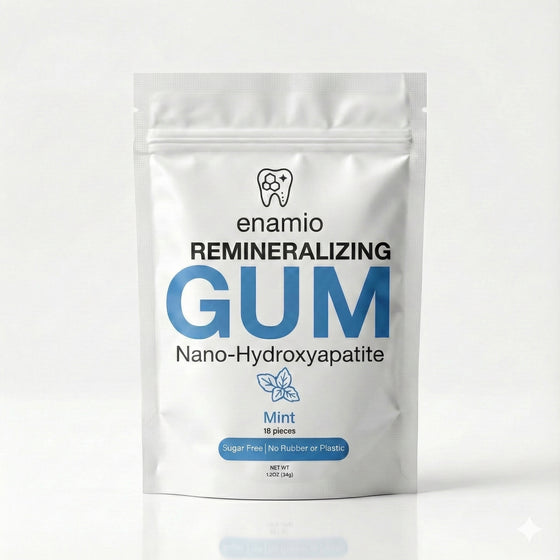
Enamio states 20 nm nano-hydroxyapatite and approximately 1 g xylitol per piece. These are manufacturer statements, not clinical outcomes. [13] [14]
The product page says one to two pieces daily, while the FAQ says one to three. Follow the current pouch. [13] [14]
The reviewed product page and FAQ omit nano-hydroxyapatite amount per piece, public certificates of analysis, particle-size certificates, a named reviewer, and an Enamio trial. View Enamio product information. [13] [14]
Enamio also publishes a cavity-prevention page and a tooth-sensitivity page, which are seller pages rather than study reports. Read their claims with the same questions this comparison applies to every study.
If your shopping question is about breath or gum base, Enamio has a bad-breath page and a plastic-free gum page too.
You can also take the Enamio quiz, but it isn't a dental exam.
How to use the comparison in an ordinary routine
The routine itself stays simple: fluoride toothpaste in twice-daily brushing, plus cleaning between your teeth once a day. If sugar-free gum suits you, it remains an optional addition between those sessions, not a replacement for either task. Your dentist's individual plan takes precedence over a general article. [1] [2]
You don't need to copy an experiment to make that distinction.
The gum study's schedule describes one unnamed formulation, while chlorhexidine and professional cleaning were co-interventions in the orthodontic toothpaste trial. They aren't instructions to add products or perform dental procedures at home. [5] [7]
Daily habits around food and brushing give broader routine context. An optional chew should fit around established tasks, not turn a missed brushing into a completed one. Chewing stimulates saliva, but it doesn't clean every tooth surface or interdental space. [1] [2]
You can judge flavor, texture, and comfort yourself.
None of these measures lesion mineral content. A fresher or smoother mouthfeel isn't DMFS, ICDAS, or the microradiographic endpoint used in the toothpaste experiments. Taste and texture can help you choose a gum without establishing that enamel gained minerals or dentin sensitivity changed clinically. [4] [6] [7]
Don't extend chewing through jaw pain. Gum is optional, and a dentist can advise about chewing restrictions or dental-appliance concerns that this comparison can't examine.
Use the current pouch if the website and packaging differ.
Combining conflicting ranges into a new instruction would create directions neither source gave. A manufacturer label and a clinical protocol serve different purposes, even when both describe product use.
When the tooth needs assessment instead of another product
Remineralization concerns mineral gain in remaining tooth tissue, while a physical cavity has missing structure that gum or toothpaste cannot regrow. NIDCR distinguishes those stages and advises dental repair for a cavity. [3]
An intact lesion and a hole aren't interchangeable.
The intact-lesion and cavitated-hole distinction explains that staging question without asking you to diagnose a tooth. A mirror check, reduced discomfort, or an ingredient list can't establish which finding applies. A sensitivity percentage doesn't measure lesion repair.
The two-week gum experiment recorded responses to tactile, air, and cold tests but didn't determine whether a painful tooth had decay, a crack, or another diagnosis. Comfort is something to report, not a way to name the cause. [7]
Ask a dentist about pain or suspected tooth damage.
Don't delay care while testing another gum or toothpaste, and let your clinician record a baseline and decide how change should be followed. Home care can support that plan without becoming a home diagnosis, whether you use fluoride toothpaste alone or also choose an optional gum.
People also ask about the comparison
Remineralizing gum vs toothpaste: am I changing my brushing product?
Changing toothpaste changes brushing, while adding gum leaves the brushing product in place. The adult trial assigned two toothpastes and restricted other fluoride- or hydroxyapatite-containing oral-care products during its eighteen-month protocol. That design measures a toothpaste comparison, not whether adding a mineral gum to your current brushing routine changes a cavity, sensitivity, or other dental outcome. Decide which choice you're considering before borrowing a result, because a shared ingredient doesn't identify the same intervention. [4]
What would a remineralizing gum vs toothpaste adjunct trial need?
An adjunct trial would compare the same brushing routine with and without a specified finished gum, naming its outcome, follow-up, and analysis population. The cited sensitivity experiment compared active and control gums. The adult trial compared toothpastes under a shared powered-brushing protocol. The adjunct question is still open, and neither result is a reason to replace fluoride toothpaste. [4] [7]
Who was included in the toothpaste studies?
The adult caries trial randomized 194 people aged eighteen to forty-five, requiring at least ten caries-free molars and premolars and excluding untreated caries. Its intention-to-treat and per-protocol analyses included 189 and 171, with company and university funding reported. The orthodontic trial recruited 150 people aged eleven to twenty-five with fixed appliances and high caries activity, then analyzed 147 and 133 respectively. These are defined study populations with different care protocols, so first ask whether the published setting resembles the question you want a result to answer. [4] [5]
Does an enamel-block experiment measure cavities prevented?
No, it measured specimens, not cavities prevented. Thirty of thirty-two enrolled adults completed it, brushing around appliances that held sound blocks and blocks with artificial initial lesions. Its microradiographic measures describe changes in those specimens, whereas DMFS in the adult trial tracked decayed, missing, or filled tooth surfaces over eighteen months. [4] [6]
So name the measurement before you trust a percentage.
What does noninferiority mean for choosing a toothpaste?
Noninferiority isn't a winner test. The adult trial's one-sided 95% upper confidence limit was 6.84 percentage points against a twenty-point margin for the proportion without a DMFS increase.
Its interval included zero. The publication states that superiority cannot be assumed, despite the small difference between the reported group percentages. Nonsignificance isn't universal equivalence. [4]
Why do the fluoride comparator numbers differ?
The original adult toothpaste trial supplied 1,450 ppm fluoride as sodium fluoride, while the original enamel-block study supplied 500 ppm fluoride as amine fluoride. These are different studies and treatment regimens. The 2022 review's introductory 1,450 ppm passage refers to a separate 2011 study. None of these concentrations establishes an equivalent brushing or chewing dose. [4] [6] [8]
Can a label amount or particle certificate establish benefit?
Disclosure identifies a product, not its dental effect.
The full paper identifies both added minerals and their amounts. That description does not establish the composition or clinical performance of a retail gum. Compare amount disclosures versus finished-product evidence. [7]
Can comfort changes predict a personal repair timeline?
A change in comfort is useful to report to your dentist. Still, the gum trial's sensitivity indexes did not measure lesion depth or enamel mineral gain. Its one- and two-week examinations don't forecast a personal repair deadline, as why remineralization has no universal deadline explains in broader care context. The difference between appearance, symptoms, and lesion activity helps frame the follow-up question without making a smoother feel or a photograph into a diagnosis. [3] [7]
What should you ask instead? Ask how the same finding will be compared over time.
10
Frequently asked questions
The questions below cover substitution, study results, product directions, and situations where a dentist needs to assess a tooth rather than another product. Sources identify each answer's basis.
Can remineralizing gum replace fluoride toothpaste?
No, gum doesn't replace fluoride toothpaste or cleaning between teeth. ADA guidance recommends twice-daily brushing for two minutes and describes chewing gum as an adjunct. Brushing disrupts plaque on tooth surfaces. If you chew sugar-free gum, keep those established tasks rather than counting the chew as a brushing session. [1] [2]
Do hydroxyapatite toothpaste studies prove hydroxyapatite gum works?
No, the toothpaste studies tested their own formulations and brushing protocols. The adult trial compared two pastes over eighteen months, while the enamel-block experiment exposed specimens inside adults' mouths. Neither tested a finished gum against toothpaste or studied adding Enamio to unchanged brushing. A gum needs a study of its identifiable formulation and claimed outcome, not a toothpaste percentage relabeled as a gum effect. [4] [6]
Is hydroxyapatite toothpaste better than fluoride toothpaste?
The cited noninferiority trials do not establish superiority. One adult trial used 10% hydroxyapatite toothpaste and a comparator containing 1450 ppm fluoride, supplied as sodium fluoride, for eighteen months. Its upper confidence limit was below a prespecified twenty-percentage-point margin, but the interval included zero. The publication says superiority cannot be assumed, so a difference between the reported group percentages is not proof of a better toothpaste. [4]
What did the direct hydroxyapatite gum study measure?
The study measured sensitivity in completers. Its full methods add details missing from the abstract. See the study section above for context and limitations. [7]
How often should I chew remineralizing gum?
Follow your current pouch, not a clinical experiment's schedule. Enamio's product page says one to two pieces daily, while its FAQ says one to three. This article doesn't choose between or average those web ranges. The experimental schedule from the unnamed 2014 test gum cannot establish a dose for Enamio, and chewing discomfort warrants stopping and seeking advice. [7] [13] [14]
Can either format reverse a cavity with a hole?
Neither gum nor toothpaste regrows a physical hole where tooth structure is missing. NIDCR distinguishes early mineral loss from a cavity needing repair by a dentist. A symptom change, phone photograph, or smoother mouthfeel can't establish the stage or prove that a lesion regained minerals. Ask a dentist about pain or suspected damage, and keep the recommended assessment rather than extending an at-home product experiment. [3]
The bottom line
Keep fluoride toothpaste in twice-daily brushing and clean between teeth daily. Gum can be an optional between-brushing addition, not another way to complete those tasks. [1] [2]
Judge a mineral claim by the finished formula, studied outcome, and analyzed participants, because the toothpaste caries results and the gum's sensitivity results answer different questions. [4] [7]
If you also chew gum, follow its current pouch. If a tooth worries you, ask a dentist rather than using comfort or a marketing label as a diagnosis. [3]
11
References
-
American Dental Association. Home Oral Care. Updated August 8, 2024. Open source.
Accessed October 13, 2026.
-
American Dental Association. Chewing Gum. Updated May 4, 2023. Open source.
Accessed October 13, 2026.
-
National Institute of Dental and Craniofacial Research. The Tooth Decay Process: How to Reverse It and Avoid a Cavity. Reviewed January 2025. Open source.
Accessed October 13, 2026.
-
Paszynska E, et al. Caries-preventing effect of a hydroxyapatite-toothpaste in adults: a 18-month double-blinded randomized clinical trial.
Frontiers in Public Health. 2023.
PMID 37533523. DOI 10.3389/fpubh.2023.1199728. Open source. Accessed October 13, 2026.
-
Schlagenhauf U, et al. Impact of a non-fluoridated microcrystalline hydroxyapatite dentifrice on enamel caries progression in highly caries-susceptible orthodontic patients: A randomized, controlled 6-month trial.
Journal of Investigative and Clinical Dentistry. 2019.
PMID 30701704. DOI 10.1111/jicd.12399. Open source. Accessed October 13, 2026.
-
Amaechi BT, et al. Comparative efficacy of a hydroxyapatite and a fluoride toothpaste for prevention and remineralization of dental caries in children.
BDJ Open. 2019.
PMID 31839988. DOI 10.1038/s41405-019-0026-8. Open source. Accessed October 13, 2026.
-
Porciani PF, Chazine M, Grandini S. A clinical study of the efficacy of a new chewing gum containing calcium hydroxyapatite in reducing dentin hypersensitivity.
The Journal of Clinical Dentistry. 2014.
PMID 25122980. Study record. Accessed October 13, 2026.
-
Wierichs RJ, Wolf TG, Campus G, Carvalho TS. Efficacy of nano-hydroxyapatite on caries prevention-a systematic review and meta-analysis.
Clinical Oral Investigations. 2022.
PMID 35103837. DOI 10.1007/s00784-022-04390-4. Open source. Accessed October 13, 2026.
-
Chatzidimitriou K, et al. The role of hydroxyapatite-based, fluoride-free toothpastes on the prevention and the remineralization of initial caries lesions: A systematic review and meta-analysis.
Journal of Dentistry. 2025.
PMID 40107597. DOI 10.1016/j.jdent.2025.105691. Open source. Accessed October 13, 2026.
-
Pawinska M, et al. Clinical evidence of caries prevention by hydroxyapatite: An updated systematic review and meta-analysis.
Journal of Dentistry. 2024.
PMID 39471896. DOI 10.1016/j.jdent.2024.105429. Open source. Accessed October 13, 2026.
-
Newton JT, et al. A Systematic Review and Meta-Analysis of the Role of Sugar-Free Chewing Gum in Dental Caries.
JDR Clinical and Translational Research. 2020.
PMID 31743654. DOI 10.1177/2380084419887178. Open source. Accessed October 13, 2026.
-
Muniz FWMG, et al. Antiplaque and antigingivitis efficacy of medicated and non-medicated sugar-free chewing gum as adjuncts to toothbrushing: systematic review and network meta-analysis.
Clinical Oral Investigations. 2022.
PMID 35072769. DOI 10.1007/s00784-021-04264-1. Open source. Accessed October 13, 2026.
Enamio. Remineralizing Gum product page. Manufacturer ingredient and direction statements. Accessed October 13, 2026.
-
Enamio. Frequently Asked Questions.
Manufacturer xylitol quantity and direction statements. Accessed October 14, 2026.
-
Hassani AR, et al. Effectiveness of plant-mediated synthesis of hydroxyapatite nano-particles impregnated in Pistachio oleogum resin on mineral contents of human teeth. An in-situ single-blind controlled study.
Journal of the Mechanical Behavior of Biomedical Materials. 2023.
PMID 37852085. DOI 10.1016/j.jmbbm.2023.106155. Open source. Accessed October 13, 2026.
Share or revisit this comparison
Educational information only. This article does not provide diagnosis or individual treatment advice. Trial results, research reviews, dental guidance, and manufacturer statements are identified in the citations. No individual clinician reviewer is claimed.