

Hydroxyapatite vs Fluoride
Share
Quick answer
Fluoride toothpaste first. Hydroxyapatite toothpaste is a credible fluoride-free option, not a proven winner. Gum is optional.
“Better” depends on the outcome and the evidence standard
A toothpaste can look promising on enamel blocks without ever showing that the people using it developed fewer cavities in daily life. Hardness, fluorescence and lesion size measure something else, and none of them counts new decay. That gap is why confident ingredient claims can outrun the research.
A two-week enamel-block study can't stand in for a long trial that counts new lesions in people.
Fluoride starts with a deep record. A 2026 scoping review describes strong evidence for fluoride toothpaste in long-term caries prevention. [21] The ADA recommends brushing twice a day with it, for two minutes. [1]
Hydroxyapatite starts from a different question: can a fluoride-free mineral toothpaste perform similarly under a defined design, population and noninferiority margin?
Several trials answer yes, each within its own preset margin and population. That's useful, but noninferiority doesn't prove superiority or identical results for every person.
A noninferiority trial asks whether a new option is worse than a comparator by more than an amount fixed before the study starts.
The margin matters.
So do adherence, missing data and whether a result counts everyone randomized or only the people who stuck to the protocol. Who paid for a study, and who supplied the product, matters too.
Several hydroxyapatite trials, and one favorable review, were funded by a toothpaste maker or included its employees. A disclosed tie doesn't erase a result. It's a reason to read the design, the analysis and the independent reviews more closely.
Measurement choices shift the picture again, because a lower fluorescence reading can reflect a surface change without showing that someone avoided a future cavity. This review gives human caries outcomes more weight than short surrogate tests.
Surrogate results still appear when they clarify uncertainty.
The guide to remineralizing teeth maps what minerals can and can't do at each stage of damage. It separates a softened white patch from enamel that's physically gone.
Format matters as well. Toothpaste is brushed across the teeth, usually twice a day, then diluted by saliva and rinsing. Gum is chewed, moves around the mouth and stimulates saliva, so a shared ingredient doesn't make the two delivery systems clinically interchangeable.
So this article takes two questions in turn, starting with toothpaste. What do the toothpaste comparisons show, and how can a fluoride-free gum fit without borrowing that evidence?
Has a dentist mentioned an early lesion? Start with whether an early lesion can still remineralize, because lesion stage decides which of these outcomes even apply to you. Questions about swallowing nano-sized particles belong in the nano-hydroxyapatite safety review, while this comparison stays with cavity outcomes in people.
Fluoride toothpaste remains the evidence-first default. Hydroxyapatite toothpaste is a credible but less settled fluoride-free alternative for people who want one.
What randomized hydroxyapatite vs fluoride toothpaste studies found
The direct trials differ in age group, formula, comparator and length, so one slogan would hide more than it shows.
Swipe or scroll sideways to read every column.
| Study | Design, population and formulas | Duration | Outcome |
|---|---|---|---|
| Paszynska 2021 [3] | Double-blind trial in children aged 3 to 7, with 207 analyzed by intention to treat (ITT) and 177 per protocol (PP). It compared 10% microcrystalline hydroxyapatite with 500 ppm fluoride as amine fluoride. | 336 days, brushing three times daily. | PP: an ICDAS increase of at least one occurred in 72.7% with hydroxyapatite and 74.2% with fluoride. The noninferiority margin was 20 percentage points. |
| Schlagenhauf 2019 [4] | Orthodontic patients with high caries activity, 147 ITT and 133 PP. A fluoride-free 10% microcrystalline hydroxyapatite paste was compared with a 1,400 ppm fluoride paste. | 168 days. | PP: at least one new ICDAS lesion in 54.7% with hydroxyapatite and 60.9% with fluoride. Noninferiority testing found no statistical difference between groups. |
| Badiee 2020 [5] | Randomized trial in 50 patients aged 10 to 35, recruited right after brace removal, with 25 per group. A nano-hydroxyapatite paste was compared with a fluoride paste. | 6 months. | White-spot area and fluorescence fell, with larger reductions reported for nano-hydroxyapatite. These measures don't count new cavities. |
| Amaechi 2019 [6] | Double-blind crossover in which 30 adults wore appliances holding primary-tooth enamel blocks. It compared 10% hydroxyapatite with 500 ppm fluoride as amine fluoride. | Four weeks per toothpaste, split into separate 14-day periods for sound and lesion-bearing enamel blocks. | Both pastes remineralized the lesions. The two didn't differ statistically in remineralization or lesion depth. |
| Paszynska 2023 [7] | Double-blind trial in adults aged 18 to 45, with 189 ITT and 171 PP. Matched paste bases differed in their active: 10% hydroxyapatite versus 1,450 ppm fluoride as sodium fluoride. | 18 months. | PP: no DMFS increase in 89.3% with hydroxyapatite and 87.4% with fluoride. Noninferiority used a 20-percentage-point margin. |
For Paszynska 2021, the abstract reports an upper one-sided 95% confidence limit of 9.8 points, while Table 2 and the Results text give 9.5. Both fall below the 20-point margin. [3] That supports comparability under the protocol, not proof that the two pastes are identical.
How big is a 20-point margin? Big enough to tolerate a sizable difference before noninferiority fails, so narrower margins and independent replication would sharpen the comparison. ICDAS scores track early enamel changes too. Knowing which cavity stages can still change keeps an ICDAS result from implying repair of every cavity.
Dr Kurt Wolff funded the child trial. Its commercial Karex paste matched the test formula, but the paper says the funder had no role in recruiting, conducting the study, data collection or statistical analysis. [3]
Schlagenhauf studied braces wearers with high caries activity, using a control paste that combined 350 ppm amine fluoride with 1,050 ppm stannous fluoride. Dr Kurt Wolff exclusively funded the trial and supplied the test paste. [4] Its fluoride-group ITT figure differs between the abstract, the main text and the results table, at 60.9%, 61.9% and 61.6%. The PP figures agree across text and table, so the table above uses them. [4]
Badiee's trial was small and used surrogate outcomes. Its funders were the Dentofacial Deformities Research Center at Shahid Beheshti University of Medical Sciences and Goltash Co. The authors declared no conflicts of interest. [5] Read it with more caution than a large trial that counts new decay.
Amaechi's title says children, yet adults wore the appliances while primary-tooth enamel blocks supplied the test surface. [6]
The crossover gave every participant both pastes. Its Methods section describes four weeks per toothpaste, with sound and lesion-bearing blocks tested in separate 14-day periods. The abstract shortens this to 14 days per arm. [6]
Paszynska 2023 adds a longer adult trial. DMFS counts decayed, missing and filled surfaces, and the study met its noninferiority rule. Its upper one-sided confidence bounds were 6.84 points per protocol and 5.68 points by intention to treat, well below the 20-point margin. [7]
Dr Kurt Wolff, the Poznan University of Medical Sciences and the Medical University in Bialystok funded the adult trial. Three authors were company employees. [7]
The ppm figures give each paper's reported fluoride content, not the compound's mass. None of these trials tested chewing gum.
Three reviews reach different levels of confidence
Pawinska's 2024 review retrieved 18 studies and meta-analyzed five clinical and eight in-situ trials. It concluded that evidence for fluoride-free hydroxyapatite products had expanded. [9] It graded studies with a National Institutes of Health system, and its abstract reports no overall GRADE rating.
Its search covered published hydroxyapatite toothpaste, mouthwash and gel trials, and two authors were employees of Dr Kurt Wolff. All authors received travel grants from the company. [9]
Wierichs 2022 included five in-vivo and five in-situ studies, and the clinical studies were too varied to pool. [10] In the in-situ data, sodium fluoride hindered demineralization while nano-hydroxyapatite did not. Under remineralizing conditions the two showed the same remineralizing potential in those studies, but the level of evidence was very low.
What does a very low grade mean? The estimate is highly uncertain, so it isn't evidence of no effect and can't support firm equivalence.
The abstract counts six studies at high risk of bias, while the Results classify seven of ten that way. Six studies were funded or published by the products' manufacturers. [10]
Chatzidimitriou's 2025 review found four eligible studies in people younger than 25, and new and progressing lesions didn't differ between hydroxyapatite and fluoride toothpastes. [11] Its pooled risk ratio was 0.98, with a 95% confidence interval from 0.85 to 1.12. The pooled odds ratio of 0.90 also crossed the no-difference line.
Intervals like these are compatible with a range of possible effects in either direction, so a null result doesn't prove equality.
The authors declared no competing interests, and the abstract gives no overall GRADE rating. [11]
Taken together, the research supports hydroxyapatite toothpaste as a plausible alternative, but it doesn't displace fluoride as the more established first choice.
How Enamio fits without borrowing toothpaste evidence
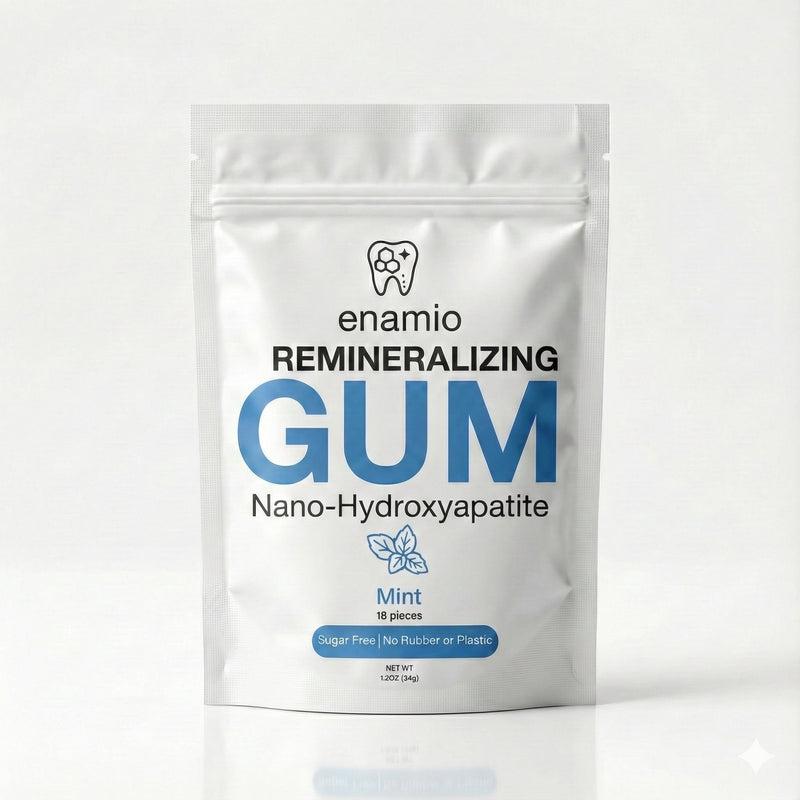
Enamio is a fluoride-free chewing gum, and its product page lists nano-hydroxyapatite and xylitol among the ingredients. [14] [23]
That describes ingredients and format, not a proven finished-product enamel outcome, and none of the trials above tested Enamio or any hydroxyapatite gum.
The toothpaste results stay with toothpaste, because they answer questions about that format, its concentrations, its brushing schedule and its study protocols.
Chewing creates a different exposure. The ADA notes that chewing gum after a meal can increase saliva flow through mechanical and taste stimulation. [22] That's general gum guidance, not an Enamio result. It doesn't show that nano-hydroxyapatite from a gum reaches enamel at a tested dose.
Enamio's own directions conflict. The product page says one to two pieces daily for 20 minutes each, while the FAQ says one to three. [14] [23] These are manufacturer directions, not a dose validated in a clinical trial. Follow the pouch you have, and ask Enamio to clarify the difference.
The product page describes its nano-hydroxyapatite as 20nm, and this article treats that size as a manufacturer statement only. [14] On October 14, 2026, the product page and FAQ did not state the nano-hydroxyapatite amount per piece. They gave no public CoA, particle-size certificate or named dental reviewer. [14] [23]
The FAQ does state about 1g of xylitol per piece, but that's a sweetener quantity, not a mineral dose. [23] Without the nano-hydroxyapatite amount, a piece can't be matched against a toothpaste concentration. A toothpaste percentage describes a whole paste, while milligrams per piece would describe the amount in one unit of gum.
Even those numbers wouldn't prove equal availability at the tooth surface.
Public documents improve transparency, but they can't create clinical outcomes. Three disclosures would make Enamio easier to evaluate: nano-hydroxyapatite milligrams per piece, a batch certificate of analysis and an independent particle-size report. A finished-gum trial against a defined comparator would answer the clinical question.
To compare labels yourself, the brand guide's formulation comparison sets out what each hydroxyapatite gum states. Record each amount, date and format first. For a worked example, the Larineco and Enamio comparison applies one checklist to two brands' public pages, keeping what each company shows apart from what each claims.
The 20nm figure raises separate safety questions about swallowing and particle size. The guide to nano-hydroxyapatite safety rulings explains that the cited EU opinions covered toothpaste and mouthwash, not gum.
What about xylitol? It's a sugar-replacing sweetener, not a calcium-phosphate mineral and not a fluoride substitute.
In children, a Cochrane review found low-quality evidence that fluoride toothpaste with 10% xylitol may reduce caries by 13% versus fluoride-only toothpaste. [12] Evidence for other xylitol products, such as lozenges, tablets and syrups, was low or very low quality. None of it establishes a benefit from xylitol gum or an effective Enamio dose.
CPP-ACP stands for casein phosphopeptide-amorphous calcium phosphate. Iijima's 2004 study compared sugar-free gum containing 18.8 mg of CPP-ACP with the same gum without it. [13] Participants wore palatal appliances holding enamel lesions and chewed for 20 minutes four times daily over 14 days. The CPP-ACP gum produced about twice the remineralization of the control gum.
That was an enamel-specimen study of a different mineral, so it doesn't test cavity prevention, hydroxyapatite gum or Enamio.
Enamio can fit as an after-meal add-on when chewing suits you, but it shouldn't replace fluoride toothpaste, cleaning between teeth or dental care.
The sources reviewed here did not include an Enamio finished-gum clinical trial. The inspected product page and FAQ did not publish the technical details listed above.
A “use both” routine keeps fluoride toothpaste first
You don't need to turn hydroxyapatite and fluoride into opposing camps, because they can sit in different places in one routine without claiming an added clinical effect.
- Brush first. Brush twice a day for two minutes with fluoride toothpaste, unless your dentist advises otherwise. [1]
- Clean between teeth. The ADA recommends cleaning between your teeth daily. [1]
- Add gum after food if it helps. The ADA frames sugar-free gum as something added to twice-daily fluoride brushing and daily cleaning between teeth. [22]
- Keep products separate. Follow each label, and don't let gum stand in for a brushing session.
- Get symptoms checked. Pain, swelling, a broken tooth or a visible hole need a dental exam.
Some people prefer fluoride-free toothpaste because of taste, swallowing worries, personal values or a dental professional's advice. Hydroxyapatite toothpaste is an evidence-informed option for people making that choice.
Parents often worry about swallowed toothpaste, and the ADA's answer is an age-appropriate amount. That means a smear the size of a rice grain once teeth appear, then no more than a pea-sized amount from ages 3 to 6. [2]
Supervise young children while they brush, and ask the dentist about fluorosis risk or a prescribed product.
Is swallowing the deciding worry? Read the ingredient-specific safety boundaries before switching, then bring your toothpaste and gum labels to the dentist.
People with high decay risk, dry mouth, braces or exposed roots may need a specific plan that a general comparison can't set.
Choosing hydroxyapatite toothpaste? Check the active, concentration, comparator and brushing frequency against the formula and protocol used in the study.
Consistency matters. A well-chosen paste can't help on days it stays in the tube.
For a full day laid out in order, the remineralization routine guide starts with fluoride brushing and fewer acid exposures, with gum optional between brushings.
Is sensitivity part of the reason you're switching? Read what to report about tooth sensitivity before a visit, because a toothpaste swap shouldn't delay an exam.
The ADA cites clinical trials that found fewer new cavities when people chewed sugar-free gum for 20 minutes after meals. [22] Those trials studied sugar-free gum in general, not hydroxyapatite gum or Enamio. A hydroxyapatite gum can be an optional after-meal add-on, though no reviewed trial shows an extra cavity-prevention benefit from adding it to fluoride brushing.
That doesn't make the add-on pointless. Its practical roles are convenience, saliva stimulation and flavor or formula preference.
What the other hydroxyapatite and fluoride trials add
These trials answer narrower questions about white spots, sensitivity, molar incisor hypomineralization (MIH) and the fluoride-containing HAF formulas. Merging them into one cavity-prevention result would mislead readers about what each tested.
Swipe or scroll sideways to read every column.
| Study | Population and formulas | Duration | Careful reading |
|---|---|---|---|
| Cagetti 2022 [15] | Triple-blind trial, 610 children aged 4 to 7, with 518 completers. HAF pastes combined fluoride-substituted hydroxyapatite with magnesium-, strontium- and carbonate-substituted hydroxyapatite in a chitosan matrix. | 24 months. | Against sodium monofluorophosphate pastes at 1,000 or 1,450 ppm, HAF arms had lower caries increments. Every arm contained fluoride. |
| Butera 2022 [16] | Randomized trial, 40 patients with white spots. A biomimetic hydroxyapatite paste was compared with a 1,450 ppm fluoride paste. | 90 days. | Sensitivity scores fell within the hydroxyapatite group. Between-group SAI and VAS comparisons showed no statistical difference. |
| Ehlers 2021 [17] | Double-blind trial, 21 children with MIH sensitivity. Microcrystalline hydroxyapatite was compared with 1,400 ppm fluoride as amine fluoride. | 56 days. | Only 14 children finished per protocol. Noninferiority held by ITT but not PP, so overall noninferiority wasn't shown. |
| Amaechi MIH 2022 [18] | In-situ crossover, 15 adults aged 18 to 60 wearing appliances with 60 MIH enamel blocks. A 20% hydroxyapatite paste was compared with a 1,450 ppm fluoride paste. | Two 14-day phases. | Both pastes increased block mineral density. Etched and unetched blocks were mixed, so this isn't a clinical MIH treatment result. |
Campus 2024 and Cocco 2025 report the same 610-child HAF cohort, not new randomized samples. [8] [19]
Their funding notes credit the University of Sassari and a company listed as Curaspet S.p.A. Curasept S.p.A supplied the toothpastes. Both reports say the sponsors had no role in design, data collection, analysis, writing or the decision to publish. [8] [19]
Butera's trial reported no external funding and no conflicts, and its acknowledgments thank the manufacturers for providing the tested products. [16]
Dr Kurt Wolff funded the Ehlers trial and employed two of its authors. The paper says the funder had no role in recruiting, conducting the study, data collection or statistical analysis. [17]
In the MIH block study, two authors were Dr Kurt Wolff staff. [18]
The sensitivity results here are small and short. For the larger review of desensitizing toothpastes, see whether tooth sensitivity means a cavity, which also covers when to book an exam.
Two 2026 reviews add current context
Unterbrink found 15 clinical toothpaste trials, but only three tested fluoride-free hydroxyapatite against caries. [20]
Three of its four authors are employees of Dr Kurt Wolff or Dr August Wolff, and one also reported personal fees from Dr Kurt Wolff. The abstract gives no formal GRADE rating. [20]
A 2026 scoping review mapped 122 studies, only 20 with direct evidence in children. It found no fluoride-free category with evidence comparable to fluoride for long-term caries prevention in children. [21]
That review reported no external funding and no competing interests, and its job was mapping evidence, not grading certainty or pooling results.
Population, formula, comparator and endpoint still decide how far each result can travel.
Hydroxyapatite vs fluoride vs xylitol and CPP-ACP
These ingredients don't compete on one simple ladder, because they have different roles, study formats and depths of evidence.
Swipe or scroll sideways to read every column.
| Ingredient | What it is | Best-supported use here | Main limit |
|---|---|---|---|
| Fluoride | A caries-preventive active used in toothpaste and community water programs. | Evidence-first toothpaste default under ADA guidance. | Amount and supervision matter, especially for young children. |
| Hydroxyapatite | A calcium-phosphate mineral related to tooth mineral. | A fluoride-free toothpaste alternative with encouraging direct trials. | Review certainty and trial independence are uneven. |
| Xylitol | A sugar alcohol used as a sweetener. | Sugar replacement in gum and other products. | Product-specific caries evidence is limited and uncertain. |
| CPP-ACP | A casein-derived calcium-phosphate complex. | Studied in selected pastes and gums under specific protocols. | It comes from milk protein, and evidence stays product-specific. |
Fluoride and hydroxyapatite are the direct toothpaste comparison, while xylitol doesn't belong in that mineral head-to-head because it's a sweetener. Xylitol gum replaces sugar, and chewing stimulates saliva, but neither feature shows mineral delivery to enamel.
CPP-ACP carries calcium and phosphate in a casein-derived complex, and it has gum-format research that stays specific to its formula and protocol. [13] Casein is a milk protein. [17] If you have a milk-protein allergy, check the label and ask your dentist before choosing a CPP-ACP product.
On a gum label, the brand guide's section on dose and ingredient position explains why list order isn't an amount. That matters when a mineral appears without milligrams.
For the non-gum steps, such as acid timing and fluoride use, see the evidence-ranked remineralization toolbox. It orders those habits by the strength of their evidence.
Which ingredient wins everything? That's the wrong question to ask of any paste or gum. Ask which format, outcome, population and study length match your situation.
Who may prefer each option?
Choose fluoride toothpaste first
For readers who want the longest prevention record, current ADA guidance and a familiar standard of care.
Consider hydroxyapatite toothpaste
A fluoride-free choice with a smaller, less certain evidence base.
Add sugar-free gum
A possible after-meal convenience that stimulates saliva, though it doesn't replace toothpaste or cleaning between teeth.
Already prescribed a high-fluoride toothpaste? Keep that plan unless your dentist changes it, whatever a product label suggests.
Bring the label if swallowing worries you, and explain what happens when you brush so your dentist can discuss the amount and supervision. Removing fluoride isn't the only answer.
Taste and texture matter when they stop you brushing consistently, so ask your dentist about a fluoride toothpaste you can tolerate.
Choosing fluoride-free care for personal reasons means accepting a different evidence base. The sources reviewed here contain more relevant toothpaste research than hydroxyapatite-gum research, so keep the formats separate.
Suspect a cavity? Read what to do after a dentist finds early decay, then follow your dentist's plan. Shopping can wait.
Sugar-free gum can fit between brushings for convenience, but it doesn't replace a brushing session.
Keep prevention evidence, preference and convenience apart.
Common hydroxyapatite and fluoride questions
Is hydroxyapatite better than fluoride?
The trials reviewed here don't establish hydroxyapatite toothpaste as generally superior for cavity prevention.
Several report noninferiority under specific designs, meaning the hydroxyapatite paste stayed inside the study's allowed difference, while fluoride has the broader prevention record. That doesn't prove superiority.
The adult 18-month trial adds a clinical endpoint beyond short block studies. Its 20-point margin and company funding still matter when judging it. [7]
Can you use hydroxyapatite and fluoride together?
You can use products with either ingredient in one routine, but no reviewed trial shows that alternating them beats fluoride toothpaste alone. Fluoride toothpaste stays the default, with each product used as directed. [1]
The daily remineralization routine lays out the whole sequence, with fluoride brushing first and gum between brushings.
Nano hydroxyapatite vs fluoride toothpaste: what changes?
Nano-hydroxyapatite can serve as a fluoride-free toothpaste alternative for someone who accepts that tradeoff. It isn't the evidence-first default in current ADA guidance.
Particle description alone doesn't decide the outcome, because concentration, formula, brushing schedule, trial quality and personal risk all affect how a result applies. “Nano” isn't a clinical grade. Wierichs found the nano-hydroxyapatite evidence too limited for a firm conclusion. [10]
For the regulatory side, the summary of EU nano-hydroxyapatite opinions explains which materials were assessed. Those opinions covered toothpaste and mouthwash, not gum.
What did the Paszynska 2021 trial show?
Children aged 3 to 7 brushed three times daily for 336 days, and the trial analyzed 207 by intention to treat and 177 per protocol. Per protocol, ICDAS increases occurred in 72.7% with hydroxyapatite and 74.2% with 500 ppm amine fluoride. Noninferiority rested on a 20-percentage-point margin. [3]
Why do systematic reviews reach different conclusions?
Reviews ask different questions, so they admit different sets of studies.
Some combine clinical and in-situ data, while others restrict age, format or outcome. Wierichs rated the pooled in-situ evidence very low, while Pawinska reached a more favorable conclusion using an NIH grading system. Those grades aren't interchangeable. [10] [9]
A newer review isn't automatically more certain, because eligibility rules, bias judgments and outcome fit decide what can be concluded.
Is fluoride toothpaste safe?
The ADA recommends fluoride toothpaste in age-appropriate amounts. Its fluoride page notes that fluorosis may occur when excess fluoride is swallowed while teeth are developing. [2]
Young children need the right amount and an adult watching. Questions about swallowing, fluorosis or prescriptions belong with a dentist. Safety depends on exposure and use, so comparing recommended use with high-dose ingestion paints a misleading picture.
Does xylitol remineralize enamel like fluoride?
The sources reviewed here don't establish a direct equivalence.
Xylitol is a sweetener, while fluoride and hydroxyapatite are studied as enamel-focused toothpaste actives. Sugar-free gum replaces fermentable sugar, and chewing stimulates saliva, [22] but the Cochrane review rated most xylitol-product evidence low or very low quality. [12]
A package that contains xylitol doesn't inherit every published xylitol result. Product, amount and comparator still matter.
Can hydroxyapatite gum prevent cavities?
The hydroxyapatite trials reviewed here tested toothpaste or toothpaste-exposed enamel blocks, so they can't establish cavity prevention from gum. None tested a finished hydroxyapatite gum. A gum trial would need a defined formula, dose, comparator, duration and clinical endpoint. Ingredient overlap can't replace that design.
For what can and can't change once decay starts, see the cavity and early-lesion guide. Seek dental care for pain or a suspected cavity.
What should I look for on a hydroxyapatite product?
Check the format, ingredient list, directions and any disclosed concentration, and don't infer a clinical dose from particle language.
On October 14, 2026, Enamio's product page and FAQ gave no nano-hydroxyapatite amount per piece or public verification documents. The FAQ states about 1g of xylitol per piece. The 20nm figure is the manufacturer's. [14] [23]
Hydroxyapatite vs fluoride FAQs
Which toothpaste should most people start with?
Fluoride toothpaste is the evidence-first starting point for most people under current ADA guidance. Brush twice a day for two minutes. [1]
Hydroxyapatite toothpaste is a reasonable fluoride-free preference, and its comparative evidence is encouraging but less settled.
People with high cavity risk or a prescription should ask their dentist before changing an established plan.
Do head-to-head trials prove equal performance?
No. The child and adult trials found hydroxyapatite noninferior within a 20-point margin, in their own populations and protocols. [3] [7]
That doesn't prove the ingredients are identical across every concentration, age, risk level or outcome.
Longer independent trials would test whether that holds in everyday use.
What certainty did the systematic reviews report?
Wierichs graded the pooled in-situ evidence as very low, and the clinical studies were too varied to combine. [10]
Pawinska used an NIH grading system, and Chatzidimitriou pooled four studies. Neither abstract reports an overall GRADE rating, so neither conclusion should be read as high certainty. [9] [11]
Can I chew Enamio after fluoride toothpaste?
Yes, as a separate after-meal add-on when chewing suits you. Follow each product's directions.
The ADA frames sugar-free gum as an addition to twice-daily fluoride brushing and daily cleaning between teeth. [22] No reviewed trial shows that Enamio improves cavity prevention beyond fluoride toothpaste.
Treat convenience and saliva as the reasons to chew it, not a proven combined effect with your toothpaste.
Why would someone choose fluoride-free toothpaste?
Taste, swallowing worries, personal values or professional advice can shape the choice. Hydroxyapatite is an evidence-informed option.
Choosing fluoride-free care doesn't require calling recommended fluoride use unsafe, and the ADA recommends fluoride toothpaste in age-appropriate amounts. [2]
For young children, discuss supervision and the right amount before changing an established routine.
Is Enamio's nano-hydroxyapatite dose published?
Not on the pages checked. On October 14, 2026, the product page and FAQ gave no nano-hydroxyapatite milligrams per piece. The FAQ states about 1g of xylitol per piece. [23]
Those pages also gave no public CoA, particle-size certificate or named dental reviewer, and the 20nm particle size is a manufacturer statement only.
Without the mineral amount, one piece can't be compared quantitatively with a toothpaste concentration.
Where can I compare hydroxyapatite gum brands?
Use the hydroxyapatite gum brand guide.
It compares formats, labels and published disclosures, but a toothpaste result doesn't show that any gum produces the same outcome.
Check the current package, because formulas and disclosures can change after publication.
References
- American Dental Association. Home Oral Care. ADA Library, accessed October 14, 2026.
- American Dental Association. Fluoride: Topical and Systemic Supplements. ADA Library, accessed October 14, 2026.
- Paszynska and colleagues, 2021. Impact of a toothpaste with microcrystalline hydroxyapatite on the occurrence of early childhood caries: a 1-year randomized clinical trial. Scientific reports, PubMed record accessed October 14, 2026.
- Schlagenhauf and colleagues, 2019. Impact of a non-fluoridated microcrystalline hydroxyapatite dentifrice on enamel caries progression in highly caries-susceptible orthodontic patients: A randomized, controlled 6-month trial. Journal of investigative and clinical dentistry, PubMed record accessed October 14, 2026.
- Badiee and colleagues, 2020. Comparison of the effects of toothpastes containing nanohydroxyapatite and fluoride on white spot lesions in orthodontic patients: A randomized clinical trial. Dental research journal, PubMed record accessed October 14, 2026.
- Amaechi and colleagues, 2019. Comparative efficacy of a hydroxyapatite and a fluoride toothpaste for prevention and remineralization of dental caries in children. BDJ open, PubMed record accessed October 14, 2026.
- Paszynska and colleagues, 2023. Caries-preventing effect of a hydroxyapatite-toothpaste in adults: a 18-month double-blinded randomized clinical trial. Frontiers in public health, PubMed record accessed October 14, 2026.
- Campus and colleagues, 2024. Effects of Hydroxyapatite-Containing Toothpastes on Some Caries-Related Variables: A Randomised Clinical Trial. International dental journal, PubMed record accessed October 14, 2026.
- Pawinska and colleagues, 2024. Clinical evidence of caries prevention by hydroxyapatite: An updated systematic review and meta-analysis. Journal of dentistry, PubMed record accessed October 14, 2026.
- Wierichs and colleagues, 2022. Efficacy of nano-hydroxyapatite on caries prevention-a systematic review and meta-analysis. Clinical oral investigations, PubMed record accessed October 14, 2026.
- Chatzidimitriou and colleagues, 2025. The role of hydroxyapatite-based, fluoride-free toothpastes on the prevention and the remineralization of initial caries lesions: A systematic review and meta-analysis. Journal of dentistry, PubMed record accessed October 14, 2026.
- Riley and colleagues, 2015. Xylitol-containing products for preventing dental caries in children and adults. The Cochrane database of systematic reviews, PubMed record accessed October 14, 2026.
- Iijima and colleagues, 2004. Acid resistance of enamel subsurface lesions remineralized by a sugar-free chewing gum containing casein phosphopeptide-amorphous calcium phosphate. Caries research, PubMed record accessed October 14, 2026.
- Enamio. Remineralizing gum product page. Checked October 14, 2026.
- Cagetti and colleagues, 2022. Efficacy of HAF toothpastes in primary and permanent dentitions. A 2-years triple-blind RCT. Journal of dentistry, PubMed record accessed October 14, 2026.
- Butera and colleagues, 2022. Home Oral Care with Biomimetic Hydroxyapatite vs. Conventional Fluoridated Toothpaste for the Remineralization and Desensitizing of White Spot Lesions: Randomized Clinical Trial. International journal of environmental research and public health, PubMed record accessed October 14, 2026.
- Ehlers and colleagues, 2021. Efficacy of a Toothpaste Based on Microcrystalline Hydroxyapatite on Children with Hypersensitivity Caused by MIH: A Randomised Controlled Trial. Oral health & preventive dentistry, PubMed record accessed October 14, 2026.
- Amaechi and colleagues, 2022. Remineralization of molar incisor hypomineralization (MIH) with a hydroxyapatite toothpaste: an in-situ study. BDJ open, PubMed record accessed October 14, 2026.
- Cocco and colleagues, 2025. Hydroxyapatite-Fluoride Toothpastes on Caries Activity: A Triple-Blind Randomized Clinical Trial. International dental journal, PubMed record accessed October 14, 2026.
- Unterbrink and colleagues, 2026. Fluoride-Free Toothpastes for Caries Prevention: A Systematic Review of Clinical Evidence on Active Ingredients. Clinical, cosmetic and investigational dentistry, PubMed record accessed October 14, 2026.
- Wong and colleagues, 2026. Navigating fluoride hesitancy: mapping the evidence base for fluoride-free toothpaste alternatives. European journal of pediatrics, PubMed record accessed October 14, 2026.
- American Dental Association. Chewing Gum. ADA Library, accessed October 14, 2026.
- Enamio. Remineralizing Gum FAQ page on enamiogum.com. Checked October 14, 2026 for fluoride status, daily directions, xylitol amount and published documents.
Keep brushing first, then choose the add-on deliberately
Enamio is a fluoride-free gum with nano-hydroxyapatite and xylitol, and it's an optional after-meal companion, not a toothpaste replacement.
View Enamio product informationPrefer the brand's own pages? See the Enamio cavity-prevention page, bad-breath page, plastic-free gum page and tooth-sensitivity page, or you can take the Enamio quiz. They're sales pages, so read them as product information, not as the evidence reviewed above.
Keep reading
- Can you remineralize a cavity?For anyone told about early decay. It separates an early enamel lesion from a hole that needs treatment.
- How to remineralize teethFor building a daily routine. It ranks brushing, diet timing and optional gum by how strong the evidence is for each.
- Is nano-hydroxyapatite safe in gum?For swallowing and particle-size questions. It shows what regulators assessed for toothpaste and mouthwash, and notes that the same reviews did not assess gum.
- Hydroxyapatite chewing gum brandsFor comparing labels. It lists what each brand discloses about format and ingredients.
Editorial disclosure
Enamio publishes this article and sells the gum discussed here. Product facts come from Enamio's own pages, while outcome claims rely on the cited studies and their stated funding.
Sources and product pages were checked October 14, 2026, and this article has not been reviewed by a named dentist.
This article provides general oral-health information and does not diagnose or treat disease. Ask a dentist about persistent symptoms, cavity risk and product choices for children.
