

Larineco vs Enamio
Share
Published by Enamio · Brand pages checked October 13, 2026
Brand comparison
A fair, same-day read of two nano-hydroxyapatite gums, with the gaps named on both sides.
Key takeaways
- Both brands name nano-hydroxyapatite on their own pages.
- Each one discloses something the other leaves out.
- 20 nm is Enamio's own manufacturer statement, not a lab certificate.
- The hydroxyapatite trial discussed here tested toothpaste, not either gum.
Why oral care gets this much attention
~90%
of US adults ages 20 to 64 with teeth have had decay, across the 1999 to 2004 and 2011 to 2016 NHANES cycles [1]
3.7B
people worldwide are affected by oral diseases, by a 2025 WHO estimate [2]
20 nm
the particle size Enamio publishes as a manufacturer statement, not an independent certificate [10]
In this comparison
If you are comparing Larineco vs Enamio, you probably want the two labels lined up so you can see how they actually differ. This page does that. It reads both brands' own live pages, dated the same day, and lays the disclosures next to each other so you can judge for yourself. The study-format comparison separates CPP-ACP gum from hydroxyapatite toothpaste research.
- 01 -
The real question is what each brand will show you
Larineco and Enamio both list nano-hydroxyapatite, but the reviewed pages differ on ingredients, directions, origin and buying terms. Compare one disclosure field at a time. A stated size describes a specification, while directions describe the intended use rather than a measured finished-gum outcome.
Read the ingredient headings first. Larineco presents twelve entries, including myrrh gum, acacia gum and egg-shell powder alongside the saps it assigns to the base. That grouping matters when you compare the number of tree ingredients. Its ingredient list names five gums, while the flavor answer assigns spruce, mastic and chicle to the base.
Enamio organizes its FAQ differently. The headings separate base, sweeteners, remineralizing actives, pH support, trace minerals, flavor and an antioxidant. A single heading can also contain several separately named ingredients. Compare the ingredient names across groups, rather than treating twelve entries and seven headings as equivalent formula counts [10].
Start with the named sweeteners and bases. Larineco lists xylitol and erythritol, while Enamio names xylitol with monk fruit. Larineco names spruce, mastic and chicle as base saps, while Enamio names chicle and candelilla wax. Check both fields against your own preferences [9][10].
If sensitivity prompted your search, our sensitivity and cavity guide explains the questions to take to a dentist.
Flavor wording has two levels: the named flavor you select and the ingredients described on the source page. Enamio's product selector offers mint, berry, cinnamon and watermelon. Its FAQ ingredient grouping names mint or berry extracts, so clarify the selected flavor's declaration rather than extending that grouping [9][10].
After that, the pages diverge. Review Enamio’s current product information and label [10]. On the Larineco product page inspected October 13, 2026, neither a manufacturing country nor a nano-hydroxyapatite particle size was stated. It does name specific tree saps and print after-meal chew timing.
Next, use the research section to distinguish a toothpaste trial's clinical endpoint from a gum review's bacterial marker. The results answer different questions. Check the tested formulation and comparator alongside the outcome before interpreting the product description. Funding and author affiliations sit beside the study, keeping the method and commercial context together [5][6].
If you want the broader picture first, our guide to where these gums sit among nano-hydroxyapatite brands maps the wider field. This page stays narrow.
Save the selected flavor, pack and inspection date with ingredient wording you want clarified, because later versions may differ. Use the same inspection date for both records when comparing their published details.
- 02 -
The science any remineralizing gum leans on, and its limits
Nano-hydroxyapatite belongs to the calcium-phosphate mineral family found in tooth enamel [4], and Pepla's review describes its dental and oral-care applications [3]. That biological role explains research interest, without establishing a finished gum's effect on enamel.
Remineralization replaces minerals lost from remaining enamel, with saliva contributing to the enamel-repair process described in NIDCR's public tooth-decay guidance [11]. A maker's label identifies ingredients without measuring enamel changes produced by chewing its formulation.
What did the toothpaste research test?
The 2022 narrative review describes mineral deposition and demineralized-enamel surface restoration in research with microcrystalline hydroxyapatite or nanocrystalline hydroxyapatite toothpastes [4]. Its fluoride-free anti-caries discussion concerns toothpaste research, without recommending gum.
The review names Canada's National Science and Engineering Research Council as its funder, under grant RGPIN-2019-07070 [4]. Joachim Enax and Frederic Meyer list Dr Kurt Wolff's oral-care research department as their affiliation [4]. The authors declare no conflict of interest [4].
The cited Paszynska trial tested hydroxyapatite toothpaste over 18 months, with double-blinding and participants aged 18 to 45 years [5]. Its non-inferiority comparator was a 1,450 ppm fluoride toothpaste. The primary endpoint was the percentage of subjects with no increase in their Decayed, Missing, Filled Surfaces score.
Per protocol, no DMFS increase was reported: 75/84 hydroxyapatite users (89.3%) versus 76/87 fluoride users (87.4%) [5]. On that endpoint, the hydroxyapatite toothpaste was not statistically inferior to the fluoride toothpaste.
The trial randomized 194 adults, 97 to each arm, with 189 in the intention-to-treat analysis and 171 finishing per protocol [5]. Each analysis contains fewer participants than the trial initially randomized.
The intention-to-treat sensitivity analysis reports 85 of 94 hydroxyapatite users and 84 of 95 fluoride users without a DMFS increase [5]. Use the matching analysis label. These denominators differ from the per-protocol groups, which include 84 and 87 participants respectively [5]. The paper repeated its primary analysis in that population as a sensitivity check.
The authors set a 20-percentage-point non-inferiority margin, comparing confidence bounds for the difference in percentages of participants without a DMFS increase [5]. Non-inferiority does not establish a superior outcome. Confidence intervals including zero do not support a claim that hydroxyapatite performed better than fluoride.
Dr Kurt Wolff funded the study alongside two universities. Those were Poznan University of Medical Sciences and Medical University in Bialystok [5]. Dr Kurt Wolff employed Joachim Enax, Frederic Meyer and Erik Schulze zur Wiesche, and the paper links it to Karex [5].
Safety monitoring included an oral and perioral examination at every visit, with observed or reported adverse events recorded in both groups [5]. Monitoring procedures are not safety results. The paper also describes a study monitor checking records for completeness, consistency and protocol adherence [5]. These procedures concern the toothpaste trial, rather than clinical testing of either finished gum.
The reviewers searched PubMed and Scopus, selecting English-language papers by title and abstract and checking references for additional articles on hydroxyapatite toothpastes. That narrative format summarizes studies rather than pooling their results [4].
A nanometer figure describes material size alone. A size statement cannot supply a missing gum formulation, exposure measurement or clinical endpoint.
There is gum research, but it measures something narrower. A 2021 systematic review and meta-analysis looked at sugar-free chewing gum and Streptococcus mutans, a cavity-linked bacterium [6]. Chewing the gum lowered the bacterial load compared with the controls. Most of those trials used xylitol gum.
The pooled effect size was about -0.42 across the thirteen trials, and roughly -0.46 in the xylitol-only subset [6]. The review also flagged a moderate level of heterogeneity across the studies [6]. Numbers like these describe a bacterial marker, not enamel.
The review pooled studies with several comparator types, from no gum to a control gum to alternatives like fluoride varnish [6]. It reported lower Streptococcus mutans load versus all controls, with moderate trial quality and variable effects [6].
Mars Wrigley is the disclosed review funder. The authors reported no sponsor role in study design, data collection, analysis, interpretation, or writing. The authors' declaration states no potential conflicts, alongside that separately disclosed source of funding.[6]
The authors rated the trials moderate quality, and in seven of the thirteen studies the effect could have been zero [6]. The review reports no recorded adverse effects among the trials included in its analysis.
For xylitol specifically, read our review of xylitol gum for teeth.
The cited 2023 European Union scientific opinion considered specific nano-hydroxyapatite material in oral-cosmetic applications, which supplies a different assessment context from finished chewing gum [7]. It concerns specific toothpaste and mouthwash material under set conditions. The opinion's oral-cosmetic assessment does not cover chewing gum or establish either finished gum's safety.
Enamio's rod-shape statement cannot establish that its ingredient matches the specific nano-hydroxyapatite material assessed in the cited oral-cosmetic opinion [9]. Retain the assessed material and its particular oral-cosmetic application together.
The ADA describes increased saliva flow from about 20 minutes of sugar-free gum after meals [8]. Saliva carries calcium and phosphate to help strengthen enamel [8], though gum supplements brushing and flossing, rather than replacing them.
- 03 -
What Enamio discloses about its formula
Enamio's pages describe ingredients, material specifications, manufacturing origin and purchase terms separately [9][10]. Origin and ingredient descriptions supply different purchase information.
FDA explains that it does not independently approve manufacturing facilities, even though regulated facilities may undergo registration and inspection requirements [12]. Registration and approval describe different actions. The agency distinguishes facility oversight from approval of an individual product or its label [12]. Enamio's facility wording remains the manufacturer's statement here, without independent authentication of the production site [10].
The FDA also says it does not approve individual food labels before marketing, although applicable labeling requirements and truthful-claim duties still apply [12]. That distinction matters when reading badges. A manufacturer's Vegan or Sugar-Free badge is a claim, rather than FDA approval [9][12]. Neither gum's classification nor labeling compliance is independently determined here.
Enamio's FAQ groups chicle and candelilla wax as the base, with xylitol USP and monk fruit under sweeteners [10]. It names carbonate nano-hydroxyapatite at 20 nm, calcium glycerophosphate and magnesium citrate under the page's remineralizing-actives heading.
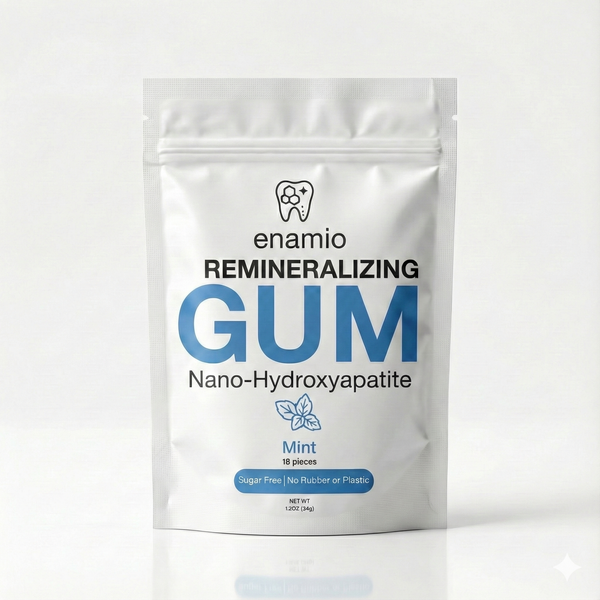
L-arginine bicarbonate is listed for pH support. Bamboo silica and zinc gluconate sit under trace minerals, and matcha green tea extract is listed as an antioxidant [10]. The product page itself also names menthol and a natural mint flavor [9].
Check the current ingredient list for the selected flavor [10]. The product page separately displays Sugar-Free, Plastic-Free, Non-GMO and Vegan badges, which do not substitute for the complete selected-flavor ingredient declaration [9].
Swipe or use arrow keys to scroll this table.
What Enamio lists, and the role it assigns each part, from its own pages (October 13, 2026).
| Group | Listed items |
|---|---|
| Gum base | Chicle, candelilla wax |
| Sweeteners | Xylitol USP, monk fruit |
| Remineralizing actives | Carbonate nano-hydroxyapatite (20 nm), calcium glycerophosphate, magnesium citrate |
| pH support | L-arginine bicarbonate |
| Trace and flavor | Bamboo silica, zinc gluconate, matcha green tea, natural mint or berry |
Enamio's reviewed pages pair xylitol with monk fruit and describe a chicle and candelilla wax base [10]. Larineco names several tree saps. Its product page pairs xylitol with erythritol alongside those separately identified base ingredients.
Compare other sweeteners in xylitol gums.
Keep the sweetener combination and base composition as separate comparison fields when reading the two labels.
Enamio's FAQ states an approximately 20 nm particle size, but this comparison records that number as the manufacturer's own specification rather than an independently authenticated measurement [10]. The inspected pages supplied no independent particle-size certificate. A shared ingredient name cannot authenticate that size or establish identical material in both brands.
Enamio also enumerates its flavors, which Larineco's product page doesn't clearly do. The lineup is Mint, Berry, Cinnamon, and Watermelon [9]. Review the current FAQ before comparing products [10]. Read the current return terms on the product page [9].
The FAQ page words it as a 30-day satisfaction guarantee on your first order [10].
On buying terms, Enamio lists its pack options and shipping details on its own pages [9]. Prices can change after this comparison's inspection date. What matters for a comparison is that the terms are written down, where you can check them yourself.
For any percentage disclosure, check whether its basis is the finished gum or one formula component. Check the denominator first. Converting that figure into milligrams per piece would also require the matching mass for the stated portion.
Four product-page flavors contrast with a mint-or-berry FAQ ingredient grouping [9][10]. Use your selected pouch's declaration, because the FAQ grouping does not enumerate every flavor offered.
- 04 -
How to use a remineralizing gum, either brand
Both brands publish conflicting daily piece counts, so check which directions apply to the specific pouch you're actually buying. Keep daily piece counts separate from each after-meal chewing interval [9][10].
ADA warns that regular extended chewing, especially with dense gum, can bring jaw pain, headaches and increased TMJ-disorder risk. Avoid gum if you have a temporomandibular joint (TMJ) disorder [8].
General ADA sugar-free-gum context
This shows general ADA guidance for sugar-free gum, not a protocol or dose for either brand [8].
1
Finish your meal
Check your pack's directions.
2
ADA context: 20 minutes
This interval is general sugar-free-gum guidance, with no verified dose for either manufacturer's finished product [8].
4
Still brush and floss
Gum adds to the basics, it doesn't replace them.
Both brands' inspected pages contain multiple piece-count instructions, so compare daily answers separately from after-meal directions. Daily Enamio counts: product-page 1 to 2, FAQ 1 to 3 [9][10]. Larineco's inspected pages distinguish daily-piece answers from separate after-meal instructions, but the two daily answers differ within that dated record.
On Larineco's own pages, one FAQ answers how many pieces per day with "one to two pieces between meals". A second FAQ recommends "2-4 pieces per day". Those two daily answers do not match. Its after-meal direction separately specifies 1 to 2 pieces for at least 30 minutes, rather than a daily total.
Pieces per day do not reveal nano-hydroxyapatite intake by themselves. That calculation also needs the mineral amount in each piece, which the reviewed product pages and Enamio FAQ don't state. The FAQ's about 1g of xylitol per piece is a different ingredient figure [10].
For label arithmetic, check per-piece and per-serving amounts before multiplying by pieces.
✓ Do
Check the directions on your selected pouch with your dental team, while maintaining brushing, between-teeth cleaning and regular dental visits.
✗ Don't
Use gum as treatment for toothache or decay, or adopt a daily count from a different pouch or website.
Before starting, check three details on your pouch: pieces, chew time, and ingredients. If the pouch and website disagree, ask the brand which directions apply to your pack. Your dentist's instructions take priority. Don't swap gum for your fluoride routine unless your dentist tells you to.
If you have sensitivity, dry mouth, allergies, or you're pregnant, that's a conversation for your dentist first. Gum can be part of a routine. It can't read your mouth the way a professional can.
- 05 -
Larineco and Enamio, side by side
Each matrix cell records a brand-page disclosure from October 13, 2026, while distinguishing manufacturer statements from this comparison's findings. The matrix keeps missing fields explicit so you can identify which information remains unavailable. "Not stated" means that the reviewed source did not supply the detail, rather than claiming it cannot exist elsewhere or in private records.
Larineco vs Enamio at a glance
Swipe or use arrow keys to scroll this table.
Enamio's column cites its product page and FAQ, while Larineco's column uses its own product page, all inspected October 13, 2026 [9][10]. Missing details remain scoped to those inspected pages.
| What's disclosed | Larineco (own site) | Enamio (own site) |
|---|---|---|
| Names nano-hydroxyapatite | Yes | Yes |
| Particle size | Not stated | Around 20 nm (manufacturer statement) |
| Particle shape | Not stated | Rod-shaped |
| Nano-hydroxyapatite milligrams per piece | Not stated | Not stated |
| Published ingredient list | Yes, 12 items in order | Yes, product page plus FAQ grouping |
| Sweeteners named | Xylitol, erythritol | Xylitol USP, monk fruit |
| Gum base named | Spruce, mastic, chicle (manufacturer-listed gum-base saps) | Chicle, candelilla wax |
| Explicit chew directions | Yes, after-meal timing on the page | Yes, though the daily count differs by page |
| Flavors enumerated | Not clearly on its product page | Mint, Berry, Cinnamon, Watermelon |
| Manufacturing country or standard | Not stated on the reviewed product page | Not independently verified in this comparison |
| Money-back guarantee | Not stated on its product page | 30 days advertised, FAQ says first order |
| Support contact | Email address, 24 to 48 hour reply | Contact through the site |
| Public certificate of analysis | None found | None found |
| Independent particle-size certificate | None found | None found |
| Named dental reviewer | None found | None found |
| Finished-gum clinical trial | None found in sources reviewed here | None found in sources reviewed here |
Compare the matrix one field at a time, using the stated information from each brand. These rows distinguish disclosed product details from facts independently verified here. Compare the named ingredients, flavor options and current purchase terms without treating a seller's declarations as independent verification.
If you have allergies or dietary limits, this is where the ingredient lists earn their keep. Larineco's list includes egg-shell powder and several plant resins. Enamio's leans on calcium and magnesium salts with a chicle base. Read the complete ingredient list against your dietary needs, and clarify any unfamiliar term before buying the selected product.
The same two documentation gaps recur in both inspected brands. Neither brand, on the pages we read, publishes a nano-hydroxyapatite milligram amount per piece. The reviewed pages supply neither brand's public certificate of analysis, independent particle-size certificate, named dental reviewer or finished-gum trial. Use the documentation checklist before treating size wording as a certificate.
Before ordering, send the brand one question quoting the conflicting directions and identifying your chosen flavor and pack. Keep its response with that pack's instructions for later reference. A clarification identifies the intended instruction for that purchase, while your dentist's individual restrictions still take priority over the general manufacturer schedule.
Use the matrix to separate ingredient preferences from buying terms. If egg-shell powder matters to your preference, start with the ingredient row. If return eligibility matters instead, read Enamio's first-order limitation with the advertised thirty-day window, rather than treating a guarantee as evidence of mineral performance [9][10].
You might lean Enamio if
You value size, flavor, origin and return-policy disclosures.
You might lean Larineco if
You prioritize named tree saps, resins and a product page with an explicit after-meal chewing instruction.
For another label-reading question, see our xylitol gum brand guide. It distinguishes a disclosed xylitol amount from an ingredient-list entry, so the presence of a sweetener doesn't become an invented quantity per piece.
- 06 -
A reader checklist for comparing any two remineralizing gums
This part isn't about Larineco or Enamio. It's a tool you can reuse on any two gums you're weighing. Six questions. If a brand can't answer one from its own page, that's a finding too.
1
Is the active named, with size or shape?
And is that number a manufacturer figure or an independent certificate? A manufacturer's stated particle size and an independent laboratory measurement require different supporting records.
2
Is the ingredient list published?
In order, with the sweeteners and the gum base named, not just a marketing summary.
3
Do the piece counts agree?
Check whether the product page and the FAQ give the same number of pieces. The reviewed pages disagree for both brands.
4
Is the making disclosed?
A country of origin or a facility standard on the brand's own site, not a marketplace guess.
5
Is there a return window and a real contact?
A stated guarantee, its fine print, and a working way to reach support.
6
What's the evidence basis?
Identify whether the cited source tested a finished gum, a toothpaste or a general ingredient mechanism. Toothpaste results don't automatically apply to gum.
Use these six questions to record which purchase details each brand actually supplies. See what to check before you buy a remineralizing gum.
- 07 -
People also ask
Is Enamio better than Larineco?
Neither brand earns a clinical ranking from the ingredient and product-page disclosures examined in this comparison. Enamio states particle size and manufacturing origin, while Larineco's reviewed page names more tree saps and gives explicit after-meal timing. For returns, compare the actual policy wording. Enamio advertises thirty days, and its FAQ limits that guarantee to first orders rather than every future purchase [9][10].
What is the difference between Larineco and Enamio gum?
The reviewed ingredient lists share nano-hydroxyapatite but describe different sweeteners, base materials and supporting ingredients. Larineco's 12-item list includes several tree saps, calcium bentonite clay and egg-shell powder, while Enamio lists calcium, phosphate and pH-support minerals alongside nano-hydroxyapatite. Their finished formulas are not established as identical. Check the entire selected-flavor declaration if one ingredient matters to you, rather than comparing only the shared mineral name.
Are Larineco and Enamio the same company?
Larineco and Enamio use different names and websites. This comparison did not verify corporate ownership, so it does not establish whether their owners are connected. This page compares published product disclosures and chewing directions.
Does Larineco publish its particle size or mineral amount?
On its own product page, read October 13, 2026, Larineco does not state a nano-hydroxyapatite particle size or amount per piece. It lists ingredients, but no nanometer figure and no nano-hydroxyapatite milligrams. Neither brand's reviewed pages give that mineral amount. Enamio does state a 20 nm figure as a manufacturer statement, which Larineco's page does not match [9].
Is nano-hydroxyapatite safe?
The cited 2023 European Union opinion assessed specific nano-hydroxyapatite material in toothpaste and mouthwash under stated conditions. It does not assess either finished gum. The assessment restricted particle shape, aspect ratios and surface treatment, so the mineral name or a rod-shape claim alone cannot establish a match. Ask about the specific material and formulation [7].
What does the evidence show for remineralizing gum?
The hydroxyapatite trial examined toothpaste over 18 months, while the gum review measured a bacterial marker, Streptococcus mutans [5][6]. Their tested outcomes differ. Lower bacterial loads in the gum review, with moderate trial quality and variable effects, don't establish either finished gum's enamel outcome [6].
See which findings come from gum, toothpaste or other products.
Where is Larineco gum made?
The Larineco product page inspected October 13, 2026 supplied no manufacturing country or facility-standard disclosure. Check the current Enamio product information and label [10]. A seller's address or brand name does not independently authenticate a factory or establish where a product was made.
What is a good alternative to Larineco gum?
Enamio is one option in the same category, and the checklist above works on any other. The disclosed size, base, flavors, origin, and guarantee differ. You can also see where brands land in our roundup of nano-hydroxyapatite gum brands. Use the checklist before buying.
What sweeteners do Larineco and Enamio use?
Both reviewed lists name xylitol, paired with erythritol in Larineco's list and monk fruit in Enamio's FAQ [10]. Check your selected flavor's declaration for its complete sweetener list. Enamio also identifies its xylitol as USP grade, without establishing that a shared ingredient makes the finished formulas identical.
Compare sweeteners in the exact flavor and format.
Is Larinco the same as Larineco?
The spelling variation appears within the Larineco US site inspected for this comparison on October 13, 2026. The inspected site's footer prints "Larinco" alongside the Larineco name used elsewhere, explaining why searches may encounter either spelling. This observation concerns the inspected website's spelling, without authenticating another site or seller. Match the domain and ingredient declaration before applying this naming observation to another seller's listing.
So is choosing between these two gums just a coin flip?
Choose a specific purchase preference before comparing labels. Enamio's reviewed pages state size, flavors and manufacturing origin, while Larineco's page names specific saps and gives after-meal instructions. Neither manufacturer's disclosures supplied the mineral amount needed to calculate a daily nano-hydroxyapatite intake here. Neither disclosure set supplies a clinical finished-gum comparison.
- 08 -
FAQs
Does Enamio use the same nano-hydroxyapatite as Larineco?
Both brands name nano-hydroxyapatite, which identifies an ingredient family rather than an independently matched material or finished formulation. Enamio's reviewed product and FAQ pages state a 20 nm particle size and rod shape, while Larineco's reviewed product page states neither. Those statements describe different levels of disclosure. The inspected pages supplied no corresponding independent particle certificate for either gum, leaving those material specifications unverified here.
Is Larineco legit?
This comparison does not authenticate Larineco's product, ownership or seller, and the reviewed website supplies disclosures described below. Its product page also provides a support contact and regulatory disclaimer, while its own survey figures remain company-published material rather than an independent assessment. Published contact details don't verify product quality. Ask Larineco for the document that would answer your specific concern, rather than treating its survey as verification.
Can a remineralizing gum rebuild a cavity?
NIDCR distinguishes early mineral loss from a formed cavity, which is structural damage requiring a dentist's repair [11]. Saliva and fluoride can help reverse early white-spot mineral loss, while ADA describes sugar-free gum as increasing saliva flow and carrying calcium and phosphate [11][8]. These mechanisms do not rebuild a hole. Neither finished gum is established here as treatment or replacement for preventive care.
Does either gum publish a certificate of analysis?
The pages inspected on October 13, 2026 supplied no public certificate of analysis or readable testing document for either gum. Enamio's third-party-testing badge is a statement on its product page, whereas a report would supply the document needed to examine that statement [9]. Match the document to your product and batch. Ask each brand for its relevant document when testing evidence is a requirement for the specific purchase you're considering.
Are the ingredients vegan or animal-derived?
Larineco lists egg-shell powder, while Enamio's product page carries a Vegan badge as a manufacturer's dietary claim. The egg-shell entry is directly relevant to an animal-ingredient preference, while the Vegan badge records Enamio's own position without independently authenticating a selected flavor's formulation. Treat dietary preference and allergy questions separately. Ask the manufacturer about your specific ingredient concern before relying on a brief comparison to choose the selected flavor [9].
Where can I find current prices and shipping?
Each brand's own pages provide the place to check current prices, pack sizes, shipping and return terms. Enamio's reviewed FAQ describes the advertised 30-day guarantee as applying to first orders, while the product page supplies buying details alongside that general offer [10][9]. Larineco's page provides an email support contact. The stated 24-to-48-hour response window describes expected contact timing, without stating a money-back period or a refund guarantee on the inspected page.
- 09 -
References
- NIDCR. Dental Caries (Tooth Decay) in Adults (Ages 20 to 64 Years). National Institute of Dental and Craniofacial Research, reviewed June 2026, accessed October 13, 2026. Source
- World Health Organization. Oral health. Fact sheet dated March 17, 2025, accessed October 13, 2026. Source
- Pepla E, Besharat LK, Palaia G, Tenore G, Migliau G. Nano-hydroxyapatite and its applications in preventive, restorative and regenerative dentistry: a review of literature. Annali di Stomatologia, July 2014, accessed October 13, 2026. Source
- O'Hagan-Wong K, Enax J, Meyer F, Ganss B. The use of hydroxyapatite toothpaste to prevent dental caries. Odontology, April 2022, accessed October 13, 2026. Source
- Paszynska E, et al. Caries-preventing effect of a hydroxyapatite-toothpaste in adults: a 18-month double-blinded randomized clinical trial. Frontiers in Public Health, 2023, accessed October 13, 2026. Source
- Nasseripour M, et al. A systematic review and meta-analysis of the role of sugar-free chewing gum on Streptococcus mutans. BMC Oral Health, April 29, 2021, accessed October 13, 2026. Source
- SCCS (Scientific Committee on Consumer Safety). Opinion on Hydroxyapatite (nano), SCCS/1648/22, European Commission, adopted 21 to 22 March 2023, accessed October 13, 2026. Source
- American Dental Association. Chewing Gum. MouthHealthy, publication date not stated, accessed October 13, 2026. Source
- Enamio. Remineralizing Gum with Nano-Hydroxyapatite. Product page (brand disclosure, own site), publication date not stated, read October 13, 2026. Source
- Enamio. FAQ | Enamio Remineralizing Gum with Nano Hydroxyapatite. Brand disclosure on Enamio's own site, publication date not stated, read October 13, 2026. Source
- NIDCR. The Tooth Decay Process: How to Reverse It and Avoid a Cavity, National Institute of Dental and Craniofacial Research, last reviewed January 2025, accessed October 13, 2026. Source
- United States Food and Drug Administration. Is It Really 'FDA Approved'? Publication date not stated, accessed October 16, 2026. Source
Larineco product facts in this comparison are from Larineco's own product page (larineco.us), read October 13, 2026. We cite it as plain text and do not link to competitor stores.
Compare without the spin
Choose the product details you want to verify before buying. Enamio's product page lists its available flavors and buying options, while its FAQ supplies the separately stated first-order guarantee terms. Check the selected pack and current terms on those pages.
Product information
Enamio Remineralizing Gum
Nano-hydroxyapatite gum with a stated 20 nm figure, a chicle and candelilla base, xylitol, and four flavors. Read the label, flavors, and return policy in full on the product page.
See the Enamio gum detailsWhere to go from here
Buying priorities
Compare remineralizing gum buying details
Compare ingredient identity, the quantity actually disclosed, and current buying terms when a shortlist contains products making different kinds of statements.
The wider field
The nano-hydroxyapatite gum field
Where several brands land once you compare what they publish.
Study methods
Read the gum-study limitations
Compare appliance-held enamel lesions with finished-gum clinical outcomes.
Educational only. Not medical advice. Ask your dentist about pain, active decay, pregnancy, allergies, or new restorations.
