

Nano-Hydroxyapatite Gum for Kids: Safety & Age Guide
Share
Published by Enamio • August 19, 2026
Searching for nano hydroxyapatite gum for kids usually comes down to one real question: is this gum right for your child? Here is a calm, honest framework for deciding whether remineralizing gum fits your child, plus the exact questions to bring to a pediatric dentist.
Quick Answer
Whether this gum fits a child depends on choking risk, the current package, and individual dental guidance.
- Chewing gum is a choking hazard for young children. [3]
- Xylitol is toxic to dogs, so store every piece securely. [6]
- Read the package and ask the child's dentist before use.
The child evidence cited here comes from toothpaste or paste, not this finished gum.
Key facts at a glance
The mineral
Tooth enamel is highly mineralized and is composed mainly of hydroxyapatite. Nano-hydroxyapatite is a nanoscale form of that mineral. [1][2]
The real gate
Chewing gum is a listed choking hazard for young children. Readiness depends on the individual child, and this guide is not medical or developmental clearance. [3][4]
Xylitol
Higher xylitol intakes can cause abdominal distress or osmotic diarrhea, and individual tolerance varies. Xylitol is also toxic to dogs. [5][6]
Brand guidance
Enamio's own FAQ says under-5 is not recommended, ages 5 to 7 need supervision, and 8+ can usually chew alone. That's brand guidance, dated here to August 19, 2026, not a universal medical cutoff. [12]
Regulatory scope
The 2025 EU SCCS opinion covers specified nano-hydroxyapatite in toothpaste and mouthwash, not chewing gum or pediatric dosing. [7]
Three numbers worth knowing
Highly mineralized
Hydroxyapatite is the primary mineral in tooth enamel. [2]
2025
The EU SCCS opinion covers specified nano-hydroxyapatite in toothpaste and mouthwash only. [7]
Within 20 min
FDA says signs of xylitol poisoning in dogs can begin within 20 minutes. Sugar-free gum is a listed source. [6]
- 01 -
Why parents even ask this
Parents ask because kids' teeth are vulnerable, and clean-label options look appealing. You want something that supports enamel without a long ingredient list you can't pronounce. Then a gum shows up promising minerals for teeth, and the marketing says "for kids." That's where the trouble starts.
Here's the thing. The phrase "for kids" is a marketing choice, not a safety certification. A product can be gentle in an adult's mouth and still be a poor fit for a five-year-old. The reasons often have nothing to do with the mineral inside. The child's age, their chewing habits, what else is in the gum, and their own dental history all matter more than the label's promise.
And the pages you find while searching rarely separate those threads. Some talk only about the ingredient. Some talk only about the age you can chew gum. Almost none put both in one place with honest sourcing, which is exactly why the "is it safe" question feels so slippery. When deciding whether remineralizing gum belongs in a child's routine, use the evidence boundaries in this article rather than conclusions from a general product guide.
A useful decision starts by separating four questions that search results often blend together. First, what format did the research actually test? The child studies cited here tested toothpaste or paste, not gum. [8][9][10] Second, what does the current package say today? Third, can the individual child manage chewing gum, given that public-health guidance lists gum as a choking hazard for young children? [3][4] Fourth, can the household store xylitol gum securely away from dogs? [6]
Keeping those questions separate prevents an ingredient study from becoming a product promise, a brand age band from becoming medical clearance, or a familiar household product from hiding a pet-storage risk. It also gives a dentist a clearer set of facts to review with you.
This guide can map those evidence boundaries and show where the sources agree or stop. It can confirm that the cited child research used toothpaste or paste, that choking guidance treats gum as a hazard for young children, and that current Enamio pages contain brand-specific age and use statements. It cannot observe your child, inspect current dental work, verify how a piece will be chewed, or predict an individual response. Those limits are not evasions. They identify which questions belong to published evidence, which belong to the package, and which require a clinician who knows the child.
We're going to take the calmer path. No fear, no hype, no invented numbers. Just the four things that actually decide this, laid out so you can make the call in a few minutes and then confirm it with your child's dentist. The mineral is real, and the safety questions are real. They just aren't the same question.
One more honest note before we start. This guide treats gum as an optional adjunct, not as a substitute for brushing or professional dental care. Keep that frame the whole way through.
- 02 -
The science of the mineral (an ingredient, not a verdict)
Nano-hydroxyapatite is a nanoscale form of hydroxyapatite, the calcium-phosphate mineral that makes up most of tooth enamel. [1] It is a small-particle form of a mineral already present in teeth.
Remineralization is the return of minerals to demineralized enamel. Chewing can stimulate saliva flow, but the cited evidence here does not establish how much mineral this gum delivers to a child's teeth. [1][5]
Enamel is the hardest tissue in the body and is composed mainly of hydroxyapatite. Once enamel is lost, it does not regenerate. [2]
The child studies cited in this guide evaluated hydroxyapatite toothpaste or paste, not chewing gum. [8][9][10] These studies do not establish the effect of this gum in children or whether it is appropriate for a particular child.
Why does that boundary matter so much? A toothpaste sits on the teeth in a fixed amount for a set brushing time. A gum delivers its ingredients differently, over a chew, mixed with saliva, and the child has to manage it in their mouth without swallowing. You can't take a toothpaste result and stamp it onto a gum. It's useful background. It isn't proof of a finished gum product for a specific child.
In 2025 the EU's Scientific Committee on Consumer Safety concluded that specified nano-hydroxyapatite materials were safe at stated concentrations in toothpaste and mouthwash. [7] It did not evaluate this chewing gum, authorize pediatric use, or provide pediatric dosing guidance.
For ingredient background and the limits of the available child evidence, use the primary sources in the References section below. The mineral is genuine, and the child evidence cited here comes from toothpaste or paste research, not a finished chewing-gum product.
The part parents miss: chewing readiness and choking
Choking risk from gum is separate from the mineral question. [3] Consider the child's swallowing history and development, and ask a clinician when readiness is uncertain.
The CDC and American Academy of Pediatrics identify chewing gum as a choking hazard for young children. [3][4] The AAP guidance emphasizes development and maturity rather than treating a birthday as automatic clearance.
Two separate tracks, decided separately
There is no single age at which every child is ready to chew gum. Do not use this checklist as medical or developmental clearance. Because chewing gum can be a choking hazard for young children, consider the child's swallowing history, development, and ability to follow directions. Ask the child's pediatrician or dentist when readiness is uncertain. [3][4]
Some situations raise the bar. A history of choking, trouble swallowing (doctors call it dysphagia), or certain developmental and behavioral factors all make gum riskier, independent of any ingredient. In those cases the answer isn't a different age. It's a conversation with your child's dentist or pediatrician before gum enters the picture at all.
Do not assume that an older child, teenager, or child with braces is automatically ready. Swallowing history, developmental needs, dental appliances, and individual clinician instructions still matter.
Xylitol, the other actives, and the dog warning
Xylitol is a sugar alcohol used as a sweetener. Higher xylitol intakes can cause abdominal distress or osmotic diarrhea, and individual tolerance varies. Follow the current package directions and do not convert study amounts or adult guidance into a child dose. [5] Xylitol is also toxic to dogs.
The American Academy of Pediatric Dentistry describes xylitol as a noncariogenic sugar substitute and notes that higher intakes can cause gastrointestinal effects. [5] For a child-specific decision, use the current package directions and the child's dentist rather than a general adult dosage guide.
Dog owners, read this twice
FDA says signs of xylitol poisoning in dogs can begin within 20 minutes. Sugar-free gum is a listed source. Store gum where a dog cannot reach it. If a dog may have eaten it, call a veterinarian, emergency animal clinic, or animal poison-control center immediately. [6]
That warning is firm on purpose. A dropped piece under the kitchen table is a real household risk, and kids drop things. If you have dogs, the gum question includes a storage-and-cleanup plan, not just a child plan.
Beyond xylitol, a remineralizing gum usually carries a handful of supporting ingredients. Enamio's product page lists a core system of actives like calcium, magnesium, zinc, and L-arginine alongside nano-hydroxyapatite, plus a plant-based chicle gum base. Flavor-specific ingredients can differ across Mint, Berry, Cinnamon, and Watermelon, so the panel shown for one flavor isn't a universal ingredient list. Check the package you actually choose. For any of them, the rule is the same: match the product to the child, not the child to the product.
Check the ingredient panel. Ask the child's clinician before use if the child has a known ingredient allergy, trouble swallowing, or a condition that affects chewing or oral care.
- 03 -
How Enamio approaches this, label first
Enamio's gum pairs nano-hydroxyapatite with xylitol and a natural chicle base, and the brand publishes its own child-use guidance. We're going to quote that guidance plainly, date it, and then tell you why it still isn't the last word. Transparency about what a label does and doesn't authorize is the honest way to handle a kids' product.
As of August 19, 2026, the product page asks for supervision under age 6. [11] The FAQ says under 5 is not recommended for choking reasons, ages 5 to 7 need direct supervision, and ages 8 and up may chew independently. [12] These are current brand statements, not universal medical cutoffs.
Read that brand guidance alongside the CDC and AAP choking guidance. [3][4] The label is a starting point, not a permission slip. Ask the child's clinician when use is uncertain.
The two Enamio pages do not fully match on daily use. The product page says 1 to 2 pieces a day for 20 minutes, while the FAQ says 1 to 3, also for 20 minutes. [11][12] This article does not choose a child dose. Follow the current package and ask the child's dentist what fits the child.
On the formulation side, the gum uses a plastic-free chicle gum base. For formulation details, review the current package label. The evidence summarized here does not establish cavity prevention, enamel rebuilding, or a child-use protocol for the finished gum.
One thing we won't do is inflate the claims. The public product page doesn't disclose a nano-hydroxyapatite percentage, so we won't invent one. Any figure you see quoted for particle size is a brand statement, not an independently verified lab result. And you won't find a cavity-prevention, whitening, or fluoride-replacement promise for kids here, because the evidence for this format and this age group doesn't support one.
The most useful way to read the Enamio pages is as a dated label record. Reference 11 records the current product-page wording, while Reference 12 records the current FAQ wording. [11][12] Dating the record matters because a live label can change. The package in your hand should therefore outrank a remembered screenshot, an old article, or a number copied from another page.
When two brand pages differ, do not combine their highest numbers into a new routine. The disagreement is information, not permission to choose whichever direction sounds more convenient. Check the package that will actually be used and take the mismatch to the child's dentist. That preserves the difference between reporting brand directions and inventing a pediatric protocol.
The ingredient list also needs to be read as a whole. Nano-hydroxyapatite is only one part of the product. Xylitol brings a separate tolerance question for the child and a serious storage question for dogs. [5][6] The chicle base describes how the gum is made, but it does not answer whether a particular child is ready to chew it.
A label-first review ends with four concrete checks: the current directions are in front of you, the child can manage gum, the product can be kept away from pets, and the child's dentist has the relevant dental context. Passing one check does not automatically satisfy the other three.
Use the same source hierarchy when comparing future updates. Primary clinical or public-health sources support the general evidence and hazard statements. The current product page and FAQ support only what Enamio says about its own product on the date checked. [3][5][11][12] Neither source type supplies an individualized child-use decision by itself.
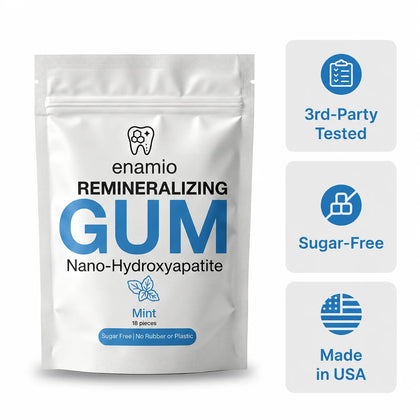
Read the label yourself
Enamio Remineralizing Gum with Nano-Hydroxyapatite
Enamio
A fluoride-free chewing gum with nano-hydroxyapatite, xylitol, and a chicle base. Sold in 2, 4, and 8 pack options. Read the current directions and warnings before deciding for a child.
If you're weighing nano-hydroxyapatite gum for kids, the current ingredient list and warnings matter more than a headline.
- 04 -
How to decide: the parent framework
The matrix below is an editorial discussion aid. It combines source-backed hazards, current package directions, and practical questions. It is not a validated score, clearance system, or pediatric dosing tool.
| Factor | What to check | Signal | Source |
|---|---|---|---|
| Chewing readiness | Can they manage gum without swallowing trouble? | Ask the child's clinician if unsure | [3][4] |
| Brand age guidance | What do the current package and FAQ say? | Treat as brand guidance, not clearance | [11][12] |
| Swallowing history | Any choking or swallowing trouble? | Ask the child's clinician first | [3][4] |
| Xylitol tolerance | Any abdominal distress with sugar alcohols? | Follow the current package | [5] |
| Dogs in the home | Could a dog reach dropped or stored gum? | Create a strict storage plan | [6] |
| Ingredient allergy or swallowing concern | Does the child have a known ingredient allergy, swallowing problem, or condition that affects chewing or oral care? | Ask the child's clinician first | Current ingredient panel |
| Dental appliances | Does the dentist or orthodontist allow gum with this appliance? | Follow individual instructions | Clinician guidance |
| Brushing routine | Is regular brushing and dental care already in place? | Do not substitute gum | Dental care plan |
| Supervision plan | Will an adult follow the current package guidance? | Plan before use | [12] |
| Context of use | Will the child be seated, supervised, and not lying down? | Avoid distracted use | Practical precaution |
| Package checked | Have you read the current package yourself? | Use current directions | [11][12] |
| Evidence expectations | Do you understand that the child evidence cited here is toothpaste or paste research, not finished-gum proof? | Keep conclusions limited | [8][9][10] |
What the matrix adds up to
The checklist groups source-backed hazards, current package directions, and practical questions. Its categories are editorial, not clinical.
- Inputs: the 12 sourced factors in the table, each paired with a practical next action.
- Method: review each question separately without adding the rows into a score.
- Result: the checklist is a discussion aid only, not safety probability, medical risk, or clinical clearance.
Bring these five questions to your pediatric dentist. They turn the matrix into a real conversation:
1
Does my child's swallowing history or development make gum inappropriate?
2
Does gum fit this child's dental needs and existing routine?
3
Should anything change in the fluoride plan you already recommend?
4
Is there a known ingredient allergy, swallowing problem, or condition that affects chewing or oral care?
5
Should this child avoid gum, and what signs mean stop?
Do
Read the current package, keep brushing, supervise younger kids, and let the dentist make the personal call.
Don't
Treat gum as a fluoride swap, pick an age off the internet, or leave a piece where a dog could find it.
This guide treats gum as an optional adjunct, not as a substitute for brushing or professional dental care. Review the current package directions before use. Do not borrow a child protocol from a general gum-use guide.
Support enamel the calm, informed way
Start with the label, not the hype. See exactly what's inside before you decide anything for your family.
Review ingredients and directions- 05 -
People also ask
Is nano hydroxyapatite gum for kids safe?
Whether it fits a child depends on the individual child, the current package, and the child's clinician. Do not use this article as medical or developmental clearance. Chewing gum is a listed choking hazard for young children. [3] The hydroxyapatite evidence summarized here comes from other formats, so it cannot settle the safety or effectiveness of this finished gum for one child.
At what age can a child chew gum safely?
There is no single universal age. Because gum can be a choking hazard for young children, consider the child's development and swallowing history, and ask the child's pediatrician or dentist when readiness is uncertain. [3][4] A birthday alone does not show how an individual child chews, follows directions, or responds when gum changes texture.
Can kids swallow hydroxyapatite gum, and is that dangerous?
If the child is choking or cannot breathe normally, call 911 or local emergency services immediately. If the child is breathing normally after swallowing gum, do not use this article to judge the situation. Follow the current package instructions and contact the child's pediatrician if symptoms develop or you are concerned. Ingredient background does not replace situation-specific medical advice after an actual swallowing event.
Is the xylitol in kids' gum a problem for children?
Higher xylitol intakes can cause abdominal distress or osmotic diarrhea, and individual tolerance varies. Follow the current package directions and do not convert study amounts or adult guidance into a child dose. [5] Count the whole product routine rather than treating xylitol as an isolated headline ingredient, and bring tolerance concerns to the child's clinician.
Is xylitol gum dangerous for pets?
Yes. FDA says signs of xylitol poisoning in dogs can begin within 20 minutes, and sugar-free gum is a listed source. Store gum where dogs cannot reach it. If a dog may have eaten it, call a veterinarian, emergency animal clinic, or animal poison-control center immediately. [6] Storage planning belongs in the decision before a package enters the home, not after a piece goes missing.
Is hydroxyapatite better than fluoride for kids?
This article does not establish that hydroxyapatite gum is better than fluoride for children. Do not change a child's fluoride routine based on this article. Ask the child's dentist which approach fits the child's age, cavity risk, and existing oral-care routine. Evidence from hydroxyapatite toothpaste or paste does not make a fluoride-free gum an equivalent replacement for a dentist-directed routine.
How much gum can a child chew per day?
There is no citable pediatric dose for this product. Enamio's pages differ, with the product page listing 1 to 2 pieces daily and the FAQ 1 to 3, both for 20 minutes. [11][12] Follow the current package and confirm any amount with the child's dentist.
Does remineralizing gum work for kids' teeth?
The child evidence cited here comes from toothpaste or paste research, not a finished chewing-gum product. [8][9][10] These studies do not establish the effect of this gum in children. Delivery format, contact pattern, package directions, and the need to manage a chewable product all make this a separate question.
Can toddlers use hydroxyapatite gum?
Chewing gum is a choking hazard for young children. Enamio's FAQ says under-5 is not recommended for choking reasons, [12] and the CDC and AAP provide broader choking guidance. [3][4] Ask the child's clinician about age-appropriate options.
What does the cited SCCS opinion cover?
The cited SCCS opinion concludes that specified nano-hydroxyapatite materials are safe at stated concentrations in toothpaste and mouthwash. It does not evaluate this chewing gum, authorize pediatric use, or provide pediatric dosing guidance. [7] Its conclusion is formulation-specific. It should not be stretched from the reviewed materials, concentrations, and product formats into a blanket statement about every nano-hydroxyapatite product or every child.
- 06 -
FAQs
What should I check before giving my child any gum?
Start with swallowing history and development because gum is a choking hazard for young children. [3] Then read the current package, check for a known ingredient allergy or condition affecting chewing, plan for dogs in the home, and ask the child's dentist when use is uncertain. Review those items separately. A familiar ingredient does not establish chewing readiness, and an age band on a brand page does not replace the child's individual dental context. Write down any uncertainty before the dental visit so the conversation stays tied to the child and the actual package.
Does Enamio say its gum is for children?
Enamio's current pages give child-use guidance in the brand's own words. The product page asks for supervision under 6, and the FAQ says under-5 is not recommended, ages 5 to 7 need supervision, and ages 8 and up may chew independently. [11][12] Treat those as dated brand statements, not universal medical cutoffs. The two pages also differ on daily use, so use the package in hand and do not turn either web page into a child dose.
What if my child accidentally swallows a piece?
If the child is choking or cannot breathe normally, call 911 or local emergency services immediately. If the child is breathing normally after swallowing gum, do not use this article to judge the situation. Follow the current package instructions and contact the child's pediatrician if symptoms develop or you are concerned. Keep the package available when you call so the clinician can review the current ingredients and directions rather than relying on a general description.
Can my child use this gum instead of brushing?
No. This guide treats gum as an optional adjunct, not as a substitute for brushing or professional dental care. Keep the child's existing oral-care routine unless the child's dentist changes it. The cited child studies evaluated toothpaste or paste, which is another reason not to convert their findings into permission to replace brushing with a finished gum product.
My kid has sensitive teeth or braces. Does that change things?
Braces do not establish chewing readiness. Ask the child's dentist or orthodontist whether gum fits the appliance and the child's individual needs. Sensitivity also belongs in that clinician conversation. Bring the current package to the appointment because product ingredients and directions are more useful than a broad promise about remineralizing gum. The clinician can also separate an appliance question from a sensitivity question instead of treating both as one generic reason to use or avoid gum.
- 07 -
References
- StatPearls (NCBI Bookshelf). Hydroxyapatite Dental Material. Last updated September 12, 2022. Read the StatPearls hydroxyapatite chapter. Accessed August 19, 2026.
- StatPearls (NCBI Bookshelf). Histology, Tooth (enamel composition). Last updated June 26, 2023. Read the StatPearls tooth-histology chapter. Accessed August 19, 2026.
- U.S. Centers for Disease Control and Prevention. Choking Hazards (Infant and Toddler Nutrition). Updated March 11, 2026. Read CDC choking-hazard guidance. Accessed August 19, 2026.
- American Academy of Pediatrics (HealthyChildren.org). Choking Prevention for Babies and Children. Updated February 27, 2026. Read AAP choking-prevention guidance. Accessed August 19, 2026.
- American Academy of Pediatric Dentistry. Policy on the Use of Xylitol in Pediatric Dentistry. 2024 revision. Read the AAPD xylitol policy. Accessed August 19, 2026.
- U.S. Food and Drug Administration. Paws Off! Xylitol is Toxic to Dogs. FDA Animal Health Literacy. Read the FDA xylitol warning for dogs. Accessed August 19, 2026.
- European Commission, Scientific Committee on Consumer Safety. Scientific Opinion on Hydroxyapatite (nano), Submission IV, SCCS/1677/25. Adopted June 26, 2025. Read the SCCS nano-hydroxyapatite opinion. Accessed August 19, 2026.
- Scientific Reports. Impact of a toothpaste with microcrystalline hydroxyapatite on early childhood caries: a 1-year randomized clinical trial. January 29, 2021. PMID 33514787. Read the early-childhood hydroxyapatite toothpaste trial. Accessed August 19, 2026.
- International Dental Journal. Effects of Hydroxyapatite-Containing Toothpastes on Caries-Related Variables: A Randomised Clinical Trial. August 2024. PMID 38453554. Read the pediatric hydroxyapatite toothpaste trial. Accessed August 19, 2026.
- BMC Oral Health. Effect of nanohydroxyapatite paste on remineralization of white spot lesions in children: a randomized control study. January 13, 2026. PMID 41530802. Read the pediatric nano-hydroxyapatite paste trial. Accessed August 19, 2026.
- Enamio LLC. Enamio Remineralizing Gum product page (current brand statement: prices, ingredients, directions, child-use wording). Live-verified August 19, 2026. Read the current Enamio product page. Accessed August 19, 2026.
- Enamio LLC. Enamio Remineralizing Gum FAQ (current brand statement: age bands, swallowing, pet warning). Live-verified August 19, 2026. Read the current Enamio FAQ. Accessed August 19, 2026.
Ready to build your routine
After reviewing the current package, proceed only if the child's dentist agrees that chewing gum fits this child. No product page or checklist establishes suitability for a specific child.
Enamio Remineralizing Gum with Nano-Hydroxyapatite
Fluoride-free gum with nano-hydroxyapatite, xylitol, and a plastic-free chicle base. Available in 2, 4, and 8 pack options. Read the current directions and warnings, and check with your dentist before use for a child.
Where to go from here
Brand navigation, not child-use evidence
The pages below are Enamio brand or shopping resources. They are not cited as proof that this gum prevents cavities, treats sensitivity, fixes bad breath, or fits a particular child. Do not use them to infer pediatric dosing, medical clearance, or a change to a child's brushing and fluoride plan. Keep the evidence boundaries and clinician guidance from this article when viewing any broader brand page. A linked page can clearly explain a product category or shopping path without becoming clinical evidence for the child-specific decision addressed here.
Another audience, same care
Another audience-specific safety guide
How the same honest, sourced approach applies during pregnancy.
The mechanism, plainly
The enamel remineralization guide
What remineralization is, and what it realistically does for teeth.
Compare cleanly
Choosing a clean sugar-free gum
How to read a gum label when you want fewer synthetic ingredients.
Educational only. Not medical advice. These statements have not been evaluated by the Food and Drug Administration, and this product is not intended to diagnose, treat, cure, or prevent any disease. Ask your child's dentist, pediatric dentist, or pediatrician about your child, and about pain, active decay, allergies, or new dental work.