

Can You Chew Gum With Braces? The Honest Answer
Share
Orthodontic care guide
If you are asking, "can you chew gum with braces," the useful answer is not a casual yes or no. It depends on your appliance, your orthodontist's rule, and what the gum does around brackets and wires.

Fixed braces
Usually the strictest rule. Brackets, wires, hooks, chains, and elastics create places for gum to catch.
Clear aligners
Take the trays out before chewing. Gum can stick to, distort, or stain the plastic.
Retainers
Remove a removable retainer. Ask before chewing with a bonded retainer or any mixed appliance.
- 01 -
Can you chew gum with braces? Start with the appliance
Fixed braces are brackets bonded to teeth and connected by an archwire. Some setups add hooks, coils, power chains, or elastics. Because those parts stay in your mouth while you eat, a sticky wad can wind around them, pull at an attachment, or hide where a toothbrush has trouble reaching.
That's why several NHS fixed-brace leaflets tell patients to avoid chewing gum entirely. University Hospitals Birmingham says chewing gum and bubble gum can damage or dislodge a brace, while Manchester and Queen Victoria Hospital group gum with sticky foods to avoid. [5][3][4] Those are practical care rules, not claims that one chew automatically snaps a bracket.
| Appliance | Chew with it in? | Main concern | Safest move |
|---|---|---|---|
| Fixed metal or ceramic braces | Only with explicit permission | Catching, residue, damaged hardware | Follow the clinic's food list |
| Clear aligners | No | Sticky residue, staining, distortion | Remove, store, chew, clean, replace |
| Removable retainer | No | Warping or coating the appliance | Put it in its case first |
| Bonded retainer | Ask | Gum around the wire or bonding pads | Use the rule from your provider |
| Functional removable brace | No | Large plastic blocks and poor fit during chewing | Remove it as directed for eating [13] |
| Expander or mixed appliance | Ask | Designs vary too much for a blanket rule | Get appliance-specific instructions |
Clear aligners are removable plastic trays shaped to move teeth in stages. The American Association of Orthodontists distinguishes them from fixed brackets because the patient inserts and removes them. [14] Chewing with trays in can grind gum into the plastic.
Take them out and keep them in their case, not in a napkin that can disappear with lunch.
- 02 -
Why orthodontists give different answers
The disagreement is real. Four of six institutional care documents in our small review restrict gum outright, a fifth restricts sugary gum specifically, and one Royal United Hospitals Bath leaflet allows a soft strip of sugar-free gum. [6] That exception matters because the rule is partly a clinical risk policy, not a universal property of all gum.
A clinic writing instructions for thousands of patients may prefer a simple ban. It is easy to remember, and it removes arguments about what counts as soft, how long to chew, or whether a particular bracket was already loose. A clinician who knows your appliance can make a narrower judgment. Both approaches can be reasonable.
The gum itself also varies. Bubble gum made for stretching behaves differently from a soft sugar-free strip. A stale pellet can start firm.
A large piece creates more material to work around wires.
Even a sugar-free label only describes the sweetener profile. It does not certify compatibility with orthodontic hardware.
Timing changes the answer too. The first days after fitting or an archwire change can feel tender. A recently repaired bracket deserves extra caution. If a hook is rubbing, gum is a poor substitute for orthodontic wax.
If you have new pain, a bite that suddenly feels different, or a wire that moved, contact the clinic instead of testing it with repeated chewing.
- 03 -
What brace-specific research actually found
Controlled studies are less alarming than clinic food lists. The largest cited randomized trial enrolled 1,000 young people at nine sites. It compared sugar-free gum with ibuprofen after fixed appliances were placed. Bond failures didn't differ in a clinically or statistically significant way.
The observed rates were 7.0% with gum and 8.8% with ibuprofen after bond-up, then 4.2% and 5.5% after the first archwire change. [7]
That finding answers a narrow question. Under the trial's conditions, the gum group did not show a clear increase in bond failure. It does not establish that every gum, every chewing style, and every appliance is safe. It also cannot tell you whether your orthodontist uses the same materials or has a local reason to be stricter.
A 2020 randomized study assigned 105 patients to chewing gum, bite wafers, or ibuprofen after a first archwire was placed. Each group had 35 participants, and the protocol allowed the assigned method as needed every eight hours for one week. [8] A 2023 systematic review then examined the wider evidence on orthodontic pain and bracket breakage. [9]
A smaller 2024 trial followed 28 participants during space closure. Appliance breakage was minimal and similar between groups, with an odds ratio of 0.7 and a very wide 95% confidence interval from 0.1 to 3.8. [10] The wide interval is the important detail. The estimate is too imprecise to declare a universal safety rule.
A 2026 randomized trial added 44 participants wearing fixed appliances. The gum group chewed sugar-free gum for five minutes after a stainless steel archwire was placed and repeated that every 12 hours for three days. [11] It's useful new evidence for short-term soreness, but it's still a defined protocol in a defined group.
- 04 -
Our ten-source evidence map
We coded ten official care documents and research sources that directly addressed gum policy, orthodontic pain, or appliance breakage. This is an editorial map, not a meta-analysis. It shows why a search can surface both "never" and "it may be fine" without either side inventing the disagreement.
| Source | Type | Population | Coded finding |
|---|---|---|---|
| Royal Devon NHS [2] | Care leaflet | Fixed braces | Restricts sugary gum |
| Manchester NHS [3] | Care leaflet | Fixed braces | Avoid gum |
| Queen Victoria NHS [4] | Care leaflet | Fixed braces | Avoid sticky foods and gum |
| Birmingham NHS [5] | Care leaflet | Fixed braces | Bans gum and bubble gum |
| Bath NHS [6] | Care leaflet | Fixed braces | Allows soft-strip sugar-free gum |
| NHS braces guidance [12] | National guidance | People with braces | Do not chew gum |
| Ireland 2016 [7] | Randomized trial | 1,000 fixed-brace patients | No measurable extra bond failure |
| Al Shayea 2020 [8] | Randomized trial | 105 fixed-brace patients | Pain and breakage evaluated |
| 2023 review [9] | Systematic review | Fixed-brace studies | Pain and breakage synthesized |
| 2024 trial [10] | Randomized trial | 28 fixed-brace patients | Minimal, similar breakage |
Calculation one: four of six documents ban gum outright, or 66.7% of this small, selected policy set. A fifth restricts sugary gum only. This doesn't estimate how many orthodontists worldwide prohibit gum.
Calculation two: four of ten mapped sources are trials or evidence syntheses, so 40% evaluate outcomes instead of issuing a care rule. That difference in purpose helps explain the different language.
Calculation three: the 1,000-person trial was about 35.7 times the size of the 28-person trial. Sample size is not the only quality marker, but it is one reason not to give equal weight to every isolated estimate.
- 05 -
If your orthodontist says yes
Permission should make your choice more conservative, not less. Pick a soft, sugar-free gum in a modest piece. Skip bubble gum, oversized pieces, very firm pellets, and anything that becomes stringy. Start gently.
If it wraps around hardware or makes an attachment feel different, stop.
1
Confirm the exact rule
Ask about your appliance, not gum in the abstract. Mention power chains, elastics, expanders, recent repairs, or bonded retainers.
2
Read the sweetener line
Sugar-free gum avoids feeding plaque bacteria the way sugar-containing gum can. The ADA says sugar-free gum can complement oral hygiene, but can't replace brushing or cleaning between teeth. [1]
3
Use less force
A brace-friendly permission is not a challenge to blow bubbles or chew aggressively. Keep the movement small and controlled.
4
Inspect and clean
Check the mirror when you finish. Rinse, brush at the normal time, and use your orthodontic cleaning tools around brackets and under wires.
The ADA reports that chewing stimulates saliva. In one gum-base study summarized by the ADA, chewing raised salivary flow 10 to 12 times above the unstimulated rate. More saliva can dilute and clear acids, but the number comes from general chewing-gum evidence, not a guarantee about braces. [1] You can read more about how saliva fits an after-meal gum routine and why xylitol is used in sugar-free gum.
Do
- Get a clear yes for your exact appliance.
- Use one soft, sugar-free piece.
- Chew gently and stop if it catches.
- Inspect and clean the hardware afterward.
Don't
- Assume sugar-free means brace-safe.
- Blow bubbles or use an oversized piece.
- Chew through a loose bracket or new pain.
- Replace brushing with gum after lunch.
Permission isn't an invitation to test the hardware. Keep the first try short enough to notice how the gum behaves. If it starts firm, wait for it to soften without clamping down hard. If a power chain or hook keeps catching, stop even if the gum was technically allowed.
Your real-world result matters more than finishing the piece.
You don't win anything by proving that a bracket can survive aggressive chewing.
Only after orthodontist approval
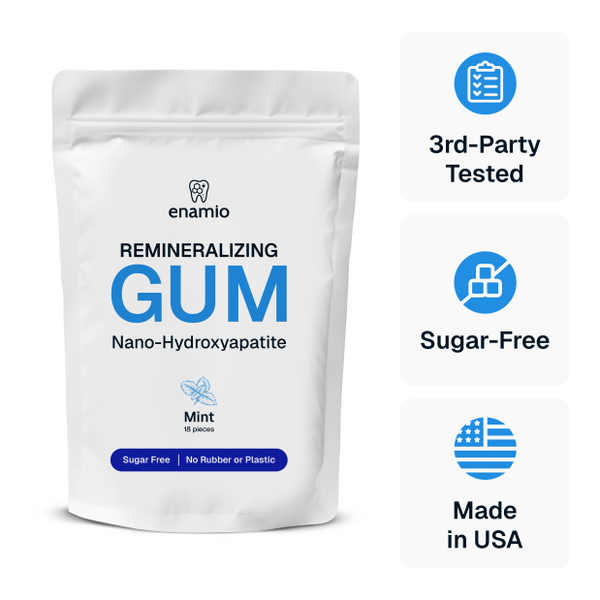
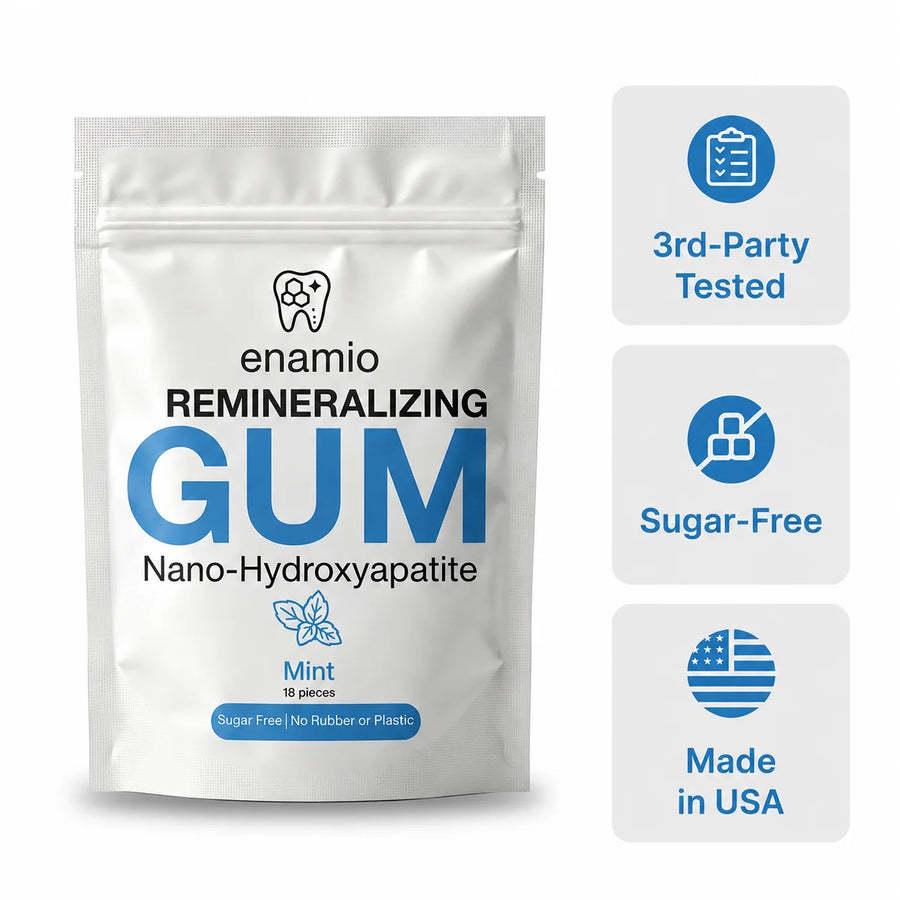
Enamio Remineralizing Gum
A sugar-free, fluoride-free gum with xylitol and nano-hydroxyapatite. It isn't an orthodontic device, and it isn't automatically suitable for every brace.
EnamioCan you chew gum with braces? Explore Enamio
Enamio contains nano-hydroxyapatite. Readers may also want the evidence boundaries in our nano-hydroxyapatite safety guide and the practical steps in Enamio usage instructions. Neither page changes an orthodontist's restriction.
- 06 -
What to do if gum gets stuck in braces
Do not panic, yank, or use a sharp household object. Remove the loose bulk with clean fingers. Rinse with cool or lukewarm water, then use the brush and interdental tools your orthodontist recommended. Work slowly around the wire instead of pulling across it.
If a small residue remains, brushing in several directions is safer than scraping with a pin, knife, or improvised metal tool. Orthodontic floss threaders and small interproximal brushes can reach spaces a standard brush misses, but use them as your clinic demonstrated. Never force a brush under a wire that looks displaced.
After cleaning, check each bracket in the mirror. A loose bracket may slide on the wire or move when touched lightly. A poking wire, missing elastic, broken chain, or sudden change in your bite deserves a call to the orthodontic office. Save any detached piece if you can do so safely.
A broken bracket is not repaired by pressing it into place, covering it with gum, or chewing on the other side for weeks. Orthodontic wax may protect a cheek temporarily if your clinic recommends it, but the office still needs to decide when to repair the appliance.
- 07 -
Gum does not clean around brackets
Sugar-free gum can stimulate saliva, but it can't brush the narrow line around a bracket or clean beneath an archwire. That distinction matters because plaque can sit in areas gum never touches. Keep brushing with fluoride toothpaste if your dental team recommends it, and clean between teeth with the tools selected for your appliance. [1][3]
The phrase "sugar-free" doesn't mean unlimited. The ADA explains that FDA rules allow the label when a food contains less than 0.5 gram of sugars per serving. Sugar alcohols such as xylitol and sorbitol are common alternatives. [1] Follow the package serving information and your clinician's advice.
If sensitivity makes cleaning uncomfortable, don't quietly brush less. Ask whether a smaller brush head, a different interdental tool, or another toothpaste is appropriate. Our guide to tooth sensitivity relief explains common causes, and the article on remineralizing gum for sensitive teeth keeps gum in its proper supporting role.
For a broader look at daily enamel support, see our cavity-risk education page. If breath is the immediate concern around lunch, our bad-breath solution page explains why cleaning and saliva matter more than masking odor. Gum can freshen. It can't remove trapped food from a bracket.
- 08 -
Aligners, retainers, expanders, and elastics
Clear aligners and removable retainers come out before gum. Store the appliance in its case, chew only if your overall treatment instructions allow it, clean your mouth, then put the appliance back as directed. Chewing with plastic in place can grind residue into it and may affect clarity or fit.
A functional brace is also removable, but wear-time instructions can be strict. Dorset County Hospital tells patients to remove a functional brace for eating, tooth cleaning, and contact sports, then store it in the box. [13] Gum is chewing. Treat it like eating unless your clinician gives a different instruction.
Expanders and mixed appliances deserve a direct question. Some have a central screw, acrylic sections, bands, or bars that change where gum can lodge. Elastics create another variable. Do not remove prescribed elastics simply to make gum easier unless that matches your written care plan.
A bonded retainer is fixed, but it is not the same as a full set of braces. Gum may still wrap around the wire or bonding pads behind the teeth. Ask what your provider recommends, especially if floss already catches or a pad feels rough.
Dentures use different materials and retention principles, so readers with removable prostheses should use our guide to chewing gum for dentures instead of applying braces rules.
If avoiding conventional plastic gum bases matters to you, read about Enamio's plastic-free natural gum base. Material preference isn't the same as hardware safety. A plastic-free natural base can still be sticky around a brace.
- 09 -
A one-minute decision check
Use this sequence before opening a pack. It is deliberately conservative because replacing a bracket is more trouble than skipping one piece of gum.
- Is the appliance removable? Take it out and store it properly before chewing.
- Did your orthodontist or written care sheet prohibit gum? Stop there. The answer is no.
- Do you have a loose bracket, poking wire, recent repair, new chain, or unexplained pain? Skip gum and contact the office.
- Was gum explicitly allowed? Choose a soft sugar-free piece and avoid bubble blowing or forceful chewing.
- Did anything catch or shift? Stop, clean carefully, inspect, and call if the hardware changed.
If you want help choosing an Enamio routine after approval, use the oral-care quiz. For purchase terms, check the current refund policy rather than relying on a blog summary.
Questions worth asking at your next appointment
A useful question is specific enough to get a useful answer. Instead of asking only, "Is gum okay?" tell the orthodontist what you want to chew, how often, and when. Ask whether the rule changes after an adjustment, while wearing elastics, or after a bracket repair. If a soft strip is allowed but pellets aren't, write that down.
You shouldn't have to reconstruct the rule from memory in a checkout line.
Ask what a loose bracket feels like in your setup, too. Some brackets slide on the wire after the bond fails. Others stay nearly still until you bite. Knowing the clinic's warning signs makes the stop rule practical.
Also ask which brush, interdental brush, floss threader, or water flosser setting they want you to use if something sticky gets around the hardware.
If your clinic uses a patient portal, save the care sheet or the office's answer where you can find it quickly. A dated message is more reliable than a memory of a rushed conversation. It also helps a parent, school nurse, or caregiver follow the same rule when you aren't at home.
Ask whether the answer changes during treatment. A clinician may permit a soft strip during one stage and restrict all gum after adding a chain, spring, expander, or fresh bond. Treat each hardware change as a reason to check again, not as proof that last month's permission still applies.
Jaw comfort belongs in the same conversation. Gum may be unwise even when the brackets can handle it if chewing triggers jaw pain, clicking, headaches, or fatigue. An orthodontic appliance already changes how the teeth meet during treatment. Don't use a generic online chewing schedule when your jaw is telling you to stop.
Finally, ask how to contact the office after hours and which problems can wait. A bit of wax for a rubbing hook is different from a swallowed piece, breathing trouble, or a major facial injury. Clear instructions reduce panic.
Clear after-hours instructions make it less tempting to improvise with gum, sharp tools, or a home repair.
- 10 -
Five real-life situations, handled conservatively
Rules become clearer when you apply them to an ordinary day. These examples are not substitutes for care instructions. They show how to avoid turning a small question into a loose bracket or a lost tray.
You are at school and forgot whether gum was allowed
Skip it until you can check the written instructions or message the clinic. Guessing offers little upside. If you want fresher breath, rinse with water and clean with the travel brush your orthodontist recommended. Do not copy a classmate's rule, even if the braces look identical.
Bonding materials, appliance stages, and recent repairs may differ.
Your friend says sugar-free gum cannot damage braces
Sugar-free describes how much sugar is in a serving. It says nothing about tackiness, piece size, or the condition of your hardware. A sugar-free bubble gum can still stretch around hooks. A soft strip can still be prohibited by your clinic.
Use the label to make an oral-health choice only after the appliance question is settled.
Your teeth are sore after an adjustment
Research on controlled chewing for orthodontic soreness is promising enough to discuss with your provider. It is not a reason to improvise when the clinic told you not to chew gum. Ask what they prefer for short-term tenderness. Soft foods, orthodontic wax for rubbing, or another clinician-approved measure may fit your situation better.
Pain that is severe, worsening, or linked to moved hardware needs a call.
You wear aligners and want gum during a long drive
Pull over safely before handling the trays. Remove them with clean hands, put them in their case, and follow the treatment plan for eating and drinking time. Do not leave aligners loose in a cup holder or wrap them in tissue. After chewing, clean your teeth or rinse as your provider directs before reinserting the trays.
Keeping them out for hours to chew is a wear-time problem, even when the gum itself is sugar-free.
A bracket feels slightly different after chewing
Stop chewing. Look in a mirror without pushing hard. Compare the bracket with the matching tooth on the other side, and check whether it slides along the wire. Avoid hard or sticky foods until the clinic advises you.
A bracket can remain captured by the wire after its bond fails, so "it did not fall out" isn't proof that everything is secure.
Parents can make the same rule easier for younger patients. Keep the clinic's food sheet somewhere visible, send an orthodontic brush in the school bag, and ask the office to explain gum permission directly to the child. Clear instructions work better than arguing after a piece is already in the mouth. If siblings have different appliances, label their care cases and avoid assuming that one child's permission applies to the other.
Travel needs a little planning too. Pack the appliance case, brush, interdental tool, wax if prescribed, and the clinic's contact number. A piece of tissue is not a retainer case, and a hotel bathroom is not the place to improvise a repair. When you have the right supplies, skipping gum for a day feels like a minor choice instead of an emergency.
- 11 -
People also ask
Can you chew gum with braces if it is sugar-free?
Only if your orthodontist allows it. Sugar-free is better for the sweetener profile, but it doesn't guarantee that a gum will stay out of brackets and wires.
What gum can you chew with braces?
If you have permission, choose the soft type your clinic recommends. One NHS leaflet specifically allows soft sugar-free strips and excludes pellets. [6] Several others prohibit gum entirely. [3][4][5]
Can gum break a bracket?
Sticky gum can pull or catch, so clinics treat breakage as a practical risk. Randomized trials didn't show a significant increase in bond failure under their study conditions, but that isn't permission for every appliance. [7][10]
Can you chew gum with braces right after an adjustment?
Some trials evaluated controlled chewing for soreness and appliance breakage. [8][11] Ask your orthodontist first, because pain can also signal a wire or bracket problem.
Can you chew gum with Invisalign-style aligners?
Remove clear aligners before chewing gum. Store the trays in their case, clean your mouth afterward, and return them according to the wear schedule.
How do you remove gum from braces?
Lift away loose gum with clean fingers, rinse, then brush slowly with orthodontic tools. Do not use sharp objects or pull hard across the wire.
Can you chew gum with elastics on?
Ask the clinician who prescribed the elastics. Do not remove or alter a prescribed elastic pattern simply to chew gum.
Does gum replace brushing after lunch?
No. Gum can't clean plaque beside brackets or food beneath wires. The ADA describes sugar-free gum as an adjunct to brushing and interdental cleaning. [1]
- 12 -
FAQs
Why did my orthodontist ban gum if studies found little extra breakage?
A clinic rule covers more real-life variation than a controlled trial. Different gum textures, chewing habits, repair histories, and appliance parts create uncertainty. A simple restriction lowers avoidable risk.
Is xylitol gum automatically safe for braces?
No. Xylitol describes a sweetener, not how a gum behaves around hardware. You still need approval for your appliance and should follow any texture or serving guidance from your orthodontist.
Should I chew gum right after braces are tightened?
Only if your orthodontist specifically permits that approach. Controlled studies used defined gum schedules for soreness, but a new pain or hardware problem needs assessment rather than self-treatment.
What if I accidentally chewed gum once?
Remove it, clean carefully, and inspect the appliance. If nothing caught and every bracket looks stable, follow your clinic's rule going forward. Call if a wire or bracket moved.
Can I chew Enamio with braces?
Ask your orthodontist. Enamio is sugar-free, but no product-level fact overrides an appliance restriction. If gum is allowed, follow both the orthodontic instructions and the product label.
When should I call the orthodontist?
Call for a loose bracket, moved or poking wire, broken chain, unexplained bite change, severe pain, swelling, or gum you can't safely clear. Seek urgent care for breathing trouble or major injury.
- 13 -
References
- American Dental Association. Chewing Gum. ADA Library, updated May 4, 2023. Source. Accessed July 27, 2026.
- Royal Devon University Healthcare NHS Foundation Trust. Instructions for wearing your fixed orthodontic brace. Version date: April 2025. Source. Accessed July 27, 2026.
- Manchester University NHS Foundation Trust. Instructions For Fixed Appliances. Updated July 2018. Stated review date July 2020. Source. Accessed July 27, 2026.
- Queen Victoria Hospital NHS Foundation Trust. Orthodontic treatment with fixed appliances. Printed May 2023. Stated review date May 2026. Source. Accessed July 27, 2026.
- University Hospitals Birmingham NHS Foundation Trust. Instructions for Patients with Fixed Appliances. Issue date: February 2024. Review date: February 2027. Source. Accessed July 27, 2026.
- Royal United Hospitals Bath NHS Foundation Trust. Oral Hygiene Advice for Patients with Fixed Braces. Publication date: February 2023. Source. Accessed July 27, 2026.
- Ireland AJ et al. Comparative assessment of chewing gum and ibuprofen in the management of orthodontic pain with fixed appliances. American Journal of Orthodontics and Dentofacial Orthopedics, August 2016. PubMed. Accessed July 27, 2026.
- Al Shayea EI et al. Comparative assessment between ibuprofen, chewing gum, and bite wafers. Journal of International Society of Preventive and Community Dentistry, 2020. PubMed. Accessed July 27, 2026.
- Guo Q et al. Effect of chewing gum on orthodontic pain in patients receiving fixed orthodontic treatment: a systematic review and meta-analysis. European Journal of Medical Research, November 8, 2023. PubMed. Accessed July 27, 2026.
- Murugan C and Kailasam V. The effect of chewing gum on the rate of en-masse space closure: a randomised controlled trial. Journal of Orthodontics, December 2024. PubMed. Accessed July 27, 2026.
- Cheong JM, Noraziman MI, Zulkarnain MI, and Mohd Ibrahim MS. The Effect of Sugar-Free Chewing Gum on Self-Reported Orthodontic Pain Associated with Stainless Steel Archwire Placement: A Randomized Controlled Trial. European Journal of Dentistry, July 15, 2026. PubMed. Accessed July 27, 2026.
- National Health Service. Braces. Last reviewed June 29, 2026. Source. Accessed July 27, 2026.
- Dorset County Hospital. Functional Brace. Written March 2021. Approved April 2021. Stated review date March 2025. Source. Accessed July 27, 2026.
- American Association of Orthodontists. Learn More About Orthodontic Treatment Options. Source. Accessed July 27, 2026.
Keep the orthodontic rule simple
Ask first. If the answer is no, skip gum. If the answer is yes, choose a soft sugar-free option, chew gently, and keep cleaning around the hardware. Enamio can fit the last path, but it cannot create permission.
Sugar-free oral care
Enamio Remineralizing Gum
EnamioMade with xylitol, nano-hydroxyapatite, and a plastic-free natural gum base. Use it only when your orthodontic care instructions allow chewing gum.
Shop EnamioRead instructionsWhere to go from here
Broader guide
Best gum for bad breath and teeth
Evidence
Does remineralizing gum work?
Sweeteners
Erythritol vs xylitol gum
Share this guide
Article link X / Twitter Facebook Email