
Best Gum for Bad Breath and Teeth: What to Look For
Share
Published by Enamio |
BREATH PLUS TOOTH SUPPORT
Best Gum for Bad Breath and Teeth: What to Look ForThe best gum for bad breath and teeth should do more than taste minty. It should be sugar-free, keep saliva moving, avoid feeding plaque acids, and include ingredients that fit a daily tooth-support routine.
Key Takeaways
Fast Facts
In This Guide
- 01 -
Problem
Bad-breath gum is easy to buy and hard to judge. A strong mint can feel clean for ten minutes, but flavor does not tell you whether the gum helps saliva, avoids sugar acids, or fits a tooth-support routine.
That is the trap. Many people shop by mint strength. Then they chew a gum that tastes sharp, fades fast, and gives them no clear reason to believe it is helping their teeth.
The better question is practical: what should the label do for breath, and what should it do for teeth? If it cannot answer both, it is probably a mint candy with better branding.
Tooth support is not a side concern. CDC/NCHS FastStats reports untreated dental caries in 25.9 percent of adults ages 20-44, 25.3 percent of adults ages 45-64, and 20.2 percent of adults 65 and older for 2015-2018. [10] Gum is not the answer to those numbers by itself, but those numbers explain why a daily chew should not work against your teeth.
Gums matter too. CDC notes that about 4 in 10 U.S. adults age 30 or older had mild, moderate, or severe periodontitis in 2009-2014. [11] Gum disease is one reason persistent odor should not be brushed off as a mint problem.
That is why this article keeps returning to routine fit. A better gum should be friendly to enamel, reasonable for the jaw, and honest about what it can and can't do. You want a small daily habit that pairs with care, not a product that asks you to ignore symptoms.
How to choose the best gum for bad breath and teeth
Start with the same baseline dentists use: sugar-free gum after meals can help saliva do useful work. The ADA says chewing sugarless gum for 20 minutes after meals can help tooth-decay risk by raising saliva flow. [1] That matters because saliva is not just moisture. It helps rinse debris, buffer acids, and bring minerals such as calcium and phosphate to the tooth surface. [2]
Breath has its own layer. StatPearls notes that intraoral causes account for about 80-85 percent of halitosis cases. [3] Tongue biofilm, plaque, dry mouth, periodontal issues, diet, and medications can all change how breath smells. Gum can help the easy parts, but it can't diagnose the hard parts.
So the label needs more than "fresh mint." It should make sense for saliva, odor chemistry, and tooth support. If your goal is daily freshness with an oral-health routine, read the ingredient panel like a checklist.
Mint can mask odor
Flavor helps the moment feel fresh, but it does not prove the gum addresses saliva, tongue biofilm, or plaque acids.
Sugar-free comes first
Sugar feeds plaque bacteria that produce acids. That is why dental guidance starts with sugarless gum. [1]
Breath needs a cause check
If odor keeps coming back, a dentist or physician should check gum health, dry mouth, medication effects, and other causes.
For a deeper breath-first path, Enamio's breath-support guide explains how zinc, xylitol, pH support, and saliva fit into the brand's daily chew. If your main concern is cavity-risk support, pair this article with the cavity-risk support page instead of relying on breath claims alone.
- 02 -
Science
Halitosis is persistent or noticeable unpleasant breath. In many cases, the source is inside the mouth, where tongue coating, plaque, food debris, gum inflammation, and low saliva can affect odor. StatPearls estimates intraoral causes at about 80-85 percent of cases. [3]
Volatile sulfur compounds are odor-linked gases that oral bacteria can produce. They matter because mint flavor can cover them for a while, while ingredients such as zinc are studied for how they interact with sulfur chemistry. [3] [5]
The ADA's gum guidance is not about perfume. It is about saliva. Chewing sugar-free gum increases saliva flow, which helps wash away debris, cancel acids from oral bacteria, and supply disease-fighting substances around the mouth. [1]
Saliva also carries calcium, fluoride, and phosphate ions at the tooth surface. [2] That does not mean gum replaces toothpaste or professional care. It means chewing can create a more helpful mouth environment after eating.
Dry mouth changes the breath picture too. NIDCR lists bad breath among dry-mouth symptoms and includes chewing sugarless gum as a self-care step to help stimulate saliva. [4] If dry mouth is medication-related or persistent, a health professional should be involved.
Zinc is the breath-specific ingredient worth knowing. In a small 11-person study, chewing gum with zinc acetate reduced measured volatile sulfur compounds by 45 percent. [5] Keep the scale in mind. That result supports the ingredient logic, not a cure claim.
Sugar-free gum evidence is broader on the tooth side. A 2020 systematic review found tentative evidence that sugar-free chewing gum reduced caries increment compared with non-chewing controls. [6] A 2021 review found reduced Streptococcus mutans load compared with non-chewing controls. [7] Both reviews still call for careful interpretation.
A better breath gum should pass two tests: does it support freshness, and does it avoid working against your teeth?
Nano-hydroxyapatite belongs in the tooth-support side of the story. The SCCS final opinion considered hydroxyapatite nano safe up to 29.5 percent in toothpaste and 10 percent in mouthwash under stated specifications. [8] That is safety context, not proof that every format works the same way.
Here is the useful takeaway. Breath support needs saliva and odor chemistry. Tooth support needs sugar-free chewing, acid balance, and ingredients that fit enamel mineral care. A gum that only gives you mint is doing the easiest job.
The same logic helps you avoid bad shopping shortcuts. "Extra strong" is a flavor claim. "Sugar-free" is a tooth-risk claim. "Zinc" is a breath-chemistry clue. "Nano-hydroxyapatite" is an enamel-mineral clue. Those labels answer different questions, so they should not be treated as interchangeable.
Think about timing too. After meals, the mouth is dealing with food debris, acids, and lower freshness. At that moment, sugarless chewing has a clear role because saliva is useful. At bedtime, chewing gum is usually the wrong tool because you should be brushing, flossing, and letting the mouth rest.
The checklist below is meant to slow the decision down. It does not say every person needs the same gum. It says a breath-and-teeth gum should show its work on the label, and the label should map back to real oral-health functions.
| Checkpoint | Why it matters | Source basis | Enamio page match |
|---|---|---|---|
| Sugar-free | Avoids sugar feeding plaque acids. | ADA gum guidance [1] | Yes, sugar-free page claim [9] |
| 20-minute chew fit | Matches after-meal saliva window. | ADA and product directions [1] [9] | Yes, 20 minutes listed [9] |
| Saliva support | Helps rinse debris and buffer acids. | ADA saliva page [2] | Yes, chew routine supports saliva |
| Xylitol | Non-cavity sweetener used in dental gum studies. | ADA and reviews [1] [7] | Yes, xylitol listed [9] |
| Zinc ingredient | Targets breath chemistry beyond mint. | Zinc gum VSC study [5] | Yes, zinc gluconate listed [9] |
| pH support | Acid balance is part of the tooth-support logic. | ADA acid guidance [1] | Yes, L-arginine plus sodium bicarbonate [9] |
| Enamel mineral | Supports the enamel-care side of the routine. | SCCS context plus product page [8] [9] | Yes, nano-hydroxyapatite listed [9] |
| Calcium or phosphate support | Matches saliva-mineral logic at the tooth surface. | ADA saliva page [2] | Yes, calcium glycerophosphate listed [9] |
| Natural gum base | Supports cleaner daily chewing choices. | Product and brand page [9] | Yes, natural chicle base [9] |
| Routine caution | Gum is a tool, not a substitute for care. | ADA gum and TMJ guidance [1] | Yes, use alongside brushing and flossing [9] |
Our calculation from sources
The checklist splits evenly: 5 of 10 checkpoints are breath-focused, and 5 of 10 are tooth-support-focused. Formula: 5 divided by 10 equals 50 percent for each side.
Enamio's public page matched all 10 checklist items on July 12, 2026. That is a label-fit calculation from sources [1], [2], [3], [5], [8], and [9], not a clinical outcome score.
How to read the score without overreading it
The 10-point table is useful because it separates label truth from outcome promises. If a gum lists sugar-free sweeteners, zinc, and enamel minerals, you can see the intended roles. You still can't assume the same result for every mouth.
A person with coffee breath after lunch needs a different answer than a person with bleeding gums, dry mouth, and a bad taste that will not clear. The first person may only need water, tongue care, and a sugar-free chew after meals. The second person needs a dental visit.
That is also why the table does not rank brands. Ranking without the right sources can turn into guesswork fast. A clean framework is more helpful: check sugar, check saliva fit, check breath ingredients, check tooth-support ingredients, then check whether the routine makes sense for you.
If a gum passes only the flavor test, it may still be fine for a short fresh-mouth moment. If it fails the sugar-free test, it is a poor fit for tooth support. If it passes the breath tests but has no enamel or mineral logic, treat it as a breath gum, not a tooth-support gum.
The strongest daily option is the one you can explain in plain English. It should not need a dramatic claim. "This gum is sugar-free, helps me chew after meals, includes zinc for breath support, and includes minerals for enamel support" is a clear reason to choose it.
- 03 -
How Enamio Works
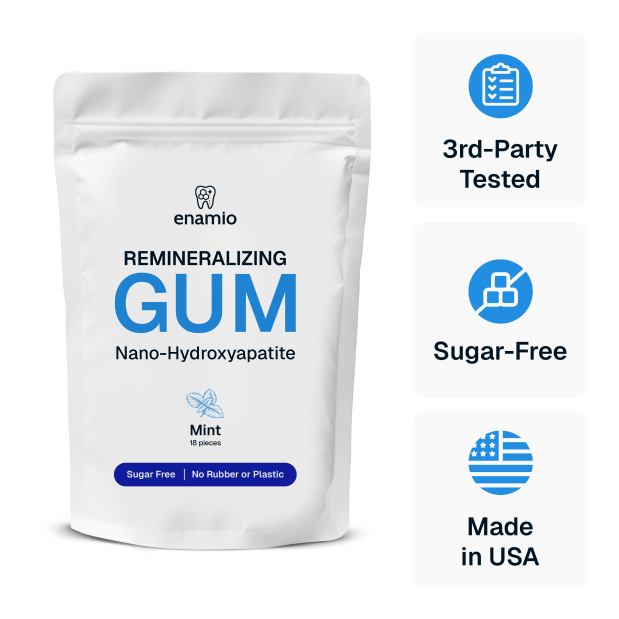
Enamio is a sugar-free remineralizing gum built around nano-hydroxyapatite, xylitol, zinc gluconate, natural chicle, calcium glycerophosphate, magnesium citrate, L-arginine, sodium bicarbonate, green tea extract, mint flavor, menthol, and monk fruit. Those ingredients were verified on the live product page. [9]
For breath, the important pieces are zinc, saliva, pH support, xylitol, and mint. Zinc gives the formula a breath-specific reason to exist beyond flavor. Xylitol and chewing fit the sugar-free saliva side of the dental guidance. [1] [5]
For pH support, Enamio lists L-arginine plus sodium bicarbonate. That combination belongs in the after-meal story because acid balance is part of why sugarless chewing is useful. It is not a reason to skip brushing, and it is not a license to sip acidic drinks all day.
For the enamel side, Enamio lists rod-shaped nano-hydroxyapatite, calcium glycerophosphate, and magnesium citrate. The product page also says the nano-hydroxyapatite particles are 20nm. [9] Those details help distinguish a mineral-support gum from a mint gum with dental-looking language.
For the chewing experience, natural chicle matters because people who chew daily may care what the base is made from. The gum base does not make a medical claim. It does make the product feel more aligned with people who want fewer synthetic materials in routine products.
That stack also explains why Enamio should not be described as just xylitol gum. Xylitol is part of the formula, and it matters. The formula also includes zinc for breath support, minerals for enamel support, and pH-support ingredients for the after-meal context.
For teeth, the formula points to nano-hydroxyapatite, calcium glycerophosphate, magnesium citrate, and pH-support ingredients. Enamio's page says it uses premium 20nm particles and lists 6 active ingredients per piece. [9] Keep the wording careful: these ingredients may support an enamel-care routine. They are not a dental procedure.
The base matters too. Enamio uses natural chicle instead of a synthetic plastic gum base. If that is part of why you are switching, the plastic-free natural gum guide explains the base choice in more detail.
Product spotlight
Enamio Remineralizing Gum
A sugar-free, plastic-free daily chew with nano-hydroxyapatite, xylitol, zinc gluconate, calcium glycerophosphate, magnesium citrate, L-arginine, and sodium bicarbonate. Live directions say to chew 1-2 pieces daily for 20 minutes each. [9]
If you want the ingredient-by-ingredient version, read Enamio's remineralizing gum ingredient guide. If you want the broader enamel-support comparison, the remineralizing gum buying guide covers that lane without turning this breath article into a broad ranking page.
Sensitivity deserves its own caution. Hot, cold, or sweet discomfort can have several causes, from enamel wear to exposed roots or dental work. Enamio's tooth sensitivity routine page can help you connect the tooth-support piece, but ongoing pain belongs with a dentist.
- 04 -
How to Use
Use gum as a timed support habit, not a replacement for cleaning. The simplest rhythm is after meals, after coffee, or between brushing sessions when you want saliva support and a cleaner mouth feel.
After coffee, gum can help with mouth feel, but water should come first. Coffee breath can be partly flavor, partly dryness, and partly a long gap since cleaning. Chew after you rinse or drink water, then get back to brushing and flossing at the normal time.
After lunch, the 20-minute habit makes the most sense. You may not have a toothbrush at work, school, or while traveling. Sugar-free gum gives you a practical bridge until you can clean properly again.
Before a meeting, do not over-chew. A few minutes can freshen the mouth, but grinding on dense gum for long stretches can tire the jaw. If you already have jaw pain, clicking, or headaches, ask your dentist before making gum a daily habit.
At night, skip gum and clean. Bad breath after waking is common, but the better bedtime routine is brushing, cleaning between teeth, and tongue care. Gum is better as an after-meal or daytime bridge than as a late-night substitute.
Before you buy, read the back of the pouch in this order: sweetener, gum base, breath ingredient, enamel ingredient, then directions. If the label makes you hunt for every answer, slow down. A daily gum should make its job clear because you are putting it in your mouth often.
One more check helps: ask whether you would still choose the gum if the flavor were milder. If the answer is yes because the formula, base, and directions make sense, you are choosing a routine product. If the answer is no, you are choosing flavor first.
The ADA guidance points to 20 minutes after meals for sugarless gum. [1] Enamio's live directions also say to chew 1-2 pieces daily for 20 minutes each, after meals or between brushing, alongside brushing and flossing. [9]
1
Clean the surfaces first
Brush twice daily, clean between teeth, and do not skip the tongue. Tongue coating can be a major odor source. [3]
2
Chew after meals
Aim for 20 minutes when chewing sugarless gum after a meal. Shorter is fine for freshness, but the dental guidance uses that 20-minute window. [1]
3
Drink water
Water helps when the issue is dry mouth, coffee, or a long gap between meals. NIDCR also lists water and sugarless gum among dry-mouth self-care steps. [4]
4
Stop if your jaw complains
The ADA cautions people with TMJ disorders against chewing gum because it can add jaw stress. See a dentist if chewing causes pain, clicking, or locking. [1]
For Enamio-specific timing, the instructions and tips page gives routine guidance, and the complete remineralizing gum use guide adds a broader daily schedule. If you mainly want xylitol education, the xylitol gum for teeth guide owns that topic.
Routine builder
Choose your next step
If you want a fast fit check, take Enamio's gum routine quiz. If you are comparing xylitol with enamel minerals, read whether xylitol gum remineralizes teeth before choosing a one-ingredient gum.
Shop Enamio remineralizing gum- 05 -
People Also Ask
What is the best gum for bad breath and teeth?
The best choice is sugar-free, chewable for about 20 minutes, and built around both breath support and tooth support. Look for saliva support, xylitol or another non-cavity sweetener, zinc or pH support, and enamel-mineral ingredients. [1] [5] [9]
Does chewing gum cure bad breath?
No. Gum can freshen breath, stimulate saliva, and support a cleaner mouth feel, but it does not diagnose the cause. Persistent odor needs a dentist or physician because dry mouth, gum disease, medication effects, sinus issues, reflux, and other causes can be involved. [3] [4]
Is xylitol gum good for bad breath?
Xylitol gum can be a smart starting point because it is sugar-free and used in dental gum research. Breath support still depends on the full routine. If odor is driven by tongue biofilm, dry mouth, or gum inflammation, xylitol alone may not be enough. Read Enamio's xylitol oral-health guide for a fuller view.
Does zinc gum help breath?
Zinc has a real breath rationale because it is studied for volatile sulfur compounds. In one small 11-person study, zinc-containing gum reduced oral VSCs by 45 percent. [5] Treat that as supportive evidence, not a guarantee.
Should bad-breath gum have nano-hydroxyapatite?
Nano-hydroxyapatite is not a breath ingredient. It belongs to the tooth-support side of a gum. If you want one chew to support freshness and enamel care, it can make sense as part of a broader formula that also includes sugar-free sweeteners and breath-support ingredients.
How long should I chew gum after meals?
The ADA's sugarless gum guidance uses 20 minutes after meals. [1] Enamio's live page also lists 20 minutes per piece and 1-2 pieces daily. [9] If your jaw gets tired or sore, stop sooner.
What gum ingredients should I avoid for breath and teeth?
Avoid sugar if the goal is tooth support. The ADA notes that sugar can be used by plaque bacteria to produce acids that harm teeth. [1] You may also want to avoid synthetic plastic gum bases if cleaner chewing is part of your buying criteria.
Can gum replace brushing or tongue scraping?
No. Gum is a support tool. The ADA says sugar-free gum is not a substitute for brushing, cleaning between teeth, balanced eating, and regular dental visits. [1] Tongue cleaning matters because tongue biofilm can contribute to oral odor. [3]
When should I see a dentist for bad breath?
See a dentist if bad breath persists, comes with bleeding gums, tooth pain, dry mouth, loose teeth, sores, a bad taste, or denture or orthodontic problems. StatPearls lists periodontal and dental causes among intraoral sources. [3]
Is sugar-free gum safe for jaw pain or TMJ?
People with TMJ disorders should avoid chewing gum unless their dentist says otherwise. The ADA warns that gum chewing can add stress to the mouth and may worsen symptoms in people with TMJ disorders. [1]
- 06 -
FAQs
Is mint flavor enough for bad breath?
Mint flavor can help breath feel fresh, but it is not the whole job. For a better daily choice, look for sugar-free chewing, saliva support, and ingredients that address breath chemistry or tooth support.
Why does dry mouth make breath worse?
Low saliva can leave the mouth feeling sticky and can reduce natural rinsing. NIDCR lists bad breath among dry-mouth symptoms and includes chewing sugarless gum among self-care steps. [4]
Can I chew Enamio more than twice per day?
Follow the live product directions and your dentist's advice. Enamio's page lists 1-2 pieces daily for 20 minutes each. If your jaw gets sore, reduce chewing and ask a dentist. [9]
Does Enamio contain sugar?
The live Enamio product page lists the gum as sugar-free and shows xylitol and monk fruit among sweetening ingredients. Product pages can change, so check the current label before buying. [9]
What if my breath only smells bad in the morning?
Morning breath can relate to overnight dryness and oral bacteria. Clean your tongue, drink water, keep dental care steady, and use sugar-free gum after breakfast if it agrees with your jaw. Persistent odor still deserves a check.
Does gum help dry mouth long-term?
Sugar-free gum can be a self-care step for dry mouth because chewing can stimulate saliva, but it does not solve every cause. NIDCR recommends asking a dentist or physician if dry mouth persists, especially when medicines or health conditions may be involved. [4]
Is chewing gum safe every day?
Daily chewing can fit some oral-care routines when the gum is sugar-free and your jaw tolerates it. Keep it moderate, follow label directions, and avoid gum if you have TMJ symptoms unless your dentist says it is appropriate. [1]
- 07 -
References
- Chewing Gum, MouthHealthy, American Dental Association, current page, https://www.mouthhealthy.org/all-topics-a-z/chewing-gum, Accessed July 12, 2026
- Saliva, MouthHealthy, American Dental Association, current page, https://www.mouthhealthy.org/all-topics-a-z/saliva, Accessed July 12, 2026
- Halitosis, StatPearls, NCBI Bookshelf, Last Update August 14, 2023, https://www.ncbi.nlm.nih.gov/books/NBK534859/, Accessed July 12, 2026
- Dry Mouth, National Institute of Dental and Craniofacial Research, last reviewed October 2024, https://www.nidcr.nih.gov/health-info/dry-mouth, Accessed July 12, 2026
- Waler SM, The effect of zinc-containing chewing gum on volatile sulfur-containing compounds in the oral cavity, Acta Odontologica Scandinavica, 1997, PMID 9226432, DOI 10.3109/00016359709115416, https://pubmed.ncbi.nlm.nih.gov/9226432/, Accessed July 12, 2026
- Newton JT et al., A Systematic Review and Meta-Analysis of the Role of Sugar-Free Chewing Gum in Dental Caries, JDR Clinical and Translational Research, 2020, PMID 31743654, DOI 10.1177/2380084419887178, https://pubmed.ncbi.nlm.nih.gov/31743654/, Accessed July 12, 2026
- Nasseripour M et al., A systematic review and meta-analysis of the role of sugar-free chewing gum on Streptococcus mutans, BMC Oral Health, 2021, PMID 33926448, DOI 10.1186/s12903-021-01517-z, https://pubmed.ncbi.nlm.nih.gov/33926448/, Accessed July 12, 2026
- SCCS Scientific Opinion on Hydroxyapatite nano - Submission IV, European Commission Scientific Committee on Consumer Safety, Publication date July 1, 2025, SCCS/1677/25, https://health.ec.europa.eu/publications/sccs-scientific-opinion-hydroxyapatite-nano-submission-iv_en, Accessed July 12, 2026
- Enamio Remineralizing Gum product page, Enamio, live product facts, ingredients, directions, and pack options, https://enamiogum.com/products/remineralizing-gum, Accessed July 12, 2026
- FastStats - Oral and Dental Health, CDC/NCHS, current page, https://www.cdc.gov/nchs/fastats/dental.htm, Accessed July 12, 2026
- About Periodontal Disease, CDC Oral Health, current page, https://www.cdc.gov/oral-health/about/gum-periodontal-disease.html, Accessed July 12, 2026
- 08 -
Ready to Build a Better Daily Chew
If your current gum is only a mint, upgrade the checklist. Choose sugar-free chewing, breath-support ingredients, and tooth-support minerals in one routine.
Enamio gives you zinc for breath support, xylitol and saliva-friendly chewing, nano-hydroxyapatite and mineral support, and a natural chicle base. Use it with brushing, flossing, tongue cleaning, and regular dental care.
Shop Enamio now- 09 -
Reading Next
For enamel support
Read the science behind Enamio for ingredient context and mineral support.
For natural chewing
Compare gum bases in the natural chewing gum guide before you buy.
For safety context
Use the nano-hydroxyapatite safety guide when you want a focused safety read.
- 10 -
Share This Guide
Use the canonical article URL when sharing so people land on the current Enamio version.
- 11 -
Medical Disclaimer
This article is educational and is not medical or dental advice. Chewing gum can support a daily oral-care routine, but it does not replace diagnosis, treatment, brushing, flossing, professional cleanings, or dental care. Ask a dentist or physician about persistent bad breath, pain, bleeding gums, dry mouth, jaw symptoms, or any new oral symptom.
- 12 -
Authority Footer
Published by Enamio on July 12, 2026. Product facts were checked against the live Enamio product page the same day. Evidence claims were limited to dental society guidance, government health pages, peer-reviewed research, and the live product label.