

Plastic Free Gum: Read the Base, Then the Research
Share
Plastic free gum is a formulation claim to check against the maker's complete base declaration. [1]
Quick answer
- US rules allow natural and synthetic base materials.
- The 2025 pilot measured particles in saliva, without establishing a clinical benefit from a declared base. [2]
- Compare the selected pouch with the seller's gum-base page before choosing.
Published by Enamio, the commercial seller whose nano-hydroxyapatite gum and selected source records are discussed here. Individual source reading dates and access limits appear in References.
Key facts at a glance
What "gum base" means
Gum base is the nonnutritive material chewed in gum, rather than a declaration of one fixed recipe. US rules permit natural materials such as chicle and specified synthetic substances including polyethylene and polyvinyl acetate under their stated specifications. Match any product claim to the maker's complete base declaration. [1]
What chicle is
Chicle is a natural gum-base material listed in US food-additive rules, rather than a name for every ingredient in a finished gum. One material isn't the whole base. The same rules permit specified synthetic materials alongside natural ones, rather than guaranteeing a wholly natural formulation. Ask which other base ingredients the selected product's complete formulation contains. [1]
~100/g
American Chemical Society (ACS) approximate average microplastic count per gram across ten tested gums [2]
1 chewer
Repeated samples are not independent participants [2]
Manufacturer declarations
Formulation claims, not release tests
Key Takeaways
- A named base is only part of the formula.
- Particle counts don't measure a dental outcome.
- Keep xylitol gum away from dogs. [6]
In this guide
For purchasing criteria, compare our remineralizing gum buyer guide with the ingredient fields in our hydroxyapatite formulation guide.
What "gum base" actually is
Gum base is the nonnutritive material chewed in gum, with natural and synthetic substances permitted under US rules. [1] One material isn't the whole base. US rules permit chicle, polyethylene, polyisobutylene and polyvinyl acetate among other specified materials, rather than reserving the category for one type of base. Compare the full declaration with your ingredient preference.
Its permitted base materials also include paraffin and petroleum wax. [1]
A permitted-materials list identifies allowed ingredients, without establishing which ingredients a manufacturer chose for a particular product.
The regulation also allows other base ingredients, including substances generally recognized as safe in food. [1]
Three statements that answer different questions
- Gum base: a general category that does not identify which permitted materials the product uses.
- Chicle: a named natural material, without a complete account of every other base ingredient.
- Full base excludes synthetic polymers: a maker's formulation declaration that still needs to match the selected product.
Suppose a pouch names chicle, but the online shop uses only natural gum without naming the other components of the base. Keep both descriptions with the product identity and reading date. Ask whether the online statement covers every base ingredient in that flavor, market and package, and save the dated reply.
This is a hypothetical label question, not evidence of mislabeling.
If the seller says its website covers a different formula, ask which wording applies to the package in your hand. Don't combine different formulas. A reply that only repeats natural leaves the complete-base question unanswered, so ask the maker to specify what its description covers.
Generic gum-base wording doesn't establish that the formula is synthetic. [1]
What the regulation cannot settle
The labeling provision in section 172.615 applies to the food additive called chewing gum base. [1] It is not a survey of retail pouches.
Separate two questions when reading the reply: whether a material is permitted and whether the selected base contains it. The regulation answers the first. The second needs a declaration for the selected product.
A legal ingredient list cannot answer every reason you might be buying gum. Particle release needs a finished-product test specifying which product, chewing conditions and particle sizes were measured. A dental comparison needs a clinical outcome, while an environmental comparison needs evidence about the finished product and its disposal.
For a manufacturer example, the Enamio product page provides ingredient and pack information. Use it to check the selected formula, not as independent evidence of particle release or dental outcomes.
Swallowing an occasional piece is another distinct question, for which Nemours discusses ordinary passage and rare blockages after large or repeated swallowing. [7]
Young children need particular caution about repeated swallowing. [7] That guidance can't certify a particular formula for a child.
Microplastics, chicle, and the 2025 research
The 2025 University of California, Los Angeles (UCLA) pilot measured particles in saliva from ten gums, without testing clinical disease. The announcement, thesis and later journal abstract differ in detail and contain unresolved timing figures. Compare each number with its source before changing your chewing routine. [2][10][12]
A microplastic is a small plastic particle, and ACS describes the pilot's saliva samples as containing particles measured on a micrometer scale. That description concerns particle size, rather than the particle count. A count per gram is a different measurement, so retain both the size statistic and reporting unit when comparing results. [2]
Gum base is the nonnutritive material that is chewed in gum. [1]
What the meeting announcement reported
ACS divided the ten tested gums into natural and synthetic groups, using five commercial products in each group. [2]
One person chewed seven pieces of each gum, giving repeated samples rather than seventy independent participants. The difference matters when judging how broadly the finding applies. [2]
ACS reported approximately one hundred particles per gram on average across the tested gums, with some samples reaching six hundred particles per gram. [2]
The historical average doesn't predict particle release from today's selected pouch. Estimating release from a current product would require its measured result, rather than importing the historical group average. [2]
The announcement doesn't identify the tested products by name.
The thesis names ten historical products across its natural and synthetic groups, providing sample identities that the ACS announcement leaves unspecified. A historical sample name cannot authenticate a selected product's later formula. For today's pouch, use the matching manufacturer declaration as the record of what its maker says it contains. [12]
What changed after the conference
Lowe, Leonard and Mohanty's later paper appeared in 2025 in the Journal of Hazardous Materials Letters, volume six, as article number 100164. [10]
Accessible journal content comprised the indexed abstract, highlights and publication identity. Full journal methods, results, supplements and disclosures weren't read, so authors' full conflict-of-interest statements remain unverified here. Those limits prevent checking unresolved timing and replication against the complete journal results. [10]
The journal abstract reports a median particle size of 45.4 micrometers, a different statistic from a count per gram. [10]
A median splits the measured sizes into two halves, rather than identifying the smallest or largest particle measured here.
The saliva samples were not a clinical trial measuring whether chewing caused disease. Particle counts describe collected saliva samples, without measuring how much enters the body or whether any dental outcome changes.
Why this guide avoids a timed-chewing rule
The thesis reports ninety-four percent by eight minutes in its abstract, but fifty-two percent in results. [12]
The conclusion repeats ninety-four percent, preserving that conflict. The journal abstract repeats ninety-four percent, but its unread full results remain a separate record. [12][10]
That conflict leaves a chewing-time rule unresolved.
The thesis's smartphone screening method has a ten-micrometer detection limit. [12]
The infrared method identifies particles larger than twenty micrometers, using their spectra to identify plastic types. These thresholds cover different measurement steps. A filter pore size describes a filter, rather than the smallest particle a later analysis can identify. [12]
Smaller particles remain unresolved by these measurement methods. Neither the announcement nor the inspected thesis methods supplies a count of every particle size released during chewing. [2][12]
The thesis checked contamination with processing blanks and pre-chewing mouth-rinse samples. [12] It reports subtracting particles found in the rinse sample from those in the chewing-gum samples to adjust for that measured background. Neither adjustment nor polymer identification establishes the particular ingredient supplying particles.
The thesis discusses manufacturing and packaging as possibilities, not established sources. [12]
Our calculation: what a per-gram average means
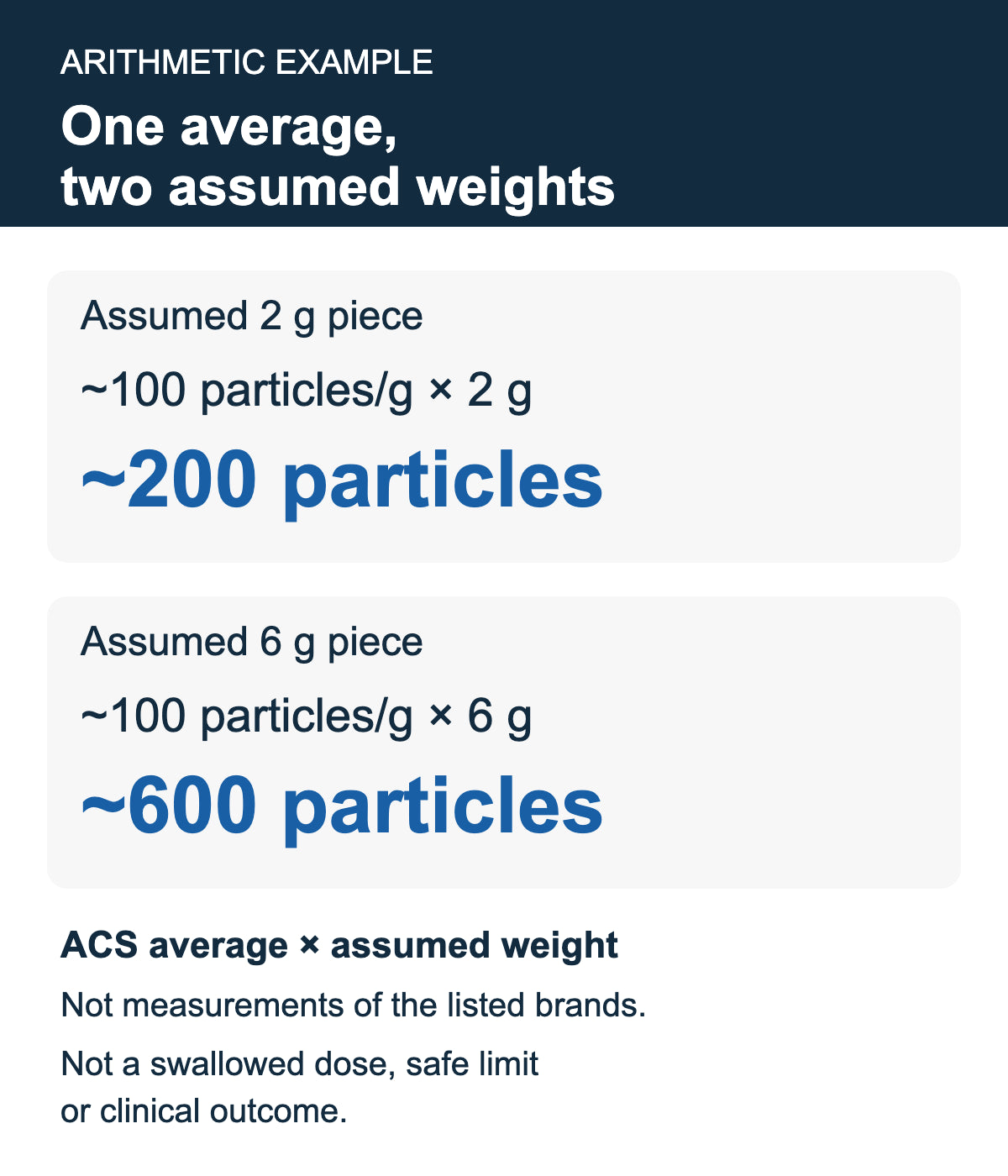
Our illustration multiplies ACS's approximate average of one hundred particles per gram by two different assumed weights. A two-gram assumption gives about two hundred particles. Applying that same reported average to a six-gram assumption gives about six hundred particles, without measuring a second product. [2]
Formula: particles/piece = average particles/gram × assumed grams/piece.
A useful way to compare release reports
When evaluating two reports, first record their product identities, collection periods, reporting units and measurement methods before comparing their headline particle counts. Converting from per-gram to per-piece needs the relevant piece weight.
An average summarizes the measured samples, whereas a maximum describes their highest result.
Replacing the average in our illustration with a sample maximum changes the calculation, even if the assumed piece weight stays the same.
A larger count needn't imply greater harm. Counts alone aren't clinical outcomes.
What remains useful when shopping
A formulation declaration and a finished-gum release test answer different shopping questions. Ask for the right document. If zero release determines your choice, request a relevant finished-gum test that identifies the product and measurement conditions. Chicle's presence isn't a finished-gum release measurement.
The EU restriction's food and food-additive exemptions address its legal scope, rather than certifying that gum releases no particles. [9]
Environmental claims need evidence about the finished product. A plant-derived base doesn't establish a decomposition time, a forest benefit or permission to discard gum outdoors.
The American Dental Association (ADA) discusses saliva stimulation from sugar-free chewing as an adjunct to fluoride brushing and cleaning between teeth. That guidance doesn't compare dental outcomes across these base materials. Keep your clinical question separate from your formulation preference. [3]
How Enamio works: read the base and the formula separately
Enamio's product information names chicle and describes its base as plastic-free, alongside a formula containing xylitol and nano-hydroxyapatite. [8] The manufacturer statement identifies ingredients, rather than a release-test result. For a particle-release question, ask for a test identifying the finished gum, sampled batch, chewing conditions and measured particles. [8]
A manufacturer declaration is the seller's own description of a product, rather than an independently measured release result. Record both the selected product's identity and your reading date. A selected-product statement may identify ingredients, while a general brand statement may leave the flavor or market unclear. Save a general statement as general.
The retained 2026-10-17 FAQ describes chicle, candelilla wax and citric acid within its gum-base entry. [11]
Compare the FAQ's base entry with the complete finished ingredient list, because an ingredient restriction may concern components elsewhere in the gum. They cover different parts of the formula. Send any disagreement to the maker with the selected package information. [11]
Which ingredients sit alongside Enamio's nano-hydroxyapatite?
The retained FAQ also names xylitol, monk fruit, calcium glycerophosphate and magnesium citrate. [11] Our ingredient guide discusses the declared formula. Use the package you selected for restrictions, since the editorial guide is not an authenticated current label.
The nano-hydroxyapatite ingredient name identifies a declared material, without stating how much mineral a piece delivers during chewing.
Twenty nanometers describes the seller's size claim for nano-hydroxyapatite particles. [8]
For the twenty-nanometer claim, ask which object was measured: the supplied ingredient, a powder sample or material released from the gum. Those samples answer different questions. Our particle specification guide explains why the sample, measurement method and size statistic belong together.
Our hydroxyapatite formulation comparison explains those distinct product fields. That guide compares declared fields, rather than ranking clinical outcomes. Safety or effectiveness findings from toothpaste and mouthwash can't establish the corresponding result for a different chewing-gum formula.
Ask for the document that answers your question
We inspected selected 2026-10-19 product passages and retained 2026-10-17 expanded texts. We haven't authenticated a current purchased pouch or independently verified a finished-gum particle-release report from those materials.
Our reading can't rule out additional testing records elsewhere.
Ask for the mass of nano-hydroxyapatite per piece in the selected formula, with the ingredient name and unit stated together. That is a formulation quantity. A powder certificate, a declared formulation amount and a chewing-release result describe different measurements, so one record cannot substitute for the other two.
The FAQ's approximate one-gram xylitol amount isn't a nano-hydroxyapatite quantity. [11]
Keep general chewing evidence separate
Dawes and Macpherson sampled salivary flow in twenty-four young adults using several gums, gum base and lozenges. [4]
The observations ran for twenty minutes under separate conditions. This was a flow-rate study, rather than a clinical comparison of Enamio with another gum. Measurements of salivary flow do not quantify how much mineral this different formula releases from a piece during chewing. [4]
A 2015 Cochrane review, searching through August 2014, found low-quality evidence for xylitol-containing fluoride toothpaste in children's permanent teeth, with important study limitations. [5]
Evidence for the other products was low or very low quality. The available evidence left the review unable to determine whether those other xylitol products prevented decay in the studied populations. That is different from proving every xylitol gum lacks an effect. Keep saliva guidance separate from xylitol-specific prevention evidence. [5]
Which daily direction applies?
The retained 2026-10-17 product page says one to two pieces daily, while the separately retained FAQ says one to three. [8][11]
To resolve the conflict, send Enamio the full selected product name and both retained directions. Ask which applies to your pouch. Save the answer instead of calculating a new daily count from incompatible seller instructions.
These are manufacturer directions, not a prescription for a dental condition.
A toothpaste study's application schedule does not establish how many pieces of a different gum to chew, or a therapeutic chewing dose. Follow your dentist's care instructions for your situation.
See Enamio's declared ingredients and directions
Compare ingredients and directions before buying. This is commercial product information, without an independently conducted release test in the materials inspected here.
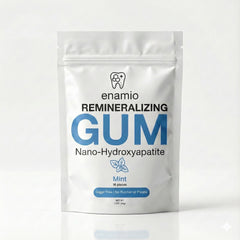
View Enamio product informationThe Mint photograph identifies the displayed pouch, rather than every flavor or its complete ingredient panel. Check all package restrictions before deciding whether to buy.
The brand's cavity-prevention product page describes a sales proposition, rather than serving as independent clinical evidence. Its breath product page is another seller presentation. Neither linked page serves as independent evidence that choosing a plastic-free base improves teeth or breath.
How to choose a plastic-free gum
Choose by the question you need answered: base composition, ingredient restriction or dental care. For a formulation preference, match the complete base statement to the selected flavor and market before comparing directions or deciding whether to buy. Save the reply beside the package information used for your comparison.
Start with the question you need answered
For a base preference, record the named material and the manufacturer's statement about the full base. Do both identify the same product? If the label says only gum base, US rules can't identify which materials the maker selected. [1]
For an ingredient restriction, use the complete ingredient declaration, including entries outside the base. If the selected package and website disagree, send both wordings to the maker and ask which applies to that flavor and market.
For a dental concern, begin with your dental professional's advice. Our sensitivity product page describes Enamio's sales positioning, while persistent pain needs assessment rather than a shopping quiz.
What about titanium dioxide in gum?
Titanium dioxide, also called TiO2 or E171, is a white color additive. A plastic-free base claim does not tell you whether the finished gum contains this color. [24] [26]
In the United States, the food-color regulation still permits titanium dioxide under specified conditions, including a limit of one percent of the food's weight. That is a regulatory limit, not the measured amount in a particular gum. The FDA says it is reviewing a petition to end this authorization. [25] [24]
The European Union withdrew its food-additive authorization in 2022. This followed EFSA's 2021 conclusion that concerns about genotoxicity, or potential damage to genetic material, could not be ruled out. EFSA could not establish an acceptable daily intake. [27] [26]
That assessment differs from the gum microplastics findings discussed above. It does not show that those tested gums caused disease.
If you prefer to avoid titanium dioxide, check ingredient and color information for the selected flavor and market. Ask the manufacturer if it is unclear. Keep its answer separate from the gum-base declaration.
Keep chewing directions attached to their source
The ADA discusses chewing sugar-free gum for twenty minutes after meals as an adjunct to home care, rather than replacing brushing or cleaning between teeth. [3] This is category guidance, not an Enamio-specific dose or outcome. It does not resolve Enamio's conflicting seller piece counts or establish a therapeutic dose for a particular gum formula.
The maker needs to resolve its conflicting piece counts for the selected pouch. Don't calculate a new daily count by averaging those instructions. If braces, aligners or recent dental work affect chewing, your dental professional's instructions take priority over a general routine.
Keep xylitol gum away from dogs, because suspected ingestion calls for prompt veterinary, emergency-clinic or animal poison-control advice without waiting for symptoms. [6]
Store the pouch where dogs cannot reach it, including after opening. A plastic-free base declaration does not change that ingredient-specific warning.
Explore Enamio product choices
Enamio's quiz connects stated concerns with the brand's product positioning, rather than diagnosing a condition or promising a dental result. Use it as a shopping tool. Compare any suggestion with the selected product's complete information and your professional advice.
Explore product choicesA gum-base preference and the way you dispose of the finished product are separate decisions. Wrap used gum for the trash. A plastic-free base declaration doesn't justify littering or flushing the finished gum, or establish that outdoor disposal is harmless.
Do
Keep the selected package and the maker's dated reply together for your comparison.
Don't
Turn conflicting seller directions into a new daily prescription.
Plastic free gum brands compared by disclosure
This eleven-row comparison records the disclosures in the inspected manufacturer sources, with nine readable sets of declarations and two unresolved entries. It ranks no clinical outcomes. A generic base entry, a specific material and an explicit full-base declaration provide different information. Match each row to its stated product and scope.
On narrow screens, swipe inside the table or focus its region and use the arrow keys.
Eleven manufacturer-source records, compared by disclosure.
| Selected product or source | Base disclosure | Sweetener disclosure | Source reading |
|---|---|---|---|
| Enamio product page and FAQ | Chicle named. Maker describes plastic-free base. | Xylitol and monk fruit. | [8][11] October 17/19, 2026 |
| Simply Gum Sugar Free Peppermint | Chicle, candelilla wax and citric acid. Maker states no plastic. | Xylitol. | [13] October 19, 2026 |
| True Gum general brand page | Tree-sap base. Maker states plastic-free. | Sugar-free stated, specific sweeteners unresolved here. | [14] October 19, 2026 |
| Underbrush Mastic Mint | Chicle, candelilla wax and citric acid. Maker states no plastics. | Xylitol and erythritol. | [15] October 19, 2026 |
| Refresh Peppermint and Ingredients page | Chicle named. General ingredient page states no synthetic plastic. | Xylitol and stevia leaf extract. | [20] [23] October 19, 2026 |
| PUR Peppermint and FAQ | Generic gum-base entry. FAQ describes synthetic ingredients and no chicle. | Xylitol. | [16] [21] October 19, 2026 |
| Spry 100-count Natural Peppermint | Generic gum-base entry, complete composition unresolved here. | Xylitol. | [17] October 19, 2026 |
| Zellie's Peppermint and base document | Natural and food-grade polymers and waxes. Maker says no chicle. | Xylitol. | [18] [22] October 19, 2026 |
| Orbit Spearmint, Mars Foodservices | Generic gum-base entry, complete composition unresolved here. | Multiple sweeteners listed. Read the complete selected declaration. | [19] October 19, 2026 |
| Glee Gum | Full current base unresolved from the accessed official page. | Current selected formula unresolved. | Own official-page check October 19, 2026 |
| Trident | Accessed official pages did not expose a usable product formula. | Current selected formula unresolved. | Own official-page check October 19, 2026 |
Unresolved is not a plastic-content finding. Use the exact product and its current package to pursue any missing detail.
Does PUR gum have plastic?
PUR says its proprietary base uses synthetic ingredients and no natural chicle, while its Peppermint ingredient list says gum base. The FAQ doesn't name each polymer. It also asserts no microplastics, but this review has not independently verified that assertion with a relevant finished-product report. Ask for that report if measured release determines your choice. [16] [21]
Does Zellie's gum have plastic?
Zellie's describes natural and food-grade polymers and waxes, while its linked gum-base document says no natural chicle. Their general polymer wording does not identify every individual polymer by name. The separate Peppermint gum declaration lists xylitol and gum base, so it still does not supply a complete base recipe or a particle-release measurement. Match those records to the selected pouch. [18] [22]
Does Orbit gum have plastic?
Mars's inspected Spearmint page lists gum base, leaving the full composition unresolved in this comparison. The US regulation lists materials manufacturers may use, without identifying which of those permitted ingredients this particular Orbit recipe contains. Displayed packs cannot authenticate every other flavor or market. Ask Mars for the base formulation matching your selected pack. [19][1]
People also ask
These answers separate base declarations, particle measurements and dental outcomes so you can find the record relevant to your question. They use inspected manufacturer statements and the historical ten-gum pilot. A product-specific clinical or safety question still needs evidence beyond a general base description, with professional advice for personal suitability.
Does chewing gum contain plastic?
US rules permit synthetic base materials including polyethylene and polyvinyl acetate, as well as natural materials such as chicle. That doesn't identify your gum's recipe. Read the selected product's full-base declaration rather than guessing which permitted ingredients the maker chose. [1]
Which big gum brands use plastic in the base?
PUR's FAQ describes synthetic base ingredients, whereas Orbit's inspected Spearmint record uses gum base. Trident's accessed official pages supplied no usable formula for the selected product, so this comparison leaves its base unresolved rather than borrowing another brand's recipe. Identify the selected flavor and market when asking about its formulation. [21][19]
What gum is plastic free?
Enamio, Simply Gum, Underbrush and Refresh describe plastic free gum bases in the selected manufacturer records compared here. True's wording concerns the general brand, without identifying a selected flavor's sweeteners. These are attributed formulation declarations, without independent particle-release findings in the statements reviewed here. Confirm which declaration applies to your chosen pouch. [8][13][14][15][20]
Is sugar-free gum the same as plastic-free gum?
Sugar-free describes the sweetener side of a gum, while plastic-free addresses a formulation claim about its base. Neither phrase supplies the complete recipe. ADA discusses sugar-free gums using several sweeteners, while US base rules permit natural and synthetic materials. Read both declarations and the remaining ingredients when a restriction affects your choice. [3][1]
Does chewing gum release microplastics?
ACS reported particles in saliva from ten tested gums in the 2025 UCLA pilot, averaging about one hundred particles per gram. One person chewed seven pieces of each gum for repeated sampling. A later journal publication exists, but the findings do not measure absorption, establish clinical harm or identify release from every current product. Check the sample identity and method before applying it. [2][10]
Can a plastic-free base release particles?
A plastic free gum declaration doesn't guarantee zero particle release, because the pilot's natural and synthetic groups had similar measured counts. Those findings concern the tested samples and their collection conditions. ACS leaves the brands unnamed, while the thesis identifies historical products rather than authenticating today's selected formula. For measured release, request a relevant finished-gum test. [2][12]
What is gum base made of?
Gum base can use the natural and synthetic materials permitted by US rules, alongside other allowed ingredients. Chicle names a listed natural material, but its presence does not identify every other component of a finished base. Ask which formulation covers your flavor and package. [1]
How can I tell if my gum has plastic?
Start with a named base material, then look for an explicit manufacturer statement covering the complete base of your selected flavor and market. For generic gum-base wording, ask which materials it represents. Send both statements to the maker when package and website descriptions of the same product conflict. Identify the exact flavor, market and package. [1]
Is natural gum better for the environment?
A chicle declaration identifies a plant-derived material, without measuring a gum's decomposition time, packaging footprint or forest impact. The EU food and additive exemptions address legal scope, rather than certifying an environmental advantage for these brands. Wrap discarded gum and bin it responsibly. [1][9]
Which gum should I choose for teeth?
A declared plastic-free base can match an ingredient preference, but it cannot rank dental outcomes. ADA describes sugar-free chewing's saliva role alongside fluoride brushing and cleaning between teeth, rather than an Enamio-specific advantage. Ask your dentist how existing restrictions or symptoms affect your choices. [3][8]
Why did natural gum shed as much microplastic as synthetic gum?
The similar measured counts do not identify why the groups were similar or which gum component supplied the particles. The thesis calls the potential source unknown. ACS reports the researchers' abrasion explanation, which does not establish one universal mechanism for all natural and synthetic gums. Avoid assigning that cause to your selected product without relevant evidence. [2][12]
Is Enamio gum plastic free?
Enamio describes its chicle-based gum as plastic-free, a statement about the manufacturer's formulation rather than particles measured during chewing of a finished product. The pilot doesn't measure your current pouch. If measured release determines your choice, request a relevant test of that finished product. [8][2]
FAQs
The inspected sources address base materials, general chewing guidance and selected product declarations, without establishing every finished gum's safety or a clinical advantage. For personal suitability, consider the complete formula and professional advice. Plant ingredients alone cannot settle that question.
Is swallowed gum dangerous?
Nemours says an occasional swallowed piece usually passes through, while a large mass or repeated swallowing can rarely cause blockage. Young children need particular caution about those swallowing patterns. That account of gum passage does not settle microscopic-particle behavior, remove choking risks or certify an Enamio formula. Seek medical advice about symptoms or concerning ingestion. [7]
Is xylitol gum safe?
A xylitol ingredient listing doesn't establish whether the complete gum suits you, so check all restrictions and directions. The US Food and Drug Administration (FDA) advises immediate veterinary, emergency-clinic or animal poison-control contact if a dog may have eaten xylitol. Keep gum inaccessible to dogs, including open pouches. Don't wait for symptoms after suspected ingestion. [6]
Is chicle gum really plastic free?
Chicle is a listed natural material, but naming it doesn't identify every other ingredient in the finished base. Ask what the whole base contains. A declaration describes formulation, while a release test measures particles collected under stated chewing conditions. [1]
Is plastic-free gum better for your teeth?
A plastic-free base declaration does not establish that a gum produces a better dental outcome. ADA's guidance concerns sugar-free chewing and saliva. Enamio's declared ingredients do not demonstrate a superior clinical result against the other products compared here. Keep fluoride brushing, cleaning between teeth and professional care in place when deciding whether gum fits your routine. [3][8]
Is nano-hydroxyapatite safe in gum?
The inspected Enamio records describe ingredients but do not verify a finished-gum safety assessment, or quantify mineral exposure from swallowing the selected gum. Ingredient identity cannot supply those missing exposure or outcome measurements. These materials also do not verify its per-piece nano-hydroxyapatite amount or a product-matched particle-size report, without proving those documents never exist. Our nano-hydroxyapatite safety guide addresses the separate material questions. [8][11]
Can kids use nano-hydroxyapatite gum?
The inspected materials do not establish a child-specific finished-gum safety assessment for Enamio, and chewing readiness cannot replace that assessment. Research in another format cannot supply it either. Ask your child's dentist about suitability and uncertain swallowing or chewing readiness before choosing a gum. Our children's gum guide separates those readiness and evidence questions. [8][11]
Is remineralizing gum legit?
ADA describes a saliva-related role for sugar-free chewing, but that mechanism does not establish an Enamio-specific clinical remineralization result. The inspected product information does not verify that result here, and this guide does not recommend gum to treat a formed cavity. For suspected decay, seek dental assessment and use our evidence guide. [3][8]
References
These references identify regulation, general guidance, research and manufacturer records, each of which answers a different kind of question. Access dates aren't testing dates. Read each scope note before treating a cited ingredient declaration or inspected abstract as evidence about a finished gum's clinical performance.
-
Electronic Code of Federal Regulations.
21 CFR § 172.615 - Chewing gum base.
Whole section read October 19, 2026. Display current through October 15, 2026.
-
American Chemical Society.
Chewing gum can shed microplastics into saliva, pilot study finds.
Published March 25, 2025. Announcement read October 19, 2026.
-
American Dental Association.
Chewing Gum.
Last updated May 4, 2023. Retained main, references and disclaimer read October 19, 2026.
-
Dawes C, Macpherson LM.
Effects of nine different chewing-gums and lozenges on salivary flow rate and pH.
Caries Research. 1992,26(3):176-182. DOI 10.1159/000261439. PubMed abstract and metadata read October 19, 2026.
-
Riley P, Moore D, Ahmed F, Sharif MO, Worthington HV.
Xylitol-containing products for preventing dental caries in children and adults.
Cochrane Database of Systematic Reviews. 2015,3:CD010743. DOI 10.1002/14651858.CD010743.pub2. Retained public summary and abstract read October 19, 2026.
-
US Food and Drug Administration.
Paws Off Xylitol; It's Dangerous for Dogs.
Consumer warning read October 19, 2026.
-
Nemours KidsHealth.
What Happens to Swallowed Gum?
Consumer information read October 19, 2026.
-
Enamio.
Enamio Remineralizing Gum with Nano-Hydroxyapatite.
Selected manufacturer passages read October 19, 2026, with expanded product text retained from October 17, 2026.
-
European Commission, EUR-Lex.
Commission Regulation (EU) 2023/2055 of 25 September 2023 amending Annex XVII to Regulation (EC) No 1907/2006 of the European Parliament and of the Council concerning the Registration, Evaluation, Authorisation and Restriction of Chemicals (REACH) as regards synthetic polymer microparticles (Text with EEA relevance).
2023. Official returned food and food-additive exemption clauses inspected October 19, 2026. Full consolidated text not assessed.
-
Lowe L, Leonard J, Mohanty SK.
Ingestion of microplastics during chewing gum consumption.
Journal of Hazardous Materials Letters. 2025,6:100164. DOI 10.1016/j.hazl.2025.100164. Publisher-indexed abstract and highlights inspected October 19, 2026.
Full journal methods and supplements unread.
-
Enamio.
FAQ | Enamio Remineralizing Gum with Nano Hydroxyapatite.
Expanded manufacturer FAQ text retained from October 17, 2026.
-
Lowe L.
Ingestion Risk of Microplastics from Chewing Gum.
UCLA master's thesis. 2025. Entire extracted text read October 19, 2026. Native figures not inspected.
-
Simply Gum.
SUGAR FREE PEPPERMINT GUM.
Selected manufacturer product declaration inspected October 19, 2026.
-
True Co.
Plastic-Free, Vegan Chewing Gum.
General manufacturer brand-page declaration inspected October 19, 2026.
-
Nathan & Sons.
Underbrush Remineralizing Gum.
Selected Mastic Mint context and manufacturer ingredient/policy passages inspected October 19, 2026.
-
The PUR Company.
Peppermint.
Manufacturer product declaration read October 19, 2026. Publication date not displayed.
-
Xlear.
100ct Xylitol Gum.
Natural Peppermint ingredient declaration within the multi-flavor manufacturer page read October 19, 2026.
-
Zellie's.
Zellie's Xylitol Mint and Gum Ingredients.
Manufacturer ingredient record updated October 7, 2026. Read October 19, 2026, distinguishing Peppermint gum from mint ingredients.
-
Mars Foodservices.
ORBIT® SPEARMINT Gum.
Manufacturer Spearmint product page read October 19, 2026. Displayed pack descriptions and ingredient line do not authenticate every package or market.
-
Refresh Gum.
Ingredients.
General manufacturer ingredient record read October 19, 2026. Publication date not displayed.
-
The PUR Company.
FAQs.
General manufacturer gum-base and microplastics assertions read October 19, 2026. Publication date not displayed. Assertions are not independently verified release measurements.
-
Zellie's.
Zellie's Xylitol Gum Base.
Manufacturer base record updated January 13, 2026. Read October 19, 2026. General declarations do not identify every polymer or authenticate a current pouch.
-
Refresh Gum.
PEPPERMINT.
Selected manufacturer product ingredient record read October 19, 2026. Publication date not displayed. This record is distinct from the general Ingredients page.
-
US Food and Drug Administration.
Titanium Dioxide as a Color Additive in Foods.
Main text, Regulatory Approach and Safety sections read November 6, 2026. Read source.
-
Electronic Code of Federal Regulations.
21 CFR § 73.575 - Titanium dioxide.
Whole section read November 6, 2026. Display current through November 4, 2026. Read source.
-
European Food Safety Authority.
Titanium dioxide: E171 no longer considered safe when used as a food additive.
Published May 6, 2021. Assessment announcement and FAQ read November 6, 2026. Its historical authorization wording predates the 2022 EU withdrawal. Read source.
-
European Commission.
Re-evaluation: Questions & Answers on titanium dioxide.
Relevant Q&A on the 2022 withdrawal and transitional provisions read November 6, 2026. Read source.
Enamio publishes this commercial guide. Manufacturer declarations are attributed rather than independently certified. Source access dates identify the inspected records, while product and research collection dates have their own meanings.
Compare the pouch before choosing
Enamio's declared plastic-free chicle base addresses a formulation preference, while its sweetener and mineral listings describe other ingredients. [8] Use the product information to compare the selected formula and resolve conflicting directions, without treating the declaration as a zero-release or dental-outcome promise.
Enamio product information
Compare available flavors and packs before reading your selected option's information. The Mint image identifies the displayed pouch.
Explore plastic free gum product informationWhere to go from here
New to the category
What remineralizing gum is
Read the category definition first.
If breath is the goal
Gum for breath and teeth
Read this Enamio commercial guide separately from the particle findings here, without treating its product positioning as independent clinical evidence.
If hot and cold bother you
Gum labels and sensitivity
For sensitivity questions, separate a gum's ingredient list from outcome evidence and prepare questions for a dental professional.
Need the selected formula and current options? See Enamio flavors and packs on the product page.
Educational only. Not medical advice. Ask your dentist about pain, active decay, pregnancy, allergies, or new dental work.