

Can Nano-Hydroxyapatite Help Gum Recession?
Share
The short answer to the hydroxyapatite gum recession question is no. Recession is lost gum tissue and attachment, while hydroxyapatite research mainly concerns hard tooth surfaces such as enamel and exposed root dentin.
- Gum recession is loss of gingival tissue and periodontal attachment around a tooth.
- No cited source shows a mineral, including hydroxyapatite or fluoride, regrowing missing gum tissue.
- Hydroxyapatite toothpaste has been studied for exposed-root dentin sensitivity, not gingival growth or Enamio chewing gum outcomes in the cited human research. [4] [5]
“Nano hydroxyapatite gum” means two things. It can describe chewing gum containing the mineral, or the gingival tissue around teeth.
Those meanings can't share one answer, because a chewing format changes how an ingredient reaches the mouth while recession needs a dental diagnosis and tissue-focused care.
Mineral changes in enamel and dentin are a separate topic, which our tooth remineralization guide explains.
We started from the original record of each cited study. For each one we recorded the tested product format, the comparison group, the follow-up period, and the measured outcome.
That method stops a toothpaste sensitivity result from becoming a chewing-gum or gingival claim. It flags promising but incomplete evidence. The article separates three decisions and keeps them in a deliberate order. First identify the cause, then manage symptoms, and finally decide whether an optional chewing product fits your routine.
Professional organizations guide the sections on recession, warning signs, and referral. Randomized trials and systematic reviews guide the narrow discussion of dentin sensitivity.
Every citation was checked against its title, PMID, DOI, and abstract details, and the reference list lets you inspect the same records yourself.
Product descriptions here come from Enamio's public product page and FAQ, which we reread on October 27, 2026. Missing-data statements refer only to those two pages, not to unpublished company records.
Two people can have similar-looking root exposure for different reasons. One may have thin gum tissue, while the other has plaque-induced inflammation, and a recession review lists both among the factors involved. [9]
Both may still describe the same cold sensitivity to their dentist. Their plans can still differ once pockets, bleeding, mobility, root condition, and radiographs are checked.
This guide can explain evidence boundaries and common options, but it can't classify your recession, estimate graft coverage, or rule out decay from a description.
Use it to prepare better questions before your next dental appointment. Bring those questions to a dentist or periodontist who can examine the exact site.
1. What gum recession changes

Healthy gum and bone should fit snugly around each tooth, the AAP says, like a turtleneck around your neck. [2] Recession is the gum margin moving toward the root, which exposes root surface. [11] It's common, with reported prevalence from 40 to 100 percent depending on the population and method. [9]
That exposed area isn't enamel. Under the gumline, cementum covers the tooth root, with dentin underneath. Its microscopic tubules can let heat, cold, or acidic and sticky foods reach the tooth's nerves. [7]
Recession can involve more than the gum you can see. Imber and Kasaj associate it with loss of periodontal tissues, including gingiva, periodontal ligament, root cementum, and bone. [9]
Why did your gum recede? Sensitivity alone can't tell you. Their review names plaque-induced inflammation and brushing trauma as the most important causes. [9]
Their modifiable conditions add plaque buildup, periodontal disease, an unusual frenum position, traumatic hygiene habits, restoration edges below the gum, smoking, and systemic conditions such as diabetes. [9]
Periodontitis deserves its own check. The American Dental Association describes it as inflammatory disease that causes loss of periodontal attachment and alveolar bone. [1] Its signs can include deep pockets, bleeding on probing, recession, and tooth mobility. [1]
The AAP calls gum disease often silent, meaning symptoms may not appear until its advanced stages, so feeling fine isn't proof of healthy gums. [3]
Its warning signs include red, swollen, or tender gums, bleeding, receding gums, pus, loose teeth, persistent bad breath, and bite changes. [3] Those signs deserve a professional visit rather than weeks of home monitoring.
Exposed roots bring their own problems. Imber and Kasaj link root exposure with sensitivity, root decay, non-decay notches near the gumline, harder plaque control, and appearance concerns. [9] Those notches change how a dentist plans treatment for the site. For such lesions, the review says a combined restorative and surgical approach can give favorable results.
An examination sorts this out, separating cosmetic concerns from disease. A clinician can also check tissue thickness by placing a probe in the gum and seeing whether it shows through. [9] The visit also identifies whether sensitivity comes from recession, decay, a crack, or another problem.
No mineral ingredient can answer that diagnostic question, so start with the tissue problem and choose care that matches what the examination finds at that site.
Instead of asking whether one ingredient “works,” ask which tissue needs help, which outcome matters to you, and which format has human evidence behind it.
If you are shopping for an optional chewing product, the Enamio product page lists current options. These are shopping details, not evidence that the gum treats recession.
2. What hydroxyapatite gum recession evidence actually shows
Start with the mineral itself. Enamel is made almost entirely of an inorganic mineral called apatite, and the 2023 review cited below studies hydroxyapatite as a biomimetic oral-care ingredient. [12] That makes it relevant to hard tooth surfaces such as enamel and dentin, but it doesn't turn it into gum tissue.
The distinction matters most when a search result says a product “helps gums” without naming a tissue. A dentin sensitivity outcome and a gingival tissue outcome are different endpoints.
Human studies measured sensitivity, not gum regrowth
Consider a 2020 network meta-analysis. It included 125 randomized trials and 12,541 patients and compared toothpaste formulations for dentin hypersensitivity. [4]
Compared with fluoride toothpaste, the potassium plus hydroxyapatite category showed large benefits for tactile and air stimuli. The outcome was sensitivity. Recession depth and gum growth were not among the outcomes tested there.
A 2019 systematic review and meta-analysis pooled six randomized trials with four-week follow-up, covering both at-home and in-office nano-hydroxyapatite desensitizing treatments. Results favored nano-hydroxyapatite for evaporative and tactile sensitivity, but not cold sensitivity. [5]
The authors called for long-term trials, and a four-week response alone can't establish tissue or long-term disease outcomes.
One double-blind randomized trial assigned 105 people, with 35 per arm, to three gel toothpaste groups. These contained two-percent nano-hydroxyapatite without fluoride, fluoride, or placebo. [6]
Participants applied the assigned toothpaste for ten minutes twice daily, and researchers assessed air and tactile sensitivity plus a visual analogue scale after two and four weeks.
That protocol can't be relabeled as chewing-gum evidence after the fact. Contact time, concentration, formulation, and study controls all differ from chewing gum.
A 2023 systematic review gathered 44 human trials of hydroxyapatite oral-care products for dentin hypersensitivity, and most at-home products in it were toothpaste. [12]
One listed trial did use chewing gum. In that 2014 study, 100 adults completed a two-week comparison of active gum containing calcium hydroxyapatite plus dicalcium phosphate dihydrate against placebo gum. [12] The review assigned that single trial a low GRADE evidence rating. It measured sensitivity, not gum tissue, and its formula differs from the actives Enamio lists.
The review's conflict-of-interest statement says that two of its authors are employees of a company in Germany. Read the methods with that disclosure in mind. [12]
Across the cited studies, the endpoint is a response to air, touch, cold, or a sensitivity score. None of them reports a higher gum margin after chewing Enamio.
Why the delivery format matters
Toothpaste, professionally applied treatments, and chewing gum are different formats. Each trial tested a specific product under a specific protocol, such as ten minutes of gel twice daily. [6] An ingredient name alone doesn't reveal the delivered dose or exposure time.
Evidence moves in steps. Material-level plausibility comes first, then a finished-format study, then a controlled product study that measures the outcome readers care about. The Enamio product page and FAQ we reviewed on October 27, 2026 cite no Enamio clinical recession study.
Study averages also don't predict one person’s result. Even within one review, the answer changed with the stimulus tested. [5]
Blinding matters too. The 2023 review lowered the grade of some trials that claimed blinding without explaining how it was done. [12]
These toothpaste studies assessed sensitivity, so ask your dentist whether that outcome matters for your exposed root. Hydroxyapatite toothpaste is worth discussing, but it isn't evidence of gingival replacement. That matches the anatomy. Blocking a dentin tubule changes a hard surface, while root coverage changes living gum tissue.
| Question | What the evidence can answer | What it cannot answer |
|---|---|---|
| Can a hydroxyapatite toothpaste ease exposed-dentin sensitivity? | Several controlled toothpaste studies report reduced tactile or air sensitivity. | They do not show replacement of lost gingival tissue. |
| Does that prove a chewing gum has the same effect? | It supports a tooth-surface mechanism worth studying by format. | It does not establish dose, exposure, or outcomes for chewing gum. |
| Can hydroxyapatite grow missing gingiva? | No cited human trial tested or showed that outcome. | Tooth mineral findings cannot be transferred to soft tissue. |
Sensitivity is only one part of the exposed-root problem
Under the hydrodynamic theory, fluid movement in exposed tubules triggers pain. Desensitizing products work by blocking tubules or quieting the nerve response, depending on their ingredients, Imber and Kasaj explain. [9]
A lower sensitivity score doesn't show a higher gum margin, and it doesn't rule out decay, a fractured tooth, or gum disease. [7]
Desensitizing toothpaste is one possible option. The ADA notes fluoride gel, bonding, gum grafting, or root-canal care can be appropriate, depending on what causes the sensitivity. [7] Persistent sensitivity needs a dental examination.
Exposed roots also change the decay conversation
The National Institute of Dental and Craniofacial Research explains that receding gums let decay-causing bacteria reach the tooth's root. With receding gums, older adults can get decay on exposed root surfaces. [8]
Fluoride enters here. A 2017 review found daily fluoride toothpaste can control root caries at the population level. Active decay may be inactivated with professional fluoride or high-fluoride toothpaste, and lesions a patient can't clean may need restoring. [10]
That's why “remineralization” must name the surface. NIDCR says early decay can be stopped or reversed with minerals from saliva and fluoride, while missing gingiva is a different problem. [8]
Acid wear from food and drink is yet another surface problem, covered in our enamel erosion guide.
A product that changes comfort can still leave disease risk unchanged. Less pain isn't proof that a root lesion or periodontal problem has resolved.
Root care depends on the lesion, and our cavity remineralization explainer covers when a lesion needs dental care. [8] [10]
3. Where Enamio fits, and where it does not
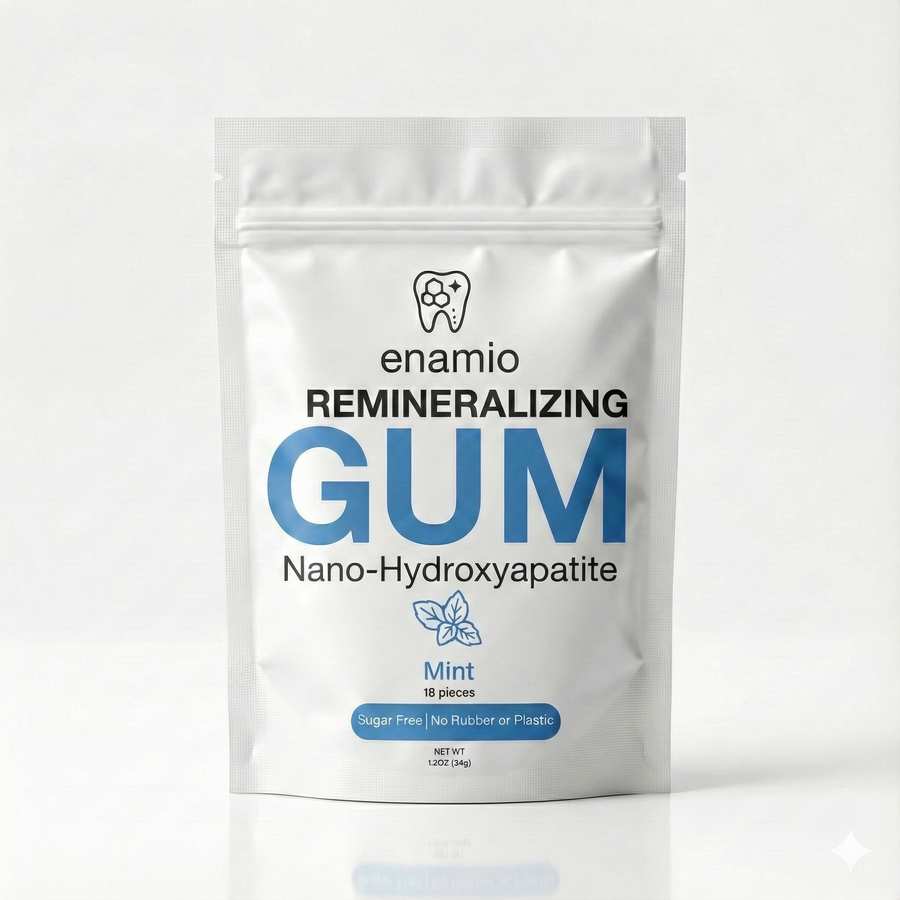
Now to Enamio itself. Enamio is a chewing gum containing nano-hydroxyapatite, so its delivery format differs from every toothpaste trial above.
We treat it as one optional part of a tooth-focused routine. It shouldn't be described as a replacement for periodontal diagnosis, grafting, or other professional care.
Enamio describes its nano-hydroxyapatite as 20 nm. That is a manufacturer statement, not an independent particle-size certificate. Our nano versus non-nano comparison explains what a size number does and doesn't measure.
The public product page and FAQ we reviewed on October 27, 2026 don't list nano-hydroxyapatite milligrams per piece or link a certificate of analysis. Neither page supplies an independent particle-size certificate or names a dental reviewer.
The FAQ does give a xylitol amount, about 1 g per piece, but that is a different ingredient.
Those missing details limit what anyone can conclude about this specific product. They don't prove that all chewing-gum formats fail, and they don't permit borrowing outcomes from toothpaste trials. The label can identify ingredients, but the reviewed product page and FAQ don't establish a measured Enamio recession outcome.
The two pages also give different directions. The product page says one to two pieces daily, while the FAQ says one to three. Follow the directions on your pouch, and ask Enamio to clarify if the package differs from both pages.
Our chewing-time guide separates a study's chewing schedule from package directions.
A particle size is a material detail, not proof of delivery, persistence, or symptom change.
Chewing changes saliva, not the diagnosis
Chewing gum increases saliva flow. That extra saliva helps dilute and neutralize acids, and it carries calcium and phosphate that can contribute to enamel remineralization. [13]
That general chewing response isn't evidence that a specific gum moves the gingival margin or restores lost attachment.
Is gum suitable for you right now? Jaw pain, dental work, braces, or a tender tooth may make any gum a poor choice until a clinician gives you specific guidance.
Saliva benefits belong to chewing sugar-free gum in general. They shouldn't be presented as proof that nano-hydroxyapatite reached an exposed root at an effective amount. A gum may be handy after meals when brushing isn't possible, but convenience isn't therapy.
Comparing formats? See our guide to hydroxyapatite chewing gum brands before you choose one.
For a broader evidence audit, read is remineralizing gum legit, and for ingredient safety questions, use the dedicated nano-hydroxyapatite gum safety guide.
A narrow, honest product role
A sensible role is an optional chewing step within ordinary oral hygiene. The product page should be read as product information, not recession evidence.
Review the Enamio remineralizing gum details for the format, and let a dentist assess recession or root pain.
For the toothpaste side, our hydroxyapatite versus fluoride guide compares the evidence for both minerals.
This boundary protects readers from a common mistake. Evidence for one material, surface, and delivery method doesn't automatically validate another finished product.
Use a simple three-part check before buying any oral-care product. Identify the promised outcome, find the tested format, and check whether a published study measured that outcome.
For recession, a gum-tissue outcome would need periodontal measurements over time, and sensitivity scores or laboratory mineral images can't substitute for them. For exposed dentin, toothpaste evidence can inform a dentist’s product discussion. It still can't establish what a different chewing formulation does at the tooth surface.
That leaves Enamio optional and tooth-focused, while your periodontal plan remains whatever a dental examination of that site supports.
Questions to ask before relying on a product claim
Ask whether the claim concerns enamel, dentin, cementum, saliva, plaque, or gingiva. A broad phrase such as “oral health” can hide that distinction, so pin down the tissue before you weigh any of the evidence.
Next, find the tested format. Powder, toothpaste, varnish, gel, lozenge, and chewing gum create different exposures. Then check the measured endpoint. Laboratory mineral deposition, patient-reported comfort, cavity progression, and recession depth are not interchangeable results.
Finally, check duration and comparison. A four-week toothpaste trial against placebo answers a smaller question than a long, product-specific periodontal trial would.
The nano-hydroxyapatite dose and certificates missing from the reviewed product page and FAQ leave this check incomplete for Enamio. Don't fill those gaps with estimates from another formula.
Suitability is personal, so anyone with jaw pain, recent dental work, choking concerns, or unexplained tooth pain should ask a clinician before adding gum.
4. What to do when gums recede
Book a dental examination when you notice a longer-looking tooth, a notch near the gumline, bleeding, or new sensitivity. Earlier assessment can identify active causes before more tissue is lost.
- Get the cause measured. Ask about recession depth, pocket depth, inflammation, bone levels, tissue thickness, and any cervical lesion.
- Ask for hygiene coaching. Imber and Kasaj note that a soft or ultra-soft brush is less damaging to soft tissues. [9]
- Address sensitivity by diagnosis. A clinician may suggest desensitizing toothpaste, fluoride gel, bonding, or another option for the affected surface.
- Discuss tissue coverage when appropriate. A periodontist may consider a connective tissue graft, coronally advanced flap, tunnel technique, or a substitute material.
- Keep maintenance visits. Follow-up helps track recession, inflammation, home care, root decay, and any change in tooth stability.
Options range widely. A published review describes plaque control, behavior changes, and desensitizing agents among nonsurgical measures for recession. The same review identifies flap or tunnel procedures with connective tissue grafts as the most predictable surgical options when coverage is the goal. [9]
The AAP explains that gum graft surgery covers the exposed root and may help reduce sensitivity. Regenerative procedures serve a different purpose when periodontal disease has destroyed supporting bone. [2]
Not every patient chooses surgery. Imber and Kasaj say treatment should weigh patient and tooth factors, and they note complete root coverage isn't always achievable. [9] Bring a medication list. Describe when the sensitivity began, note whether cold, sweets, touch, or chewing triggers it, and say whether the pain lingers.
Ask the clinician to show you the measured recession and pocket depths. A recorded baseline makes later change easier to judge than memory or mirror checks.
Gum disease changes the order. The ADA says periodontal treatment aims to remove plaque, biofilm, and calculus and leave an environment that can be maintained in health. [1]
Each repair has limits. A restoration can cover a worn or decayed cervical area without moving gum tissue, while a graft changes tissue coverage instead. A graft, in turn, may not correct any lost tooth structure.
Seek prompt dental care for pain with swelling, pus, a loose tooth, facial swelling, or fever. [3] [8] Recession that keeps progressing deserves prompt attention too.
Persistent bad breath with bleeding or swelling needs a dental visit, since the AAP lists these warning signs. [3]
For routine chewing gum choices, compare texture, allergens, sweeteners, and packaging. The Enamio plastic-free gum page covers the brand's gum-base description.
After periodontal treatment, the ADA notes, more frequent visits, possibly every three to six months, may help. [1]
5. People also ask
Does nano-hydroxyapatite gum work?
It depends on what “gum” means and which outcome you expect, since the word can mean chewing gum or gum tissue. Human trial evidence supports some hydroxyapatite toothpaste formulations for exposed-dentin sensitivity. [4] [5]
It doesn't establish gingival growth, or the same effect for a finished chewing-gum product.
Does hydroxyapatite help receding gums?
Hydroxyapatite may be relevant to an exposed tooth surface, especially when that surface reacts to touch or air. The gum is different. The cited studies do not establish replacement of lost gingiva or periodontal attachment.
A dentist can determine whether the exposed area needs desensitizing care, decay management, monitoring, or a periodontal procedure.
Can nano-hydroxyapatite toothpaste help gum recession?
Toothpaste may reduce sensitivity from exposed dentin in some patients. That symptom change isn't a change in recession depth.
Choose toothpaste with your dentist when roots are exposed, because root-caries risk, fluoride needs, abrasivity, and the cause of sensitivity all matter. [9] [10] Our gum versus toothpaste comparison explains how the two formats differ.
Can receding gums grow back on their own?
Don't count on it. Imber and Kasaj note that untreated recession tends to move further toward the root over time, even in well-motivated patients. [9]
The Cochrane review concluded that several root-coverage procedures may be used for single or multiple recession defects, though most included trials had unclear or high risk of bias. [11]
What about mouthwash or supplements? The sources cited here do not establish that a rinse or mineral supplement replaces a receded gingival margin. Such products may target plaque, inflammation, or tooth surfaces instead.
Ask which endpoint supports a claim. A change in bleeding or plaque is not proof of new tissue attachment.
What is the difference between tooth remineralization and gum healing?
Remineralization is mineral gain in tooth tissue, while gingival healing describes changes in soft tissue after irritation, disease control, or surgery. The two processes involve different tissues and measure different endpoints. A mineral result on enamel or dentin cannot prove a soft-tissue result.
What helps sensitivity from an exposed root?
Options can include desensitizing toothpaste, fluoride gel, bonding, a gum graft, or root-canal care, and the right one depends on what is causing the pain. [7]
Persistent sensitivity needs an examination. The ADA lists several possible causes, including decay, fractured teeth, worn fillings, gum disease, worn enamel, and exposed roots. [7]
Is chewing gum useful after meals?
Chewing after a meal can increase saliva flow. Swallowing the extra saliva clears acid. Sugar-free gum still doesn't replace twice-daily fluoride brushing and daily cleaning between your teeth. [13]
Our xylitol and remineralization article covers that ingredient question, and the xylitol oral-health guide covers use and safety.
Which gum is best when roots are sensitive?
No chewing gum should be selected as a substitute for diagnosis. Choose sugar-free options, and avoid any flavor or texture that triggers discomfort.
Our best chewing gum for teeth guide compares routine factors, while a dentist can recommend a sensitivity product for your specific surface.
Can hydroxyapatite cover an exposed root?
Laboratory work shows hydroxyapatite can block dentin tubules, but that microscopic surface action isn't the same as covering a root with living gingival tissue. [12]
Root coverage is a periodontal outcome, measured in the gum tissue. A periodontist evaluates whether tissue surgery is suitable and what degree of coverage is realistic.
Can I monitor recession at home?
You can notice visual changes, sensitivity, bleeding, or food trapping, and home photographs taken under similar lighting may help describe a concern at your appointment.
Only a clinical examination can measure pockets, attachment, and bone support. Don't delay care for a visual change.
Does stopping sensitivity mean the recession is fixed?
No, it doesn't. A desensitizer works on the tooth surface or the nerve response, while the gum margin can stay exactly where it was. [9] Keep your dentist's follow-up plan. Objective measurements matter more than a single comfortable day.
Will a dentist always recommend grafting?
Not always. Imber and Kasaj note that some patients aren't willing to have surgery, and that preventive measures should then maintain gum conditions. [9]
A periodontist can explain expected coverage and donor-site choices, so ask about healing time, alternatives, risks, and how success will be measured.
6. FAQs
Can fluoride regrow gum tissue?
No. Fluoride has important tooth-surface uses, especially for decay control, but it does not replace lost gingiva or lost periodontal attachment. A dentist may use fluoride for an exposed root while separately managing recession.
Is an exposed root always caused by gum disease?
No. Gum disease is one cause, but a recession review also lists brushing trauma, thin tissue, smoking, and frenum position. An examination separates active inflammation from those other factors.
Can I use sensitivity toothpaste on an exposed root?
Often, yes, and one recession review makes it the first step for sensitivity. Ask a dentist when pain is new or persistent, because decay, a fractured tooth, or a worn filling can cause similar pain.
Why does a receding gumline feel cold?
Root exposure can uncover dentin and its microscopic tubules, so heat and cold can reach the nerves inside the tooth. Similar pain can have other causes, so persistent sensitivity needs assessment.
Can a gum graft cover an exposed root?
It can in selected cases. A periodontist weighs recession depth, tissue thickness, and the attachment between teeth, which affect results. Complete coverage isn't always achievable, so ask what is realistic for your site.
Can periodontitis come back after treatment?
It can. The ADA says a periodontitis patient remains a periodontitis patient even after successful therapy and needs lifelong supportive care to prevent recurrence.
Can root decay hide near the gumline?
Decay can be hard to judge in a mirror. NIDCR says a dentist can look for staining, check for soft or sticky areas, or take an x-ray, which can show decay.
Does Enamio publish a nano-hydroxyapatite dose per piece?
Not on the pages we reviewed. The public product page and FAQ, read on October 27, 2026, list no nano-hydroxyapatite milligrams per piece and link no certificate of analysis or independent particle-size certificate. Enamio's 20 nm description is a manufacturer statement.
Has a named dentist reviewed Enamio’s recession claim?
The public product page and FAQ we reviewed name no dental reviewer. This article makes no product recession claim, and its clinical guidance comes from professional bodies and identified publications.
Is recession the same as periodontitis?
No. Recession describes the gum margin moving toward the root, while periodontitis involves inflammatory loss of attachment and supporting bone. They can occur together, but one does not prove the other.
Should I stop chewing gum if a root hurts?
Stop whatever predictably causes pain. Then arrange an assessment, because pain can point to causes beyond ordinary dentin sensitivity, such as a fractured tooth. Worn fillings can also hurt.
When should I see a periodontist?
Ask for a periodontal evaluation when recession progresses, roots stay sensitive, or gum disease signs appear. A dentist can refer you when the defect or supporting tissues need specialist assessment.
Can recession be managed without surgery?
In some cases, yes. Nonsurgical options in one review include plaque control, behavior change, and desensitizing agents, though untreated recession tends to progress over time.
Choose a tooth-focused addition with clear limits
Enamio can fit beside brushing and professional care.
It does not replace an examination for recession, bleeding, root pain, or tooth mobility.
Choose it for the chewing format and published product details, not with any expectation of changing or regrowing lost gingival tissue.
See Enamio gum optionsNeed help choosing a routine? Take the Enamio oral-care quiz.
Read next
- How cavity-prevention gum fits into daily care
- Enamio cavity-prevention page
- Enamio bad-breath page
- Enamio tooth-sensitivity page
- About Enamio and its product approach
- Shipping and returns
References
- American Dental Association. Periodontitis. Read the professional overview, accessed October 27, 2026.
- American Academy of Periodontology. Surgical Procedures. Read the patient guidance, accessed October 27, 2026.
- American Academy of Periodontology. Gum Disease Information. Review warning signs, accessed October 27, 2026.
- Martins CC, et al. Desensitizing Toothpastes for Dentin Hypersensitivity: A Network Meta-analysis. Journal of Dental Research, 2020, 99(5):514-522, PMID 32037944, DOI 10.1177/0022034520903036. View the record, accessed October 27, 2026.
- de Melo Alencar C, et al. Clinical efficacy of nano-hydroxyapatite in dentin hypersensitivity: A systematic review and meta-analysis. Journal of Dentistry, 2019, 82:11-21, PMID 30611773, DOI 10.1016/j.jdent.2018.12.014. View the record, accessed October 27, 2026.
- Vano M, et al. Reducing dentine hypersensitivity with nano-hydroxyapatite toothpaste: a double-blind randomized controlled trial. Clinical Oral Investigations, 2018, 22(1):313-320, PMID 28361171, DOI 10.1007/s00784-017-2113-3. View the record, accessed October 27, 2026.
- American Dental Association MouthHealthy. Sensitive Teeth. Read the patient guidance, accessed October 27, 2026.
- National Institute of Dental and Craniofacial Research. Tooth Decay. Read the health information, accessed October 27, 2026.
- Imber JC, Kasaj A. Treatment of Gingival Recession: When and How? International Dental Journal, 2021, 71(3):178-187, PMID 34024328, DOI 10.1111/idj.12617. View the record, accessed October 27, 2026.
- Heasman PA, et al. Gingival recession and root caries in the ageing population: a critical evaluation of treatments. Journal of Clinical Periodontology, 2017, 44 Suppl 18:S178-S193, PMID 28266119, DOI 10.1111/jcpe.12676. View the record, accessed October 27, 2026.
- Chambrone L, et al. Root coverage procedures for treating localised and multiple recession-type defects. Cochrane Database of Systematic Reviews, 2018(10):CD007161, PMID 30277568, DOI 10.1002/14651858.CD007161.pub3. View the record, accessed October 27, 2026.
- Limeback H, Enax J, Meyer F. Clinical Evidence of Biomimetic Hydroxyapatite in Oral Care Products for Reducing Dentin Hypersensitivity: An Updated Systematic Review and Meta-Analysis. Biomimetics (Basel), 2023, 8(1):23, PMID 36648809, DOI 10.3390/biomimetics8010023. View the record, accessed October 27, 2026.
- American Dental Association. Chewing Gum. Read the professional overview, accessed October 27, 2026.
Medical note: This article provides general education and is not a diagnosis. A dentist or periodontist should evaluate recession, persistent sensitivity, swelling, bleeding, or loose teeth.
Our About page explains Enamio.