

Gum and Teeth
Share
By Borzoo Haghighat · Published October 2026 · Sources checked October 13, 2026
The sweetener, the chew, and your dental condition answer different questions. For product-specific ones, see remineralizing gum questions.
Key facts at a glance
The split
Sugar-sweetened gum adds fermentable sugar. Sugar-free gum can increase saliva without adding that sugar [1].
The ADA Seal
Only sugar-free gums are considered for the ADA Seal of Acceptance [1].
The 20 minutes
Chewing sugar-free gum for at least 20 minutes after eating or drinking helps neutralize plaque acids [2].
The limit
The cited nano-hydroxyapatite review did not test a finished gum, so it cannot establish a finished-gum repair result [10].
In this guide
- 01The short answer
- 02Does gum cause cavities?
- 03Does gum wear down enamel?
- 04What the evidence says
- 05Do dentists recommend gum?
- 06Is gum bad for your jaw?
- 07Remineralizing and nHA gums
- 08How to chew without harm
- 09People also ask
- 10FAQs References · Ready to build your routine · Reading next · Share
- 01 -
Is chewing gum bad for your teeth? The short answer
Chewing gum isn't automatically bad for your teeth: sugar-sweetened gum can add cavity risk, whereas sugar-free gum stimulates saliva without adding fermentable sugar [1].
Dental biofilm and repeated sugar exposure drive caries, which makes the sweetener more relevant than chewing alone [3].
Remineralization means mineral gain after mineral loss. An ingredient list doesn't prove this process occurred in a damaged tooth, so the chew and tooth claims need different evidence [3].
Sugar-free gum avoids sugar as its main sweetener. That label can help you compare sugar exposure. The ADA Seal answers another question: whether the submitted product met requirements for its intended use [1].
- 02 -
Does chewing gum cause cavities? Sugar gum vs sugar-free
Sugar-sweetened gum can add cavity risk, while sugar-free gum uses sweeteners that are less readily metabolized by cavity-causing bacteria [1]. A major expert review describes tooth decay as a "biofilm-mediated, sugar-driven" disease, where acid pulls minerals out of enamel when sugar is around often enough [3]. Chewing isn't the trigger. The sugar riding along with it is.
Sugar in gum becomes available to dental biofilm, where bacterial metabolism produces acids. Repeated sugar exposure can favor mineral loss, while saliva helps the balance return toward mineral gain [3].
Sugar-free gum avoids sugar as its main sweetener. A systematic review found lower Streptococcus mutans measures in its pooled comparison with all control groups [9]. Those included no gum, control gum, and other interventions.
The lower bacterial counts are a surrogate finding, so they don't prove that a finished gum prevents cavities or produces a clinical tooth outcome.
A tooth that hurts when you chew needs a different decision from a gum label comparison. Because symptoms alone can't identify the cause, keep a product choice separate from arranging a dental examination.
Scroll sideways or use the arrow keys.
| Claim about gum | Verdict for gum | What the evidence is | Source |
|---|---|---|---|
| Sugar-free gum raises saliva that buffers plaque acid | Supported | ADA summary plus saliva physiology, flow rises several-fold | [1][4] |
| Sugar-free gum helps neutralize plaque acids | Supported (scientific opinion) | EFSA specifies chewing for at least 20 minutes after eating or drinking | [2] |
| Chewing sugar-free gum after meals links to less decay | Supported (clinical, per ADA) | ADA cites clinical trials of 20-minute chewing | [1] |
| Sugar-free gum links to fewer cavity bacteria | Bacterial outcome, moderate trial quality | Review and meta-analysis of controlled trials on S. mutans | [9] |
| Sugar-sweetened gum can add to cavity risk | Supported (mechanism) | Sugar-driven, biofilm-mediated caries process | [3] |
| Xylitol gum reliably prevents cavities | Not confirmed | Review of nine trials, results inconsistent | [11] |
| Ordinary sugar-free gum causes enamel erosion | Not established here | The erosion review defines acid exposure as the cause and does not test gum | [14] |
| Everyday gum chewing causes jaw disorders | Not shown as a general cause | Negligible-to-dose-dependent, low certainty | [5] |
| The cited nHA review proves a finished gum repairs teeth | No | The review did not test a finished nHA chewing gum | [10] |
| Gum is a substitute for brushing | No | ADA calls gum an adjunct, fluoride toothpaste is primary | [1][3] |
| Xylitol gum is dangerous to dogs | Yes (pets) | FDA warns that xylitol poisoning can be fatal to dogs | [8] |
Read the table as a map of sources, with each verdict tied to the format actually tested. Findings from toothpaste or specimens held in the mouth cannot establish the same outcome for chewing gum.
- 03 -
Does chewing gum wear down your enamel?
The sources reviewed here do not establish ordinary sugar-free gum as a cause of enamel erosion. They also do not justify a universal safety guarantee.
A dental erosion review defines erosion as non-carious hard-tissue loss caused by direct exposure to acids from outside or inside the body [14]. It names acidic foods and drinks, reflux, and eating disorders as important contexts.
"Non-carious" doesn't mean harmless. The term identifies erosion as distinct from bacterial tooth decay, which prevents a cavity paper from being used to answer an erosion question.
The review separates dietary acids from acids originating inside the body, but it doesn't compare gum textures, sweeteners, or flavors [14]. Those product questions remain outside its tested scope.
The source set also lacks a gum-specific trial on sour or acidic flavorings. Without that evidence, a broad warning about all fruit gum would be as weak as broad reassurance.
Chewing does stimulate saliva, which supplies bicarbonate, calcium, and phosphate [1]. That mechanism supports acid buffering, but it does not prove that a particular gum cannot contribute to wear.
- 04 -
What the evidence says about sugar-free gum (saliva, ADA, EFSA)
By stimulating saliva, sugar-free gum helps dilute and neutralize plaque acids, while saliva supplies calcium and phosphate for normal enamel mineral balance [1].
The ADA describes these physiological roles separately from the evidence needed for a particular product's tooth outcome.
Plaque bacteria make acid from fermentable carbohydrates. Buffering resists a change in acidity, and stimulated saliva has more bicarbonate and greater buffering capacity than resting saliva [1].
According to the ADA, stimulated saliva helps clear acids through swallowing, while calcium and phosphate contribute to mineral balance [1]. Together, these processes don't guarantee that an existing damaged area has regained mineral.
When comparing messages on a wrapper, "stimulates saliva" describes the response to chewing rather than a measured result in a damaged tooth. "Repairs your tooth" describes a much larger outcome and needs evidence for that product and endpoint.
The ADA Seal has a stated scope: manufacturers submit laboratory or human evidence that can include surrogate measures such as increased salivary flow [1]. Accepted indications set the limits of that recognition.
The ADA reports average unstimulated flow of 0.3 to 0.4 milliliters per minute in healthy people. Unsweetened, unflavored gum base can stimulate flow to 10 to 12 times the resting rate [1]. You don't need a mineral ingredient to explain that chewing response.
Those averages aren't a test for your mouth. They can't measure your own flow change, establish a twelvefold personal response, or predict a percentage reduction in cavities.
The ADA also identifies flavor and sweetness as saliva stimuli, so chewing movement alone doesn't explain the response [1]. A stronger flavor isn't proof of a better tooth outcome.
Humphrey and Williamson's review covers normal saliva composition, flow, and function rather than a finished-gum trial capable of answering a product-outcome question [4].
What does the 20-minute condition mean?
EFSA's 2009 scientific opinion distinguishes plaque-acid neutralisation, maintenance of tooth mineralisation, and reduction of oral dryness [2]. Its conclusions concern sugar-free gum as a category. They aren't an evaluation of Enamio's mineral formula.
For plaque acid and mineralisation, the opinion specifies at least twenty minutes of chewing after eating or drinking [2]. That is time spent chewing, not a twenty-minute wait before starting. Oral dryness has a separate condition: use whenever the mouth feels dry.
The Commission's register PDF, generated in 2013, records the plaque-acid and mineralisation entries with the same duration condition [16]. The SUGARS FREE nutrition qualification applies to both entries. Treat this dated register as a historical claim record, not as individual dental advice.
The scientific opinion's plaque-acid discussion also says the response depends on salivary-gland function and individual secretory capacity [2]. That finding doesn't measure how much saliva your mouth produces.
Most clinical mineralisation studies presented in the opinion involved children, whereas adult evidence included in situ enamel blocks rather than equivalent natural-tooth clinical studies [2].
One in situ study found no additional remineralisation compared with no gum [2].
Maintenance isn't a recovery promise. EFSA accepted specific effects but rejected broad "tooth protection and strength" wording as too imprecise to describe those effects [2]. A dentist can assess the damaged tooth and whether chewing suits you.
Grams of gum and daily frequency belong to a different European claim, whose separate wording is explained in our guide to chewing-time and gum-weight conditions. Keep each condition attached to its claim rather than combining them into a personal chewing schedule.
What did the bacterial review measure?
Nasseripour and colleagues included thirteen studies in adults and children, with controls ranging from no gum and control gum to probiotics or fluoride varnish. The pooled sugar-free-gum result compares all those controls, rather than no gum alone [9].
The reported effect size for Streptococcus mutans was -0.42, with a 95% confidence interval from -0.60 to -0.25.
Seven individual study intervals included zero [9].
Over study periods of two weeks to eighteen months, protocols varied and the review described trial quality as moderate [9].
Bacterial load remains a surrogate measurement, so this result isn't a count of cavities avoided.
Mars Wrigley funded the review. The authors said the funder had no role in study design, data work, interpretation, or writing. They declared no potential conflicts concerning authorship or publication [9].
Funding belongs in the reading, and a favorable bacterial average still cannot identify a finished product's clinical effect.
Where does that leave enamel recovery?
Saliva participates in the balance between mineral loss and gain in caries, alongside other protective and pathological factors [3]. Saliva flow isn't evidence of individual lesion recovery.
The ADA summarizes clinical trials reporting less decay with sugar-free chewing for twenty minutes after meals [1]. That supports an adjunct role. It doesn't turn gum into a treatment for a painful tooth.
Keep the endpoint attached to the claim.
More saliva, less plaque acid, fewer bacteria, and fewer cavities describe different measurements, while a customer's report of smoother teeth adds another kind of information.
Enjoyment can help you choose a chew, which is the distinction explored in what a gum review can tell you about experience. It can't certify mineral gain.
- 05 -
Do dentists recommend chewing gum?
The ADA describes sugar-free gum as an adjunct, not a substitute for twice-daily fluoride brushing and daily cleaning between teeth [1]. That is category guidance, rather than a recommendation tailored to your mouth.
The caries review identifies fluoride toothpaste and lower sugar exposure as central prevention measures, keeping gum secondary to brushing [3].
If a dentist suggests gum, ask whether the aim is saliva stimulation, comfort during dryness, or addressing a tooth problem before deciding where chewing fits.
Brush twice daily
Fluoride toothpaste is the main tool, and gum does not replace it [1].
Clean between teeth
Floss or interdental brushes reach what gum and a brush miss.
Add sugar-free gum
Chew after meals for the saliva boost, as a helpful extra.
A seller's testimonial isn't a professional recommendation. Our method for reading gum reviews separates reported experience from evidence of a tooth outcome.
Three questions worth asking
What benefit are we aiming for? Ask your dentist to name the intended goal, since a mineral ingredient on the label cannot explain the reason for a recommendation.
Does chewing suit my mouth? Mention pain, locking, or restricted movement when discussing suitability, because NIDCR includes reducing gum chewing among its simple measures for TMD [15].
Which directions should I follow? Bring the product name and pouch. If online quantities disagree, ask for clarification rather than choosing the larger number.
- 06 -
Is chewing gum bad for your jaw or TMJ?
A 2025 review found effects from negligible to dose-dependent with low certainty, without establishing gum chewing as a simple general cause of TMD [5].
TMD, or temporomandibular disorder, covers pain and problems in the jaw joint and the muscles that move it. TMJ is the joint itself. People often say "TMJ" when they mean the disorder.
The review classified two studies as randomized trials and six as observational, rating both groups Low in its GRADE table [5]. Samples and tasks differed, leaving no universal safe duration.
The review's suggestion that muscle adaptation to chewing might be protective is an observation, rather than proof that chewing provides protection [5].
Greater chewing exposure was associated with symptoms in some studies, but that observation doesn't establish gum as the cause of every jaw disorder.
The review authors reported no external funding and declared no conflicts [5].
- 07 -
Remineralizing and nano-hydroxyapatite gums, including Enamio
The 2022 review included five in vivo and five in situ nano-hydroxyapatite studies, but none tested a finished chewing gum [10]. Those other-format results cannot establish an Enamio outcome.
In vivo studies follow participants using the tested product, whereas in situ studies place specimens in the mouth, often in an appliance. A specimen endpoint isn't automatically a change in a person's natural tooth.
The review's full text counts 633 teeth in 420 patients across the in vivo studies, using teeth and patients as distinct denominators. For in situ work, it reports 1,031 specimens in more than 95 participants. Teeth, specimens, and people are different denominators [10].
Clinical results weren't pooled because the designs and measured outcomes, including lesion scores and laser fluorescence, differed across the included clinical studies. Because the review graded its in situ evidence very low, a favorable comparison should not be presented as firm evidence of a clinical tooth outcome.
During demineralization, sodium fluoride limited mineral loss more than nano-hydroxyapatite, which didn't differ from the fluoride-free control. Under remineralizing conditions, the review instead reported similar potential for nano-hydroxyapatite and sodium fluoride [10].
The reviewers found no conclusive efficacy evidence, so the demineralizing and remineralizing comparisons should stay tied to their different experimental conditions. Their abstract lists six high-risk studies, while the Results list seven. According to the abstract, six studies were funded or published by manufacturers whose products were tested [10].
By contrast, the review itself was funded by its authors and their institution, with University of Bern support for open access [10]. They declared no competing interests. Included-study funding is a separate disclosure.
Xylitol is a separate question
The 2024 review of nine human clinical trials, some placebo-controlled, could not confirm that xylitol had a preventive effect against dental caries [11].
That clinical conclusion doesn't negate saliva stimulation from chewing [1].
The varied populations, evaluation periods, doses, and measured outcomes don't supply a gram target that everyone should follow. The separate explanation of research schedules and pouch directions explains why a study schedule and a pouch instruction need to be read in their own contexts.
What Enamio's disclosures establish
Enamio is an optional sugar-free choice, with nano-hydroxyapatite and xylitol listed by the manufacturer on its product page and FAQ [12][13]. Ingredient presence doesn't measure a tooth result.
A public CoA or independent particle-size certificate was not verified on the inspected PDP and FAQ. Neither page named a dental reviewer. Those gaps describe the inspected PDP and FAQ, without making a claim about Enamio's entire publication history.
The FAQ states about 1 g of xylitol per piece. That is a manufacturer figure for the sweetener, not the nano-hydroxyapatite amount, and the 20 nm particle description supplies neither clinical proof nor independent documentation.
The FAQ describes natural chicle rather than synthetic rubber or plastic polymers, and the displayed Mint pouch says "No Rubber or Plastic" [13]. Those manufacturer and packaging statements don't establish independent health or disposal findings.
If base identity matters to you, our chicle and gum-base explainer treats it as a material question. A base preference doesn't establish a dental advantage.
The product page says one to two pieces daily, while the FAQ says one to three [12][13]. Follow your pouch, ask for clarification if materials disagree, and don't average the ranges or treat either as a validated clinical dose.
The evidence presented here doesn't establish Enamio repair, sensitivity, or whitening outcomes.
Missing documentation is an evidence gap, rather than proof that a product failed. A buying decision can use the published facts, comfortable chewing, and your own dental advice without assuming an unmeasured benefit.
To compare those disclosures across mineral gums, see our hydroxyapatite gum brand comparison. Its ingredient fields do not establish which product is safest for your mouth or prove a tooth-repair result.
- 08 -
Is aspartame in gum bad for you?
Many mainstream sugar-free gums are sweetened with aspartame alongside sugar alcohols. In 2023 the World Health Organization's cancer agency (IARC) classed aspartame as a possible hazard, while its expert committee on food additives (JECFA) kept the acceptable daily intake at 40 mg per kg of body weight; the US FDA's figure is 50 mg per kg. A few pieces of gum contain a small fraction of that. People with phenylketonuria (PKU) need to avoid or limit aspartame, which is why those gums carry a phenylalanine warning.
For teeth, aspartame doesn't feed cavity-causing bacteria the way sugar does. If you'd rather avoid it, read the ingredient list: xylitol-only gums, and Enamio (our gum, sweetened with xylitol and monk fruit), contain none.
Does chewing gum give you a jawline?
No study has shown that chewing gum changes the shape of your jaw or face. Chewing works the jaw muscles, and a few small studies have measured short-term muscle effects, but jawline appearance mostly depends on bone structure and body fat. Heavy chewing can also strain the jaw joint, so stop if you get jaw pain or clicking.
Lower-risk gum habits
Choose sugar-free gum as an optional addition to fluoride brushing and daily cleaning between teeth, as the ADA describes [1].
This category guidance supplies neither a universal daily amount nor permission to chew through pain.
Keep the foundation. Brush twice daily with fluoride toothpaste and clean between teeth daily. Adding gum doesn't replace either habit [1].
Read the sweeteners. Sugar-free identifies a different sugar exposure from sugar-sweetened gum, without identifying every ingredient or making every formula equivalent.
Separate base preference from tooth evidence. A chicle label answers a material question, while the steps for checking a gum-base disclosure explain what a generic base listing leaves unknown.
Read minutes as minutes of chewing. The plaque-acid claim specifies at least twenty minutes after eating or drinking [16]. It doesn't establish a daily piece count or override jaw symptoms.
Follow your pouch. Enamio's online ranges conflict. Don't turn the higher range into a target because another reader reports a benefit.
Grams of gum, grams of xylitol, pieces, and chewing occasions describe different quantities. Read how to interpret a chewing schedule before treating similar-looking numbers as equivalent or copying one measure into another kind of instruction.
Comfort gives useful feedback, but it isn't a clinical endpoint.
Stop if gum produces jaw pain instead of extending the session to meet a number, since NIDCR includes reducing gum chewing among simple TMD measures [15].
Switching flavors can't establish why one tooth hurts, so use our symptom guide for a sensitive tooth as background while arranging an individual examination.
Do
Use the pouch and your clinician's advice together, keeping product directions separate from schedules used in trials.
Don't
Don't use gum to test a painful tooth or restoration, or increase chewing to chase a promised enamel timeline.
Recent dental work, orthodontic appliances, and existing jaw problems can change chewing suitability, so ask the clinician treating you about timing and restrictions. This general guide can't clear a fresh filling, crown, extraction site, or appliance.
Keep the pack and note which product you used and when discomfort occurred, so a clinician has concrete context for discussing ingredients or symptoms. Those observations help explain your experience without identifying its cause.
Gum remains optional. If chewing doesn't suit you, maintain brushing, interdental cleaning, and dental care. There is no need to force a gum routine into that foundation.
- 09 -
People also ask
Does chewing gum cause cavities?
Sugar-sweetened gum adds fermentable carbohydrate exposure. Dental caries is a sugar-driven, biofilm-mediated disease, so frequency and amount of sugar exposure matter [3]. Sugar-free gum removes that source of sugar.
Does chewing gum wear down enamel?
The cited erosion review defines erosion as non-carious tissue loss caused by acids [14]. It did not test chewing gum, so this article cannot guarantee that every gum formulation is enamel-neutral. Dietary and stomach acids are relevant to erosion. Sugar-free status answers the sweetener question, while erosion involves acid exposure and needs separate consideration.
Is sugar-free gum good for your teeth?
It can support saliva flow without adding sugar. The EFSA opinion specifies chewing sugar-free gum for at least 20 minutes after eating or drinking [2].
Do dentists recommend chewing gum?
Qualifying sugar-free gum is an adjunct to ordinary care, according to the ADA [1]. It cannot replace fluoride brushing or cleaning between teeth. The Seal is product-specific. Its scope is the submitted product's intended use, and sugar-free status alone doesn't establish that a gum holds it.
Is chewing gum bad for your jaw or TMJ?
The 2025 review reported mixed effects with Low certainty [5]. Stop chewing through pain. NIDCR distinguishes painless sounds from painful clicking, locking, and restricted movement [15]. Studies used different participants and chewing tasks, so the review can't turn those varied results into a safe number of daily minutes.
How long should you chew gum after a meal?
The EFSA condition calls for at least 20 minutes of chewing sugar-free gum after eating or drinking [2]. Those minutes are chewing time. They don't mean waiting twenty minutes before you begin, and they aren't a universal daily dose or a jaw-safety limit. If chewing hurts, stop rather than treating the plaque-acid condition as permission to continue through pain.
What kind of chewing gum is best for your teeth?
Start by checking sugar-free status and any claimed ADA Seal [1]. Materials answer another question. If a natural base matters to you, read what a named chicle base establishes before treating base identity as evidence of clinical effectiveness.
Can chewing gum actually help prevent cavities?
Sugar-free gum may lower some caries risk factors, but it is not treatment. A review links habitual use to lower bacterial measures [9], and the ADA summarizes trials reporting less decay after 20-minute chewing [1]. These findings do not replace fluoride or sugar reduction.
Is chewing gum bad for your teeth after acidic drinks?
Acidic drinks belong to the erosion discussion, while chewing can raise saliva flow [14][1]. That leaves an evidence gap. The cited erosion review didn't test gum after acidic drinks, so neither erosion protection nor a brushing schedule follows from the saliva response alone.
Is xylitol the reason sugar-free gum can help?
Plain gum base can raise saliva flow through chewing [1]. Xylitol caries prevention is less certain: the nine-trial review couldn't consistently confirm that clinical outcome [11]. The distinction matters when reading a sugar-free label. Saliva stimulation does not by itself make a particular sweetener a proven cavity shield or a replacement for fluoride care.
Can chewing gum repair weakened enamel?
Saliva participates in mineral balance, but that mechanism is not proof that a finished gum repairs enamel [1]. The cited nano-hydroxyapatite review did not test finished gum [10]. No Enamio repair claim follows. Specimens in an oral appliance also differ from natural teeth, so a laboratory-style mineral measurement isn't a clinical repair result.
What if chewing makes my jaw click or ache?
Stop if chewing hurts, and seek advice for persistent pain, painful clicking, locking, or limited movement [15]. Painless sounds alone don't require treatment. The gum review cannot provide a universal safe duration.
FAQs
Can xylitol gum upset your stomach?
Is chewing gum OK for kids?
What if a dog eats xylitol gum?
Does chewing gum help a dry mouth?
Does nano-hydroxyapatite gum repair teeth?
How much Enamio should I chew daily?
What does an ADA Seal on gum mean?
Can I chew after a filling or crown?
Does a chicle base prove a dental benefit?
References
-
American Dental Association. Chewing Gum
Oral Health Topics, updated May 4, 2023. ADA source. Accessed October 13, 2026.
-
EFSA Panel on Dietetic Products, Nutrition and Allergies (NDA).
Scientific Opinion on the substantiation of health claims related to sugar-free chewing gum and dental and oral health,
including gum and tooth protection and strength (ID 1149), plaque acid neutralisation (ID 1150), maintenance of tooth mineralisation (ID 1151),
reduction of oral dryness (ID 1240), and maintenance of the normal body weight (ID 1152) pursuant to Article 13(1)
of Regulation (EC) No 1924/2006
EFSA Journal, 2009, volume 7, article 1271, 20 pages. DOI 10.2903/j.efsa.2009.1271.
Original EFSA opinion. Accessed October 13, 2026.
-
Pitts NB, Zero DT, Marsh PD, et al. Dental caries.
Nature Reviews Disease Primers, 2017, volume 3, article 17030. PMID 28540937. DOI 10.1038/nrdp.2017.30.
PubMed record. Accessed October 13, 2026.
-
Humphrey SP, Williamson RT. A review of saliva: normal composition, flow, and function.
The Journal of Prosthetic Dentistry, 2001, volume 85, issue 2, pages 162-169. PMID 11208206. DOI 10.1067/mpr.2001.113778.
PubMed record. Accessed October 13, 2026.
-
Alam MK, AL Shayeb M, Natarajan PM, et al.
Association of temporomandibular disorders and other jaw anomalies in chewing gum users-a systematic review.
Journal of Oral & Facial Pain and Headache, 2025, volume 39, issue 2, pages 35-47.
PMID 41070532. DOI 10.22514/jofph.2025.022. PubMed record. Accessed October 13, 2026.
-
Oku T, Nakamura S.
Threshold for transitory diarrhea induced by ingestion of xylitol and lactitol in young male and female adults.
Journal of Nutritional Science and Vitaminology, 2007, volume 53, issue 1, pages 13-20. PMID 17484374. DOI 10.3177/jnsv.53.13.
PubMed record. Accessed October 13, 2026.
-
Commission of the European Communities. Reports of the Scientific Committee for Food (Sixteenth series)
REPORT OF THE SCIENTIFIC COMMITTEE FOR FOOD ON SWEETENERS. Opinion expressed September 14, 1984. Published 1985, printed page 3.
Commission report. Accessed October 13, 2026.
-
U.S. Food and Drug Administration. Paws Off! Xylitol is Toxic to Dogs
FDA source. Accessed October 13, 2026.
-
Nasseripour M, Newton JT, Warburton F, et al.
A systematic review and meta-analysis of the role of sugar-free chewing gum on Streptococcus mutans.
BMC Oral Health, 2021, volume 21, article 217. PMID 33926448. DOI 10.1186/s12903-021-01517-z.
Full text. Accessed October 13, 2026.
-
Wierichs RJ, Wolf TG, Campus G, Carvalho TS.
Efficacy of nano-hydroxyapatite on caries prevention-a systematic review and meta-analysis.
Clinical Oral Investigations, 2022, volume 26, issue 4, pages 3373-3381. PMID 35103837. DOI 10.1007/s00784-022-04390-4.
Full text. Accessed October 13, 2026.
-
Ortiz-Sáez B, Aguilella-Traver M, Hernández-Pando C, et al.
Is xylitol effective in the prevention of dental caries? A systematic review.
Journal of Clinical and Experimental Dentistry, 2024, volume 16, issue 10, pages e1307-e1315. PMID 39544205. DOI 10.4317/jced.62008.
Full text. Accessed October 13, 2026.
-
Enamio. Enamio Remineralizing Gum with Nano-Hydroxyapatite
Manufacturer product information. Product-page source. Accessed October 13, 2026.
-
Enamio. FAQ | Enamio Remineralizing Gum with Nano Hydroxyapatite
Manufacturer statements, not clinical verification. FAQ source. Accessed October 13, 2026.
-
Schlueter N, Jaeggi T, Lussi A. Is dental erosion really a problem?
Advances in Dental Research, 2012, volume 24, issue 2, pages 68-71. PMID 22899683. DOI 10.1177/0022034512449836.
PubMed record. Accessed October 13, 2026.
-
National Institute of Dental and Craniofacial Research. TMD (Temporomandibular Disorders)
Clinical guidance. NIDCR source. Accessed October 13, 2026.
-
European Commission. EU Register of nutrition and health claims made on foods
Article 13(1) sugar-free-gum claim and condition entries, printed pages 37-38. Register PDF generated February 14, 2013.
Official register source. Accessed October 13, 2026.
Check the product information before choosing
Enamio is an optional sugar-free choice. If its ingredients and chewing format interest you, review the current product information and the pouch directions. This guide doesn't establish a finished-product enamel result.
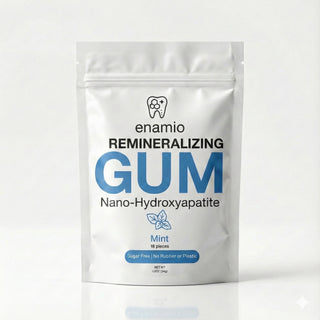
Enamio Remineralizing Gum
The manufacturer lists nano-hydroxyapatite and xylitol. Compare ingredients with your needs and check current ordering terms at purchase time. Follow your pouch when online quantities disagree.
View Enamio product informationChoose the next question that matters
For symptom questions, the sensitivity-versus-cavity explanation helps you prepare for a dental conversation without using gum to diagnose your tooth.
For a buying decision, use the checklist for separating reviews from health evidence. Taste and texture reports can inform a preference while leaving questions about a clinical tooth outcome unanswered.
For appearance questions, read the evidence behind chewing gum and jawline claims.