

Chewing Gum for Acid Reflux: What Studies Show About Enamel
Share
Published by Enamio
Reflux and enamel, explained
Acid-exposure evidence is not the same as heartburn relief or enamel protection.
Chewing gum for acid reflux has been studied for after-meal acid exposure. That evidence does not establish heartburn relief or protection from tooth wear.
Quick Answer
Does chewing gum help acid reflux? It can lower after-meal acid exposure. One small trial found better esophageal acid clearance, but measured pH rather than symptom relief [2].
- One reflux trial tested 30 minutes of chewing after a meal 🫧
- EFSA's plaque-acid opinion specifies at least 20 minutes after eating or drinking [4]
- Lower acid exposure is not proof of enamel erosion protection
Key Takeaways
- The reflux studies measured acid exposure after meals, not a cure or enamel outcome.
- Reflux is two problems at once: the burn you feel and the enamel it wears.
- Erosion shows up in about half of reflux patients, far more than in people without reflux [5] 🦷
- If mint triggers your symptoms, consider a non-mint sugar-free option without assuming equal clinical effects.
- Frequent heartburn, trouble swallowing, or weight loss means see a doctor [8].
~37%
Derived difference between reported median acid-exposure times, not a symptom-relief rate [2]
20 min
Minimum chew time in the EFSA oral-health condition [4]
~2.4x
Ratio of pooled erosion prevalence percentages, not a prospective risk estimate [5]
several-fold
Rise in saliva flow when you chew [1]
In this guide
The evidence is narrower than most summaries suggest. Chewing gum for acid reflux has modest support for lowering after-meal acid exposure. The trials measured pH, not symptom scores or enamel outcomes. Saliva is the reason the idea makes sense.
The second job is your enamel, which reflux acid can keep wearing down even on a day your chest feels fine. Want the evidence laid out plainly? Start with what the evidence really says, then come back for the reflux angle.
- 01 -
Acid reflux and tooth enamel: what the evidence shows
If your dentist mentioned wear from repeated acid exposure, read how acid erosion affects enamel. The reflux studies discussed here answer a separate question about acid exposure after a meal.
Acid reflux is stomach acid washing back up into your esophagus, and the heartburn is the part you notice. The part you may not feel is what that same acid does to your teeth. Reflux creates two separate questions. Gum has pH evidence for the first and no direct erosion outcome for the second.
Picture two readers. One just wants the after-dinner burn to quit so they can sleep. The other has a dentist who already flagged acid wear and wants to guard what enamel is left. Same gum, two different goals, and this guide answers both.
Dental erosion is the permanent loss of tooth enamel caused by acid, not by bacteria [6]. Diet acids can cause it. So can stomach acid that reaches the mouth during reflux or vomiting [6]. Once that mineral is gone, it does not simply grow back.
How common is erosion when reflux is in the picture? More common than most people guess. A 2022 meta-analysis of 28 studies and 4,379 people found dental erosion in 51.5% of patients with GERD, the clinical name for frequent acid reflux, versus 21.4% of people without reflux [5]. A separate systematic review landed close behind, at 48.8% versus 20.5% [6].
The reported percentages show an association, but results varied substantially between studies. Dividing 51.5 by 21.4 gives 2.4, a descriptive prevalence ratio rather than the review's pooled odds ratio [5]. It does not predict an individual's tooth wear.
Reflux-related wear can involve the inside surfaces of upper and lower teeth [6]. A dental examination is more useful than judging enamel from how much heartburn you feel.
Heartburn alone does not establish a GERD diagnosis. Recurrent symptoms or complications need clinical assessment [8]. Do not judge the seriousness of chest discomfort only by how often it happens.
Two problems, and chewing gum for acid reflux has evidence for acid clearance, not for solving either condition.
This is why worn enamel and sensitive teeth so often travel together. If cold water or something sweet has started to sting, that tenderness can trace back to acid wear. A plan for sensitivity from worn enamel is worth a look. Starting an enamel-defense routine early beats chasing damage later.
So keep both jobs in mind. Gum may help after-meal acid clearance. Enamel protection still needs its own evidence and care plan.
- 02 -
The science of chewing gum for acid reflux
Chewing stimulates saliva, which can help clear and buffer acid. Saliva also carries calcium and phosphate. That provides a rationale for studying gum, but it does not establish symptom relief or enamel protection for a particular product. [1]
Flow can climb from roughly 0.3 to 0.4 milliliters a minute at rest to about 1 to 2 when you chew, a several-fold jump [1]. That extra saliva does two useful things at once. It lifts the pH in your mouth and esophagus, and it speeds acid clearance.
Acid clearance is how quickly the esophagus pushes acid back down and saliva washes the lining with something milder [1]. Faster clearance means less acid contact with esophageal tissue. It does not prove less tooth wear, because the reflux trials did not measure enamel outcomes.
Chewing raises saliva that buffers post-meal acid, though enamel still needs its own care [1] [4].
Does any of this show up in reflux measurements? It does, within limits. In a crossover trial of 31 people with reflux symptoms, gum was chewed for 30 minutes after a meal [2].
The trial found median percentages of the two-hour observation period at esophageal pH below 4 of 5.7% without gum and 3.6% with gum [2]. The p-value was 0.001. The outcome was acid exposure, not symptom relief or enamel protection.
Avidan and colleagues tested sitting, one hour of walking, and one hour of gum chewing on separate study days. Chewing reduced acid contact in both groups, while walking had a smaller, short-lived effect only in the reflux group [3].
Separately, EFSA concluded that sugar-free gum helps neutralize plaque acids when chewed for at least 20 minutes after eating or drinking [4]. That oral-health finding is not a GERD treatment recommendation or proof of erosion repair.
The reflux evidence is small and acute. It does not establish lasting symptom control after the study window [2]. Gum is a limited after-meal option, not a barrier against reflux or enamel erosion.
Timing counts because the reflux trial tested chewing during the 30 minutes after a meal [2]. EFSA's separate oral-health condition also places sugar-free gum after eating [4]. Neither source proves that chewing later has no value.
The same saliva that buffers acid also keeps your mouth from drying out, which is part of the dry-mouth and fresher-breath side of saliva. One habit, several small payoffs.
The clearest gum evidence is about saliva and timing. It is not proof that one finished product treats reflux or protects enamel.
So which interventions actually hold up, and for which job? Here is the evidence laid out as a ladder, reflux relief on one side and enamel on the other, with the strength of each claim stated plainly.
| Intervention | Targets | Source and type | Outcome | Evidence limits |
|---|---|---|---|---|
| Sugar-free gum after meals | Oral pH | EFSA opinion, regulatory review [4] | Helps neutralize plaque acids | Plaque-acid finding, not a reflux treatment claim |
| Post-meal gum, reflux patients | Esophageal acid exposure | Moazzez 2005, crossover pH trial, n=31 [2] | pH below 4 time 5.7% to 3.6% | Small, short-term pH trial |
| Chewing or walking, tested separately | Esophageal acid exposure | Avidan 2001, ambulatory pH study [3] | Gum reduced acid contact, while walking effects were smaller and brief. | Small, short-term pH study |
| Bicarbonate gum | Esophageal and pharyngeal pH | Smoak and Koufman 2001, pH study, n=40 [13] | Raised pH more than regular gum | pH outcomes, not symptom or enamel outcomes |
| Xylitol, sugar-free gum | Enamel environment | Meta-analysis, S. mutans [9] | Fewer cavity-linked bacteria | Bacterial counts, not erosion outcomes |
| nHA oral-care products, not gum | Caries and enamel lesion measures | Wierichs 2022, five clinical and five in situ studies [10] | Findings differed by test conditions | Very low certainty for pooled in situ findings |
| Finished nano-hydroxyapatite gum | Enamel | No trial located in our evidence review | Not established | No finished-product trial located in this review |
The final column states the limits of each source. These descriptions are not a formal evidence-grading assessment. Our finished-product evidence review located no published trial of a finished nano-hydroxyapatite gum. That is an evidence gap, not proof that no such study exists or that the product fails.
Reflux relief and enamel protection are two different jobs
Three outcomes need separate labels. Lower esophageal acid exposure is not the same as proven symptom relief, and neither is the same as enamel protection. The gum trial measured pH after a meal [2]. It did not test whether chewing prevents erosion or restores enamel already lost [2].
Keep the evidence in two lanes. Saliva and timing explain the measured esophageal pH change. The reflux gum trials provide no dental outcome data [2]. Ask your dentist about a separate erosion-care plan [6].
For more depth, read more on xylitol and acid attacks and compare remineralizing gum labels.
Why keep them separate? A lower pH-exposure result cannot be turned into proof of symptom relief or proof that enamel was protected. The reader needs both boundaries before choosing a gum or a dental routine.
Mint or no mint? A caution for some reflux sufferers
Mint can backfire for some people with reflux. The NIH's National Institute of Diabetes and Digestive and Kidney Diseases lists mint among foods that commonly trigger or worsen GERD symptoms [7]. That source does not say mint affects everyone, so treat it as a personal trigger, not a rule.
If mint is your trigger, pick a non-mint sugar-free gum. The reflux rationale comes from chewing and saliva, not from mint flavor. Enamio makes Berry, Cinnamon, and Watermelon alongside Mint, all on a plastic-free gum base with non-mint flavors.
- 03 -
How Enamio fits: formula facts and evidence limits
Enamio is a sugar-free gum positioned for enamel support, not for treating reflux. Nano-hydroxyapatite belongs to the same mineral family as enamel and has been studied mainly in toothpaste [10]. That ingredient evidence does not prove a finished gum changes reflux, symptoms, or enamel outcomes.
Start with what chewing already gives you. Saliva carries calcium and phosphate toward the tooth surface [1]. Enamio also contains xylitol, which is associated with fewer cavity-linked bacteria in the mouth [9]. Those are separate claims, and neither turns Enamio into a reflux treatment.
The formula also lists monk fruit, calcium, magnesium, zinc, and L-arginine. An ingredient list tells you what is present, not what dose reaches saliva or what clinical outcome follows. The finished product needs its own evidence before any of those ingredients can support an outcome claim.
Enamio is not a reflux treatment. This article does not establish that any gum treats underlying GERD, heals the esophagus, or replaces care from a clinician. Its role here is an optional sugar-free after-meal gum with an enamel-focused formula.
If chewing gum for acid reflux is already part of your after-meal routine, Enamio is one sugar-free option. The saliva evidence applies to chewing, while the mineral formula remains ingredient-informed rather than finished-product proven. Keeping those claims separate is the point.
Nano-hydroxyapatite has been studied mostly in toothpaste, so gum does not replace brushing with a clinician-recommended toothpaste [10]. Use Enamio only as its current label directs. Do not copy a research protocol from a different gum onto this product.
That leaves three layers of evidence. Chewing research explains saliva. Ingredient studies make nano-hydroxyapatite relevant to enamel care. Only a finished-product trial could show what this exact gum changes in people, and our evidence review did not locate one.
Choosing by flavor or ingredient list cannot substitute for evidence from the finished product in people.
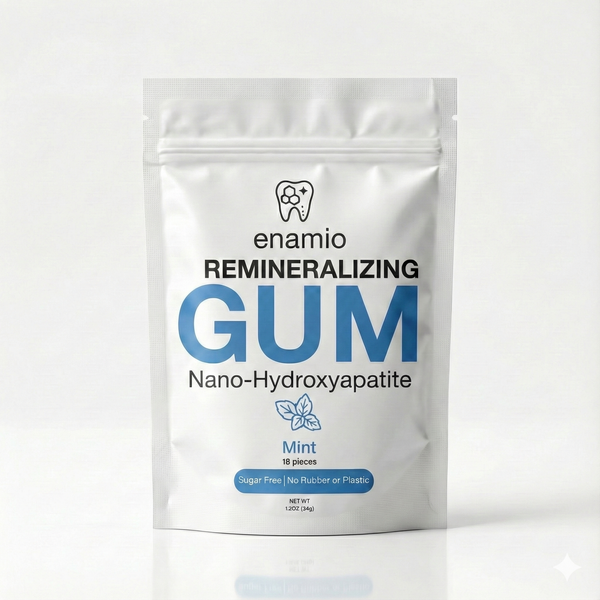
The enamel-side habit
Enamio Remineralizing Gum
A sugar-free gum with a plastic-free gum base. 18 pieces per pouch, in Mint, Berry, Cinnamon, and Watermelon.
The current product page lists 15% off the first subscription order, then 10% off recurring orders. A $24.99 California order was quoted $3.99 for ground shipping. Check the rate for your address before ordering. Contains xylitol, so keep it away from dogs.
See Enamio's after-meal routine →What the evidence does and does not show
The review included five clinical studies and five in situ studies, where samples were carried in the mouth. The clinical results were not pooled.
The pooled in situ findings were of very low certainty. nHA results were similar to sodium fluoride under remineralizing conditions, but showed less protection under demineralizing conditions [10] [11]. These findings do not establish benefit from a finished gum.
There is a bigger gap worth naming. Our evidence review located no published finished-product trial of a nano-hydroxyapatite gum. It was not a systematic search of every gum trial, so this remains an evidence gap rather than proof that no study exists.
Ingredient information alone does not establish that the finished gum improves reflux symptoms or protects enamel from reflux.
So the fair read is this. The mineral science is plausible, the cited hydroxyapatite studies use other oral-care formats, and our review found no finished-gum result. For the category definition, read what remineralizing gum means.
Enamio contains nano-hydroxyapatite, but the cited studies do not establish a reflux or enamel benefit from this finished gum. Ingredient research cannot justify cure, rebuild, reverse, or treatment claims for Enamio.
Build the enamel side of your routine
An enamel-focused formula for an after-meal habit, not a reflux treatment.
Shop Enamio- 04 -
How to use gum for reflux, and for your teeth
Keep study methods separate from product directions. The reflux trial tested 30 minutes of sugar-free chewing after a meal [2]. EFSA's plaque-acid opinion is not an Enamio dose or a reflux prescription [4]. Enamio's current product page directs 1 to 2 pieces daily, chewed for 20 minutes each [12].
1
Use the studied post-meal window
The reflux trial placed 30 minutes of chewing after a meal [2]. That describes the study, not a prescription.
2
Follow the product label
EFSA's opinion does not set Enamio's daily piece count [4]. Follow the current product directions and stop if chewing causes pain.
3
Go non-mint if mint is a trigger
Mint can trigger symptoms in some people [7]. Choosing another flavor does not prove that a gum treats reflux.
4
Keep dental care separate
Ask your dentist how to manage acid wear, including appropriate fluoride products and daily hygiene [6]. Gum does not replace that plan.
✓ Do
Keep a pouch where you eat, follow its directions, and pick a flavor you will reach for consistently.
✗ Don't
Lean on gum instead of prescribed care, or use symptom relief as proof that your teeth are protected.
For more on label directions and research schedules, see how often to chew for the most benefit. If cavities are your main worry, the same routine can support a cavity-risk routine.
Gum remains an add-on. It does not replace anything a doctor has prescribed for reflux.
Read the product label before you start. Compare the pieces-per-day direction and chew time with the current product page [12], and check for any pet-safety note about xylitol and dogs. If the label and the brand FAQ disagree, follow the package and contact the maker. Store an opened pouch sealed and dry, and bin used gum in the trash rather than a sink.
The real trick is making it automatic. Stack the gum onto something you already do, like clearing the table or starting the dishwasher. Keep a pouch in the kitchen and one in your bag, so you're never hunting for it after lunch out. A habit you'll actually keep beats a perfect routine you drop by Wednesday.
Tell your dentist about reflux, vomiting, acidic drinks, and sensitivity so your care plan addresses the relevant risks [6].
Pair the gum with one more habit that costs nothing. Try to finish eating at least 3 hours before you lie down, which the NIH's dietary guidance links to less nighttime reflux [7]. Meal timing and gum chewing are different strategies with different evidence. Neither guarantees symptom relief.
- 05 -
When to see a doctor
Arrange a medical review for recurrent heartburn or symptoms that keep waking you at night. Trouble swallowing, unintended weight loss, and gastrointestinal bleeding are alarm features that need prompt assessment [8].
Seek urgent medical care for vomiting blood, black tarry stools, or food stuck with difficulty swallowing. New or severe chest pain should not be assumed to be reflux. Call emergency services for severe chest pain, especially with breathing difficulty, faintness, or sweating.
Do not use gum to delay care. Do not stop or change prescribed reflux treatment on the basis of this article.
The small gum studies measured acid exposure, not reliable relief of heartburn. Persistent reflux is a different conversation, and it deserves a professional, both to protect your esophagus and to catch tooth wear early [8]. There is no prize for toughing it out.
Loop in your dentist too, not just your doctor. A dentist can assess tooth wear and advise on fluoride and other management options [6]. If you already know you have reflux, bring it up at your next cleaning. They'll know exactly what to look for.
- 06 -
People also ask
Does chewing gum help acid reflux?
It can lower after-meal esophageal acid exposure. In a trial of 31 people with reflux symptoms, 30 minutes of post-meal gum cut time at pH below 4 from 5.7% to 3.6% [2]. The trial did not measure heartburn scores, so symptom relief remains a cautious inference.
Is mint gum bad for acid reflux?
Mint gum can worsen reflux for some people, so choose non-mint if mint is a trigger for you. The NIH's NIDDK lists mint among foods that commonly set off GERD symptoms [7]. The reflux evidence is about chewing and saliva, not a benefit from mint flavor.
Does acid reflux damage tooth enamel?
Yes, repeated reflux acid can erode tooth enamel, which is a separate problem from the heartburn you feel. A 2022 meta-analysis of 28 studies found dental erosion in 51.5% of GERD patients versus 21.4% of controls, an odds ratio near 5 [5]. Protecting enamel needs its own plan.
What is the best gum for acid reflux?
The cited studies do not establish a best gum for reflux. Sugar-free gum was tested after meals, but that does not prove that every formula performs the same way [2]. Avoid mint when it is a personal trigger [7].
How long should I chew gum for reflux?
The reflux trial tested 30 minutes after a meal [2]. EFSA's separate oral-health condition uses at least 20 minutes after eating [4]. Follow your gum's label for amount and frequency, and stop if your jaw aches or symptoms worsen.
Can gum replace reflux medication?
No, gum cannot replace reflux medication or a doctor's care. The 2022 ACG guideline recommends prompt evaluation when alarm features such as trouble swallowing, weight loss, or gastrointestinal bleeding appear [8]. See a clinician for reflux that keeps returning.
Does sugar-free gum protect teeth?
Sugar-free gum supports teeth by raising acid-buffering saliva, but it does not undo erosion that has already happened. EFSA accepts a cause-and-effect link between sugar-free gum and neutralizing plaque acids [4]. Ask your dentist about a separate erosion-care plan [6].
Is bicarbonate gum better for reflux?
A bicarbonate-containing gum raised esophageal and pharyngeal pH more than regular sugar-free gum in a 40-person LPR study [13]. The study measured pH, not heartburn relief or enamel outcomes. This study does not establish which gum provides better symptom relief.
When should you chew gum for acid reflux?
The reflux trial placed chewing in the 30 minutes after a meal [2]. EFSA's oral-health condition also places sugar-free gum after eating, but it answers a different question [4]. Follow the product label for amount and frequency.
Can chewing gum make acid reflux worse?
It can make symptoms worse for some people, especially when mint is a personal trigger. The NIH's NIDDK lists mint among foods that commonly trigger reflux, so switch to a non-mint sugar-free gum if mint bothers you [7]. See a doctor if reflux keeps returning [8].
Does gum after meals help heartburn?
It may help after a meal by increasing saliva and acid clearance. The strongest trial cited here measured lower esophageal acid exposure, not heartburn scores [2]. Treat gum as an optional add-on rather than proof of symptom control.
What did the main gum trial actually measure?
The Moazzez crossover trial measured the percentage of post-meal time that esophageal pH stayed below 4. It compared gum with no gum in 31 people with reflux symptoms and found 3.6% versus 5.7% [2]. Those numbers describe acid exposure, not relief a person reported feeling. It did not measure enamel loss or prove that a specific brand relieves symptoms.
- 07 -
FAQs
Does chewing gum help reflux at night?
Use gum after your evening meal, not while lying in bed. Chewing in bed creates a choking risk, and NIH guidance suggests finishing food at least 3 hours before lying down [7]. Gum is not a treatment for nighttime reflux.
The main reflux trial studied chewing after a meal, not during sleep. Nighttime symptoms that keep returning belong in a conversation with a clinician.
How many pieces of Enamio should I chew?
Enamio's current product page directs 1 to 2 pieces daily, chewed for 20 minutes each [12]. Its FAQ gives a different count of 1 to 3 pieces. Do not combine those directions into a higher dose. Follow the package directions and ask Enamio to clarify any mismatch.
Do not copy the 30-minute research protocol onto Enamio. More pieces are not proven to improve outcomes.
Is sugar-free gum better than regular gum for reflux?
Choose sugar-free gum. The reflux trial and EFSA oral-health guidance cited here both used sugar-free gum [2] [4]. Xylitol is associated with fewer cavity-linked bacteria, though that does not prove a finished gum prevents cavities [9].
This choice is about the evidence cited here and avoiding added sugar. It does not show that every sugar-free formula performs the same way.
Will gum protect my enamel from reflux acid?
The studies cited here do not prove that gum prevents enamel erosion from reflux. Chewing raises saliva that buffers acid and carries calcium and phosphate toward the tooth surface [1], but the reflux trials measured esophageal pH rather than dental outcomes. Existing erosion cannot be reversed by chewing gum [6].
Ask your dentist which fluoride products and brushing routine are appropriate [6]. Enamel care remains separate from reflux symptom management.
Is nano-hydroxyapatite gum proven to rebuild enamel?
No finished nano-hydroxyapatite gum result was located in our evidence review. Hydroxyapatite has mostly been studied in toothpaste and other oral-care formats, and reviewers call that evidence not conclusive [10]. The missing gum trial is an evidence gap, not proof of failure, and it cannot support a claim that gum rebuilds lost enamel.
Is sugar-free gum safe to chew daily, and around pets?
Follow the product label and stop if chewing causes jaw pain. Xylitol is toxic to dogs, so keep any xylitol gum well away from pets. Ask your dentist about chewing if you have jaw pain, active decay, or new dental work.
This article does not establish that more frequent chewing is safer or more effective. Product directions and personal dental needs set the limit.
- 08 -
References
- Humphrey SP, Williamson RT. A review of saliva: normal composition, flow, and function. Journal of Prosthetic Dentistry. 2001. pubmed.ncbi.nlm.nih.gov/11208206. Accessed October 12, 2026.
- Moazzez R, Bartlett D, Anggiansah A. The effect of chewing sugar-free gum on gastro-esophageal reflux. Journal of Dental Research. 2005. journals.sagepub.com. Accessed October 12, 2026.
- Avidan B, Sonnenberg A, Schnell TG, Sontag SJ. Walking and chewing reduce postprandial acid reflux. Alimentary Pharmacology and Therapeutics. 2001. pubmed.ncbi.nlm.nih.gov/11148431. Accessed October 12, 2026.
- EFSA Panel on Dietetic Products, Nutrition and Allergies. Scientific opinion on health claims related to sugar-free chewing gum. EFSA Journal. 2009, volume 7, issue 9, article 1271. efsa.europa.eu. Accessed October 12, 2026.
- Yanushevich O, et al. Prevalence and risk of dental erosion in patients with gastroesophageal reflux disease: a meta-analysis. 2022. ncbi.nlm.nih.gov/pmc/PMC9316498. Accessed October 12, 2026.
- Picos A, Badea ME, Dumitrascu DL. Dental erosion in gastro-esophageal reflux disease: a systematic review. Medicine and Pharmacy Reports. 2018. medpharmareports.com. Accessed October 12, 2026.
- National Institute of Diabetes and Digestive and Kidney Diseases (NIH). Eating, diet, and nutrition for GER and GERD. niddk.nih.gov. Accessed October 12, 2026.
- Katz PO, et al. ACG clinical guideline for the diagnosis and management of gastroesophageal reflux disease. American Journal of Gastroenterology. 2022. pubmed.ncbi.nlm.nih.gov/34807007. Accessed October 12, 2026.
- Systematic review and meta-analysis of sugar-free chewing gum and Streptococcus mutans. BMC Oral Health. 2021. doaj.org. Accessed October 12, 2026.
- Wierichs RJ, et al. Efficacy of nano-hydroxyapatite on caries prevention: a systematic review and meta-analysis. Clinical Oral Investigations. 2022. link.springer.com. Accessed October 12, 2026.
- Open-access copy of reference 10, the same Wierichs 2022 review rather than an independent study. ncbi.nlm.nih.gov/pmc/PMC8979882. Accessed October 12, 2026.
- Enamio. Remineralizing Gum: ingredients, directions, and purchase terms. Manufacturer product page. Checked October 12, 2026. Product information, not clinical evidence.
- Smoak BR, Koufman JA. Effects of gum chewing on pharyngeal and esophageal pH. Annals of Otology, Rhinology and Laryngology. 2001. journals.sagepub.com. Accessed October 12, 2026.
- 09 -
Ready to build your routine
A practical summary: if you try chewing gum for acid reflux, use sugar-free gum after a meal, skip mint if it triggers you, and keep enamel care separate. Gum may lower after-meal acid exposure, but it is not a reflux treatment or proven erosion shield.
The enamel-side habit
Enamio Remineralizing Gum
Sugar-free, with a plastic-free gum base, nano-hydroxyapatite and xylitol. Mint, Berry, Cinnamon, and Watermelon, so mint-sensitive readers have options.
The current product page lists 15% off the first subscription order, then 10% off recurring orders. A $24.99 California order was quoted $3.99 for ground shipping. Check the rate for your address before ordering.
Reading next
The evidence check
Is remineralizing gum legit?
The plain-English read on what the science supports, and where it stops.
Dial in the routine
How often to chew for the most benefit
Timing and frequency, so the after-meal habit actually sticks.
If cold water stings
Relief for sensitive teeth
When acid wear turns into sensitivity, start here.
Find your fit
Take the 30-second gum quiz
A couple of questions to match you with the right flavor and routine.
Educational only, not medical advice. Ask your dentist or doctor about pain, swallowing trouble, active decay, pregnancy, allergies, or persistent reflux.