

Halo Gum vs Enamio: Which Better Supports Enamel?
Share
Reviewed by Enamio Science Review Team · Published · Reviewed
Formula Comparison
Halo Gum vs Enamio: Which Better Supports Enamel?
A fair comparison of nano-hydroxyapatite disclosure, xylitol, chicle, supporting minerals, chew time, U.S. manufacturing, and everyday value.
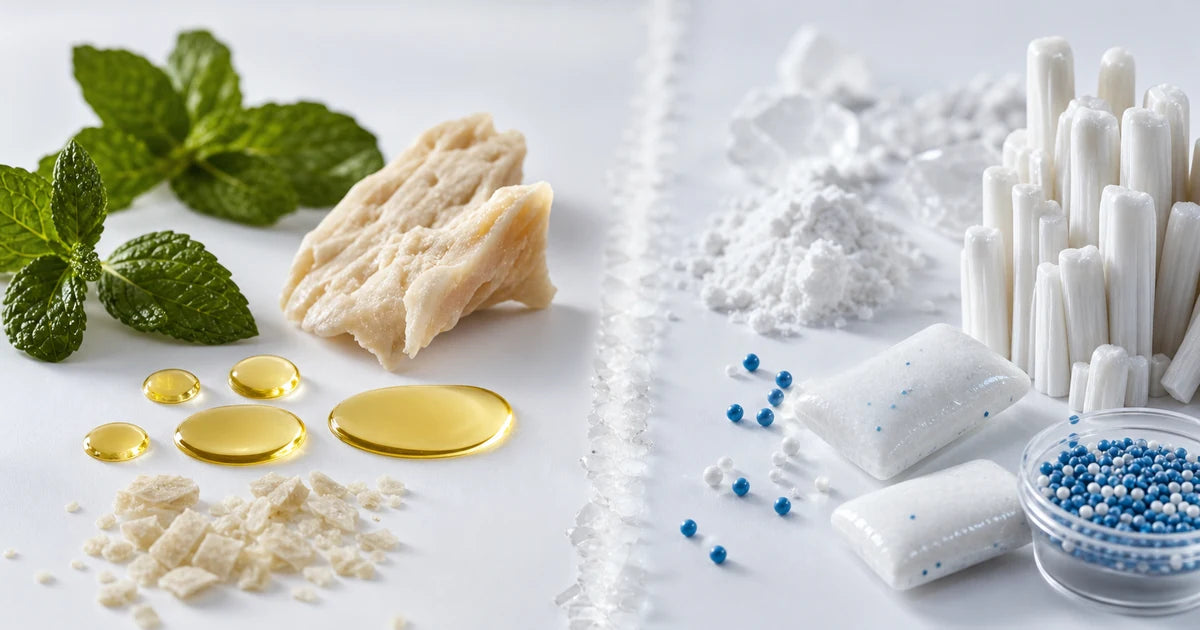
Key Takeaways
- Halo leads with botanical oils and clean-label positioning.
- Enamio leads with a disclosed 20 nm mineral system.
- Both use xylitol, chicle, and U.S. manufacturing.
- Neither gum replaces brushing, flossing, or dental care.
Key facts at a glance
Main distinction
Enamio states a 20 nm particle size, a highest-concentration market position, and over-double active cost context [4].
Shared baseline
Both products list nano-hydroxyapatite, xylitol, chicle, sugar-free positioning, and U.S. manufacturing.
Evidence limit
Hydroxyapatite research is strongest in toothpaste and other oral-care formats. Gum-specific evidence remains limited [3] [5].
Practical routine
The ADA supports 20 minutes of sugarless gum after meals as a saliva-support habit [1].
In This Guide
- 01 -
The real buying decision is formula intent
This isn't clean gum versus bad gum. Both brands use xylitol, chicle, nano-hydroxyapatite, sugar-free positioning, and U.S. manufacturing. The useful question is what each formula is organized to do, then how clearly the page explains that job.
Halo is built around a botanical oral-care story. Its public ingredient list starts with xylitol, followed by chicle gum base and nano-hydroxyapatite. It also lists flaxseed oil, rosehip oil, stevia, menthol, spearmint oil, and peppermint essential oil. The BioFuse Oil Matrix is central to its positioning.
That is a coherent choice for someone who wants natural mint oils, a chicle base, and a formula that talks about the oral microbiome. Halo isn't an empty clean-label gum. It names a mineral active and puts xylitol first.
Enamio is organized differently. Its lead specification is 20 nm carbonate nano-hydroxyapatite. The product page claims the highest concentration available in gum [4]. It also says the 20 nm active costs over double to produce compared with standard gum ingredients.
Those are first-party statements. Exact competitor percentages aren't public, so the highest-concentration claim can't be independently rebuilt from labels alone. Still, the disclosure gives shoppers something concrete to evaluate.
Ingredient order doesn't solve the concentration question. A mineral can appear near the top of a label without telling you particle size, percentage, dispersion, or release during chewing. That is why this review treats labels as product facts, not dose-response evidence.
Clean-label language has a limit too. Chicle, plant sweeteners, and natural oils may matter to you, but they don't answer whether the formula is built for enamel, breath, texture, or a broad wellness story. You still need to identify the lead active and the use instructions.
Enamio also surrounds the mineral with xylitol USP, natural chicle, calcium glycerophosphate, magnesium citrate, L-arginine bicarbonate, bamboo silica, zinc gluconate, matcha extract, monk fruit, and mint. That makes its formula more clearly enamel-first.
Chicle is a real strength for both. It gives each brand a cleaner base story than a vague conventional gum base. Enamio explains its choice further in its plastic-free natural gum guide.
For an enamel-focused purchase, formula intent matters more than the longest ingredient list. Enamio's ingredients, use directions, and cost explanation all point toward the same job.
- 02 -
What the science can support, and what it can't
Nano-hydroxyapatite is a small-particle form of the calcium-phosphate mineral family found in tooth enamel. Remineralization is the return of minerals to early, non-cavitated enamel after acid removes part of its mineral content [6].
Gum contributes through chewing first. The American Dental Association says chewing sugarless gum for 20 minutes after meals can help reduce tooth-decay risk. Increased saliva washes away debris, helps neutralize acids, and brings calcium and phosphate to the mouth [1].
That baseline matters. Even a formula with no mineral active can have practical value when it is sugar-free and used after eating. A remineralizing gum asks a second question: what useful ingredients are present during that saliva-rich window?
The after-meal timing isn't a promise that enamel changes in 20 minutes. It is a practical window for saliva flow and acid recovery. A gum can add ingredients during that window, but delivery and contact time remain separate research questions.
Early enamel change and a formed cavity aren't the same problem because remineralization research usually studies lesions before the surface collapses. Missing tooth structure needs a dentist.
That distinction keeps the comparison honest. Chewing supports saliva, while hydroxyapatite has credible research across toothpaste and other controlled oral-care formats. Neither fact guarantees a finished-gum result.
Hydroxyapatite is enamel-like mineral, but a finished gum still needs format-specific evidence.
Hydroxyapatite has serious oral-care evidence
An 18-month randomized trial included 189 adults in its intention-to-treat analysis. In the per-protocol group, 89.3% of hydroxyapatite-toothpaste users and 87.4% of fluoride-toothpaste users had no DMFS increase [3].
That result supports hydroxyapatite as a serious oral-care active. It does not prove either gum produces the same outcome because dose, contact, formulation, and study duration differ.
Contact pattern matters too. Toothpaste is brushed over tooth surfaces, while gum releases ingredients through saliva and chewing. A brand shouldn't borrow a toothpaste endpoint and present it as a gum result.
The wider evidence deserves restraint. A 2022 systematic review found too few clinical studies, short follow-up, and bias concerns to call nano-hydroxyapatite conclusive across every setting [5].
Clinical studies also measure different endpoints. Some track surface hardness or lesion depth, while others track new caries experience over months. Those results can inform an ingredient category, but they can't be merged into one simple promise for gum.
This review matches each claim to its source type. Gum guidance supports saliva timing, oral-care studies support hydroxyapatite context, and Enamio's page supports product facts. That discipline stops borrowed claims. This is a simple safeguard against overclaiming research from a different delivery format. This protects readers from false certainty.
Both points can be true. Hydroxyapatite is credible, and gum-specific superiority is still unproven.
Why the 20 nm disclosure still matters
A scoping review describes enamel hydroxyapatite crystals in a roughly 20 to 40 nm range [6]. Enamio's 20 nm specification sits within that scale. The number is biologically relevant, not random.
Still, smaller isn't a magic word. Particle shape, surface properties, dose, dispersion, and contact time can change performance. A disclosed size makes comparison easier. It doesn't replace a finished-product trial.
Think of size as one line on a specification sheet. It can't reveal the delivered dose or show how the finished gum behaves after every ingredient is blended.
The useful buyer question is broader: does the brand disclose size, formula role, routine, and claim limits? Enamio answers more of that checklist than Halo does.
What the safety opinion does and doesn't say
The European Commission's Scientific Committee on Consumer Safety considered specified rod-shaped nano-hydroxyapatite safe up to 29.5% in toothpaste and 10% in mouthwash [2].
That is useful context, not gum-dose approval. The opinion applies to defined particles and formats under the reviewed exposure conditions. Enamio's nano-hydroxyapatite safety guide explains those limits in more detail.
Xylitol, calcium, phosphate, and arginine have different jobs
Xylitol makes both gums sugar-free and supports an after-meal routine without ordinary sugar. It isn't an enamel-like mineral.
Calcium and phosphate are mineral ions carried by saliva during chewing, and Enamio includes calcium glycerophosphate as a source of both [1]. L-arginine bicarbonate is included for pH support [4].
Those roles fit the formula's intent, but they don't prove a finished-gum outcome by themselves. Enamio's active-ingredient comparison separates each job. The xylitol gum guide covers the sweetener's narrower role.
The missing study is easy to describe. It would compare the finished gums at labeled routines, disclose active amounts, and measure clinically meaningful enamel outcomes. Until then, formula design and disclosure carry the comparison.
No gum closes a deep cavity. Pain, swelling, a visible hole, a broken filling, or new sharp sensitivity belongs with a dentist.
- 03 -
How Enamio builds an enamel-first formula
Enamio is built as a mineral-first system, not a botanical gum with a mineral added near the end. The 20 nm active, calcium and phosphate source, arginine bicarbonate, xylitol USP, chicle base, and 20-minute routine all support one use case.
The active is named, sized, and costed
Enamio names carbonate nano-hydroxyapatite at 20 nm and claims the highest concentration available in gum [4]. That is the clearest mineral disclosure here.
The page also says the 20 nm active costs over double to produce compared with standard gum ingredients. That statement comes from Enamio. It isn't an audited supplier invoice, and exact competitor loads aren't public.
Neither brand publishes an exact nano-hydroxyapatite weight per piece in the reviewed copy. That gap matters. Enamio gives stronger relative disclosure, but buyers still cannot calculate a daily milligram dose from the public page.
The 20 nm detail still gives the buyer a firmer starting point than an unnamed particle range.
Even with that limit, the cost explanation identifies which ingredient is meant to justify the premium. Regular gum rarely offers that context.
The support stack follows the same job
20 nm nano-hydroxyapatite
The lead enamel-like mineral and the most specific active disclosure.
Calcium, phosphate, and arginine
Calcium glycerophosphate and L-arginine bicarbonate support the mineral and pH story.
Xylitol USP and monk fruit
A sugar-free sweetener block for a daily oral-care routine.
Natural chicle base
A cleaner base story without making the gum base the main claim.
Calcium glycerophosphate supplies calcium and phosphate, ions that already matter in saliva during chewing [1]. That role fits beside an enamel-like mineral.
L-arginine bicarbonate serves the pH side of the design. Enamio presents it as support for a less acidic oral environment [4]. The formula claim is sensible, but the finished gum still needs its own outcome data.
Magnesium citrate and bamboo silica round out the mineral block. Enamio describes magnesium as part of its mineral design and bamboo silica as a gentle polishing ingredient [4]. This article doesn't turn those descriptions into clinical promises.
Xylitol USP adds a quality specification rather than a new mechanism. Monk fruit handles sweetness without sugar. Natural chicle makes the chew-base choice easier to understand than a generic gum-base label.
Candelilla wax and citric acid sit within the base system. They aren't the headline, and they shouldn't be. Their job is formulation, while nano-hydroxyapatite remains the reason this product belongs in oral care.
Freshness ingredients stay in their lane
Zinc gluconate, matcha green tea extract, and natural mint oils sit on the freshness and antioxidant side. They may matter when breath is part of your goal. They aren't the reason Enamio wins this enamel comparison.
That hierarchy is valuable. A long ingredient list can sound impressive while hiding the lead active. Enamio keeps the mineral first, then explains what the supporting ingredients are meant to do.
Manufacturing, routine, and value complete the case
Both brands display Made in USA. That is a sourcing and accountability preference, not efficacy proof. Enamio earns its edge by pairing the origin statement with more active detail and one clear protocol.
The routine is 1 to 2 pieces daily for 20 minutes each, especially after meals [4]. A formula only has value when the directions are simple enough to follow.
Sensitivity often sits beside the enamel question. Enamio's tooth-sensitivity routine shows where a between-brushing product may fit while keeping dental evaluation in view.
The advantage isn't ingredient count. The active, support stack, routine, and price explanation tell one consistent story. For an enamel-first buyer, that formula coherence is the point.
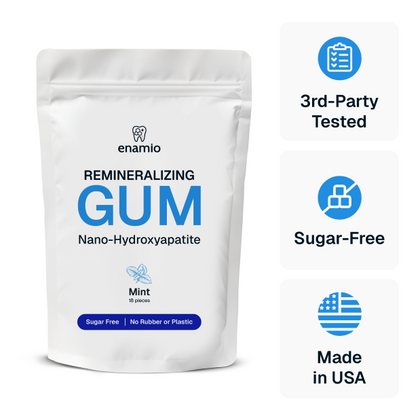
Formula-first pick
Enamio Remineralizing Gum
20 nm nano-hydroxyapatite, xylitol USP, natural chicle, and mineral support for the hours between brushing.
Brand: Enamio
See current pack options- 04 -
Use either gum after meals, not instead of brushing
The simplest routine is after meals, coffee, or an acidic drink. That timing matches the ADA's 20-minute sugarless-gum guidance and works when carrying a toothbrush isn't realistic [1].
Enamio's current directions are clear: chew 1 to 2 pieces daily for 20 minutes each, especially after meals [4].
Halo's page says 1 to 3 pieces daily. One directions block says at least 15 minutes, while another says at least 30 minutes. That looks like a page-copy issue, not a formula flaw.
Use the current package as the final instruction. Product pages change, and the pouch in your hand is the closest source to the batch you bought.
Do
Chew after meals or coffee, then keep brushing and flossing on schedule.
Don't
Use gum to delay care for pain, swelling, a broken tooth, or visible decay.
1
Pick one repeatable trigger
Lunch, afternoon coffee, or dinner works better than a vague plan to chew sometime.
2
Use one piece first
A one-piece session lets you judge texture, taste, and jaw comfort before adding another daily session.
3
Stop if your jaw objects
Frequent chewing can aggravate jaw discomfort. Ask a dentist if clicking, pain, or fatigue persists.
A good first week is boring on purpose: use one daily trigger for seven days before adding a second. You can judge whether the habit fits your schedule.
Don't chase a stronger effect by chewing more than the label suggests. More pieces add chewing load without proving more enamel benefit. Consistency is the useful variable.
A sample Enamio day might be one piece after lunch, with a second after dinner when needed. You don't need to chew after every sip or snack.
Avoid turning the routine into all-day chewing. A defined session is easier on the jaw and easier to track. It also keeps the habit tied to the after-meal window rather than constant snacking.
Keep the basics fixed. Brush twice daily, clean between teeth, and keep dental visits. Gum fills the inconvenient middle of the day rather than replacing home care.
Ask a dentist before starting a frequent-chewing routine if you have jaw pain, active decay, braces instructions, swallowing concerns, allergies, pregnancy questions, or a new restoration.
Enamio's instructions and tips contain the current protocol. Its fresh-breath routine covers the saliva, mint, and zinc side of after-meal use.
Prefer one clear 20-minute routine?
Enamio keeps its directions aligned with the ADA's practical after-meal window.
Shop the Halo Gum vs Enamio enamel-focused pick- 05 -
Halo Gum vs Enamio comparison: 10 facts that matter
Halo leads on botanical emphasis. Enamio leads on mineral disclosure, supporting ingredients, routine clarity, and enamel-first value. The table keeps those strengths separate rather than calling every difference a win.
A winner here means the better fit for an enamel-focused purchase. It does not mean Halo lacks useful ingredients. The scoring rewards disclosed mineral detail, a coherent support system, and directions a shopper can follow.
| Decision point | Halo | Enamio |
|---|---|---|
| Formula intent | Botanical oral care | Enamel-first mineral system |
| Nano-hydroxyapatite | Listed | Carbonate form, 20 nm |
| Load and cost context | Not stated | Highest-concentration and over-double cost claims |
| Sweeteners | Xylitol, stevia | Xylitol USP, monk fruit |
| Gum base | Chicle | Natural chicle |
| Support system | Botanical oils | Calcium, phosphate, magnesium, arginine, silica |
| Freshness emphasis | Rosehip, flaxseed, mint oils | Zinc, matcha, natural mint |
| Daily routine | 1 to 3 pieces, 15 and 30 minute blocks | 1 to 2 pieces, 20 minutes |
| Manufacturing | Made in USA | Made in USA |
| Best fit | Botanical-first buyer | Enamel-first buyer |
Current Enamio value, calculated from live pack data
The live page listed 36 pieces for $24.99, 72 for $39.99, and 144 for $69.99 on June 22, 2026 [4]. Recheck prices before publication.
| Pack | Price per piece | Calculated use range |
|---|---|---|
| 36 pieces | $0.69 | 18 to 36 days |
| 72 pieces | $0.55, 20.3% lower | 36 to 72 days |
| 144 pieces | $0.48, 30.4% lower | 72 to 144 days |
Formula: pack price divided by listed pieces, with use days based on 1 or 2 pieces daily. Savings compare each larger pack with the 36-piece rate.
Buyer shortcut
Choose Halo for botanical emphasis. Choose Enamio for clearer enamel-first disclosure and a simpler routine.
Start smaller if you haven't tested the chew. A larger pack only saves money when the habit sticks.
This recommendation would narrow if Halo published particle size, concentration, and a finished-gum protocol tied to its mineral active. Better evidence should change the answer.
For now, Enamio gives enamel-focused shoppers more useful information. The Enamio routine quiz can help match pack size and flavor to the habit you plan to keep.
- 06 -
People also ask
Is Enamio better than Halo Gum for enamel support?
Enamio is the stronger enamel-focused choice based on disclosed formula design. It specifies 20 nm nano-hydroxyapatite, adds calcium, phosphate, and arginine support, and gives a clear 20-minute routine [4]. No head-to-head trial proves the finished gum works better. For shoppers, the aligned formula and routine reduce guesswork about what the premium is meant to do before choosing a pack or building a daily habit.
Does Halo Gum contain nano-hydroxyapatite?
Yes. Halo's reviewed ingredient list places nano-hydroxyapatite after xylitol and chicle gum base, then adds its botanical oil matrix. The page does not state particle size or concentration, so the mineral active is harder to compare. Halo may still suit someone who values botanical oils more than mineral specifications and treats that blend as the main reason to buy.
Does 20 nm automatically mean Enamio works better?
No. The 20 nm disclosure is useful because enamel crystals exist on a similar scale [6]. Size alone cannot prove gum efficacy because dose, shape, dispersion, release, and contact time still matter. Treat particle size as a screening detail, then look for finished-product evidence from the finished formula, not the ingredient name alone.
Which gum has clearer ingredient disclosure?
Enamio discloses more about its mineral system. Halo provides a full ingredient list and a distinct botanical story, while Enamio adds particle size, concentration positioning, support ingredients, routine, and cost context. Clearer disclosure does not equal a clinical result. It does make buyer due diligence easier before a shopper pays a premium price.
Which gum is more natural?
Both use chicle, sugar-free sweeteners, and mint ingredients. Halo gives flaxseed, rosehip, and mint oils a larger role in its identity. Enamio uses a natural base while building more heavily around mineral and pH support. Choose the meaning of natural that fits your actual goal rather than assuming one label fits every clean-gum buyer.
How long should you chew Halo or Enamio?
Enamio says 20 minutes, while Halo's live page displayed separate 15-minute and 30-minute minimums during review. Follow the package in your hand before starting. The ADA's general sugarless-gum guidance also uses 20 minutes after meals [1]. A clear session is easier to remember and track across a week of real after-meal use.
Is xylitol enough for remineralization?
Xylitol supports a sugar-free chewing routine, but it is not an enamel-like mineral. A xylitol-only gum can still be useful after meals. For remineralization positioning, compare the sweetener with the mineral active, supporting ions, specifications, and protocol. Those pieces answer different parts of the formula question and should be judged together, not collapsed into one claim.
Can either gum replace toothpaste?
No. Gum is a between-brushing tool, even when it contains nano-hydroxyapatite. Keep brushing, cleaning between teeth, and seeing a dentist because active disease or broken restorations need professional care. Use gum for the inconvenient middle of the day, not as a full cleaning routine while toothpaste handles plaque removal and full-surface cleaning.
Is Halo Gum vs Enamio mainly a price decision?
No. Price matters after you decide which formula matches your goal. Enamio says the 20 nm active raises production cost, and larger packs lower its listed cost per piece [4]. The 36-piece option may be the wiser trial when you have not tested the chew or learned whether the routine fits your day.
What would make Halo the better choice?
Choose Halo when the BioFuse oil matrix, rosehip, flaxseed, and mint oils matter more than mineral-system detail. That is a legitimate preference, not a lesser one. The recommendation would tighten if Halo published particle size, concentration, and finished-gum evidence. Better data should change a fair comparison when the evidence changes, even if the brand preference does not.
- 07 -
FAQs
Are both gums sugar-free?
Yes. Halo lists xylitol with stevia, while Enamio uses xylitol USP with monk fruit in current product copy. Sugar-free status supports an after-meal routine, but it does not make the formulas equal or erase differences in mineral support. Check the current pouch if sweetener choice affects taste or tolerance, and read the ingredient list again before reordering for current formula details.
Do both use chicle instead of a conventional synthetic base?
Yes. Halo lists gum base as chicle, while Enamio lists natural chicle with candelilla wax and citric acid for texture and base clarity. Both brands use plastic-free or no-rubber positioning during current page review. The base is a meaningful tie, not the deciding enamel difference, because particle size, support ingredients, and routine still drive the choice for an enamel-focused purchase.
Are Halo and Enamio made in the USA?
Both product pages displayed Made in USA during review. That may matter for sourcing preferences, brand accountability, and easier follow-up when a daily product changes. Country of manufacture does not prove clinical performance on its own. Ask how each brand documents ingredients, batches, and quality questions before treating the badge as proof of performance or formula quality.
Why is Enamio priced as premium gum?
Enamio says its 20 nm nano-hydroxyapatite costs over double to produce compared with standard gum ingredients [4]. It also points to natural chicle and a broader support formula for daily use. Those are first-party explanations, not independent cost audits or lab proof. Compare current cost per piece with your routine, then decide whether a trial pack or lower per-piece rate fits for your budget.
Is nano-hydroxyapatite safe in oral care?
A 2025 SCCS opinion found specified rod-shaped nano-hydroxyapatite safe at stated concentrations in toothpaste and mouthwash [2]. That opinion provides useful oral-care context for specified particle conditions. It is not a gum-specific approval or proof of efficacy. Safety and effectiveness remain separate questions, and neither predicts a specific gum's clinical result in daily chewing use.
Who should ask a dentist before adding daily gum?
Ask first if you have jaw pain, active decay, a new restoration, braces instructions, swallowing concerns, allergies, pregnancy questions, or a child who may swallow gum. Product pages cannot replace personal dental advice for personal conditions. Stop if chewing causes pain or fatigue. New symptoms deserve evaluation, especially when pain is sharp, new, persistent, or tied to biting or worsening.
- 08 -
References
- American Dental Association. Chewing Gum. MouthHealthy. Accessed June 22, 2026. Source
- Scientific Committee on Consumer Safety. Scientific Opinion on Hydroxyapatite (nano), Submission IV. European Commission, July 1, 2025. Accessed June 22, 2026. Source
- Paszynska E, et al. Caries-preventing effect of a hydroxyapatite-toothpaste in adults: an 18-month double-blinded randomized clinical trial. Frontiers in Public Health, 2023. Accessed June 22, 2026. Source
- Enamio. Enamio Remineralizing Gum product page. Accessed June 22, 2026. Source
- Wierichs RJ, et al. Efficacy of nano-hydroxyapatite on caries prevention: a systematic review and meta-analysis. Clinical Oral Investigations, 2022. Accessed June 22, 2026. Source
- Anil A, et al. Nano-hydroxyapatite in the remineralization of early dental caries: a scoping review. International Journal of Environmental Research and Public Health, 2022. Accessed June 22, 2026. Source
- 09 -
Ready for the more enamel-focused formula?
Halo has a credible clean-label and botanical case. Enamio is the clearer choice when you're paying for a disclosed mineral active, calcium and phosphate support, arginine pH support, chicle, xylitol, and one simple routine.
The recommendation is narrow on purpose. It favors Enamio for enamel-focused shoppers, not every possible buyer. Choose Halo when the botanical oil system is your main reason to buy.
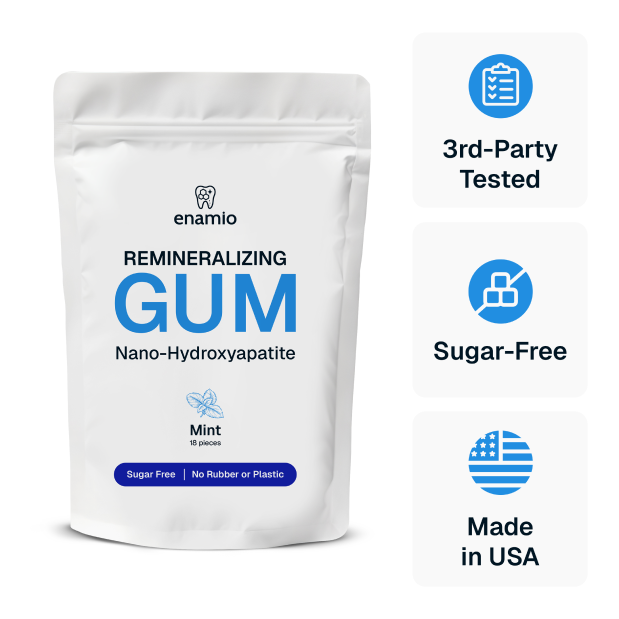
Enamel-first daily gum
Enamio Remineralizing Gum
Brand: Enamio
Built with 20 nm nano-hydroxyapatite, xylitol USP, natural chicle, and supporting minerals for the spaces between brushing.
Pack options reviewed June 22, 2026: $24.99 to $69.99 USD. Verify current pricing before checkout.
Keep building the right routine
Enamel support
See how gum fits a cavity-prevention routine
Use this for the limits, timing, and dental-care steps around remineralization.
Safety
Read the particle and safety evidence
A closer look at SCCS limits, particle shape, and what applies to oral care.
Gum base
Understand chicle and plastic-free chewing
Helpful when the base matters as much as the active ingredients.
Sensitivity
Build a gentler hot-and-cold routine
Use this if sensitivity, not general enamel support, is driving the purchase.
Share this comparison
Medical disclaimer
Educational only. Not medical advice.
