
Hydroxyapatite Chewing Gum Brands: Complete 2026 Guide to Nano-HA Gums - Enamio
Share
Last reviewed by Enamio Science Review Team ·
Evidence-Led Category Audit
Hydroxyapatite Chewing Gum Brands: Which Is Worth It?
A five-brand audit of particle disclosure, mineral source, formula depth, and real cost per piece, with a clear answer for different buyers.

Hydroxyapatite chewing gum brands can look interchangeable until you compare what each one actually discloses. Because Enamio publishes this guide, the conclusion should stand on the checklist, not the logo. In this five-brand audit, Enamio is the only option pairing an animal-free formula with a disclosed 20 nm rod-shaped specification and a broader support stack. It is not always the cheapest starter purchase, but its four- and eight-pack prices are competitive per piece.
Key Takeaways
- Enamio pairs plant-based sourcing with a full particle spec.
- Rod shape matters because needle material falls outside the SCCS opinion.
- Twenty nanometers fits enamel scale, but size alone isn't proof.
- Chew after meals and keep brushing and flossing.
Key Facts at a Glance
Clearest particle spec
Enamio discloses 20 nm, rod-shaped carbonate nano-hydroxyapatite.
Animal-derived inputs
Underbrush, Larineco, and Dentagum list eggshell powder. VanMan lists cattle bone hydroxyapatite.
Main mechanism
Chewing increases saliva, while mineral particles spend time against the enamel surface.
Current Enamio value
One-time pricing is about $0.69 per piece in the two-pack, $0.56 in the four-pack, and $0.49 in the eight-pack.
Evidence limit
Most hydroxyapatite studies use toothpaste, gels, or laboratory models rather than finished chewing gums.
Best-Documented Fit
Enamio Remineralizing Gum
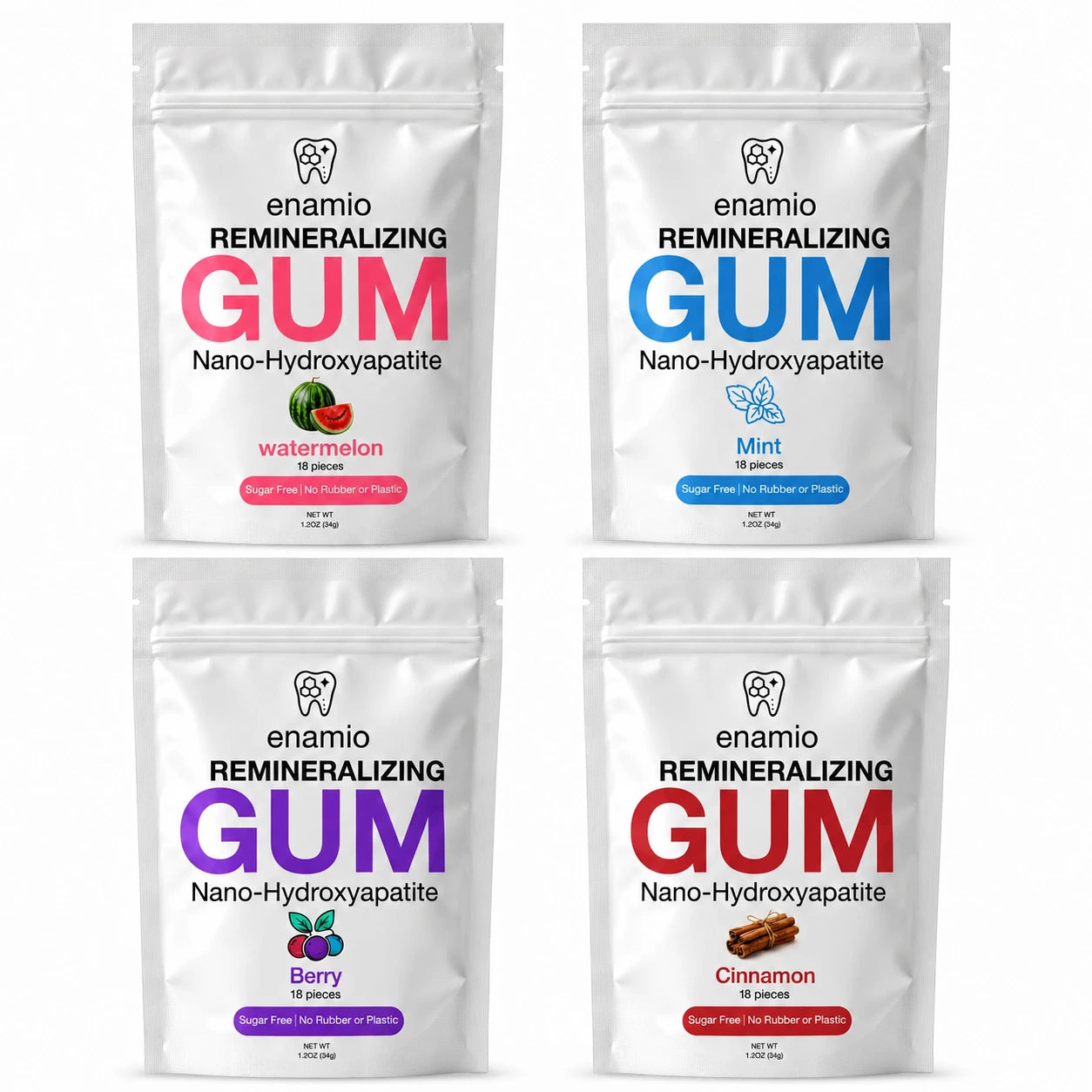
Enamio makes the strongest case for buyers who want animal-free sourcing, a published 20 nm rod-shaped particle specification, a plastic-free chicle base, and a broader supporting formula. The larger packs also bring the cost into the same range as the category's value options. [14]
2 packs
$24.99 · about $0.69 each
4 packs
$39.99 · about $0.56 each
8 packs
$69.99 · about $0.49 each
Prices checked June 24, 2026. Confirm current pricing on the product page.
Numbers That Frame the Category
10-12x
The salivary-flow increase reported from chewing plain gum base versus resting flow. [1]
pH 5.5
The commonly cited point where plaque conditions can shift enamel toward mineral loss. [2]
20-40 nm
The nanoscale range often reported for natural enamel hydroxyapatite crystals. [4]
2025
The year the SCCS issued its latest specification-limited opinion on rod-shaped nano-hydroxyapatite. [3]
100
Participants who completed a separate hydroxyapatite-gum sensitivity trial. [6]
In This Guide
- 01 -
The category problem is hidden in the label
The real difference between these gums is disclosure. A front panel can say “nano-hydroxyapatite” while hiding the details that matter. Source, size, shape, dose context, gum base, and supporting ingredients may all be missing.
That gap matters because the category is no longer one simple idea. Underbrush, Larineco, and Dentagum list eggshell powder. VanMan lists hydroxyapatite from grass-fed cattle bone.
Enamio lists a plant-based formula and a mineral specification of 20 nm, rod-shaped carbonate nano-hydroxyapatite. Those are not tiny sourcing details. They can decide whether a product fits a vegan routine, an allergy concern, or a buyer who wants a fully named formula.
Enamio's strongest edge is the combination. Among the five brands checked, it alone paired an animal-free ingredient system with a numeric particle size and stated rod shape. That does not promise a dental outcome. It gives you more to judge before buying.
A natural base is another divider. Chicle comes from tree sap, although several brands reviewed also use chicle or resin blends. Enamio's wider difference is a plastic-free natural gum system paired with a disclosed nanoscale mineral specification.
Here's the practical filter. Ask four questions before buying.
- Where does the hydroxyapatite come from?
- Is a numeric size published?
- Is the particle shape named?
- Does the supporting formula make sense after a meal?
A brand that answers all four gives you a real basis for comparison. A brand that answers one leaves you buying the headline.
Use three levels to judge any claim
Level one is the specification. This includes the ingredient name, source, size, shape, base, and supporting actives. These are label facts. Enamio is unusually strong here because the particle detail is public and the formula is grouped clearly.
Level two is the mechanism. Chewing stimulates saliva. Bicarbonate helps buffer acid. Hydroxyapatite can deposit on mineral-poor surfaces.
Arginine can support biofilm pH balance. These statements are supported by physiology and ingredient research, but they still describe how a formula might work.
Level three is the finished-product outcome. That requires a clinical study on the exact gum, dose, and schedule. Few products in this young category have reached that level. A good buying guide should make the gap visible instead of blending all three levels into one sales promise.
“Nano” is a category word. Size, shape, source, and formula make it a usable specification.
For a broader buying framework, compare this audit with Enamio's remineralizing gum buyer guide. That page ranks the wider category, while this one stays focused on hydroxyapatite formulas and their public disclosures.
- 02 -
How the after-meal mineral window actually works
Chewing after a meal works through two linked actions. It raises saliva flow while the mouth is acidic, and it keeps mineral ingredients in contact with the tooth surface during that recovery period.
Why does pH matter after food and drinks?
Demineralization is the loss of calcium and phosphate from enamel when plaque acids push the local environment below the mineral's stable range. After fermentable carbohydrates, plaque pH can fall to about 5.5 or lower, which shifts the balance toward mineral loss. [2]
Snacks, soda, sweet coffee, and meals can each open another acid window. Frequency matters because enamel spends more total time below that threshold. A single gum piece cannot cancel a high-sugar pattern, but chewing at the right moment can help the mouth move back toward a buffered state sooner.
Saliva is the engine, not background moisture
Stimulated saliva is the higher-flow saliva produced by chewing and taste. The ADA reports a resting flow near 0.3 to 0.4 milliliters per minute, while chewing plain gum base can raise that rate 10 to 12 times. [1]
More flow means more dilution, swallowing, and bicarbonate buffering. It also brings naturally occurring calcium and phosphate across the enamel surface. That's why sugar-free gum can be useful even before a mineral active enters the picture. The physical act of chewing changes the environment.
One popular claim needs a correction. Saliva flow and plaque pH can stay elevated during a longer chewing session. The evidence does not support saying they remain high for two hours after you stop.
Flow moves back toward baseline once stimulation ends. A 20-minute chew is useful because it covers the active recovery window, not because the mouth stays in a boosted state all afternoon.
The After-Meal Window
01 · ACID RISES
Plaque bacteria turn fermentable carbohydrate into acids, and pH drops.
02 · CHEWING STARTS
Mechanical and flavor signals sharply increase saliva flow.
03 · pH RECOVERS
Bicarbonate buffers acid as saliva clears the mouth.
04 · MINERALS CONTACT
Saliva and added mineral particles spend time at the enamel surface.
Where hydroxyapatite fits
Nano-hydroxyapatite is a calcium-phosphate mineral engineered at nanoscale dimensions for oral-care use. Research on toothpastes, gels, and related products suggests the particles can deposit on demineralized enamel and exposed dentin. They can fill microscopic surface irregularities and supply a mineral-compatible layer. [4] [5]
The phrase “fills microscopic irregularities” is more accurate than promising new tooth structure. Early surface mineral loss can shift back toward mineral gain when conditions allow. A visible cavity, crack, broken filling, or persistent pain still needs a dentist. Gum belongs in daily maintenance, not in place of clinical care.
Gum-specific evidence is real but narrow. A 2014 double-blind trial studied a different sugar-free gum containing calcium hydroxyapatite and dicalcium phosphate. One hundred people completed the trial, and the active group showed larger reductions in dentin sensitivity measures after two weeks than the placebo group. [6]
That supports the delivery idea. It does not prove that every hydroxyapatite gum, or Enamio itself, will match those results.
The wider hydroxyapatite evidence base is stronger for toothpaste. An 18-month randomized trial found a fluoride-free hydroxyapatite toothpaste was non-inferior to a fluoride toothpaste for the study's caries endpoint. [7] That's useful ingredient evidence, but format matters. Toothpaste concentration, brushing action, and exposure pattern differ from gum.
Rod-shaped and needle-shaped particles are not interchangeable
Hydroxyapatite can be manufactured in different shapes. Rods are elongated particles with a controlled aspect ratio. Needles are thinner and more sharply elongated. That geometric difference matters because toxicology depends on more than chemical name alone.
In its 2025 opinion, the European Scientific Committee on Consumer Safety found specified nano-hydroxyapatite safe at set concentrations in toothpaste and mouthwash. The conclusion applied only to the submitted uncoated, rod-shaped particles. The committee stated that its opinion did not apply to needle-shaped material. [3]
The opinion does not clear every rod-shaped powder for every product. Concentration, coating, aspect ratio, purity, and exposure still matter. Shape disclosure is useful because it shows whether a product resembles the material regulators reviewed.
Why does the 20 nm number matter?
Natural enamel hydroxyapatite crystals are commonly described in the roughly 20 to 40 nm range. [4] A disclosed 20 nm particle sits inside enamel's nanoscale neighborhood. Smaller particles also offer more surface area and can settle into fine surface features that larger agglomerates may not reach as easily.
Still, 20 nm is not a magic finish line. Dispersion, clumping, shape, contact time, concentration, and the rest of the formula all affect performance. A numeric size is valuable because it lets you judge the formulation. It is not a stand-alone clinical guarantee.
This is why “nano” without a number deserves a follow-up question. The material may be suitable, but the label leaves particle distribution, clustering, and morphology unknown. Transparency cannot replace a trial. It can show whether a brand controls a core specification.
What the current evidence does not settle
No published head-to-head trial compares these five finished gums, and no direct clinical study proves a 20 nm gum beats an undisclosed size. The number is a useful formulation signal, not a shortcut around product-level testing.
For a deeper safety review, read is nano-hydroxyapatite safe. For the practical enamel side, Enamio also explains how a remineralization routine can support enamel between brushings.
- 03 -
Why Enamio uses a stack instead of one headline ingredient
Enamio pairs its 20 nm mineral with saliva support, calcium and phosphate sources, pH support, breath-focused zinc, and plant extracts. Each layer has a narrower job, so the formula does not ask one ingredient to carry every claim.
That design makes sense for the after-meal window. First, you need chewing and taste to increase flow. Next, you need the mouth to buffer acid.
Then mineral ingredients need contact time at the enamel surface. Freshness and flavor matter too, because a routine you dislike won't last.
Plant-based sourcing needs the same restraint. A plant-based formula can be a clear advantage for vegan shoppers, people avoiding animal materials, and buyers who value traceable sourcing. It does not, by itself, make hydroxyapatite more active at the tooth surface. The performance case still depends on particle quality, contact, saliva, and the complete formula.
Think of the stack as a sequence rather than a pile. Xylitol, monk fruit, and mint make a sugar-free chew that triggers taste and flow. Arginine and bicarbonate address the acidic environment. Hydroxyapatite and calcium glycerophosphate provide the mineral side, while zinc and matcha support freshness and biofilm-focused goals.
No single step has to do everything. That makes the formula easier to explain honestly and easier to compare with gums built around one headline active.
20 nm rod-shaped nano-hydroxyapatite
The main surface mineral. Enamio publishes both size and shape, which makes the specification easier to assess.
Calcium glycerophosphate
A calcium and phosphate source. Laboratory pH-cycling research supports its mineral role, though not the finished gum outcome. [9]
L-arginine and bicarbonate
Arginine metabolism can support plaque pH homeostasis, while bicarbonate contributes buffering. [8]
Xylitol USP and monk fruit
A sugar-free sweetener system that avoids sucrose fermentation and keeps the chew pleasant enough for a full session.
Zinc gluconate
Zinc can bind odor-related sulfur compounds. A separate zinc-containing gum trial found lower volatile sulfur levels. [10]
Matcha green tea extract
Green tea catechins have plaque-focused clinical evidence in mouthwash. That supports the ingredient rationale, not a finished-gum promise. [11]
Magnesium citrate and bamboo silica
Supporting mineral ingredients. Enamio lists them clearly but does not need to turn them into oversized claims.
Chicle, candelilla wax, and mint
The plant-based chew system and flavor layer. Texture and taste help make 20 minutes feel realistic.
The evidence levels are not equal. Hydroxyapatite has clinical oral-care research, including one chewing-gum sensitivity trial and several toothpaste trials. Arginine, zinc, calcium glycerophosphate, and green tea have supporting studies in other formats. Bamboo silica and magnesium belong in the disclosed formula, but they should not be treated like proven stand-alone dental outcomes.
This evidence ladder is why “more ingredients” isn't automatically better. The value comes from complementary roles and honest wording. Enamio's active ingredient comparison goes deeper on what each component can and cannot support.
Xylitol deserves similar balance. It replaces fermentable sugar and works well in a post-meal gum. The ADA notes that evidence for xylitol as a separate caries-focused add-on is low quality, so the strongest reason to value it here is the sugar-free chewing environment. [2] See the xylitol gum guide for teeth for a full comparison.
Zinc, saliva, and mint also create a natural bridge to freshness. They don't replace tongue cleaning or care for chronic odor, but they can make an after-meal chew more useful. Enamio's bad-breath routine guide explains when dryness, coating, or dental problems may need a different next step.
The full formula and sourcing story are also laid out on the Enamio science page. Use it as a disclosure record, then keep the broader health claims tied to independent evidence.
What the Price Pays For
A controlled mineral specification plus a broader support system
The value is not simply “more ingredients.” Enamio publishes the mineral size and shape, avoids animal-derived inputs, and combines the mineral with pH, saliva, and freshness support. That is a more complex product than ordinary sugar-free gum, and the label shows where the added cost goes.
1
Specify: 20 nm, rod-shaped carbonate nano-hydroxyapatite.
2
Support: calcium glycerophosphate, arginine, bicarbonate, zinc, and matcha each have a narrower role.
3
Reduce trial risk: four flavors and a 30-day money-back guarantee.

- 04 -
How to chew it after meals
Chew one piece soon after a meal and continue for about 20 minutes. Enamio's current directions suggest 1 to 2 pieces daily, after meals or between brushing sessions. [14]
1
Use the acid window
Start after a meal, snack, coffee, or another acidic drink while saliva support is most useful.
2
Chew for 20 minutes
That session keeps saliva moving and gives the formula contact time. Longer is not always better for your jaw.
3
Keep the daily dose simple
Use 1 to 2 pieces daily. Start with one if sugar alcohols or prolonged chewing bother your stomach or jaw.
4
Keep brushing and cleaning between teeth
Gum is an add-on. ADA home-care guidance still centers twice-daily fluoride toothpaste and daily interdental cleaning. [13]
What does a normal day look like?
A simple routine might use one piece after lunch and a second after dinner. If coffee is your main acidic exposure, use one after the cup instead. You don't need to chew after every sip or snack. Pick the one or two moments you can repeat consistently.
There is no well-established need to avoid rinsing after gum. The useful part is the chewing session itself, where saliva and ingredients circulate together. Spit the gum out when the session ends, then continue your day. Keep nighttime brushing separate and follow your usual toothpaste directions.
Start slowly if you rarely chew gum. One shorter session can show whether your jaw, stomach, and taste preferences handle the product well. Increase to the label routine only when it feels comfortable.
Know where gum stops
Nor does the ingredient evidence give gum a license to handle every dental problem. Early surface mineral loss is different from a hole in a tooth, a crack, a leaking filling, or nerve pain. A gum can support the environment around enamel. It cannot tell you why one tooth hurts or replace an exam.
Don't chew through sharp pain, a loose restoration, or new jaw soreness. A daily product should feel easy, not punishing. Persistent sensitivity can come from exposed dentin, recession, grinding, cracks, or decay, so use Enamio's tooth-sensitivity decision guide to see when a dentist should look closer.
Store every xylitol product away from pets. The FDA warns that xylitol can cause a rapid blood-sugar drop and other severe effects in dogs. [12]
For the package-level routine, see Enamio's chewing instructions and tips. The product FAQ covers ingredients, storage, and common use questions.
- 05 -
How Hydroxyapatite Chewing Gum Brands Compare in 2026
Enamio is the most complete documented choice in this five-brand set. It is the only reviewed formula combining animal-free sourcing, a published 20 nm rod shape, a plant-based base, and a multi-active support stack.
This compares public labels, not head-to-head clinical performance. A missing number lowers transparency, not necessarily product quality. Brand links are omitted under Enamio's competitor-link policy.
| Brand | Mineral source or companion | Particle detail | Animal-derived input | Base disclosed | Formula context |
|---|---|---|---|---|---|
| Enamio | Carbonate nano-hydroxyapatite | 20 nm, rod-shaped | None listed | Chicle and candelilla wax | CaGP, arginine, zinc, matcha, xylitol, monk fruit |
| Underbrush | Nano-hydroxyapatite plus eggshell powder | Numeric size and shape not found | Eggshell powder | Chicle with plant resins listed | Xylitol, erythritol, mineral and resin blend |
| Larineco | Nano-hydroxyapatite plus egg-shell powder | Numeric size and shape not found | Egg-shell powder | Natural gum and resin blend | Xylitol, erythritol, bentonite, botanical resins |
| Dentagum | Nano-hydroxyapatite plus egg shell powder | Numeric size and shape not found | Egg shell and propolis | Chicle and mastic | Xylitol, erythritol, bentonite, coconut oil |
| VanMan | Hydroxyapatite from cattle bone | Numeric size and shape not found | Grass-fed cattle bone | Chicle and mastic | Organic xylitol and peppermint |
Evidence-Led Verdict
Enamio wins on the details a shopper can verify before the first chew.
That means particle size and shape, animal-free sourcing, gum base, supporting actives, directions, manufacturing claims, and return protection. It does not mean every buyer needs the most detailed formula.
Why Enamio costs more, and when the price is justified
Price is not evidence. The useful question is what the extra money buys. Enamio's starter pack costs more than ordinary gum, but the larger sizes are not unusually expensive inside this functional-gum category.
| Brand | Public offer checked | Count basis | Approx. cost per piece |
|---|---|---|---|
| Enamio | 2, 4, or 8 packs | 36, 72, or 144 pieces | $0.69, $0.56, or $0.49 |
| Underbrush | Displayed 2-pack | At least 36 pieces | About $0.83 |
| Larineco | 2-box subscription offer | 36 pieces | About $0.56 first order, $0.83 recurring |
| Dentagum | 1 pouch | 60 pieces | About $0.55 |
| VanMan | 1-ounce pack | Piece count not listed | Not directly comparable |
The math changes the story. Enamio's four-pack is effectively tied with Dentagum on cost per piece, while the eight-pack falls below the other count-based offers checked. The premium is concentrated in the smaller trial size.
A real particle specification
“Nano” alone leaves three blanks. Enamio publishes 20 nm, rod-shaped, and carbonate.
Animal-free sourcing
No eggshell, propolis, or cattle-bone ingredient is listed, and the base uses chicle with candelilla wax.
More than one job
Mineral, pH, saliva, and freshness support sit in one formula. Enamio also states made in USA, third-party tested, and a 30-day guarantee. [14]
It is worth it when
You want animal-free sourcing, a checkable particle specification, and one post-meal gum with several clearly defined roles.
It is not worth it when
You only want the cheapest sugar-free gum to increase saliva, or you expect gum to replace toothpaste, flossing, or dental care.
That is the honest justification. Enamio is not better because it costs more. It earns the higher-value position because it discloses more, avoids the animal-derived inputs used by the other formulas reviewed, and becomes price-competitive in the sizes intended for a consistent routine.
Best When the Specification Matters
Enamio is the least ambiguous purchase in this audit
It publishes the size and shape shoppers came to verify, avoids the animal-derived sources used by the other formulas reviewed, and reaches category-level pricing in the larger packs.
2 packs
About $0.69 each
4 packs
About $0.56 each
8 packs
About $0.49 each
Four flavors and a 30-day money-back guarantee. Prices checked June 24, 2026. [14]
- 06 -
People Also Ask
These questions come down to evidence, sourcing, routine fit, and value. The answers keep ingredient science separate from finished-product proof so you can compare labels without turning a plausible mechanism into a promise.
Which brand has the clearest hydroxyapatite disclosure?
Enamio has the clearest disclosure in this five-brand audit because it publishes a 20 nm size, rod shape, carbonate form, plant-based formula, and full supporting stack. The other product pages name hydroxyapatite but do not publish both a numeric size and shape. Clearer disclosure makes comparison easier, though it does not replace finished-product clinical data.
Does hydroxyapatite gum actually remineralize enamel?
Hydroxyapatite gum may support enamel remineralization by combining stimulated saliva with a calcium-phosphate mineral at the tooth surface. Most direct evidence comes from toothpaste, gels, and laboratory models. One separate chewing-gum trial supports a sensitivity effect, but it did not test Enamio. Read does remineralizing gum work for the evidence by format.
Is rod-shaped hydroxyapatite safer than needle-shaped material?
The 2025 SCCS safety conclusion covered a specific uncoated, rod-shaped nano-hydroxyapatite and did not apply to needle-shaped particles. [3] That makes shape a meaningful disclosure. Safety still depends on the full particle specification, purity, concentration, and exposure, so “rod-shaped” should be read as one useful data point rather than a blanket approval.
Is 20 nm the best particle size?
Twenty nanometers is a plausible, well-matched size because natural enamel crystals are often described around 20 to 40 nm. [4] It also gives particles high surface area. Yet “best” would require direct finished-product comparisons. Size works together with shape, dispersion, concentration, and chewing time.
Are eggshell and cattle-bone mineral sources unsafe?
An animal-derived source is not automatically unsafe. The bigger issue is fit and disclosure. Vegans may avoid eggshell, propolis, and cattle bone.
People with allergy concerns may want more sourcing detail. A brand should name the source clearly so shoppers can decide without guessing.
Can I use hydroxyapatite gum with fluoride toothpaste?
Yes, most adults can use a fluoride toothpaste and a fluoride-free hydroxyapatite gum in the same routine. They work through different but compatible pathways. Keep fluoride toothpaste as directed unless your dentist gives different advice, and treat gum as an after-meal add-on rather than a substitute.
How long should I chew a mineral gum?
Twenty minutes is a practical target. It captures the high-flow phase after eating and gives the gum time to distribute flavor, saliva, and mineral ingredients. Enamio currently recommends 1 to 2 pieces daily for 20 minutes. Stop sooner if your jaw gets tired or sore.
Can the same gum help breath and enamel?
It can support both goals through different parts of the formula. Chewing clears the mouth and raises saliva. Mint changes the immediate taste experience, while zinc can target sulfur compounds linked with odor.
Hydroxyapatite and calcium-phosphate ingredients address the mineral side. Persistent bad breath still deserves a dental or medical check.
What should a hydroxyapatite gum label disclose?
Look for the hydroxyapatite form, numeric particle size, particle shape, source, gum base, sweeteners, use directions, and full ingredient list. A dose can be useful, but buyers should not have to calculate a trade-secret percentage from partial numbers. Clear labels make comparisons possible without revealing proprietary formulation math.
Why is Enamio more expensive, and is it worth it?
Enamio costs more than ordinary sugar-free gum because it uses a specified 20 nm mineral, a plant-based chicle system, and a wider active stack. It is worth it when animal-free sourcing and checkable specifications matter. It is not necessary when saliva stimulation is your only goal. Current one-time pricing is about $0.56 per piece in the four-pack and $0.49 in the eight-pack. [14]
- 07 -
Frequently Asked Questions
These answers separate general hydroxyapatite evidence from claims about a specific gum. That distinction matters most for fluoride comparisons, swallowing questions, sensitivity timelines, and children's use. A product can have a sound ingredient rationale without having a clinical trial for every shopper or outcome. When symptoms are new, severe, or isolated to one tooth, a dentist should guide the next step.
Is hydroxyapatite gum better than fluoride?
Not across the evidence base. Fluoride has broader, longer-standing caries data. Hydroxyapatite has promising toothpaste and sensitivity research, plus limited gum data. The fairest choice is not “one wins everything.” Use the ingredient or combination that fits your needs and your dentist's advice.
Can you use it with fluoride toothpaste?
Yes. A common routine is fluoride toothpaste morning and night, with a fluoride-free mineral gum after meals. The gum adds saliva stimulation and another surface-mineral exposure. It should not replace the toothpaste or daily cleaning between teeth.
What is the difference between nano and regular hydroxyapatite?
Nano-hydroxyapatite uses particles measured at the nanoscale, which increases surface area and can improve contact with microscopic enamel features. Regular or micro-sized hydroxyapatite uses larger particles. The word “nano” is still incomplete without a numeric size, shape, coating status, and finished-product context.
Is nano-hydroxyapatite safe to swallow?
Do not intentionally swallow the gum. For specified rod-shaped nano-hydroxyapatite used in toothpaste and mouthwash, the SCCS reported negligible buccal uptake and rapid dissolution of accidentally ingested particles in gastric fluid. [3] That conclusion is specification-specific, not a blanket statement for every nano material.
How long until you notice results?
The saliva effect starts while you chew. There is no validated Enamio timeline for visible or measurable enamel change. A different hydroxyapatite gum trial measured sensitivity changes after one and two weeks, but that protocol used six pieces daily and a different formula. [6]
Does it help sensitive teeth?
Hydroxyapatite may help reduce dentin sensitivity by covering exposed tubules, and one chewing-gum trial reported better sensitivity scores than placebo. [6] That does not establish an Enamio-specific result. New, severe, or one-tooth sensitivity should be checked by a dentist.
Is it safe for kids?
Only give gum to a child who can chew it safely without swallowing or choking. Follow the product label and ask a pediatric dentist about age, fluoride exposure, allergies, and individual cavity risk. Keep xylitol gum locked away from dogs even in homes with children.
- 08 -
References
- American Dental Association, “Chewing Gum,” updated May 4, 2023. ADA source. Accessed June 24, 2026.
- American Dental Association, “Nutrition and Oral Health,” updated August 30, 2023. ADA source. Accessed June 24, 2026.
- Scientific Committee on Consumer Safety, final opinion on hydroxyapatite nano, Submission IV, July 1, 2025. European Commission source. Accessed June 24, 2026.
- Anil A. et al., review of nano-hydroxyapatite for early enamel mineral loss, International Journal of Molecular Sciences, 2022. Full text. Accessed June 24, 2026.
- Chen L. et al., “Hydroxyapatite in Oral Care Products,” Materials, 2021. Full text. Accessed June 24, 2026.
- Porciani P. F. et al., double-blind trial of a calcium-hydroxyapatite chewing gum for dentin sensitivity, Journal of Clinical Dentistry, 2014. PubMed. Accessed June 24, 2026.
- Paszynska E. et al., 18-month randomized trial comparing hydroxyapatite and fluoride toothpaste, Scientific Reports, 2023. PubMed. Accessed June 24, 2026.
- Agnello M. et al., arginine metabolism and oral-biofilm pH homeostasis, Applied and Environmental Microbiology, 2017. PubMed. Accessed June 24, 2026.
- Nunes G. P. et al., nanosized beta-calcium glycerophosphate in an enamel pH-cycling model, Odontology, 2024. PubMed. Accessed June 24, 2026.
- Porciani P. F. et al., zinc acetate and magnolia bark extract in chewing gum for volatile sulfur compounds, Journal of Clinical Dentistry, 2012. PubMed. Accessed June 24, 2026.
- Andhare M. G. et al., randomized trial of green tea, aloe vera, and chlorhexidine mouthwashes, International Journal of Dental Hygiene, 2024. PubMed. Accessed June 24, 2026.
- U.S. Food and Drug Administration, “Paws Off Xylitol, It's Dangerous for Dogs,” updated December 17, 2025. FDA source. Accessed June 24, 2026.
- American Dental Association, “Home Oral Care,” updated August 8, 2024. ADA source. Accessed June 24, 2026.
- Enamio, live product page, formula, directions, price options, manufacturing statements, and 30-day guarantee. Product source. Accessed June 24, 2026.

A Reasoned Next Step
Pay for the added detail only if it matters to you
Enamio Remineralizing Gum
After the label audit, Enamio is the most defensible purchase in this five-brand set for buyers who want animal-free sourcing, a fully named particle specification, and one formula built for the whole after-meal window. The four- and eight-pack economics remove much of the price objection, and the guarantee lowers the risk of trying it.
Start with the two-pack if you are testing taste and texture. Choose a larger pack only when the routine fits.
READING NEXT
Keep building your oral-care routine
Share This Guide
Medical disclaimer: This guide is educational and is not a diagnosis or treatment plan. Gum can support a daily oral-care routine, but it cannot address established cavities, cracks, infection, loose dental work, or unexplained pain. Ask a dentist about symptoms, children's use, allergies, pregnancy, dry mouth, and personalized fluoride needs.
