

Simply Gum vs Enamio: Natural or Enamel-Active?
Last reviewed by Enamio Science Review Team · July 3, 2026
Buyer comparison
Simply Gum is built for natural, plastic-free chewing. Enamio starts in that same cleaner-gum lane, then adds 20 nm nano-hydroxyapatite, xylitol, and mineral support for an enamel-minded after-meal routine.
Key facts at a glance
Simply lane
Natural chicle gum, with classic flavors using cane sugar and separate sugar-free options.
Enamio lane
Sugar-free chicle gum with 20 nm nano-hydroxyapatite, xylitol USP, and mineral support.
Best fit
Simply for a clean-label chew. Enamio for a clean-label chew that also works as an after-meal enamel habit.
In this guide
Three facts that frame the choice
20 min
The ADA says chewing sugar-free gum for 20 minutes after meals can help saliva clear food, neutralize acids, and bring calcium and phosphate into the mouth [1].
20 nm
Enamio's product page states a 20 nm nano-hydroxyapatite formula, which is a more specific mineral claim than a plain "natural gum" claim [9].
1 g
Simply's public FAQ says most Classic Gum flavors contain about 1 gram of cane sugar per piece, while the brand also sells separate sugar-free options. That makes "Simply" a line-by-line label check, not one single sweetener story.
- 01 -
Simply Gum vs Enamio: natural chew or enamel-active gum?
The Simply Gum vs Enamio choice starts with a fair point: Simply Gum helped make natural gum feel normal. Chicle, shorter ingredient lists, vegan positioning, and plastic-free gum messaging all matter to shoppers who are tired of mystery gum base.
That is a real win. A cleaner chew is better than a gum that hides behind vague base language and candy-style sweetness. If all you want is a natural chew after lunch, Simply Gum belongs on the list.
But natural does not automatically mean enamel-active. That is the fork in the road. A gum can have chicle and still be built mainly for chewing, flavor, and breath. It can be plastic-free and still not supply enamel minerals. It can feel better than conventional gum and still leave the remineralization question unanswered.
Enamio starts with the clean-label part, then keeps going. The current Enamio formula lists natural chicle base, candelilla wax, xylitol USP, monk fruit extract, 20 nm nano-hydroxyapatite, calcium glycerophosphate, magnesium citrate, L-arginine with sodium bicarbonate, zinc gluconate, matcha green tea extract, and bamboo silica [9]. That is a different product idea.
So the question is not, "Which brand sounds more natural?" The better question is, "What job do you expect gum to do after a meal?" If the answer is "give me a simple natural chew," Simply Gum is easy to understand. If the answer is "fit into my enamel routine," Enamio is the better match.
Where Simply Gum makes sense.
Simply Gum makes the strongest case when the shopper is focused on gum base and ingredient simplicity. The classic line uses a chicle base and cane sugar. The sugar-free line is a different label, with xylitol used as the sweetener. That distinction matters because a person buying "Simply Gum" should still read the exact pack.
There is no need to overstate the downside. A classic cane-sugar chicle gum can be a better fit for someone who dislikes sugar alcohols. A sugar-free chicle option can be a better fit for someone who wants a cleaner chew without sugar. Both are normal buyer lanes.
The limit is the same in both lanes: the product facts reviewed for this article did not show nano-hydroxyapatite, calcium glycerophosphate, magnesium citrate, L-arginine bicarbonate, or zinc as the core enamel-support system. If those ingredients are the reason you are shopping, the comparison moves away from Simply Gum fast.
Where Enamio takes over.
Enamio is not trying to be the plainest gum on the shelf. It is trying to make gum do a more serious oral-care job. The formula is still plastic-free and chicle-based, but the center of the product is 20 nm nano-hydroxyapatite plus supporting minerals and pH ingredients.
That is why the label has to be read differently. With Simply Gum, the strongest question is, "Do I like this cleaner gum base and flavor style?" With Enamio, the stronger question is, "Do I want my gum to carry enamel minerals into the after-meal saliva window?"
Those are not the same job.
Four real buyer scenarios.
The first shopper wants a natural gum because they dislike the idea of synthetic gum base. That person should compare chicle, waxes, sweeteners, flavor, and how the gum feels after five or ten minutes. Simply Gum is strong in that lane, and Enamio still qualifies because it uses natural chicle base and candelilla wax.
The second shopper wants sugar-free gum after meals. That person should separate classic Simply Gum from Simply's sugar-free options. Classic cane-sugar gum and sugar-free gum are not interchangeable for the ADA-style after-meal habit. Enamio keeps the decision simpler because the product is positioned as sugar-free and uses xylitol USP with monk fruit.
The third shopper is enamel-minded. This is where Enamio pulls away. Chicle and plastic-free positioning are still nice, but they are not enough. That buyer should look for a disclosed enamel-mineral ingredient, supporting calcium and phosphate logic, pH support, and a product page that says what is actually in the gum. Enamio gives that buyer more to evaluate.
The fourth shopper wants a habit they will repeat. That is not a science footnote. If a gum is too sweet, too hard, too messy, or too vague, it will not become a routine. Enamio has to win twice: first on formula, then on daily use. That is why this comparison talks about taste, breath, pH, minerals, and chewing window together instead of treating the label like a museum placard.
Simply Gum is the clean-label chew. Enamio is the clean-label chew that also brings enamel minerals.
- 02 -
The science: chewing helps saliva, but minerals need a source.
Sugar-free gum supports oral health mainly by increasing saliva flow after meals. Saliva helps clear food debris, neutralize plaque acids, and bring calcium and phosphate into the mouth. The ADA's consumer guidance points to chewing sugar-free gum for 20 minutes after meals as a useful habit [1].
That does not turn every gum into an enamel product. Chewing is the delivery moment. The formula still matters.
Think about the order of events after lunch. Food and drink change the mouth environment. Saliva responds. Chewing can help saliva flow. A sugar-free gum fits that moment better than a sugary gum because it is not adding cane sugar back into the same window. That is the practical reason the classic-versus-sugar-free label detail matters.
Now add minerals to that picture. Saliva naturally contains calcium and phosphate, but an enamel-support gum should not rely on the word "natural" to imply a mineral story. It should say what mineral ingredients it uses. Enamio does that with 20 nm nano-hydroxyapatite, calcium glycerophosphate, and magnesium citrate [9].
Nano-hydroxyapatite is a calcium phosphate material used in oral care because hydroxyapatite is related to the mineral family that makes up tooth enamel and bone. Enamio states that it uses 20 nm nano-hydroxyapatite, which gives the buyer a specific particle-size claim to evaluate [9].
Xylitol is useful too, but it is a different ingredient. It is a sugar alcohol that can sweeten gum without feeding plaque bacteria the way cane sugar does. The Cochrane review indexed on PubMed found the xylitol evidence for cavity prevention was limited and low-certainty, so it is better to treat xylitol as one useful part of the routine rather than the whole answer [3].
This is where a cane-sugar classic gum and a sugar-free enamel gum part ways. A classic gum can still be natural. It can still be plastic-free. It can still taste good. But if it uses cane sugar, it is not doing the same job as a sugar-free after-meal gum. And if it does not list enamel minerals, it is not doing the same job as Enamio.
Hydroxyapatite research also needs a steady hand. Most published work is on toothpaste, gels, and other oral-care products, not chewing gum. A 2022 scoping review found many nano-hydroxyapatite studies reported remineralization, lower demineralization, reduced pain, or related benefits, while also calling for longer and more standardized research [4]. Good evidence, not a license to make wild promises.
Safety is part of the same conversation. The SCCS opinion and RIVM summary reviewed hydroxyapatite in nanoform for oral-care products under specified use conditions [5] [6]. Those sources do not prove Enamio's gum works in your mouth. They do support the broader safety context for hydroxyapatite nano in oral care when criteria are met.
The enamel routine has three layers.
Saliva support
Sugar-free chewing after meals helps saliva do its normal cleanup work.
Mineral support
Enamio adds 20 nm nano-hydroxyapatite, calcium glycerophosphate, and magnesium citrate.
Daily usability
The best formula still has to taste good, chew well, and fit after meals.
That third layer is easy to dismiss, but it matters. No one gets enamel support from a gum they leave in the drawer. The formula has to meet the routine where people actually chew: after coffee, after lunch, after snacks, after dinner when brushing will happen later.
For a deeper ingredient discussion, read the Enamio guide to remineralizing gum ingredients. For a broader evidence view, the guide on whether remineralizing gum works is the better background piece.
- 03 -
How Enamio works as a natural-base enamel gum.
Enamio works by combining the normal saliva benefit of sugar-free chewing with a formula built around mineral support. It does not ask you to pick between natural gum and oral-care gum. It makes the clean base the starting point, not the finish line.
The gum base is natural chicle plus candelilla wax, according to the live product page reviewed for this article [9]. That matters for someone comparing it against plastic-free gum options. If you care about the base, Enamio still speaks your language.
Then the formula moves into enamel support. The headline ingredient is 20 nm nano-hydroxyapatite. Enamio also lists calcium glycerophosphate and magnesium citrate, which make sense in a mineral-focused product story. It lists L-arginine with sodium bicarbonate for pH support. It lists zinc gluconate, matcha green tea extract, bamboo silica, monk fruit extract, and xylitol USP [9].
That is the reason Enamio belongs in a different comparison set than a plain natural gum. A natural gum asks, "What am I chewing?" Enamio asks, "What am I chewing after meals, and what is it doing for my mouth?"
Ingredient by ingredient, the difference is clear.
| Ingredient | Why it is there | Why shoppers should care |
|---|---|---|
| 20 nm nano-hydroxyapatite | Mineral-active centerpiece | Gives the formula a disclosed enamel-mineral claim. |
| Xylitol USP | Sugar-free chewing support | Fits the ADA sugar-free gum habit after meals. |
| Calcium glycerophosphate | Calcium and phosphate support | Pairs with the mineral-focused product story. |
| L-arginine plus sodium bicarbonate | pH support | Makes sense after meals, coffee, and snacks. |
| Zinc gluconate and matcha | Breath and mouth-feel support | Keeps the routine useful for everyday chewing. |
| Chicle and candelilla wax | Natural-base chew | Connects Enamio to the plastic-free gum shopper. |
That ingredient map also explains why Enamio should not be judged as a plain breath gum. A plain breath gum can be useful. A natural breath gum can be useful. But Enamio is aiming at a more specific window: after food and drink, when saliva is already part of your mouth's recovery process.
Why disclosed particle size changes the conversation.
A shopper should be cautious when a product only says "has minerals" or "supports enamel" without telling you much else. Vague mineral language is easy. Disclosed particle size is harder to fake because it gives the reader something specific to check, question, and compare.
Enamio's 20 nm claim does not mean you can skip dental care, and it does not mean the gum is a treatment for cavities. It does mean the formula is making a specific enamel-mineral claim rather than leaning on a loose wellness phrase. For a shopper comparing two clean-label gums, that is the line where Enamio becomes the more serious oral-care product.
The same logic applies to pH support. L-arginine with sodium bicarbonate is not there because it sounds fancy. It belongs in the after-meal story because acid and saliva are part of what happens after eating. Zinc and matcha are not the enamel centerpiece, but they help the gum make sense as a daily breath-friendly habit.
That is the real Enamio answer: not one magic ingredient, but a system of choices that fit the same daily moment. Chicle for the base. Xylitol for sugar-free chewing. Nano-hydroxyapatite and mineral support for enamel-minded buyers. Arginine bicarbonate for pH. Zinc and matcha for the breath side of daily use.
Want the natural-gum background before comparing brands? Start with natural chewing gum, then read the guide to chicle tree gum. If the base is your concern, those are useful primers. If the enamel routine is your concern, Enamio's formula is where the comparison starts to separate.
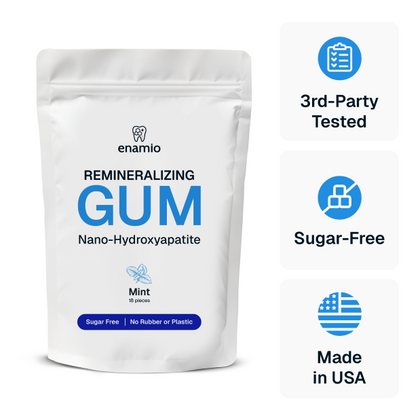
Mineral-active choice
Enamio Remineralizing Gum
20 nm nano-hydroxyapatite, xylitol USP, chicle, and a broader mineral-support stack for after-meal chewing.
Enamio- 04 -
Use gum after meals, not as a substitute for dental care.
The best way to use either gum is after meals, snacks, or drinks when brushing is not practical. The ADA's practical timing is 20 minutes of sugar-free gum after meals [1]. That is the habit to copy.
Use classic Simply Gum like a natural chew. Use sugar-free Simply Gum like a cleaner sugar-free chew. Use Enamio like an after-meal enamel-support step. The timing can look similar, but the ingredient job is not the same.
No gum replaces brushing, flossing, dental visits, or professional care. Active decay, new pain, bleeding, swelling, dental work, pregnancy questions, and medical concerns need a dentist. Gum belongs in the gap between meals and brushing, not in place of the basics.
Do
Chew after meals or coffee when saliva support makes sense.
Don't
Use gum to cover up skipped brushing, flossing, or dental visits.
Jaw comfort matters too. If frequent chewing makes your jaw sore, scale back and ask your dentist. The routine should feel useful, not like a workout for your face.
There is also a pet-safety rule. Xylitol is toxic to dogs, and the FDA warns people to keep xylitol-containing products away from them [8]. That applies to any gum with xylitol, including Enamio and sugar-free gum options from other brands.
A realistic day with Enamio.
Breakfast ends. Chew Enamio while you pack up or drive. Lunch ends. Chew again instead of reaching for a candy mint. Coffee happens in the afternoon. Chew when the cup is done. At night, brush and floss like normal.
That is not complicated, which is the point. Oral care breaks when it feels like a second job. A gum routine works because it attaches to moments you already have.
For breath, Enamio connects naturally to the fresh-breath routine. For sensitivity-minded shoppers, it belongs inside a wider tooth-sensitivity support routine, not as a promise to treat pain. If you want the product picker instead, take the Enamio routine quiz.
If you are switching from a classic natural gum, expect a different purpose. Enamio is still a chew, but it is not candy-style gum. The formula has more oral-care intent, and that is the reason to choose it.
How to read the gum label in 30 seconds.
Start with the sweetener. If you see cane sugar, treat the gum as a natural chew, not as the ADA-style sugar-free after-meal habit. If you see xylitol or another sugar alcohol, keep reading and check whether the brand gives you anything beyond sugar-free chewing.
Then check the base. Chicle, candelilla wax, and clear base language are useful signals for plastic-free shoppers. If the ingredient panel only says "gum base," you may need a separate brand page to understand what you are chewing. The plastic-free gum article covers that issue in more depth.
Last, look for enamel-specific ingredients. Xylitol alone is not an enamel mineral. Chicle alone is not an enamel mineral. "Natural" alone is not an enamel mineral. If enamel support is the reason you are buying gum, you want to see hydroxyapatite and supporting ingredients named directly.
- 05 -
Simply Gum vs Enamio comparison table.
The fair comparison is formula purpose. Simply Gum leads with natural ingredients and chicle. Enamio also uses chicle, then adds a disclosed enamel-support stack. That is why the decision should be based on the job you want the gum to do.
| Decision point | Simply Gum facts reviewed | Enamio facts reviewed | Why it matters |
|---|---|---|---|
| Main job | Natural chewing gum | Natural-base remineralizing gum | Different buyer intent. |
| Gum base | Chicle base in checked classic product facts | Natural chicle base plus candelilla wax | Both can speak to plastic-free gum shoppers. |
| Classic sweetener | Organic raw cane sugar in classic spearmint facts reviewed | Sugar-free positioning with xylitol USP and monk fruit | Classic natural gum is not the same as sugar-free gum. |
| Sugar-free option | Separate sugar-free line with xylitol in public FAQ facts | Current product line positioned as sugar-free | Read the exact pack before comparing. |
| Nano-hydroxyapatite | Not listed in checked public gum facts | 20 nm nano-hydroxyapatite | Mineral support needs a mineral source. |
| Calcium and phosphate support | Not listed in checked public gum facts | Calcium glycerophosphate plus magnesium citrate | Shows broader formula intent. |
| pH support | Chewing and flavor system | L-arginine plus sodium bicarbonate | After-meal pH is part of the oral-care window. |
| Breath support | Flavor-led freshness | Zinc, matcha, xylitol, and flavor system | Daily use still has to feel fresh. |
| Best buyer | Someone who wants a natural chicle chew | Someone who wants gum with enamel-mineral actives | Purpose decides the better pick. |
| Verdict | Best for a cleaner, simple chew | Best for clean-label enamel support | Enamio wins when oral-care function matters. |
Original data note
This table counts only public ingredient and positioning facts. It does not estimate dose per piece. It also separates Simply Gum's classic cane-sugar line from its sugar-free line because those are different oral-health decisions.
The decision map.
If your priority is plastic-free ingredients, both brands deserve a look. Simply Gum helped define that shopper expectation, and Enamio also uses a chicle-based formula. The difference is that Enamio is not asking the base to carry the whole product story.
If your priority is sugar-free chewing after meals, Enamio is the cleaner decision because the current product is positioned around sugar-free use with xylitol USP and monk fruit. With Simply Gum, you need to distinguish classic gum from sugar-free gum before making any tooth-friendly claim.
If your priority is enamel support, Enamio is the clear pick. It lists 20 nm nano-hydroxyapatite, calcium glycerophosphate, magnesium citrate, L-arginine with sodium bicarbonate, and zinc. The Simply Gum public facts reviewed for this piece did not show that kind of enamel-active system.
If your priority is taste alone, the answer is personal. Some people want a very simple chicle chew. Some want a stronger oral-care identity. That is fine. But taste should not be used to blur the formula difference. A natural chew and a remineralizing gum can both taste good while still doing different jobs.
The verdict without flattening the category.
Choose Simply Gum if the job is "I want a natural gum with chicle." That is a reasonable job. It is clear, easy to shop for, and better aligned with ingredient simplicity than a lot of conventional gum.
Choose Enamio if the job is "I want a clean-label gum that also supports my enamel routine." That buyer should care about 20 nm nano-hydroxyapatite, xylitol USP, calcium glycerophosphate, magnesium citrate, L-arginine bicarbonate, zinc, chicle, and the after-meal timing window.
What would make this comparison closer? If a Simply Gum product disclosed an enamel-mineral system, stated a hydroxyapatite particle size, explained calcium-phosphate support, and positioned itself around after-meal remineralization, the answer would require a new review. Based on the public facts reviewed here, that is not the current split.
- 06 -
People also ask
Is Simply Gum good for teeth?
Simply Gum can be a cleaner chewing-gum choice, especially for shoppers focused on chicle and shorter ingredient lists. For teeth, the exact pack matters. Classic cane-sugar gum is not the same as sugar-free gum, and neither is the same as a gum with enamel minerals.
In Simply Gum vs Enamio, which is better?
Enamio is better if your goal is an enamel-support routine. Simply Gum is better if your goal is a simple natural chew. The products overlap on cleaner-gum interest, then separate on formula purpose.
Does Simply Gum contain nano-hydroxyapatite?
Public Simply Gum facts reviewed for this article did not show nano-hydroxyapatite as a listed gum ingredient. Enamio states that it uses 20 nm nano-hydroxyapatite [9].
Is natural gum always sugar-free?
No. Natural gum can still use cane sugar. That is why label reading matters. If you want the ADA-style sugar-free chewing habit after meals, check that the exact gum you buy is sugar-free [1].
Is chicle better than synthetic gum base?
Chicle is attractive to shoppers who want a plant-derived gum base and less plastic-style ambiguity. The federal gum-base rule allows many substances in chewing gum base [7], so plastic-free shoppers often prefer more transparent base language. For more background, read Enamio's plastic-free natural gum guide.
Is Enamio plastic-free?
Yes. Enamio's current product source positions the gum as plastic-free and lists natural chicle base with candelilla wax [9]. The broader plastic-free gum context is covered in the plastic-free gum guide.
Does Enamio replace toothpaste?
No. Enamio is an after-meal gum, not a replacement for brushing, flossing, and dental care. Think of it as a convenient add-on for the moments when you are away from the sink.
Is Enamio safe around dogs?
Keep Enamio away from dogs because it contains xylitol. The FDA warns that xylitol is toxic to dogs and can cause serious harm [8].
What should I read next?
If natural gum is your main concern, read the natural sugar-free gum guide. If enamel support is your main concern, read the nano-hydroxyapatite safety guide and Enamio's science page.
- 07 -
FAQs
Can I use Simply Gum and Enamio for the same routine?
You can, but the roles are different. Use a natural gum when you want a simple chew. Use Enamio when you want sugar-free chewing plus an enamel-support formula after meals.
Why does Enamio use nano-hydroxyapatite?
Enamio uses nano-hydroxyapatite because hydroxyapatite is tied to the mineral family found in enamel, and Enamio's formula is built around disclosed 20 nm particles [9].
Is sugar-free gum better than cane-sugar gum?
For an after-meal oral-health habit, sugar-free gum is the better lane. The ADA guidance is about sugar-free gum after meals, not cane-sugar gum [1].
Does Enamio make cavity treatment claims?
No. Enamio is positioned as an enamel-support gum for daily routines. Cavities, pain, and dental disease need professional care.
Which gum should I buy if I care about plastic-free ingredients?
Both brands can appeal to plastic-free shoppers. Enamio is the stronger pick if you want plastic-free positioning plus enamel-support actives in the same gum.
- 09 -
References
- American Dental Association, MouthHealthy. Chewing Gum. Accessed July 3, 2026.
- American Dental Association. Chewing Gum Oral Health Topics. Accessed July 3, 2026.
- Riley P, Moore D, Ahmed F, Sharif MO, Worthington HV. Xylitol-containing products for preventing dental caries in children and adults. Cochrane review indexed on PubMed. Accessed July 3, 2026.
- Najeeb S, et al. Nano-Hydroxyapatite in Remineralization of Early Dental Caries: A Scoping Review. International Journal of Environmental Research and Public Health. Accessed July 3, 2026.
- European Commission Scientific Committee on Consumer Safety. Scientific Opinion on Hydroxyapatite (nano), Submission IV. Accessed July 3, 2026.
- RIVM. New safety data confirms hydroxyapatite in nanoform is safe for oral care products. Accessed July 3, 2026.
- Electronic Code of Federal Regulations. 21 CFR 172.615, Chewing gum base. Accessed July 3, 2026.
- U.S. Food and Drug Administration. Paws Off! Xylitol is Toxic to Dogs. Accessed July 3, 2026.
- Enamio. Enamio Remineralizing Gum product page. Accessed July 3, 2026.
- 10 -
The better pick depends on what you expect gum to do.
Buy Simply Gum when the goal is a natural chew and a shorter label. Buy Enamio when the goal is clean-label chewing plus enamel-mineral support. That is the whole comparison.
For a daily oral-care routine, Enamio is the stronger choice because it combines the practical saliva window of sugar-free gum with ingredients that actually belong in an enamel-support discussion: 20 nm nano-hydroxyapatite, xylitol USP, calcium glycerophosphate, magnesium citrate, L-arginine bicarbonate, zinc, and chicle.
Ready for the enamel-active choice?
Try Enamio Remineralizing Gum after meals.
A natural chicle base, sugar-free chewing, 20 nm nano-hydroxyapatite, xylitol USP, and mineral support in one daily gum routine.
Shop Enamio