

Remineralizing Gum Reviews: What Results Really Mean
Share
Published by Enamio - Published - Updated
Review evidence guide
A practical way to read remineralizing gum reviews: what public customer feedback, the rating distribution, and the evidence limits behind Enamio review claims can actually tell you.
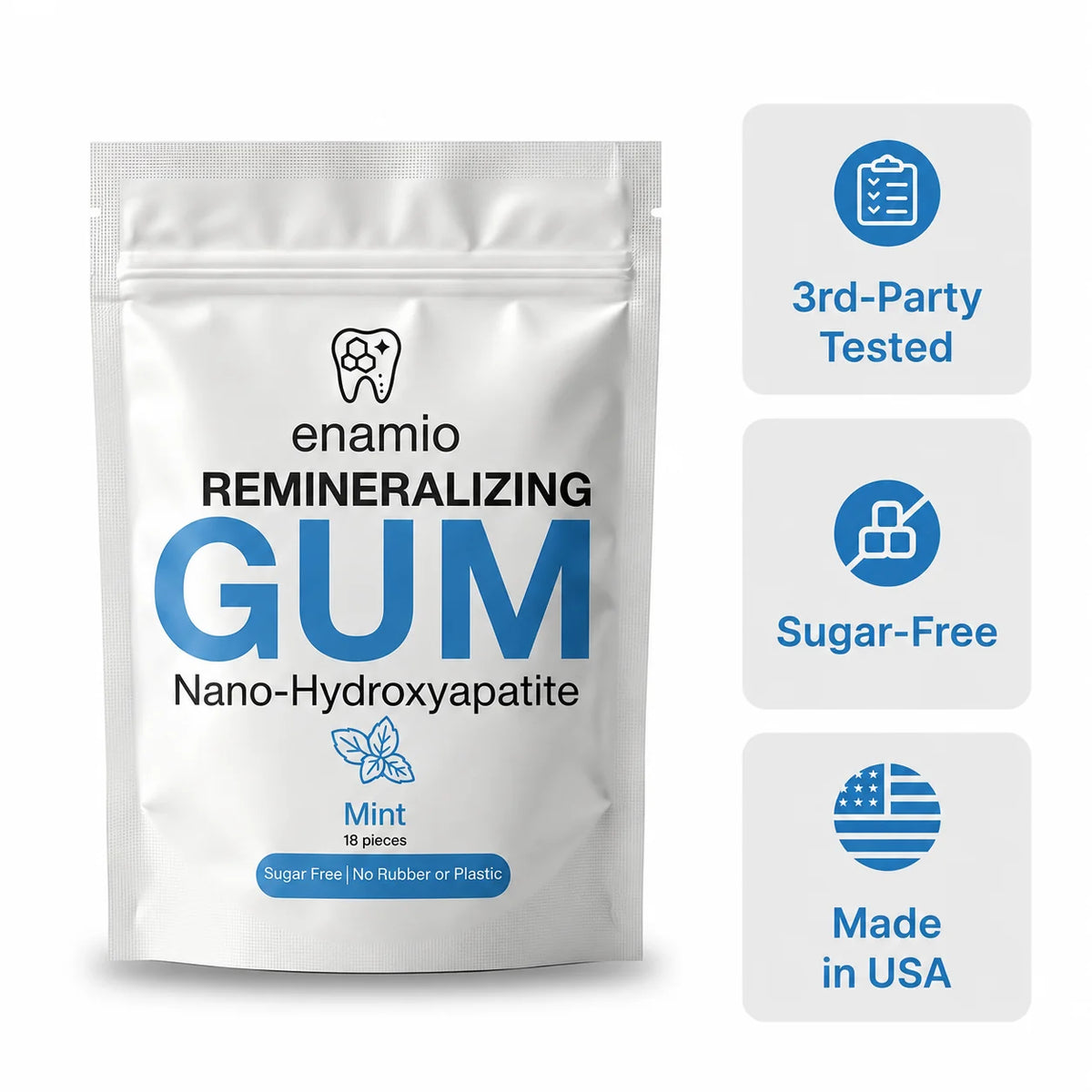
Key Takeaways
- Enamio's public widget showed 98 reviews on July 13, 2026.
- The histogram recomputes to 3.67 stars from those reviews.
- Flavor and texture comments matter for daily use.
- Clinical claims still need clinical sources.
In this guide
- 01 -
Why review stars need context
On July 13, 2026, the public product page showed two review signals that were not identical. The hero area said Enamio was rated 4.3 out of 5 based on 20+ reviews. The Judge.me widget showed 3.67 out of 5 based on 98 reviews.
That isn't a tiny footnote. It's the reason to read the full widget before making a decision. [1]
The histogram is more useful than either single badge. It showed 46 five-star reviews, 17 four-star reviews, 9 three-star reviews, 9 two-star reviews, and 17 one-star reviews. Our calculation from those visible counts gives 64.3% four-or-five-star ratings and 26.5% one-or-two-star ratings.
That pattern says the reviews are mixed, but not empty. Most ratings were positive. A meaningful share was critical. That's what real customer data often looks like when a product asks people to build a habit, chew for a set window, and judge subtle changes over time.
The first visible page also gave practical feedback. One buyer liked the discipline of chewing for 15-20 minutes but said Berry flavor faded quickly. Another same-day buyer said the gum tasted delicious.
A lower-star reviewer said the product was not for them. Deeper in the set, other reviews focused on delayed shipping and value, or liked the taste but flagged texture around dental work.
None of those comments proves enamel support. They do tell you what to watch in your own use.
Watch flavor duration, texture around dental work, delivery expectations, daily chew time, and whether the routine feels worth repeating. If you want the category-wide buyer page, use the existing best remineralizing gum guide. This article is about reading review evidence without getting fooled.
| Signal | Value | How to read it |
|---|---|---|
| Widget reviews | 98 | The broadest public count we found. |
| Widget average | 3.67 / 5 | Computed by the visible histogram. |
| Hero badge | 4.3 / 5 on 20+ reviews | A smaller badge signal, not the full story. |
| Five-star count | 46 | Positive experience signal. |
| Four-star count | 17 | Mostly positive with some tradeoffs. |
| Three-star count | 9 | Middle feedback. |
| Two-star count | 9 | Critical but not lowest. |
| One-star count | 17 | Strong friction signal. |
| Four-or-five-star share | 64.3% | Most ratings were positive. |
| One-or-two-star share | 26.5% | Enough criticism to read closely. |
- 02 -
Reviews aren't clinical evidence
A review is a user report. Clinical evidence is a controlled attempt to test a question. Those two things can support each other, but they aren't the same kind of proof.
Oral health has a huge public-health backdrop. WHO estimates that oral diseases affect about 3.7 billion people worldwide, and CDC surveillance continues to track untreated decay and tooth loss in U.S. adults. Those numbers explain why shoppers care so much about products that may support daily tooth care. [2] [3]
Sugar-free chewing gum has a more specific evidence lane. The ADA describes sugar-free gum as a way to increase saliva flow, which helps dilute and neutralize plaque acids after eating. It also makes clear that gum isn't a substitute for brushing or flossing. [4]
Xylitol has its own evidence trail. A 2021 systematic review and meta-analysis examined sugar-free chewing gum and Streptococcus mutans, the bacteria often discussed in cavity-risk research. That kind of source can support a careful statement about oral ecology.
It can't tell you that one shopper's smoother-feeling teeth came from one package of gum. [5]
Nano-hydroxyapatite is also a science topic, not only a review topic. Europe's consumer-safety committee issued a scoped opinion on a specific rod-shaped, uncoated nano-hydroxyapatite in toothpaste and mouthwash at defined concentrations. That's a safety assessment for those product types, nothing more.
It doesn't establish gum efficacy, it doesn't certify any specific product, and it doesn't turn a customer review into a lab result. [6]
So what can reviews do? They can show whether customers keep chewing long enough for the product to have a realistic chance. They can reveal taste fatigue. They can flag softening, packaging, shipping, or expectation problems.
They can also show that critical feedback was visible when you checked, which is worth something for trust.
Reviews answer fit
Taste, texture, chew time, shipping, and repeat use.
Studies answer mechanisms
Saliva flow, plaque acids, xylitol, and mineral safety.
Your dentist answers diagnosis
Pain, decay, restorations, and sensitivity need dental advice.
Product-page benefits describe the intended formula. Customer reviews describe whether the chewing experience fits real life.
- 03 -
What Enamio is designed to support
Enamio is built around a mineral-active idea: use a sugar-free gum routine to deliver nano-hydroxyapatite, xylitol, chicle, and supporting ingredients during moments when people are already likely to chew. The public product page tells shoppers to chew 1-2 pieces daily for 20 minutes each. [1]
That use direction matters for reviews. A same-day review can tell you if the taste is appealing. It can't tell you whether a 20-minute daily routine changed enamel feel over two or three weeks. A review after consistent use is more relevant for routine fit, but it still remains customer-reported experience.
The strongest review signal for a dental gum isn't only star count. It's whether comments match the job of the product.
Do buyers talk about sticking with the chew time? Do they mention texture after several minutes? Do they say whether the gum fits after meals?
Do they separate shipping issues from formula issues? Those details are more useful than a row of perfect stars.
Enamio's mix of positive and critical reviews is useful because it gives you tradeoffs. Flavor and texture are real barriers. So is shipping. Those barriers don't erase the formula, but they do affect whether a person will use the gum often enough to judge it fairly.
If you care most about formula details, read the Enamio ingredient guide and the science page. If you care most about how to use it, start with the use protocol. Reviews help you decide whether you can live with the routine.
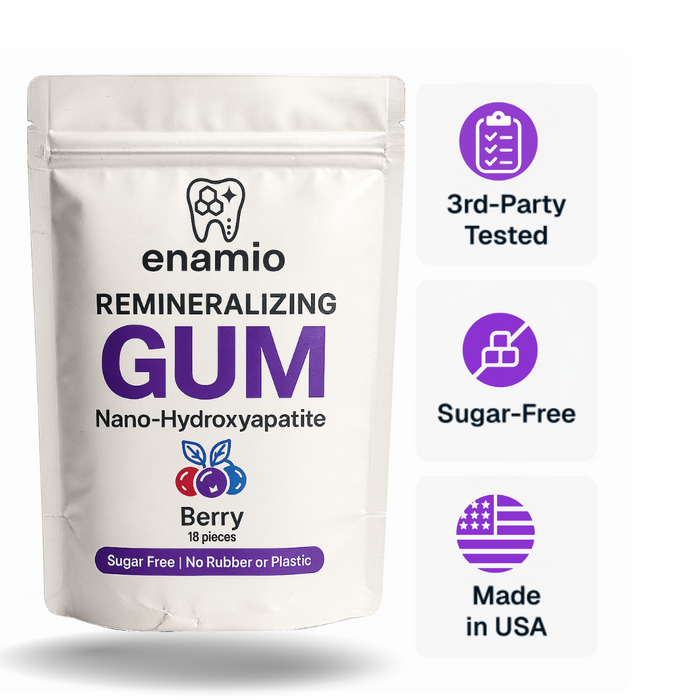
Review-aware routine
Enamio Remineralizing Gum
Enamio
A sugar-free gum built around 20 nm nano-hydroxyapatite, xylitol, and chicle for an after-meal oral-care routine.
Choose quantity on the live product page: 2 Packs, 4 Packs, or 8 Packs.
Read remineralizing gum reviews and choose a pack- 04 -
How to run a fair 30-day trial
A fair trial starts before the first piece. Write down why you're using the gum. Maybe you want a sugar-free after-meal habit.
Maybe you care about enamel support. Maybe you want a plastic-free natural gum base. Your reason changes which reviews matter most.
Use the label direction as the baseline. The live page says to chew 1-2 pieces daily for 20 minutes each. Don't turn that into a medical protocol.
Treat it as the product's normal use instruction, then keep brushing, flossing, and dental visits in place. [1]
Track four things for 30 days: chew time, flavor duration, texture, and whether the habit fits your meals. Add one note about tooth feel if you want, but keep it humble. Smoother-feeling teeth can be useful feedback. It isn't a diagnosis.
Dental work changes the review lens. If you have crowns, fillings, aligners, implants, dentures, or fresh dental work, texture comments may matter more to you than aggregate stars. The recent dental-work chewing guide explains why timing and clearance matter.
Bad breath and saliva are another lane. If your main goal is freshness, you should care about chew time, flavor fade, and saliva feel. For deeper breath context, use Enamio's bad-breath support page. For enamel and cavity-risk habits, use the cavity-prevention routine page.
Clean-label shoppers should read base and sweetener comments carefully. If you care about the gum base, compare user texture notes with the plastic-free natural gum page. If you care about xylitol, review the xylitol oral-health explainer.
Do
Log chew time, flavor, texture, and routine fit.
Do not
Treat one review as proof of enamel repair.
If sensitivity is your main issue, read the tooth-sensitivity support page before buying. If you aren't sure which path fits, take the Enamio routine quiz. Reviews help, but your use case should lead.
How to judge remineralizing gum reviews without overreading them
Start reading remineralizing gum reviews with the sample size. A 98-review widget gives you more context than a small badge, but it's still not a market-wide study. It's a public snapshot from one product page at one moment in time.
Then look at the distribution. A 3.67-star average can hide two very different realities. One product might have mostly three-star reviews.
Another might have many five-star reviews and many one-star reviews. Those aren't the same story.
Enamio's visible distribution looked polarized enough to be worth reading. There were many happy customers, and there were enough critical customers to make the friction clear. That's useful. It tells you this isn't a product everyone experiences the same way.
Next, separate formula comments from fulfillment comments. A delayed package is frustrating, and it belongs in the buying decision. It doesn't tell you whether nano-hydroxyapatite, xylitol, or chewing time makes sense for your mouth.
Taste comments deserve their own lane. If a reviewer says flavor fades fast, that matters because a 20-minute chew asks more from flavor than a two-minute fresh-breath gum. A short flavor curve can make a good routine harder to repeat.
Texture comments deserve another lane. Gum that feels soft after several minutes may bother some people, especially if they have dental work or aligners. That's a real use-case issue. It isn't a universal failure.
Routine comments are the highest-value review signal. If someone says they actually chewed for 15-20 minutes, that review tells you more than a one-line star rating. The product asks for time, so the review should mention time.
Be careful with day-one praise. A same-day comment about taste is still useful. It only answers the first-use question. It can't answer the two-week or one-month question, and it can't answer the enamel question.
Be careful with dramatic negative comments too. A one-star review can be valid and still be narrow. If the problem was shipping, flavor, texture, or personal fit, the review may help a specific shopper without deciding the whole product.
The most useful buyer move is to match review themes to your own blockers. If you hate flavor fade, give that theme more weight. If you have crowns or recent dental work, give texture notes more weight. If you mainly want a plastic-free gum base, read the base and ingredient pages before the star count.
Clinical context should sit beside the review context. Sugar-free chewing gum can support saliva after meals, and saliva matters because it helps buffer acids. That evidence supports the habit logic. It doesn't make every positive review clinically measured.
Nano-hydroxyapatite context also belongs outside the review box. Safety opinions, ingredient disclosures, and dental studies help explain why the active is plausible. They don't turn a customer's smooth-feel note into a measured enamel result.
That is why this post links Enamio's science and category pages instead of repeating them. Use remineralizing gum reviews for lived experience. Use the science page for evidence. Use the category guide for choosing between gum types.
You can also use reviews to set a stop rule. If texture is bad for you after a week, stop forcing the habit. If flavor fades but the chew remains comfortable, you may still decide the routine fits. The right answer depends on your blocker.
For a fair personal trial, keep the rest of your oral-care routine stable. Don't change toothpaste, brushing frequency, whitening products, and gum all at once, then credit one item for every change you feel.
Write down what you can honestly observe: chew time, flavor duration, texture, freshness, comfort, and whether you remembered to use it after meals. Leave diagnoses to your dentist. That keeps the experiment useful and safe.
One more thing: a visible rating mismatch should make you more careful, not cynical. Product pages can show different app blocks, cached badges, and widget summaries. The fix is simple. Read the larger widget, read the histogram, and check the date.
The visible widget included both positive and critical comments at the time checked, which gives you something real to weigh.
Review transparency also matters because regulators care about fake or misleading reviews. The FTC's final rule on fake reviews is a reminder that review systems are part of consumer protection, not only marketing copy. [7]
Treat reviews as field notes. They're messy, useful, and incomplete. The win isn't blind trust. It's knowing exactly what a review can tell you and what it cannot.
A review scorecard you can use before buying
The easiest way to keep remineralizing gum reviews useful is to score them by decision value. A five-star review that only says "great" is pleasant, but it doesn't tell you much. A three-star review that explains flavor faded after ten minutes and texture changed near dental work is doing real work. It can be more useful than a vague five-star note.
Start with time-in-use. A review written after one piece can judge opening flavor, pouch experience, and first chew comfort. It can't judge habit fit over a month. A review that mentions daily use, after-meal timing, or a 15-20 minute chew deserves more weight because it matches the way the product is meant to be used.
Then score specificity. Useful reviews name the exact friction.
Berry flavor faded, the gum became soft, the texture was not right with dental work, the package was delayed, or the price felt high for the buyer. Specific friction lets you decide whether the problem applies to you. A general complaint may still be valid, but it's harder to translate into a buying decision.
Next, separate formula, routine, and fulfillment. Formula comments are about ingredients, sweetness, taste, mouthfeel, and chew stability. Routine comments are about remembering to use the gum, chewing long enough, and whether it fits after meals.
Fulfillment comments are about shipping, packaging, subscription expectations, or value. All three matter, but they answer different questions.
For a product like Enamio, texture deserves extra attention because the review page includes dental-work friction. If you have recent fillings, crowns, implants, bridges, aligners, or tenderness, that single theme may matter more than the average rating. A gum can be well formulated and still be a poor personal fit for a mouth that should not be chewing yet.
Flavor deserves the same practical treatment. A quick flavor fade isn't a clinical failure, but it can break the routine. If a gum asks for 20 minutes of chewing, flavor comfort has to last long enough for the habit to feel normal.
That's why flavor notes in reviews are more than taste chatter. They predict whether the buyer will repeat the habit.
Look for expectation language too. Some shoppers expect a gum to feel like candy, some expect a dental product to feel medicinal, and some expect immediate tooth changes. A good review tells you what the reviewer expected. If the expectation doesn't match your goal, the star rating may deserve less weight.
You should also discount any review that turns personal feeling into a diagnosis. A smoother tooth feel can be real, and it can still be subjective. Pain relief, cavity reversal, enamel rebuilding, and dental-work safety aren't things a customer review can certify. Those claims belong with a dentist or a controlled source, not a comment box.
A practical shopper can use a simple five-part filter: time used, taste, texture, routine fit, and claim discipline. If a review covers at least three of those areas, it's probably worth reading closely. If it covers only emotion, stars, or a shipping complaint, keep it in context.
| Review detail | Why it matters | How much weight to give it |
|---|---|---|
| Chew time mentioned | Shows whether the reviewer used the gum near the intended routine. | High for routine-fit decisions. |
| Flavor duration | Predicts whether a 20-minute chew feels repeatable. | High if taste fatigue stops habits for you. |
| Texture around dental work | Can matter more than average stars for people with restorations. | High if your dentist has warned you about chewing. |
| Shipping or value complaint | Affects buying experience but doesn't test the formula. | Medium, unless delivery timing is your main blocker. |
| Dental result claim | May be personally meaningful, but isn't measured evidence. | Low without dental confirmation. |
This scorecard has one narrow job. The point isn't to replace the broader best-gum guide or the science page. The point is to help you inspect review data.
When you want ingredient details, go to the ingredient guide. When you want a category comparison, go to the category guide. When you want to know whether a review should change your decision, use this filter.
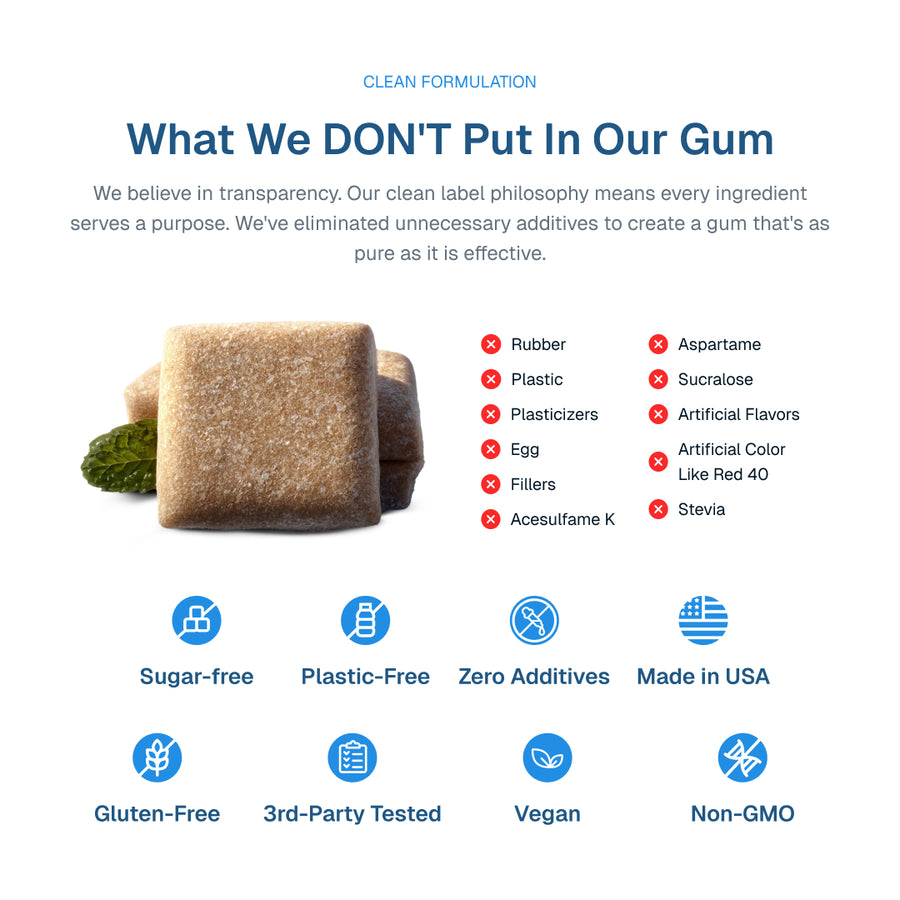
A useful review should be checked against the current label and product page, especially when it discusses ingredients or exclusions.
A final caution: review data can change quickly.
The count, rating, histogram, and visible first-page comments may be different when you read the product page. That's normal for a live review widget. The durable lesson is the method. Read the largest available review block, check the date, inspect the histogram, separate claim types, and then decide whether the repeated friction points apply to your mouth and routine.
What the July 2026 review snapshot shows
The July 2026 review snapshot isn't a simple hype story. It shows a product with many satisfied users and a visible group of disappointed users. That's exactly why the reviews are worth reading.
A perfect-looking page would give fewer decision clues. A mixed page gives you friction points, positive signals, and a better sense of who may not enjoy the product.
The positive side is easy to understand. Many people rated the gum highly, and some visible comments focused on taste or the appeal of a structured chewing habit. That supports the idea that the product can fit real routines for some buyers. It doesn't mean every buyer will like the texture, flavor curve, or value equation.
The critical side is just as useful. One-star and two-star reviews aren't noise when they point to repeated practical issues. If the lower-star comments cluster around shipping, then fulfillment deserves attention.
If they cluster around flavor and texture, then first-week comfort deserves attention. If they mention dental work, then anyone with restorations should be more cautious.
The rating mismatch also deserves a calm explanation. A product page can show a hero badge, a review app summary, and a widget histogram from different display blocks. A careful buyer should not assume bad intent from that alone. The better habit is to privilege the visible histogram and the largest live review count because those give the most context.
That is why the recommendation here is measured. If you want a sugar-free gum with xylitol, chicle, and 20 nm nano-hydroxyapatite, Enamio is worth evaluating. If you need proof that a gum repaired enamel, reviews can't give you that.
If you need dental-work clearance, your dentist matters more than the widget. If you need to know whether the daily routine feels realistic, the reviews are genuinely helpful.
- 05 -
People Also Ask
Are Enamio remineralizing gum reviews reliable?
They are useful, but they should be read as customer experience data. The public widget showed 98 reviews and a full rating distribution on July 13, 2026, which is more helpful than a single badge. [1]
Why did one page show 4.3 stars while the widget showed 3.67?
We saw both signals on the same product page. A cautious reader should treat the larger Judge.me widget count as the better context and check the live page before buying. [1]
Do reviews prove remineralizing gum works?
No. Reviews can describe taste, texture, and routine fit. Mechanism claims need oral-health sources, such as ADA gum guidance, xylitol research, and nano-hydroxyapatite safety reviews. [4]
How long should I try the gum before judging it?
Use a 30-day personal log if your dentist has not told you to avoid gum. Track chew time and texture first, then note comfort or smoothness without calling it a diagnosis.
What complaints should I take seriously?
Take flavor fade, soft texture, sticking around dental work, and delivery issues seriously because they affect repeat use. They don't automatically judge the science of the formula.
Are negative reviews a bad sign?
Not by themselves. A visible mix can be healthier than a perfect wall of praise, especially in a category where taste and texture are personal.
Should I ignore reviews that mention shipping?
No. Shipping is part of the customer experience. Just separate fulfillment friction from formula feedback when you judge whether the gum fits your routine.
What is the best review to trust?
The best review explains use time, flavor, texture, and context. A vague star rating says less than a specific note from someone who actually used the product.
Why do remineralizing gum reviews show different rating numbers?
Different badges pull from different samples. A hero badge may cite a smaller featured set, while the full widget recomputes from every visible rating. When remineralizing gum reviews disagree like this, trust the histogram over any single average.
- 06 -
FAQs
Can a customer review show enamel has remineralized?
No. A review can report smoother feel or better routine fit, but enamel change needs dental evidence or controlled measurement.
Should I buy Enamio if I only care about taste?
Read the flavor comments first. The visible review page included both a taste-positive note and a Berry flavor fade concern.
Is Enamio a replacement for brushing?
No. Sugar-free gum can support saliva flow after meals, but brushing, flossing, and dental care stay in the routine.
Where should I compare ingredient claims?
Use Enamio ingredient and science pages for formula details, then use reviews to judge daily fit.
What should I do if gum sticks to dental work?
Stop and ask your dentist if you have recent or sensitive restorations. The dental-work guide is a better starting point for that use case.
- 07 -
References
- Enamio Remineralizing Gum product page and public Judge.me widget HTML. Accessed July 13, 2026. Source
- World Health Organization. Oral health fact sheet. March 17, 2025. Accessed July 7, 2026. Source
- CDC. 2024 Oral Health Surveillance Report. October 9, 2024. Accessed July 7, 2026. Source
- American Dental Association. Chewing Gum oral-health topic. Accessed July 7, 2026. Source
- Nasseripour M, et al. A systematic review and meta-analysis of sugar-free chewing gum and Streptococcus mutans. BMC Oral Health. 2021. Accessed July 13, 2026. Source
- Scientific Committee on Consumer Safety. Opinion on Hydroxyapatite (nano), Submission IV. Adopted June 26, 2025. Accessed July 13, 2026. Source
- Federal Trade Commission. Final rule banning fake reviews and testimonials. August 14, 2024. Accessed July 13, 2026. Source
- 08 -
Choose a routine, not a repair claim
The useful question isn't whether one review sounds convincing. The useful question is whether the formula, use directions, taste, texture, and evidence standard fit your daily life. Enamio is built for people who want a sugar-free, mineral-active gum after meals, with a public review mix you can inspect before you buy.
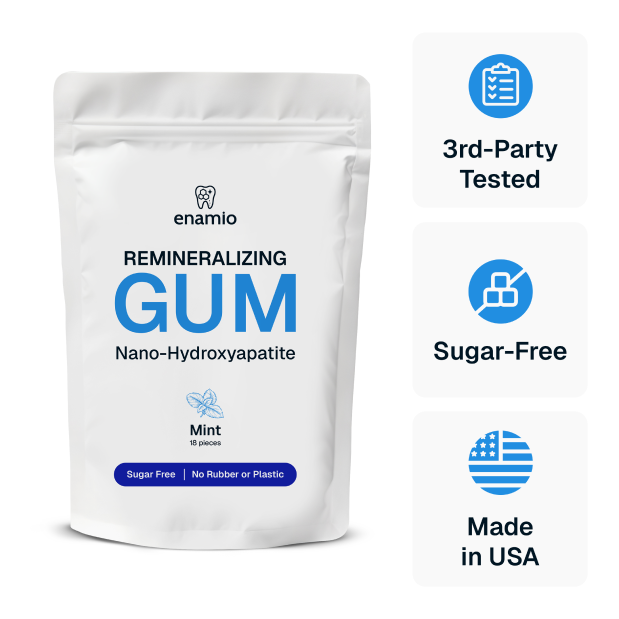
Enamio Remineralizing Gum
Enamio
20 nm nano-hydroxyapatite, xylitol, and chicle in a daily chewing routine. Read the live reviews, then choose the habit you can repeat.
Choose quantity on the live product page: 2 Packs, 4 Packs, or 8 Packs.
See Enamio reviews and pack optionsTake the routine quizWhere to go from here
Formula details
Read the active-system details behind the reviews.
Safety context
Separate review comfort from safety evidence.
Brand field
Compare the broader nano-hydroxyapatite gum lane.
Educational only. Not medical advice. Ask your dentist about pain, active decay, pregnancy, allergies, or new restorations.