

Dentagum vs Enamio
Share
Dentagum vs Enamio: Dentagum costs less per piece, while Enamio's ingredient text lists monk fruit and a stated plant source. Enamio publishes this comparison without establishing either gum's clinical benefit.
Published by Enamio · October 11, 2026
Buyer comparison
Enamio sells one of these gums. This comparison uses product information and cited research, without hands-on testing or independent clinical evaluation.
Dentagum vs Enamio comes down to formula, dietary fit, price and documentation, with a separate kind of evidence needed to answer each buyer question.
Dentagum lists xylitol, erythritol and egg shell, while Enamio's ingredient text names xylitol and monk fruit [6] [10]. Compare stated sweetener grams separately from ingredient order.
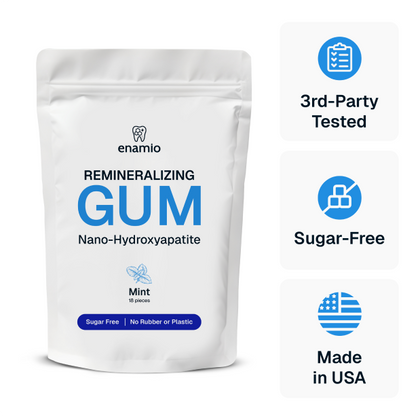
The gum in this comparison
Enamio Remineralizing Gum
Plant-based nano-hydroxyapatite, xylitol, and monk fruit in a chicle base. The product page lists four named flavors, while the FAQ describes manufacturing as taking place in the USA.
In this guide
- 01Dentagum vs Enamio: the full comparison
- 02Do the evidence claims hold up?
- 03Why enamel wears down
- 04The science: nano-hydroxyapatite and xylitol
- 05How Enamio works
- 06How to use remineralizing gum
- 07Side effects and safety
- 08The verdict by use case
- 09People also ask
- 10FAQs, references and next steps
- 01 -
Dentagum vs Enamio: the full comparison
For a one-time US purchase, DentaGum Spearmint showed $33 for 60 pieces ($0.55 each); ENAMIO Mint showed $24.99 for two pouches totaling 36 pieces (about $0.69 each). Add shipping and any applicable tax to your actual order before comparing delivered prices. Prices checked November 18, 2026.
The clearest differences are sweeteners, mineral source, and price per piece. Dentagum uses xylitol and erythritol with egg shell in the mix at about $0.55 a piece. Enamio uses xylitol and monk fruit with a plant-based claim at about $0.69 a piece [6][10].
Who each gum is for
Pick Dentagum if
You want the larger pouch and the lower entry price per piece, erythritol is fine for you, and an egg allergen is not a concern.
Pick Enamio if
You prefer Enamio's stated plant source and listed monk fruit, after checking the exact package.
Keep both xylitol gums away from dogs [6] [10] [7]. The table compares disclosed buyer fields, while customer ratings describe reported experience rather than measured enamel changes or cavity incidence.
Dentagum and Enamio side by side, using the product pages and FAQs inspected on October 16, 2026. Prices describe one-time purchases and exclude subscriptions, promotions, shipping charges and tax. Dentagum flavors were checked again on November 13, 2026.
Swipe or scroll horizontally to view both brands.
| Attribute | Dentagum | Enamio |
|---|---|---|
| Pieces per pouch or pack (entry) | 60 per pouch | 36 per two-pack |
| Price, one-time entry | $33.00 | $24.99 |
| Price per piece (entry) | ~$0.55 | ~$0.69 |
| Mineral type and source | Inspected product page/FAQ does not identify mineral feedstock. Eggshell powder is separately listed. | Plant-based nano-hydroxyapatite (20 nm, maker's spec) |
| Sweeteners | Xylitol + erythritol | Xylitol + monk fruit in ingredient text. Confirm the current package. |
| Gum base | Chicle listed | Chicle |
| Third-party heavy-metal testing | Test material linked on page | Third-party testing advertised. No public CoA on the inspected product page/FAQ, October 16, 2026 |
| Made in | Not stated (seller in Dover, DE) | Manufacturer claims US production. Origin documentation not independently verified. |
| Flavors listed | Spearmint, Cool Berry, Chill Watermelon, Cool Mango, Cinnamon. Checked November 13, 2026. | Mint, Berry, Cinnamon, Watermelon |
| Return or guarantee (stated) | Advertised 30-day first-order guarantee. Conditions apply. | 30-day guarantee, first order |
Dentagum's guarantee applies to eligible first orders purchased from its own website, with contact required within thirty calendar days of the recorded delivery [15]. Return authorization and return of the remaining product are required, with return shipping paid by the customer. Enamio advertises a thirty-day satisfaction guarantee for first orders only [6]. Read both current policies before purchasing, particularly their eligibility and return requirements.
Value per piece, across pack sizes
Dentagum is cheaper per piece at the entry pack, about $0.55 versus $0.69 for Enamio's two-pack [6][10]. But the gap closes fast when you buy in bulk. At their largest bundles, both land near $0.49 a piece.
Dentagum's comparison attributes its $29.99 Enamio price to an Amazon listing checked in May 2026 [14]. This article uses Enamio's own-store two-pack price of $24.99 [6]. These are different retail-channel and date snapshots, so the difference does not establish that Dentagum's quoted price is false.
The transparency ledger
The ledger separates published facts, manufacturer statements, and missing data for both brands.
What is published, claimed, or missing on each brand's pages, checked October 16, 2026.
Swipe or scroll horizontally to view both brands.
| Fact | Dentagum | Enamio |
|---|---|---|
| Particle size | Not disclosed on the inspected product page/FAQ, October 16, 2026 | 20 nm, claimed by maker |
| Public lab certificate | Heavy-metal material linked | No public CoA or independent particle certificate on the inspected product page/FAQ, October 16, 2026 |
| Per-piece sweetener amount | Not disclosed on the inspected product page/FAQ, October 16, 2026 | Xylitol about 1 g |
| Vegan | No, egg shell listed | States plant-based source |
| Country of manufacture | Not stated | Manufacturer claims US production. Origin documentation not independently verified. |
| Efficacy percentages on page | Percentages displayed. Supporting finished-gum study not located in the pages reviewed. | Numerical efficacy claims appear in the FAQ. Not verified here for this finished gum. |
Particle size does not establish a clinical benefit. A separately listed eggshell ingredient also does not identify the source of the hydroxyapatite. mineral-source and gum-base comparison
- 02 -
Do the evidence claims hold up?
Ingredient research and finished-gum evidence answer different questions, and reviews of hydroxyapatite in toothpaste and gel don't settle this brand comparison [4] [9]. Keep toothpaste, mouthwash, gel and gum attached to the findings each source actually reports. The manufacturer's product-specific percentages need their own supporting methods and results.
Dentagum's page displays 83 percent for enamel remineralization, 91 percent for sensitivity, 87 percent for cavities, and 79 percent for gum health [10].
Which study, sample size and measured endpoint support those product-specific percentages? The inspected page supplied no linked study methods or sample size, although it also carried a disclaimer about FDA evaluation.
Enamio's FAQ presents numerical claims about plaque acidity, white spots, lesion depth and cavity risk without establishing those outcomes for the finished gum [6]. The same product-specific standard applies when this article examines Enamio's numerical claims. A manufacturer page's percentage doesn't substitute for a product-specific study with an identifiable intervention, comparator and measured endpoint.
The cited materials do not establish clinical efficacy for either finished gum. The 2025 review included one hydroxyapatite gum study with two adults, but it was not a census of all chewing-gum research [9]. The larger CPP-ACP studies used a different ingredient and an in-situ model [2][3]. Neither evidence set establishes Dentagum-versus-Enamio superiority.
Check the tested sample and measured outcome. A contaminant certificate describes the tested sample. It does not establish cavity prevention or sensitivity relief among users of the finished gum. product-document evidence guide
If you are weighing whether any of this category is worth it, our deeper read on whether remineralizing gum is legit walks through the same evidence without hype.
- 03 -
Why enamel wears down in the first place
Acidic conditions favor mineral loss, while saliva supplies minerals and buffers acids, providing a rationale for sugar-free gum as an adjunct to oral care [1].
That is category evidence about chewing and saliva, rather than a tested outcome for either brand. It doesn't measure what Dentagum or Enamio delivers to teeth or establish a clinical result.
Here's NIDCR's account of the acid challenge. You eat, bacteria feast on the sugars and starches left behind, and they pump out acid as a byproduct. Demineralization is the stage where that acid pulls calcium and phosphate out of the enamel surface. NIDCR explains that early mineral loss can stop or reverse.
Saliva provides the counterweight, carrying calcium and phosphate while helping neutralize the acids that plaque bacteria can produce. The ADA reports a ten-to-twelvefold flow increase with unsweetened, unflavored gum base [1]. The ADA distinguishes that plain base from sweetened, flavored consumer gums, which can produce a different flow response. Saliva clearance, buffering and mineral supply are related roles, rather than interchangeable measurements.
Why does this matter for a Dentagum vs Enamio decision? Added minerals don't measure performance. The sugar-free chewing overview explains saliva stimulation, while Enamio's cavity-prevention page offers commercial information about the manufacturer's positioning. Neither replaces a formula-specific outcome.
Frequent fermentable-carbohydrate exposure gives plaque bacteria repeated opportunities to produce acid, although every meal, snack or drink needn't produce the same response [1]. The repeated exposure pattern matters alongside the food's fermentable carbohydrate content. Distinguish the saliva benefit of chewing sugar-free gum from an acid-recovery measurement for either of these brands.
Mineral loss and mineral gain can occur at different times, as NIDCR's description of the tooth-decay process explains [12]. Neither proves a gum effect. The ADA describes sugar-free gum as an addition to regular care, not a substitute for fluoride brushing and cleaning between teeth [1]. The cited sources don't establish a finished-Dentagum or finished-Enamio clinical outcome.
The ADA describes healthy unstimulated saliva flow as approximately 0.3 to 0.4 milliliters per minute, a baseline measured under resting conditions [1]. Chewing changes that flow, but a higher flow rate doesn't quantify mineral delivery from either gum.
Keep one boundary clear before treating a gum's product description as personal advice about a cavity in your tooth. None of this reverses a hole that has already formed.
NIDCR explains that early decay can stop or reverse through minerals supplied by saliva and fluoride from toothpaste [12]. Once a cavity forms, a dentist must repair permanent damage. Its parent-focused page doesn't test either gum, so the early-lesion versus physical-hole distinction remains a category boundary.
- 04 -
The science: how nano-hydroxyapatite and xylitol work
Nano-hydroxyapatite is a microscopic form of calcium phosphate related to the mineral in enamel, and studied oral-care formulations have shown remineralization effects [9]. Format matters.
A mineral's resemblance to tooth material doesn't establish delivery, contact or clinical benefit from every retail gum containing it. Keep the tested formulation beside the finding rather than treating the ingredient name as interchangeable evidence.
Xylitol is a sweet-tasting sugar alcohol that oral acid-producing bacteria ferment poorly, which helps explain interest in it as a sugar substitute [5].
That explanation doesn't describe a clinical trial of Dentagum or Enamio's finished formula. The review reports bacterial outcomes separately from caries incidence, and its findings don't establish a cavity-preventive effect for either gum. The mechanism supplies background for reading the studies rather than a product-specific outcome.
Mineral ingredients, sugar-free sweetening and chewing-induced saliva form the proposed combination behind these gums, while the illustration separates acid challenge from saliva buffering.
The numbers that matter
10-12x
Increase in saliva flow reported by the ADA for unflavored, unsweetened gum base. Not a measurement of either brand. [1]
20 min
Chewing duration used in the cited sugar-free-gum guidance, not an enamel-repair deadline. [1][8]
1 of 15
A 2025 hydroxyapatite review held 15 clinical studies, and only one tested a chewing gum, in just two adults. [9]
How strong is the evidence, really?
The 2024 review retrieved eighteen studies, with five clinical and eight in-situ studies entering its meta-analysis after more specific assessment [4]. Those included studies weren't thirteen gum trials or thirteen tests of the same formulation. Its toothpaste, mouthwash and gel findings belong to their actual formulations, controls and measured caries or proxy outcomes. Don't convert another format's results into a clinical-equivalence claim for either gum.
One study in the 2025 hydroxyapatite review involved gum and two adults, with calcium and phosphorus assessed using enamel specimens in appliances [9].
That narrow endpoint concerns the specimens, rather than clinical cavity incidence among gum customers. The review's fifteen studies don't become fifteen gum studies, and this specimen measurement doesn't establish a clinical result for Dentagum or Enamio.
There is older, sturdier work on minerals in the mouth, just with a different active. In-situ trials of CPP-ACP, a milk-derived mineral complex [16], showed dose-related remineralization of early lesions when chewed four times a day for two weeks [2][3]. That is a model for how a mineral gum could help, not proof that either of these gums does.
In these in-situ studies, participants wore appliances holding enamel samples with artificial lesions [2][3]. The measured changes in those samples were not demonstrations that either commercial gum repaired cavities in participants' own teeth.
The 2001 CPP-ACP study found dose-related specimen remineralization, making its disclosed amounts useful for understanding that particular active's results [2]. CPP-ACP is a different active from the nano-hydroxyapatite listed by these two brands.
Its dose response cannot set an ideal amount for either brand or prove that a larger mineral number produces a better gum.
Iijima's randomized crossover study compared gum containing 18.8 mg CPP-ACP with an equivalent gum without it [3].
Participants chewed four times daily for 14 days. Prepared enamel specimens showed approximately twice the control's remineralization, followed by laboratory acid challenges lasting eight or sixteen hours. The measured object was enamel in an appliance.
Shen's trial involved 30 people wearing enamel samples, with 20 minutes of chewing followed by another 20 minutes of appliance retention [2].
CPP-ACP amounts of 0.19, 10.0, 18.8 and 56.4 mg produced relative increases of 9, 63, 102 and 152 percent. Those percentages compare specimen remineralization with control gum. They aren't percentages of teeth repaired or people cured.
Two authors reported company employment, while all authors reported travel grants from the same company [4].
Read the disclosure. It doesn't erase the results or establish neutrality, and our guide to controls and denominators explains another part of assessing them.
The xylitol review included nine human trials with differing populations, interventions, controls, doses and follow-up periods, so their endpoints shouldn't be collapsed [5]. Some bacterial findings were favorable.
The authors couldn't confirm a caries-preventive effect, which keeps bacterial counts separate from cavity outcomes for the gums compared here. No branded daily dose follows.
A bacterial count, enamel-specimen measurement and clinical cavity count describe different outcomes, even when each appears in a paper about oral care. Keep their units. Our calculation and study-unit explanation distinguishes those denominators without turning arithmetic into evidence that a finished gum works.
Hydroxyapatite and fluoride have been compared in specific oral-care formulations [9]. Results from toothpaste or other topical products do not establish that either chewing gum is equivalent to fluoride toothpaste. Published hydroxyapatite trials also vary by concentration and product type, so findings do not transfer automatically from one format to another [9]. This article does not recommend replacing fluoride toothpaste with gum [1].
The 2025 review discusses dentinal-tubule effects in studied oral-care formats, without establishing either finished gum as a sensitivity treatment [9]. Have persistent symptoms assessed.
Enamio's tooth-sensitivity page offers commercial information rather than an independent clinical evaluation or a diagnosis for your tooth.
Use the cross-brand formulation ledger to separate particle class, mineral source and evidence scope, then check what early remineralization can and cannot change for lesion boundaries. These are different questions. Enamio's science page presents its manufacturer's explanation rather than independent proof for this pair.
- 05 -
How Enamio works, and what it does not say
Enamio describes the mineral source for its nano-hydroxyapatite as plant-based. Twenty nanometers is the maker's stated particle-size specification, rather than an independently measured distribution for the finished gum [6].
The rest of the formula is where it separates from a plain xylitol chew. Enamio's FAQ lists calcium glycerophosphate, magnesium citrate, L-arginine bicarbonate, bamboo silica, zinc gluconate, and matcha green tea extract alongside nano-hydroxyapatite [6]. That FAQ list counts seven actives when nano-hydroxyapatite is included with the supporting ingredients.
Enamio's FAQ names xylitol and monk fruit and states about one gram of xylitol per piece [6]. Keep about attached when comparing that figure with another gum. The product page lists four flavors, while the FAQ's flavor wording still names mint and berry. Verify the exact pouch rather than treating shared web descriptions as a physical panel.
Individual-ingredient research doesn't establish the finished formula's performance, because ingredient presence alone doesn't measure delivery or the size of a clinical effect [4] [6] [9]. Nor does the length of an ingredient list establish which gum will perform better for its users. The ingredient-evidence explanation explains why an ingredient list alone cannot establish finished-product benefits.
Enamio describes calcium and magnesium compounds as mineral sources and L-arginine bicarbonate as pH support [6]. Zinc gluconate is described as supporting fresh breath. Matcha is listed as an antioxidant, but these are manufacturer-stated roles rather than measured contributions from the finished gum. Don't turn a list of stated ingredient roles into a clinical-benefit score for this gum.
You can compare material preferences without predicting a clinical result.
For example, the FAQ groups chicle, candelilla wax and citric acid under gum base, separately from the mineral ingredients [6]. Those are recipe descriptions. They don't measure texture, tolerance or mineral delivery for your selected pouch.
The cited research describes mechanisms and outcomes in specific formulations. Research on those products does not establish a clinical effect for either gum compared here. Halo comparison's quantity-and-documentation section [4] [9]
Enamio is marketed for after-meal use [6]. That describes the intended routine, not a demonstrated 20-minute period of mineral uptake or a faster repair result. Use the directions on the current pouch rather than increasing intake to pursue an unverified outcome.
The product and FAQ ingredient text names xylitol and monk fruit [6]. Read that as attributed web information. A gallery graphic described in the variant-specific Halo and Enamio disclosure comparison conflicts with that sweetener wording, so a current package matters. This article doesn't certify an erythritol-free physical formula.
One more point sets the mineral apart. Enamio states its nano-hydroxyapatite is plant-based, which matters if an animal-derived source is a dealbreaker for you [6]. The 2025 review did note that in the lone two-person gum study, a synthetic hydroxyapatite gum delivered more calcium than a plant-based one [9]. That's a single tiny study, so treat it as a flag to watch, not a verdict.
The inspected Enamio pages identify ingredients, but an ingredient list does not establish a finished-product clinical result. [6]
The product page advertises third-party testing. Those inspected pages supplied no public certificate of analysis, independent particle-size certificate or named dental reviewer, which doesn't establish that testing never occurred.
The FAQ's about-one-gram xylitol statement answers a separate quantity question [6]. It isn't the mineral amount. Our grams-per-piece comparison shows why total sugar alcohol, xylitol and whole-piece weight must stay in separate fields. None supplies a measured release rate for this formula.
Apply the same standard to Dentagum. Assess evidence for the specific finished-product claim. For gum-base preferences, review the manufacturer's material description. plastic-free gum page
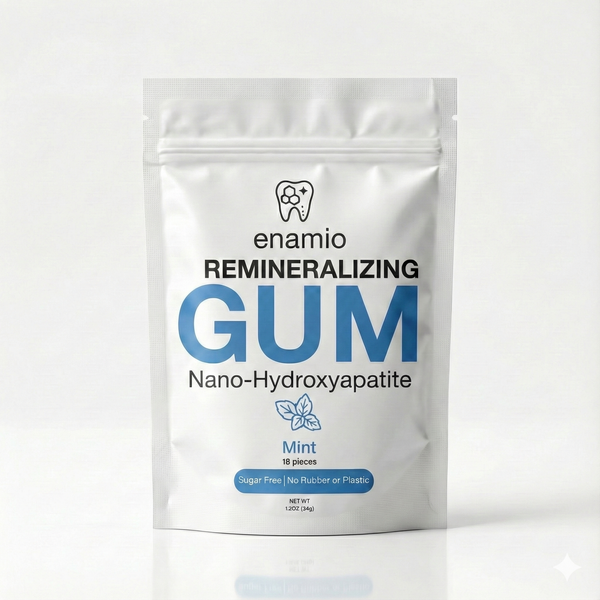
Manufacturer formula
Enamio Mint pouch
Enamio's manufacturer describes an after-meal chewing routine, without making this article's product comparison a clinical trial [6].
See Enamio product options- 06 -
How to use remineralizing gum so it earns its keep
Use the directions printed on your selected current gum pouch.
Enamio's product page says one to two pieces daily, while its FAQ says one to three, so these web ranges conflict [6]. Don't average them. The cited sugar-free-gum guidance describes chewing time rather than validating a daily dose for either finished formula [1].
A familiar meal can be a reminder to check your pouch's directions.
It isn't a clinical dose. The frequency-versus-duration comparison shows why daily pieces and minutes per session are separate instructions. Enamio's bad-breath page is commercial information, not evidence of a measured breath benefit for either gum.
1
Chew after you eat, not before
After-meal timing can be a reminder to use gum according to its package directions, rather than a demonstrated schedule for mineral uptake.
2
3
Stack it onto brushing, not instead of it
Gum is optional. Keep brushing with fluoride toothpaste and cleaning between teeth rather than letting a new chewing routine displace either established habit [1].
Do
Follow your pouch and clinician's advice together. Store every xylitol-containing pouch away from pets, including bags and other places a dog can reach.
Don't
Don't sleep with gum in your mouth. Never leave xylitol gum where a dog can reach it, because ingestion calls for immediate veterinary advice [7].
Enamio states about one gram of xylitol per piece, but the xylitol studies used varied amounts, vehicles and exposure schedules [5] [6]. Keep the units straight. A stated sweetener quantity doesn't establish an effective dose or measured mineral uptake for the finished gum.
The cited EU Register extract lists at least twenty minutes of chewing after eating or drinking as a condition for its sugar-free-gum plaque-acid claim [8]. That is a condition recorded in that document, not proof that either finished gum outperforms the other.
Build it onto habits you already have. Keep a pouch at your desk for the after-coffee chew, and a few pieces in the car for the drive home after lunch. Follow the frequency stated on your current pouch. Miss one and you simply catch the next meal.
Adding pieces to pursue a faster result doesn't substitute for regular brushing or professional care, and the cited sources don't establish such a strategy. Keep gum optional.
Stop chewing if it hurts and ask a dental professional about persistent symptoms. Painless sounds don't establish a disorder. Our jaw-comfort and chewing guide separates those questions. Larger xylitol intakes can cause digestive upset, and the review doesn't establish a personal tolerance threshold [5].
- 07 -
Side effects and safety for both gums
The main cautions for both gums are xylitol-related and allergen-related, not unique to either brand. The biggest one is not about you at all. Xylitol is toxic to dogs, so both gums must be kept well away from pets, and a vet should be called fast if a dog swallows any [7].
Larger xylitol intakes can cause digestive upset, and the review's dose descriptions don't establish how much either finished gum a particular person will tolerate [5]. Responses differ.
The allergen point is where the two diverge. Dentagum's page lists egg shell powder, which makes it unsuitable for a vegan diet and a real concern if you have an egg allergy [10]. Enamio states a plant-based source with no animal ingredient listed [6]. Read your own label either way.
Dentagum's ingredient list explicitly names erythritol, while Enamio's product and FAQ ingredient text names xylitol and monk fruit [6] [10]. Check the current package.
The NHLBI account links higher blood erythritol levels with cardiovascular events and describes separate laboratory platelet work [11].
It doesn't clinically assess Dentagum. Dentagum's product page and FAQ checked October 16, 2026 did not disclose erythritol per piece. Read why blood-level associations differ from gum exposure before making a product-safety comparison.
Check pets, personal tolerance and listed ingredients [7] [10]. Those aren't a comparative cardiovascular verdict. The worked sweetener-label example explains why a total sugar-alcohol amount cannot identify each sweetener's individual quantity. Missing amounts don't prove safety or harm.
- 08 -
The verdict by use case
Neither gum is the universal winner, so match it to what you actually care about. Below is the plain read, fair to both [6][10].
Lower entry price per piece
Dentagum, at about $0.55 a piece for 60 pieces, if erythritol and egg shell are fine with you.
Plant-based claim and monk fruit
Enamio's stated plant-based source and xylitol-and-monk-fruit ingredient text. Check your selected package.
Finished-product evidence
The inspected records do not establish a clinical winner between these finished gums. Enamio states about 1 g of xylitol per piece, a sweetener declaration rather than a mineral-benefit result.
Match the documented fields to your priorities before buying. The broader brand comparison adds other formulas to the shortlist, without making this pair a clinical winner. Enamio's product link below lets you inspect current options and the manufacturer's terms before choosing a pouch.
- 09 -
People also ask
Does Dentagum work?
The sources reviewed here don't establish a finished-Dentagum clinical benefit. A 2025 narrative review included 15 studies, with one gum study involving two adults [9]. Those participants wore enamel specimens, so the result doesn't demonstrate cavity repair in customers' own teeth. Reviews and ingredient mechanisms can't supply the missing product outcome.
What are Dentagum's side effects?
Sugar-alcohol tolerance and the full ingredient list both matter, particularly because Dentagum lists egg shell powder and shouldn't be treated as egg-free [5] [10]. Keep xylitol away from dogs [7]. Those cautions don't establish a comparative human-safety ranking or predict whether a particular buyer will experience digestive symptoms.
Is Dentagum better than Enamio?
Neither has demonstrated superiority in the sources reviewed here. Dentagum's entry pouch is about $0.55 per piece and lists xylitol, erythritol and egg shell [10]. Enamio's two-pack is about $0.69 per piece, with its stated plant-based source and xylitol-and-monk-fruit ingredient text [6]. Match preferences rather than a clinical ranking.
What are Dentagum's ingredients?
Dentagum lists nano-hydroxyapatite, xylitol, erythritol, mastic gum, propolis, coconut oil, chicle, spearmint, egg shell powder, bentonite clay, activated charcoal, and a terpene blend [10]. The egg shell powder is what makes it non-vegan. Vegan or egg-allergic buyers should note that one line.
How much does Dentagum cost per piece?
Dentagum is about $0.55 per piece at the single pouch, which is 60 pieces for $33.00 [10]. Its largest bundle falls to roughly $0.49 a piece. Buying bundles narrows the per-piece gap with rivals.
Is Dentagum vegan?
No, its ingredient list names egg shell powder, while Enamio's FAQ states a plant-based source and no animal products [6] [10]. Check the selected pouch. A source statement helps dietary screening, but it doesn't demonstrate a dental advantage or replace verification of an ingredient relevant to your allergy.
How does Dentagum compare to Nathan and Sons?
This article doesn't establish a head-to-head clinical result against Underbrush. Dentagum's own ingredient list names xylitol, erythritol, nano-hydroxyapatite and egg shell powder, which are disclosed formulation facts [10]. Check the selected Underbrush package before comparing ingredients. Our Nathan and Sons formula comparison separates Mastic Mint from other flavors and records conflicting web directions.
Is Dentagum FDA approved?
The reviewed materials don't establish FDA drug approval for Dentagum, and the manufacturer's FDA disclaimer doesn't demonstrate that it holds such approval [10]. A disclaimer isn't approval. This article makes no FDA-approved-treatment claim for either gum, regardless of the manufacturer's description of its ingredients or dental purpose.
Where is Dentagum made?
Dentagum's product page and FAQ checked October 16, 2026 did not state a manufacturing country, while Enamio's FAQ says made in the USA [6] [10]. Seller location isn't origin. A Dover, Delaware address doesn't establish where Dentagum was manufactured, so ask about the exact package if that field determines your choice.
What evidence should support a finished-gum claim?
Look for research that identifies the tested finished product, the participants and the measured outcome. A certificate about a raw ingredient or contaminants answers a different question. [6]
What do Dentagum reviews say?
Dentagum's page includes positive and critical customer comments, along with ratings and totals that it attributes to different sales surfaces [10].
Those totals aren't independently verified here. Compare the stated variant and date before treating counts as comparable, and use comments for reported taste, texture and service rather than clinical efficacy. Reviews aren't enamel measurements.
Is Dentagum or Enamio better for sensitive teeth?
Both list nano-hydroxyapatite, but the reviewed sources don't establish either gum as a sensitivity treatment [6] [10]. The 2025 review discusses dentinal-tubule effects in studied oral-care formats [9]. A sensitivity result depends on the tested formulation and endpoint, so an ingredient list cannot settle this comparison. Have persistent sensitivity assessed rather than extending chewing to pursue relief.
- 10 -
FAQs
Is Dentagum legit?
Dentagum is a real product sold through its own store, with a stated 30-day guarantee and heavy-metal test material linked on its page [10]. What is not verified is the set of efficacy percentages it shows without a citation we could find.
Contaminant testing doesn't measure cavity outcomes in people chewing gum. For a buyer, that means judging it on its label and price, not its headline percentages.
Is Dentagum chewing gum the same as DentaGUM dental resin?
Are Dentagum and Enamio fluoride-free?
Both brands describe their gums as fluoride-free [6][10].
Results from studied toothpastes or other oral-care formats don't establish either gum's clinical equivalence to fluoride toothpaste [9]. A fluoride-free label identifies formulation rather than measured dental effectiveness [9]. Neither should replace your regular brushing with fluoride toothpaste or daily cleaning between teeth, as the ADA describes [1].
How soon should I expect results from a remineralizing gum?
The reviewed evidence doesn't establish a clinical timeline for either finished gum to change enamel in its users [9]. The twenty-minute guidance describes chewing duration, rather than measured enamel change [1].
A suspected cavity or persistent symptom needs dental assessment, rather than extending a gum-chewing session to seek improvement [12].
Which gum is the better value overall?
It depends on how much you buy. Dentagum has the lower entry price per piece, about $0.55 versus $0.69, but both drop to roughly $0.49 a piece at their largest bundles [6][10]. For volume buyers the value is nearly a wash, so the formula and diet fit should break the tie.
Within Enamio's own range, the price per piece falls about thirty percent from the two-pack to the eight-pack, so buying bigger is where the real saving sits [6].
Do Dentagum or Enamio help with bad breath?
The sources reviewed here do not establish a measured bad-breath benefit for either finished gum.
Chewing stimulates saliva, a category mechanism rather than a tested Dentagum or Enamio breath outcome [1]. Enamio lists zinc gluconate and describes its role as supporting fresh breath, without establishing its amount or the finished formula's breath effect [6]. Neither replaces brushing and flossing for lasting fresh breath.
- 11 -
References
American Dental Association
Chewing Gum
Oral Health Topics, updated May 4, 2023
Source · Checked October 16, 2026
Shen P, et al.
Remineralization of enamel subsurface lesions by sugar-free chewing gum containing casein phosphopeptide-amorphous calcium phosphate.
Journal of Dental Research, 2001
PMID 11808763 · DOI 10.1177/00220345010800120801
Source · Checked October 16, 2026
Iijima Y, et al.
Acid resistance of enamel subsurface lesions remineralized by a sugar-free chewing gum containing casein phosphopeptide-amorphous calcium phosphate.
Caries Research, 2004
PMID 15528910 · DOI 10.1159/000080585
Source · Checked October 16, 2026
Pawinska M, et al.
Clinical evidence of caries prevention by hydroxyapatite: An updated systematic review and meta-analysis.
Journal of Dentistry, 2024, 151:105429
PMID 39471896 · DOI 10.1016/j.jdent.2024.105429
Source · Checked October 16, 2026
Ortiz-Saez B, et al.
Is xylitol effective in the prevention of dental caries? A systematic review.
Journal of Clinical and Experimental Dentistry, 2024
PMID 39544205 · DOI 10.4317/jced.62008
Source · Checked October 16, 2026
U.S. Food and Drug Administration
Paws Off! Xylitol is Toxic to Dogs
Consumer animal-safety information
Source · Checked October 16, 2026
European Commission
EU Register on nutrition and health claims
Historical extract generated February 14, 2013, page 38
Sugar-free gum plaque-acid entry · Claim IDs 485 and 1150
Source · Checked October 16, 2026
Naim J, Sen S
The Remineralizing and Desensitizing Potential of Hydroxyapatite in Dentistry: A Narrative Review of Recent Clinical Evidence.
Journal of Functional Biomaterials, 2025, 16(9):325
PMID 41003396 · DOI 10.3390/jfb16090325
Source · Checked October 16, 2026
Dentagum, manufacturer
Remineralizing Chewing Gum
Manufacturer product page and embedded FAQ
Manufacturer product information: Dentagum product page · Checked October 16, 2026
National Heart, Lung, and Blood Institute, NIH
Common type of artificial sweetener linked to increased risk of heart attack and stroke
February 27, 2023
Source · Checked October 16, 2026
National Institute of Dental and Craniofacial Research
The Tooth Decay Process: How to Reverse It and Avoid a Cavity
Information for parents of school-age children, reviewed January 2025
Source · Checked October 16, 2026
Asiga
Instructions For Use - DentaGUM - Part Number: PN / 03653
Revision 09, effective January 30, 2024
Source · Checked October 16, 2026
Dentagum, manufacturer
Dentagum vs Enamio: Which Remineralizing Gum Wins?
Manufacturer comparison, including its stated May 2026 Amazon price check
Dentagum manufacturer comparison
Checked October 16, 2026
Dentagum, manufacturer
30-Day Risk-Free Guarantee
Manufacturer policy for eligible direct-website first orders
Checked October 16, 2026
National Health and Medical Research Council, Australia
Improving dental health
Research impact case study, July 3, 2025
Source · Checked October 16, 2026
Ready to build your routine
Compare Enamio flavors and pack sizes, then check the current ingredients, directions and purchase terms before ordering. [6]
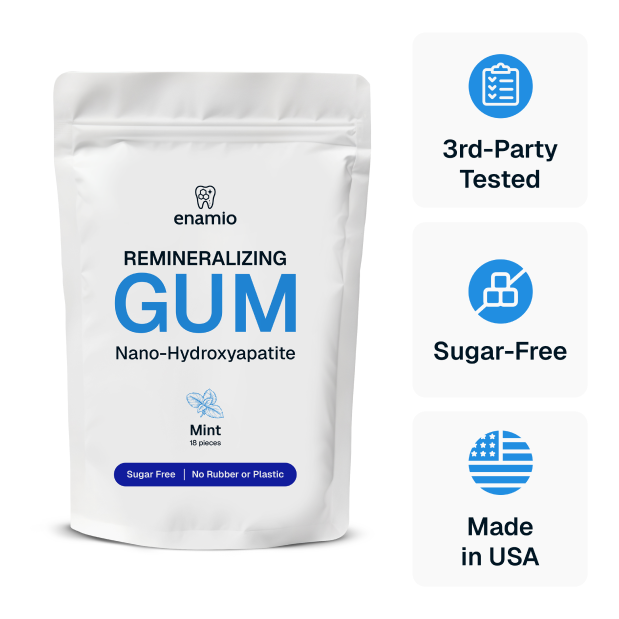
Product information
Enamio Remineralizing Gum
Enamio sugar-free gum comes in a choice of flavors and pack sizes. Review the current product details before ordering. You can browse Enamio's quiz when choosing among its product options. Enamio preference quiz.
View current Enamio product informationWhere to go from here
See every brand
Our full remineralizing gum guide
A dated fourteen-brand comparison organizes disclosed formulas, counts, value and documentation, so you can broaden a shortlist without assuming equivalent clinical performance.
Read sweetener amounts
Xylitol labels and stated grams
Compare ingredient order, total polyols and explicitly stated xylitol grams.
Match the exact variant
Halo Gum vs Enamio
Follow a variant-specific comparison of shared web descriptions, artwork and documentation.
Educational only, not medical advice. Ask your dentist about pain, active decay, pregnancy, allergies, or new restorations.