

Does Hydroxyapatite Gum Whiten Teeth? The Evidence
Share
Does hydroxyapatite gum whiten teeth? Cited non-gum nano-hydroxyapatite studies don't show tooth whitening from Enamio.
Published by Enamio
Toothpaste research can't answer a gum question on its own, so first distinguish surface deposits from color inside a tooth.
Quick Answer
The sources reviewed here don't establish whitening by hydroxyapatite gum, although some products called whitening gums target surface stains. [2] The 2023 review covers seventeen publications using non-gum formulations in laboratory and human research. [3] These aren't Enamio results or deadlines.
- Bleaching changes inner color, while surface-stain removal targets deposits on the tooth's surface.
- Cited studies used non-gum products.
- No Enamio whitening result shown.
For broader remineralizing-gum evidence, read our evidence review, while this article focuses on tooth color, stain claims and toothpaste-to-gum comparisons.
Key Takeaways
- Surface deposits and internal color can coexist.
- The cited research includes human investigations as well as laboratory experiments.
- Saliva isn't a color measurement.
- Have a newly changing tooth assessed before choosing a cosmetic product.
Contents
What a whitening-gum label can and cannot tell you
Whitening can mean removing surface deposits, while bleaching changes color within a tooth. [2] Start by asking which result a product claims. The claimed result tells you which measurement to look for when you read the research behind an oral-care product.
Would cleaner-looking surfaces meet your goal if the underlying tooth shade stayed the same?
A question for your appointment
Write down which teeth changed and when you first noticed it. Take that written history to your dental appointment so you can explain the sequence without relying on memory.
An after-meal sugar-free chew can feel fresh without measuring a change in an established deposit. Keep that after-meal habit separate from a cosmetic treatment choice.
Cleveland Clinic recommends regular cleanings and exams, while the ADA distinguishes professional surface-stain removal from peroxide bleaching. [1] [2] Ask which fits your teeth and dental work. Our Enamio-published gum comparison covers product disclosures for shopping, not diagnosis or whitening advice.
Cleveland Clinic advises an immediate dental appointment when discoloration accompanies pain, bad breath, bleeding gums or holes. [1]
A tooth newly darkening after injury needs assessment, so tell your dentist instead of waiting for gum to change it. [1]
Two kinds of tooth color: extrinsic and intrinsic

Discoloration can occur on a tooth's surface, within it, or in both locations. [1] [2] Location doesn't diagnose the cause. Some over-the-counter peroxide products can affect internal color, so compare active ingredients and the intended outcome rather than assuming every toothpaste works the same way. Ask which concern applies to your teeth.
Extrinsic discoloration describes material on the tooth surface, which is a different location from color within enamel or dentin. Coffee, tea, red wine and tobacco are among the reported exposures. [1] A brown area still needs assessment rather than an assumed coffee-stain diagnosis.
Intrinsic discoloration concerns color within enamel or dentin, with aging, injury, medicines and excessive developmental fluoride exposure among possible contributors. [1] [2] Tell your dentist whether the color difference is longstanding or whether one tooth has changed more recently than the others. The examination connects that history with the condition of the tooth.
Aging can change the way enamel shows underlying dentin, so removing a deposit may leave the underlying shade unchanged. [1] Ask whether a proposed treatment addresses a surface deposit, the underlying shade, or both.
Extrinsic (on the surface)
Causes: coffee, tea, red wine, tobacco, plaque film.
Question to discuss: which deposits could cleaning remove, and what color might remain? Surface stain and internal color can coexist. [1] [2]
Intrinsic (inside the tooth)
Possible causes include aging dentin, trauma, tetracycline, fluorosis and inherited developmental differences.
Ask how the diagnosed cause, natural teeth and existing restorations affect your options. An internal color difference does not automatically mean needing a restoration or tell you which cosmetic approach fits the tooth.
The ADA notes that surface and internal causes can combine. [2] If a deposit improves but a color difference remains, take that observation to the examination. The useful detail for your appointment is the change you noticed, rather than a diagnosis guessed from the remaining shade.
Compare the active ingredients and intended outcome, not just the word toothpaste. Some pastes primarily address surface stain, while peroxide-containing products can affect intrinsic color. [2] [10]
A photograph of tooth color cannot show which layer is responsible or explain the particular change you have noticed. Coffee can contribute surface stain, while a single dark tooth or gray band may need a different evaluation. Read how remineralizing gum works.
What chewing gum can and cannot do to stains
The cited saliva findings don't establish a measured tooth-color change from Enamio gum. Saliva is the fluid in your mouth. Chewing sugar-free gum stimulates its flow and supports food clearance and plaque-acid neutralization, which are different endpoints from measured tooth color. [6] Compare the actual outcomes.
Stookey's available abstract discusses stimulated saliva and seven chewing-gum trials with caries-related outcomes. [6]
It reports no finished-Enamio coffee-stain measurement. The inspected PubMed record has no accompanying conflict statement, which does not establish commercial independence.
EFSA's 2009 opinion assessed plaque-acid neutralization for a defined sugar-free gum category, with at least twenty minutes after eating or drinking. [7]
Its defined category excludes certain gums that contain specific active ingredients.
These are historical category conditions, rather than current Enamio directions or permission to make a legal claim.
Those historical category conditions don't establish a whitening period for Enamio gum.
When reading a stain claim, separate three questions: did an existing deposit change, were new deposits prevented, or were loose food particles cleared? A fresh feeling is not that measurement.
Ask a dentist what caused established discoloration and which options fit. [1] Use the saliva findings to understand food clearance and plaque-acid neutralization, rather than treating them as measurements of tooth color. They don't quantify Enamio's coffee-pigment removal or the duration of a color change. [6]
Our ingredient and label guide separates ingredient descriptions from product evidence. Ask whether the evidence tests the finished product and the outcome being claimed. Keep the study's tested formulation, intended outcome and comparison group together, rather than carrying one result across to another product.
Use the table below to compare questions about different discoloration types. It organizes questions rather than ranking treatments. In particular, 'not established here' describes an evidence limit rather than proof that an effect is impossible.
Methodology
Clinical guidance can help frame the questions raised by a color change, while the separate mineral, whitening and saliva sources explain limits on product comparisons. The rows organize appointment questions without prescribing treatment or predicting success. [1] [2] The review and laboratory findings retain their original product formats below.
- Sources include Cleveland Clinic, ADA and NIDCR early-decay guidance, hydroxyapatite whitening and caries reviews, a bovine-tooth experiment, and saliva research.
- Method: separate color concerns, dental-care options and evidence limits.
- Limit: row counts aren't sample sizes, success rates or estimates of how often a product works.
On a phone, swipe left and right across the table to read columns outside the screen's visible area.
Color concerns to discuss before choosing a product
| What you noticed | What the sources distinguish | Question for the appointment | What a gum claim would need to show |
|---|---|---|---|
| Deposits associated with coffee, tea, wine, tobacco or plaque buildup | These can contribute to extrinsic discoloration, without excluding an internal component. [1] [2] | Which deposits can cleaning remove, and what color would remain? | A measured surface-stain outcome for that finished gum, rather than saliva flow alone. |
| Gradual yellowing or a naturally darker shade | Natural tooth color and aging can differ from a removable surface deposit. [1] | Is the concern underlying color, surface stain, or both? | A relevant natural-tooth color measurement, with the starting shade and comparison identified. |
| One tooth becoming darker, including after an injury | A single changing tooth can have a cause requiring professional assessment. Color alone does not diagnose its pulp. [1] | What caused the change, and does the tooth need care before cosmetic treatment? | A cosmetic claim cannot replace investigation of the affected tooth. |
| Longstanding bands, mottling or developmental color differences | Medicines, fluorosis and development are among possible contributors. Treatment depends on the actual cause. [1] [2] | Which options fit this diagnosis, and what limitations should I expect? | Evidence addressing that type of discoloration, without treating an unrelated toothpaste experiment as a gum trial. |
| A white patch | Early mineral loss can produce a white spot, but discoloration has other causes. [9] [1] | Is this decay or another finding, and which care is appropriate? | Separate mineral and appearance outcomes. A color photograph cannot establish lesion activity or mineral gain. |
| A crown, filling or other restoration no longer matching | Bleaching expectations for natural teeth do not apply to tooth-colored restorations. This does not rule out surface deposits on them. [2] | Would cleaning change the appearance, and how would whitening adjacent teeth affect the match? | An outcome specific to the material and surface condition, rather than a blanket promise to whiten dental work. |
The table helps organize an appointment, but its descriptions cannot establish the cause of your discoloration or select a treatment without an examination. Dentists assess causes, including hidden concerns, before discussing appropriate cosmetic options. Keep that assessment separate from a gum's label and from changes seen in a photograph.
Which study settings were actually represented?
We compiled the review's seventeen listed publications. Each row identifies one publication by its review citation number and records the setting studied. The two publications with both laboratory and human investigations appear once, so the table counts publications rather than adding participants or specimens together. [3]
Publication inventory from the 2023 review
Swipe horizontally to read every column.
| Publication and review number | Study setting | Unit counted | Source | Read date |
|---|---|---|---|---|
| Hojabri and Kunzelmann, 2022 (37) | laboratory only | One publication | [3] | October 18, 2026 |
| Shang and colleagues, 2022 (38) | laboratory only | One publication | [3] | October 18, 2026 |
| Shang and Kunzelmann, 2021 (39) | laboratory only | One publication | [3] | October 18, 2026 |
| Hojabri and colleagues, 2021 (40) | laboratory only | One publication | [3] | October 18, 2026 |
| Sarembe and colleagues, 2020 (41) | laboratory only | One publication | [3] | October 18, 2026 |
| Bommer and colleagues, 2018 (42) | laboratory and human | One publication | [3] | October 18, 2026 |
| Jin and colleagues, 2013 (43) | laboratory only | One publication | [3] | October 18, 2026 |
| Kim and colleagues, 2011 (44) | laboratory only | One publication | [3] | October 18, 2026 |
| Dabanoglu and colleagues, 2009 (45) | laboratory only | One publication | [3] | October 18, 2026 |
| Park and colleagues, 2007 (46) | laboratory only | One publication | [3] | October 18, 2026 |
| Kim and colleagues, 2006 (47) | laboratory only | One publication | [3] | October 18, 2026 |
| Park and colleagues, 2006 (48) | laboratory only | One publication | [3] | October 18, 2026 |
| Niwa and colleagues, 2001 (49) | laboratory and human | One publication | [3] | October 18, 2026 |
| Steinert, Kuchenbecker and colleagues, 2020 (50) | human only | One publication | [3] | October 18, 2026 |
| Steinert, Zwanzig and colleagues, 2020 (51) | human only | One publication | [3] | October 18, 2026 |
| Woo and colleagues, 2014 (52) | human only | One publication | [3] | October 18, 2026 |
| Raoufi and Birkhed, 2010 (53) | human only | One publication | [3] | October 18, 2026 |
Method and limits
- Inputs are the review's Tables 1 and 3, read October 18, 2026, rather than full underlying papers.
- Merge Bommer 42 and Niwa 49. Match citation numbers 37 through 53 across both tables.
- Laboratory includes extracted human or bovine teeth and blocks, rather than trials with people.
- Table 2 repeats laboratory publications for quality scoring, so it supplies no additional publication rows.
These percentages describe publication settings, rather than the strength of a whitening effect. Our calculation: 11 / 17 × 100 = 64.7 percent of publications contain laboratory investigations only. Publications including human investigations account for (4 + 2) / 17 × 100 = 35.3 percent, without establishing a pooled treatment effect or the safety of gum. [3]
Mixed-design publications represent 2 / 17 × 100 = 11.8 percent overall. Those two mixed publications are already included in the human count, so they aren't extra publications.
Does hydroxyapatite gum whiten teeth? Toothpaste versus gum
The cited non-gum studies don't establish that hydroxyapatite gum whitens teeth, since they tested other formulations and measured outcomes. Hydroxyapatite is a calcium-phosphate mineral found naturally in tooth enamel. [8] The cited non-gum research includes toothpaste formulations containing nano-hydroxyapatite at specified concentrations, which cannot supply an Enamio chewing dose. [3] [4] Compare the tested product and outcome before applying a study's result.
The 2023 systematic review included seventeen publications on hydroxyapatite whitening, with no gum among its listed products. [3] Formats included toothpastes, rinses, gels, dissolvable films and experimental mixtures, which aren't delivered to teeth in the same way as a chew.
Mineral is not pigment
Enamel mineral chemistry does not by itself establish a whitening result. [8]
No gum vehicle
No gum appears in the review's product tables. [3] That's the scope of this review, not a search of every gum trial worldwide.
Forty bovine incisors were split into four groups of ten: one-percent or ten-percent hydroxyapatite by weight, HAP-free slurry, and water. [4]
Three thirty-second applications were separated by twenty-four-hour storage in artificial saliva, with color measured twenty-four hours after each application. [4]
This laboratory sequence doesn't describe chewing gum. After the third application, the ten-percent slurry group had a reported mean instrumental color difference, delta E, of 4.47. [4]
Delta E isn't a count of shade-guide steps or an Enamio outcome. These were bovine teeth.
The concentration and schedule aren't an Enamio dose or a personal whitening deadline.
Fluidinova supplied the hydroxyapatite free of charge for this laboratory research. [4]
The Department of Conservative Dentistry and Periodontology at LMU Munich supported the work, and Projekt DEAL enabled open-access funding. The authors declared no competing interest. [4]
The 2024 review asks about caries prevention using hydroxyapatite toothpastes, mouthwashes and gels. [5]
Its abstract distinguishes eighteen retrieved studies from five clinical and eight in-situ contributions to the meta-analysis.
That's a different formulation and outcome question from gum whitening, as our evidence guide explains when separating product comparisons.
The whitening evidence is heterogeneous. The 2023 review separates eleven laboratory-only publications, four human-only publications and two containing both designs. [3] Together, the human-only and mixed-design publications contain six human investigations, so the overall count of seventeen publications must not be presented as seventeen clinical trials.
Varying formulations and methods prevented a pooled whitening estimate.
A negative human comparison needs to remain visible alongside favorable laboratory findings in the review. In the review's Table 3, a 150-person, twelve-week hydroxyapatite toothpaste comparison did not reduce stain over the placebo fluoride paste. [3]
That single comparison doesn't establish failure for every other toothpaste formulation.
The comparison was against fluoride placebo paste, rather than an untreated control.
Meyer and Enax were Dr Kurt Wolff employees in the 2023 review, which reported no external funding. [3]
The 2024 review reports their employment and company travel grants to all authors, while other authors declared no company financial interests. [5]
Publication alone doesn't establish that authors are independent of commercial interests. A statement about external funding answers a different question from the authors' separately declared company employment relationships.
A white patch is not simply a pigment deposit.
NIDCR describes early mineral loss as one possible source of a white spot, before permanent cavitation. [9]
A white patch has several possible causes. [1] Ask a dentist to identify the patch before assuming that mineral gain must make its color disappear.
A color measurement can reflect optical appearance without showing pigment removal or bleaching.
The hydroxyapatite review discusses such proposed effects in non-gum products. [3] Those effects aren't interchangeable mechanisms.
Compare gum and toothpaste as different formats before interpreting a measured change.
Where Enamio fits, and what remains unproven
Enamio's inspected product-page and FAQ texts describe sugar-free gum with hydroxyapatite and xylitol. [11] [12] That's a seller description. Neither text supplies a finished-Enamio whitening trial, and their daily directions differ, so choose an optional chew for flavor and convenience. Choose any cosmetic treatment separately from a preference for chewing gum.
The retained seller texts list chicle, sweeteners and mineral ingredients as descriptions to compare with the actual pouch. [11] [12]
Begin the comparison with the wording on your selected gum package. Our Enamio ingredient guide organizes the questions to ask about a particular pouch and its particle specifications.
The seller's description is not independent verification.
The inspected seller descriptions do not establish a finished-gum whitening result.
They supplied neither a public certificate of analysis nor a particle-size certificate. Those omissions describe only the pages inspected here, rather than establishing what every private or public document might contain. Ask the seller for the product information you need to check an ingredient restriction.
For a product comparison, write down the selected pack's ingredient list and directions rather than working from the word remineralizing alone. Identify the flavor, market and package size before comparing those documents. Put the product-page description and FAQ beside that list, marking any difference instead of silently choosing the instruction you prefer.
Which specific detail about the selected gum would change your purchase decision? Flavor and an ingredient restriction ask different questions. A reply about flavor does not establish whether the finished gum changes tooth color. Ask the seller the specific question that determines your purchase decision.
For an ingredient restriction, check the current pouch and ask whether the information applies to your selected flavor and pack.
For a claimed benefit, check which finished formulation was studied and which outcome was measured.
Then read the reply's scope.
An ingredient listing, particle document and clinical outcome report answer different questions, and obtaining one wouldn't establish the others.
Keep the response with the product details you used, so you can check what was actually stated before ordering. Check which selected pack the reply describes.
Keep toothpaste abrasivity out of the gum comparison. RDA measures dentifrice abrasivity, and the ADA cautions against quantitative safety rankings below 250. [10] It isn't a gum-abrasion test, so it cannot establish this formulation as harmless or harmful.
When evaluating the formulation rationale, separate the evidence about chewing from the seller's statements about the ingredients in its gum. Chewing can stimulate saliva, while the seller lists hydroxyapatite as an ingredient. [6] [11] A finished-gum study would need to test the claimed outcome under its intended use conditions.
Cavity risk and cosmetic goals can overlap. NIDCR explains how fluoride and saliva can help early enamel regain minerals before a cavity forms. [9] That doesn't promise a visible mark will disappear. Our early-lesion and cavity guide distinguishes mineral gain in remaining tissue from replacing a missing part of a tooth.
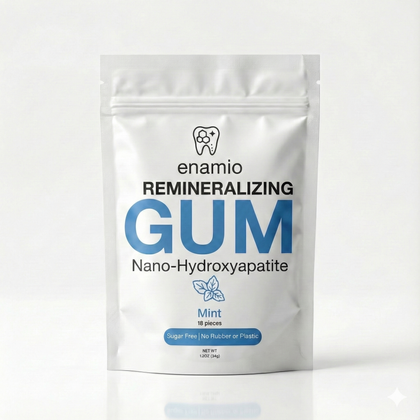
Enamio Remineralizing Gum
The inspected seller texts describe a sugar-free, fluoride-free gum with chicle, hydroxyapatite and xylitol. [11] [12] Check the current pouch and selected product details. The sources reviewed here do not establish stain removal or a change in underlying tooth color from Enamio. Choose by flavor and convenience.
Whitening can cause sensitivity and gum irritation. [2] Do not interpret a chewing product as a treatment for those symptoms. Describe them to your dentist, using our sensitive-tooth guide to prepare location, timing and triggers without diagnosing the cause yourself.
Flavor can guide a gum preference. Check the stated ingredients against any restriction your dentist has given you before choosing a pack. Discuss a shade-change goal before buying for that purpose.
How to use it, and what to realistically expect
The retained pages gave different daily directions for the same named gum: one to two pieces on the product page and one to three in the FAQ. [11] [12] Don't average those two different daily ranges into a new instruction. Check your current pouch and ask the manufacturer which directions apply to the exact pack you selected.
Your product's serving directions, your dental care plan and a research protocol answer different questions, so start with the label and any restriction your dentist has given you.
- Keep brushing and flossing as directed by your dental professional.
- Follow the label's serving and frequency directions.
- A research protocol isn't a set of brand directions for the gum you're choosing.
- Don't increase quantity or chewing time for whitening.
The historical EFSA condition concerns category-level plaque-acid neutralization. [7] It doesn't state an Enamio daily quantity or chewing time for a visible color change. For chewing alongside routine care, read our gum-use guide. If your package and the seller's pages disagree, get that instruction clarified first.
✓ Do
Keep the particular product directions separate from brushing and flossing, and ask your dentist about any personal restriction before changing ordinary care.
✗ Don't
Expect a shade change or a staged before-and-after photo.
Before-and-after photographs show a tooth's appearance at two moments, rather than a complete history of changes. Photographs don't measure tooth mineral content. The non-gum studies used particular formulations, controls and color measurements. [3] Check whether the photograph illustrates the actual study and its tested product.
If you change toothpaste while beginning a gum, you can't isolate the gum's contribution from a later, lighter-looking photograph. A comparison group helps researchers separate explanations, including toothpaste changes, which matching the photograph's angle alone cannot rule out.
Don't use gum to manage sensitivity after bleaching. Tooth sensitivity and gum irritation are known whitening side effects, and persistent symptoms deserve a dentist's advice. [2] If chewing aggravates jaw trouble, stop and ask a dental professional.
The bovine experiment's repeated applications and artificial-saliva storage describe a laboratory protocol, without providing a personal Enamio whitening timeline. [4] The seller descriptions do not supply a finished-gum study that establishes a whitening timeline.
Recheck the goal before buying another pack.
Keep the after-meal habit separate from the cosmetic decision. Follow the gum's label, maintain ordinary dental care, and discuss a color concern with your dentist. This guide doesn't establish an Enamio whitening treatment.
People also ask
Does hydroxyapatite gum whiten teeth?
A whitening benefit from chewing a hydroxyapatite gum isn't established by research on the non-gum formulations included in this review. The cited hydroxyapatite review lists non-gum formulations, with both laboratory and human designs. [3] Sharing an ingredient with a toothpaste doesn't establish the same tooth-color outcome for Enamio or another particular finished gum product. Our gum evidence guide explains how formulation and measured outcomes limit product comparisons.
Does remineralizing gum whiten your teeth?
Mineral gain and whitening are different outcomes. Some whitening products address surface deposits, while peroxide products can change underlying tooth color. [2] The word remineralizing on a gum label doesn't tell you that its finished formulation was tested for either kind of color change. Read our remineralizing-gum definition, then check the particular cosmetic claim separately.
Does hydroxyapatite whiten teeth?
Some studied formulations changed measured tooth color.
The 2023 review includes heterogeneous findings, with no gum among its listed products. [3] Its human and laboratory results don't establish that every hydroxyapatite product removes pigment, bleaches natural teeth, or produces the same visible effect. Check the delivery format and comparison before assuming equivalent product results.
Is remineralizing gum the same as whitening?
No, those terms describe different intended outcomes. Remineralization concerns mineral gain in remaining tissue, whereas whitening concerns a change in appearance. [8] A tooth can have a mineral-related problem and a separate color concern, so evidence about one doesn't automatically answer the other. Our early-lesion versus cavity guide explains why missing tooth structure matters.
Can gum remove coffee stains?
An Enamio coffee-stain result isn't established.
Saliva research addresses mechanisms and caries outcomes, rather than this product's measured pigment removal. [6] Clearing food particles after a meal is a different endpoint from removing an established coffee deposit or preventing another stain from forming later. Ask whether finished-product research actually measured the stain outcome being claimed.
Does nano-hydroxyapatite toothpaste whiten teeth?
Some experimental toothpaste findings concern measured color. Shang and colleagues tested toothpaste slurries on bovine teeth under controlled laboratory conditions. [4] Their three applications and artificial-saliva storage don't provide a personal timetable, shade-guide improvement, or an expected result from chewing Enamio gum. Compare how toothpaste and gum evidence differ before transferring product-specific findings.
What is a white spot lesion?
A white patch can reflect mineral loss.
NIDCR describes a white spot among the possible early signs of tooth decay. [9] Developmental changes and fluorosis can also affect appearance, so an online image can't identify the cause of a particular patch on your tooth. [1] The white-spots guide organizes questions without replacing examination or promising recovery.
Does gum damage enamel?
Toothpaste abrasivity can't establish a gum's safety.
The ADA's RDA discussion concerns dentifrices and brushing, rather than a gum-specific abrasion test. [10] An absence of gum findings in that source doesn't prove a particular formulation harmless or identify why a tooth feels sensitive after chewing. Report symptoms using the guide to reporting sensitivity for your dentist.
What actually whitens teeth?
The appropriate option depends on the cause. Surface-stain removal and peroxide bleaching address different aspects of tooth appearance and discoloration. [2] Existing restorations, the condition of natural teeth and the reason for the color change affect what a dentist recommends and the outcome discussed. Ask which aspect of your concern the proposed treatment would change.
Can gum fix yellow teeth?
Yellow appearance doesn't identify one cause. Aging, surface deposits and other factors can contribute to a change in tooth color. [1] A gum ingredient list doesn't distinguish those causes or establish that chewing the product will correct the color of the affected teeth. Describe when the change appeared before choosing cosmetic treatment or products.
Is whitening gum safe?
Safety depends on the particular finished product.
The label whitening doesn't identify a uniform formulation, exposure or individual chewing restriction. The cited sources don't establish a common safety profile for every such gum, or show that a color claim overrides your dentist's advice. Our hydroxyapatite safety guide separates ingredient questions from finished-product evidence.
Does hydroxyapatite gum whiten teeth if the brand is Enamio?
These sources establish no finished-Enamio whitening outcome. Its retained product-page and FAQ texts describe ingredients, while making their own seller claims. [11] [12] Those descriptions are not a clinical comparison showing how much tooth color changes, how long a result lasts, or which discoloration responds. Use our ingredient guide for label questions, keeping cosmetic outcomes separate.
FAQs
Is nano-hydroxyapatite gum safe for daily use?
Will whitening toothpaste plus gum whiten my teeth faster?
How is Enamio different from a whitening gum?
Can kids use nano-hydroxyapatite gum?
Does xylitol or monk fruit whiten teeth?
How soon does a remineralizing gum before-and-after show up?
Does charcoal gum whiten teeth?
Should I use whitening strips instead of gum?
Is hydroxyapatite the same as fluoride?
References
-
Cleveland Clinic. Tooth Discoloration.
Updated July 3, 2025, clinical main rechecked October 18, 2026.
-
American Dental Association. Whitening.
Oral Health Topics, updated August 16, 2022. Retained clinical main and policy text reviewed October 18, 2026.
-
Limeback H, Meyer F, Enax J. Tooth Whitening with Hydroxyapatite: A Systematic Review.
Dentistry Journal, 2023, volume 11, issue 2, article 50, DOI 10.3390/dj11020050, article text, textual tables and declarations rechecked October 18, 2026.
-
Shang R, Kaisarly D, Kunzelmann KH. Tooth whitening with an experimental toothpaste containing hydroxyapatite nanoparticles.
BMC Oral Health, 2022, volume 22, article 331, DOI 10.1186/s12903-022-02266-3, methods, narrative results and declarations rechecked October 18, 2026.
-
Pawinska M and colleagues. Clinical evidence of caries prevention by hydroxyapatite: An updated systematic review and meta-analysis.
Journal of Dentistry, 2024, volume 151, article 105429, DOI 10.1016/j.jdent.2024.105429, retained own metadata, full abstract and competing-interest statement rechecked October 18, 2026.
-
Stookey GK. The effect of saliva on dental caries.
Journal of the American Dental Association, 2008, volume 139 supplement, pages 11S-17S, DOI 10.14219/jada.archive.2008.0347, metadata and full structured abstract rechecked October 18, 2026.
-
EFSA Panel on Dietetic Products, Nutrition and Allergies. Scientific Opinion on the substantiation of health claims related to sugar-free chewing gum and dental and oral health, including gum and tooth protection and strength (ID 1149), plaque acid neutralisation (ID 1150), maintenance of tooth mineralisation (ID 1151), reduction of oral dryness (ID 1240), and maintenance of the normal body weight (ID 1152) pursuant to Article 13(1) of Regulation (EC) No 1924/2006.
EFSA Journal, 2009, volume 7, issue 9, article 1271, retained complete opinion text, identity rechecked October 18, 2026.
-
Dawes C. What Is the Critical pH and Why Does a Tooth Dissolve in Acid?
Journal of the Canadian Dental Association, 2003, volume 69, issue 11, pages 722-724, retained complete three-page source identity rechecked October 18, 2026.
-
National Institute of Dental and Craniofacial Research. The Tooth Decay Process: How to Reverse It and Avoid a Cavity.
Reviewed January 2025, complete clinical main rechecked October 18, 2026.
-
American Dental Association. Toothpastes.
Updated February 11, 2026, complete clinical main rechecked October 18, 2026.
-
Enamio. Enamio Remineralizing Gum.
Manufacturer product page, retained complete visible main inspected October 17 and reread October 18, 2026. Seller statements are not independent clinical evidence.
-
Enamio. FAQ | Enamio Remineralizing Gum with Nano Hydroxyapatite.
Manufacturer FAQ, retained complete visible main inspected October 17 and reread October 18, 2026. Its directions and ingredient descriptions are seller statements.
Ready to build your enamel routine
Enamio Remineralizing Gum
The manufacturer describes Enamio as a sugar-free hydroxyapatite gum. [11] Finished-gum whitening isn't established here. Review ingredients, pouch directions and the selected pack before deciding whether you want an optional chew.
For manufacturer information, see the cavity page, freshness page, gum-base page and sensitivity page. These are sales pages. Their outcome claims are not adopted as clinical evidence or recommendations for the color concern discussed here.
Reading next
This definition guide distinguishes mineral gain from a cosmetic color change, helping you compare the intended outcome before reading claims about a particular chewing product.
Compare gum ingredients and formats
Use this Enamio-published guide to compare gum ingredients and product formats. Check the actual pouch first.
Publisher information for this Enamio-written guide. It does not identify a dental reviewer or supply independent product evidence.
Educational only, not medical advice.
Published by Enamio
This Enamio-published guide names no individual dental reviewer, and you can read about Enamio for publisher information.