

Is Xylitol Gum Safe During Pregnancy? The Evidence
Share
PREGNANCY + ORAL CARE
For readers asking “is xylitol gum safe during pregnancy,” this label-first guide separates ingredient evidence, finished-gum labels, stomach tolerance, and the questions worth taking to your care team.
Key Takeaways
- Food-additive status doesn't clear every finished gum.
- Pregnancy gum evidence is narrower than a product label.
- Polyols can upset a sensitive stomach, so watch tolerance.
In this guide
- 01 -
Why the answer has layers
The safest answer is conditional, not a blanket yes or no. Xylitol as a food ingredient, a particular finished gum, and your own pregnancy are three different questions. Pregnancy oral-health guidance adds context, but it doesn't turn a sweetener or a product page into personal medical clearance [4][6].
Pregnancy can change the mouth in ordinary, uncomfortable ways. The CDC describes pregnancy gingivitis in roughly 60% to 75% of pregnancies, while HRSA notes that nausea, vomiting, heartburn, and dry mouth can alter the oral environment [6][7]. That does not diagnose anything about you. It explains why a pregnant reader may be looking for a sugar-free chew, a gentler routine, or help with a stale taste.
Here's the thing. A product can be sugar-free and still have a long ingredient list. A gum can contain xylitol and still require a look at flavoring, minerals, extracts, allergens, directions, and tolerance. The word on the front isn't the whole label.
1. Ingredient
What food-safety and oral-health sources say about xylitol itself.
2. Gum
What the complete formula, directions, amounts, and delivery form add.
3. Person
How symptoms, allergies, medications, and pregnancy history change the conversation.
A label-first decision is more useful than a confident-sounding internet verdict. If you have persistent vomiting, reflux, painful chewing, a known allergy, a high-risk pregnancy, or a medication question, bring the exact product label to your obstetric clinician, midwife, dentist, or pharmacist. A routine oral-health page can help you prepare. It cannot replace that review.
For the oral-care piece, you can read Enamio's cavity-care context, its bad-breath support options, and its tooth-sensitivity information as separate educational paths. None of those pages answers the personal pregnancy question for you.
That may feel less tidy than a one-word verdict. It is also more honest. The label, the evidence, and your symptoms belong in the same conversation.
The context in four numbers
- 02 -
Is xylitol gum safe during pregnancy? Read the evidence in layers
Xylitol is a five-carbon polyol, or sugar alcohol, used as a food sweetener and humectant. JECFA lists it as INS 967 and records an acceptable daily intake as “not specified” in its food-additive evaluation. That phrase describes the scope of the evaluation. It does not provide a personal pregnancy dose or clear every finished gum [1].
The FDA uses a similar condition-based frame. Its food-additive guidance considers the identity of an ingredient, its intended use, amount, food type, exposure, metabolism, studies, and vulnerable populations [2]. A database entry about xylitol cannot tell you how much is in a particular piece of gum, what other ingredients are present, or whether your clinician wants you to avoid a specific extract or flavor.
That is what finished-product evidence means here. It is evidence tied to a complete formula, ingredient amounts, directions, population, and conditions of use. A single-ingredient record cannot stand in for that package. Nor can a study of one gum be quietly transferred to another gum with a different base, sweetener blend, mineral, flavor, or serving direction.
A food-use record answers one question. Your label and your care team answer the next two.
What does gum add to the question?
A useful evidence check asks four plain questions. What was studied? Who was studied? What did the product contain? And what outcome was measured? If a source answers only the first question, you're looking at a clue, not a complete decision. That's not a criticism. Food and oral-care evidence often arrives in pieces.
Food-use evidence
Can describe an ingredient's identity and permitted food context. It can't tell you the amount in a gum or whether your care team wants a specific product avoided.
Oral-care evidence
Can describe saliva, plaque, or chewing effects. It doesn't automatically answer fetal outcomes or complete-formula questions.
Pregnancy evidence
Can describe a specific population and protocol. It won't make a different gum identical to the study product.
The PPaX trial makes this visible. It enrolled 10,069 people, but enrollment isn't the same as a universal answer. Its clusters were in Malawi, its product was part of a research protocol, and its design was open-label. Even a large trial can be narrow in setting and formula. That's how science works. The number matters, and the boundary matters too.
The same check applies to the 20-minute phrase that appears in dental gum guidance and on the Enamio product page. You might see that timing and assume it is a pregnancy recommendation. It isn't. It is a study or manufacturer context. Your care team may want a different plan, or no gum at all, depending on symptoms and history.
And what about the “natural” label? Natural doesn't mean every person will tolerate every ingredient. A botanical extract still deserves a label review. A mineral still has an amount and a delivery form. A sweetener still adds to the day's total. You don't have to be frightened by the list, but you shouldn't let a reassuring adjective do the work of reading it.
Ingredient evidence can be encouraging. Gum evidence can be useful. Neither one knows your medication list, your allergies, or how the last eight weeks have actually gone, and that is the part a clinician fills in.
Chewing changes saliva flow. The ADA describes sugar-free gum as an adjunct to brushing and cleaning between teeth, not a replacement for either one. In the cited dental evidence, gum-base chewing increased salivary flow, and a 20-minute after-meal period appears in clinical study context [3]. That is an oral-care mechanism. It is not a pregnancy schedule.
Xylitol gum research also has limits. A 2022 systematic review screened 424 records and included 14 articles covering 16 studies. Thirteen of the 14 gum studies reported lower plaque accumulation, yet the authors described heterogeneity and called for more research [11]. Cochrane's review included 10 studies and 5,903 analyzed participants, then rated the evidence low quality and found insufficient evidence for firm conclusions about many xylitol products, including gum [12].
Those findings can support a measured oral-care conversation. They cannot prove that every gum reduces cavities, that a particular formula fits every pregnancy, or that brushing and dental visits can be skipped. A lower plaque marker is not a pregnancy outcome.
For a broader, non-pregnancy-specific explanation of xylitol evidence, see Enamio's xylitol oral-health overview. It belongs beside this article, not in place of it.
What did the PPaX pregnancy trial actually test?
The PPaX trial is the study most likely to be overread. It was an open-label, cluster-randomized trial across 8 health centers in and around Lilongwe, Malawi, with 10,069 enrolled participants. The intervention used xylitol gum twice daily within that study protocol. Those details matter more than a headline result [9][10].
| Measure | Value | Unit |
|---|---|---|
| Enrolled intervention-site participants | 4,549 | participants |
| Enrolled active-control-site participants | 5,520 | participants |
| Total enrolled participants | 10,069 | participants |
| Preterm intervention analyzed denominator | 4,349 | participants |
| Preterm intervention events | 549 | births |
| Preterm active-control analyzed denominator | 5,321 | participants |
| Preterm active-control events | 878 | births |
| Low-birthweight intervention analyzed denominator | 4,305 | participants |
| Low-birthweight intervention events | 385 | neonates |
| Low-birthweight active-control analyzed denominator | 5,260 | participants |
| Low-birthweight active-control events | 679 | neonates |
| Outcome | Xylitol gum | Active control | Difference | Reported RR (95% CI) |
|---|---|---|---|---|
| Preterm birth | 12.6% (549/4,349) | 16.5% (878/5,321) | 3.9 points | 0.76 (0.57 to 0.99) |
| Low birthweight | 8.9% (385/4,305) | 12.9% (679/5,260) | 4.0 points | 0.70 (0.49 to 0.99) |
| Neonatal demise | 0.2% (8/4,305) | 0.4% (22/5,260) | 0.2 points | 0.41 (0.19 to 0.89) |
The PPaX result is worth reading carefully. It is also a poor shortcut for a personal decision. The study gum is not automatically the same as the gum in your hand, and a reported association does not answer every question about ingredients, tolerance, medication, or pregnancy history.
If you want more ingredient context, Enamio's active-ingredient comparison, nano-hydroxyapatite safety guide, and enamel science guide answer different questions. None turns xylitol evidence into a finished-formula pregnancy conclusion.
- 03 -
How to read the current Enamio label
Nano-hydroxyapatite is a calcium-phosphate oral-care ingredient presented in very small particles. The current Enamio page lists 12 displayed ingredient entries, including rod-shaped nano-hydroxyapatite, but xylitol evidence cannot establish the pregnancy safety of that ingredient, its amount, or the complete gum delivery system. Treat the page as a label source, not independent pregnancy evidence.
That distinction may sound fussy. It isn't. A finished gum is a bundle of ingredients, a gum base, flavoring, a sweetener system, and directions. If one part of the bundle changes, the answer can change too. The page checked for this draft displayed six flavor or assortment choices, three pack choices, a twelve-entry ingredient list, and no verified xylitol amount per piece [13].
Label facts
The page lists xylitol, monk fruit, chicle, bamboo silica, calcium glycerophosphate, zinc gluconate, magnesium citrate, L-arginine plus sodium bicarbonate, green tea extract, natural mint flavor, menthol, and rod-shaped nano-hydroxyapatite [13].
Still unknown
The fetched page did not disclose xylitol milligrams per piece. It also does not make this article a product-specific pregnancy assessment for every listed active, flavor, or personal situation [13].
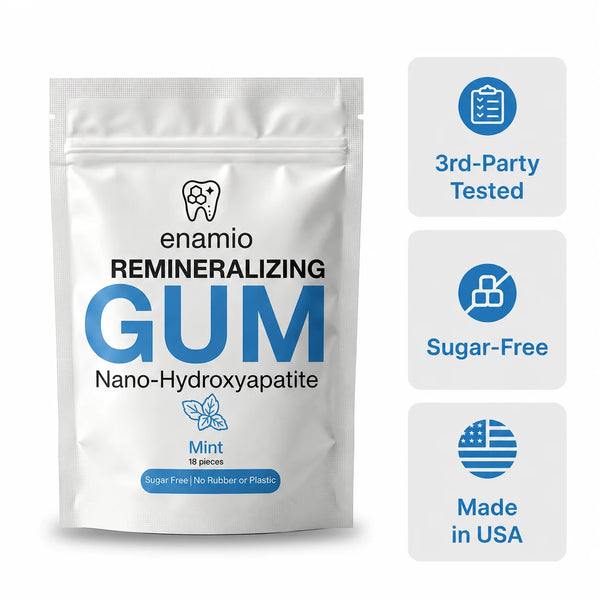
A label example, not a clearance
Enamio Remineralizing Gum
The live product page is useful for seeing what a complete formula includes. It is not independent evidence that the formula is appropriate for every pregnancy.
If you are considering it, review the current label with the professional who knows your history. The current product label can change, so check the live page rather than an old screenshot.
Why the ingredient list matters
Xylitol is only one line in the label. A pregnant reader may also want to ask about a botanical extract, mineral salt, flavor compound, sweetener blend, allergy concern, or medication interaction. The live page lists green tea extract without giving this article a verified extract amount or caffeine analysis. That gap is a reason to ask, not a reason to guess.
The product page also displays a six-active benefits block beside a longer ingredient list. That mismatch does not prove a problem, but it does show why a careful reader should use the actual current ingredients rather than a short marketing summary. Write down the exact flavor and the exact label before asking a clinician.
If the gum base itself matters to you, Enamio's page about plastic-free gum base is a separate product-material explanation. It does not answer pregnancy safety. If you want to compare ingredient roles, the Enamio ingredient guide adds context, but the same boundary applies.
- 04 -
How to think about use, dose, and tolerance
Use a pregnancy gum question as a five-part label-and-tolerance check, not a math exercise. Follow the selected product's directions, count other polyol sources across your day, notice symptoms, and ask a clinician when the formula or your health history adds uncertainty. This article does not set a pregnancy dose.
The current Enamio page says to chew 1 to 2 pieces daily for 20 minutes each. Those are the manufacturer's product directions. They are not pregnancy instructions, and the page does not disclose a verified xylitol amount per piece. Do not turn that text, an adult study, or the PPaX twice-daily study schedule into advice for yourself [13].
1
Read the whole label
Look for xylitol, other polyols, flavoring, botanicals, minerals, allergens, directions, and any amount per piece. Sugar-free is one fact, not the entire answer.
2
Ask what is missing
If the label does not give a xylitol amount, do not calculate one from pack size, piece count, or a different product. Missing data is a prompt for the manufacturer or care team.
3
Count the full day
Gum is not the only possible source of a polyol. Mints, candies, drinks, supplements, and other sugar-free foods can change total exposure.
4
Watch tolerance
A peer-reviewed review explains that polyols can cause gastrointestinal discomfort or laxative effects with excess intake, and sensitivity varies between people [8].
5
Choose the right reviewer
A dentist can discuss oral-care fit. An obstetric clinician, midwife, or pharmacist can discuss pregnancy history, symptoms, medication, and the complete formula.
What does tolerance look like? A mild taste preference is one thing. Repeated bloating, cramping, loose stool, or diarrhea is another. Do not respond to a poorly tolerated product by guessing a new amount from a generic internet chart. Pause and ask a professional if symptoms persist, feel severe, or overlap with a pregnancy concern.
The same plain rule applies to nausea, reflux, dry mouth, and metallic taste. Chewing can stimulate saliva, but gum is not a treatment for nausea or reflux. HRSA specifically links nausea, vomiting, heartburn, and dry mouth with pregnancy oral-health changes [6]. Persistent symptoms deserve a conversation about the cause, not a stronger gum routine.
What belongs in the clinician conversation?
Bring the package or a current link, then point to the exact line that worries you. Is it xylitol? A second polyol? Green tea extract? Menthol? The gum base? The answer may be different for a person with a high-risk pregnancy, a medication question, a known allergy, gestational diabetes concerns, or a sensitive stomach. You don't need to solve that puzzle before you ask.
A dentist can focus on gingivitis, plaque, sensitivity, enamel exposure, and whether gum belongs beside brushing and interdental cleaning. An obstetric clinician, midwife, or pharmacist can focus on the pregnancy, symptoms, medicines, and ingredient context. Sometimes the answer is simply “keep using the routine you already tolerate.” Sometimes the new formula isn't worth the uncertainty. Both are reasonable outcomes.
You can also ask the product maker for the xylitol amount per piece and the full flavor-specific label. If the answer isn't available, keep that gap visible. A missing number is not a reason to invent one, and a polished product page isn't a substitute for a package-level review. That's the whole point.
For ordinary product-use mechanics outside the pregnancy decision, the xylitol gum routine guide and Enamio's instructions and tips page are the better destinations. If you recently had dental work, use the separate dental-work gum guide rather than assuming a pregnancy article covers procedure timing.
A practical label audit
Start with the product identity. Write down the exact gum, flavor, serving direction, and package version in front of you. FDA food-safety evaluation is tied to intended use, amount, food type, exposure, metabolism, studies, and vulnerable populations [2]. That is why “contains xylitol” is a starting point, not the finished answer.
Next, copy the whole ingredient list instead of only the front-of-pack sweetener. The current Enamio page displayed 12 ingredient entries, including xylitol, monk fruit, chicle, bamboo silica, mineral compounds, green tea extract, flavor, menthol, and nano-hydroxyapatite [13]. Listing those names does not prove that any finished formula fits every pregnancy. It simply shows why the full list matters.
Then look for amount information. A label may give a serving size without giving the xylitol amount per piece. The packet's live-page check found no verified xylitol milligram amount per piece for Enamio [13]. Do not back-calculate it from the number of pieces in a pouch. Do not borrow a number from another brand. If the amount affects your decision, ask the manufacturer or your care team.
Consider the rest of your day, too. Polyols can cause gastrointestinal discomfort or laxative effects for some people, and a peer-reviewed review describes sensitivity as dependent on amount, multiple sources, and the individual [8]. That practical warning does not create a pregnancy threshold. It does give you a reason to count other sugar-free foods, notice a pattern, and stop treating repeated symptoms as a challenge to push through.
Finally, separate label directions from study schedules. The current Enamio page says 1 to 2 pieces daily for 20 minutes each [13]. ADA material discusses 20 minutes after meals as a clinical gum-use context [3]. PPaX used gum twice daily in its own Malawi trial [9]. Those are three different facts, not a pregnancy schedule.
A simple example makes the boundary clearer. Imagine a reader has a new gum, a sensitive stomach, and a label that names xylitol but not the amount per piece. The defensible conclusion is not “safe” or “unsafe.” The conclusion is that the label and tolerance questions remain open. ACOG notes that no adverse effects have been reported with xylitol gum products, while also noting that these products have not been studied extensively [5]. That is useful context, not personal clearance.
Bring the open questions to the right professional. A dentist can discuss oral-care mechanics and symptoms in the mouth. An obstetric clinician, midwife, or pharmacist can discuss pregnancy context, medicines, allergies, and the complete formula. The reader does not need to arrive with a verdict. A clear label, a short symptom history, and one specific question are enough to start.
- 05 -
People also ask
The short answer to the common follow-up questions is usually a boundary plus one practical action. Read the question first, then the scope of the evidence. That keeps a useful detail from turning into a promise.
Is xylitol gum safe during pregnancy in the first trimester?
Generic sugar-free-gum evidence does not support a trimester-specific verdict [5]. The first trimester does not make a label unnecessary, and it does not let a reader borrow a dose from a non-pregnancy study. Check the complete formula and ask the care team about a new product if you are unsure.
What does “is xylitol gum safe during pregnancy?” mean for the full label?
Choose by the complete label, not by “sugar-free” alone. Check sweeteners, other polyols, active ingredients, flavoring, allergens, directions, and whether the amount per piece is disclosed. The general xylitol gum selection guide covers buyer context, while this page adds pregnancy-specific caution.
How much xylitol gum should you chew per day?
No pregnancy dose is supplied here. The PPaX trial used gum twice daily in its own research protocol [9][10], while the current Enamio page gives product directions without a verified xylitol milligram amount per piece [13]. Neither fact becomes a personal instruction. Follow the selected label and ask a clinician when dose or exposure is a concern.
Are xylitol mints and gum the same question?
No. A mint and a gum can differ in serving size, contact time, sweeteners, flavoring, and other ingredients. Cochrane found evidence varied across xylitol-containing products, so the word xylitol is not enough to make the products interchangeable [12]. Compare the whole labels.
Can gum help with dry mouth or a metallic taste?
Chewing may stimulate saliva, which can make the mouth feel less dry for some people [3]. It is not a treatment for nausea, reflux, or a persistent pregnancy symptom. Choose a flavor you tolerate and ask the care team about ongoing symptoms. For a separate freshness question, see the bad-breath and teeth guide.
Does xylitol gum reduce cavities or plaque during pregnancy?
It may support an oral-care routine, but pregnancy-specific evidence does not prove cavity prevention for every product. One review found lower plaque in 13 of 14 gum studies [11], and Cochrane rated broader xylitol evidence low quality [12]. Keep brushing, cleaning between teeth, and dental care at the center.
Does xylitol gum affect the baby or reduce preterm birth?
The PPaX trial reported lower preterm birth, low birthweight, and neonatal demise rates in its xylitol-gum group, but the study does not establish fetal protection. It tested one product, one protocol, one setting, and an open-label cluster design [9][10]. Do not start a gum or copy its schedule because of the outcome table.
Can xylitol cause diarrhea or stomach cramps?
Yes, polyols can cause GI discomfort or laxative effects for some people, especially with excess intake or several sources in one day. A peer-reviewed review says sensitivity varies [8]. Stop a poorly tolerated product and ask a clinician when symptoms persist, feel severe, or overlap with pregnancy concerns.
Is nano-hydroxyapatite gum safe during pregnancy?
Xylitol evidence cannot establish the pregnancy safety of nano-hydroxyapatite, green tea extract, minerals, menthol, flavoring, or a complete gum formula [13]. Review the current label with a dentist, pharmacist, midwife, or obstetric clinician when the ingredient question matters to your care.
Should a dentist or obstetric clinician review the product?
Yes, especially with a high-risk pregnancy, medication question, allergy, medical condition, severe nausea or vomiting, chewing pain, or uncertainty about a multi-ingredient formula. Bring the exact label or live product URL. A professional can answer the part this article cannot.
- 06 -
FAQs
These six questions fill in practical gaps without pretending that a general article can personalize prenatal care. Each answer keeps the ingredient, product, and person layers visible.
Does “ADI not specified” mean unlimited xylitol?
No. “ADI not specified” is JECFA wording from a food-additive evaluation. It is not an instruction to consume unlimited xylitol, a personal pregnancy dose, or a clearance for every finished gum [1].
Can I use a product page as proof that a gum fits my pregnancy?
No. A product page can provide current label facts, but manufacturer marketing is not independent pregnancy evidence. Use the label to ask a dentist, obstetric clinician, midwife, or pharmacist a product-specific question [13].
What should I do if the label does not list xylitol per piece?
Do not estimate the amount from pack size, piece count, or another gum. Treat the missing amount as an open label question and ask the manufacturer or your care team if that information matters to your decision [13].
Can gum replace brushing or cleaning between teeth?
No. The ADA describes sugar-free gum as an adjunct to brushing and cleaning between teeth. Chewing may stimulate saliva, but it does not replace routine oral care or a dental visit [3].
What if a gum flavor makes nausea worse?
Stop using that flavor. A gum is optional oral-care support, not a reason to push through nausea, vomiting, reflux, or a strong aversion. Ask your prenatal care team about persistent or severe symptoms.
- 07 -
References
These sources support different parts of the answer. Government food-use records do not evaluate this finished gum. Dental guidance does not set a pregnancy dose. The PPaX paper reports one study, and the Enamio page supplies manufacturer label facts.
- WHO and FAO Joint Expert Committee on Food Additives. Xylitol chemical record, INS 967, evaluation 1983, database accessed August 5, 2026. Source
- U.S. Food and Drug Administration. Understanding How the FDA Regulates Food Additives and GRAS Ingredients, current page accessed August 5, 2026. Source
- American Dental Association. Chewing Gum, current page accessed August 5, 2026. Source
- American Dental Association. Pregnancy, current page accessed August 5, 2026. Source
- American College of Obstetricians and Gynecologists. Oral Health Care During Pregnancy and Through the Lifespan, Committee Opinion No. 569, August 2013, reaffirmed 2025, accessed August 5, 2026. Source
- Health Resources and Services Administration. Oral Health and Pregnancy, current page accessed August 5, 2026. Source
- Centers for Disease Control and Prevention. Talking to Pregnant Women about Oral Health, May 15, 2024, accessed August 5, 2026. Source
- Advances in Nutrition. Gastrointestinal Disturbances Associated with the Consumption of Sugar Alcohols with Special Consideration of Xylitol, 2017, accessed August 5, 2026. Source
- Med, Elsevier, indexed in PubMed. A cluster randomized trial of xylitol chewing gum for prevention of preterm birth: The PPaX trial, Epub November 13, 2024, issue April 11, 2025, accessed August 5, 2026. Source
- ClinicalTrials.gov. Prevention of Prematurity and Xylitol Trial, NCT02333227, record accessed August 5, 2026. Source
- Soderling E, Pienihakkinen K. Effects of xylitol chewing gum and candies on the accumulation of dental plaque: a systematic review, Clinical Oral Investigations, January 2022, accessed August 5, 2026. Source
- Cochrane Oral Health. Xylitol-containing products for preventing dental caries in children and adults, March 26, 2015, accessed August 5, 2026. Source
- Enamio. Enamio Remineralizing Gum product page, live label and directions accessed August 16, 2026. Source
Ready to review a label?
A product page can be a useful starting point if you treat it like a changing label, not a prenatal recommendation. Review the current formula first. If the ingredients, directions, or your symptoms raise a question, take the page to your care team before choosing a routine.
Optional product review
Enamio Remineralizing Gum
Inspect the current ingredient list and directions, then decide with the right professional for your situation.
Review the current labelRead use instructionsWhere to go from here
If hot and cold pain is the question
Read the sensitive-teeth context
Separate sensitivity education from pregnancy and formula review.
If evidence quality is the question
Read the gum evidence guide
Keep general product research separate from prenatal advice.
If product fit is the question
Use the Enamio product quiz
A low-pressure way to browse routine options, not medical guidance.
If ingredient mechanisms are the question
Visit the Enamio science page
See the brand's broader explanations without confusing them with pregnancy evidence.
Share this label-first guide
Share on XShare on FacebookEmail the guide